“Technology is like a knife—it depends on how you use it.”
We hear this cliché all the time. According to today’s guest, though, it isn’t true at all. Because:
- Technology is not neutral.
- Technology is a tool of control and manipulation.
- Technology lays bare structures of power and hierarchy.
- Technology creates monopolies.
Josef Mühlbauer studies the most precious thing of all—peace. Although he is an Austrian political scientist and journalist, a scholar at the University of Graz, we talk in Bulgarian: his mother passed our language on to him. And the themes of technology, peace and democracy, of rethinking the social contract, are so important that it is high time we began the real civilizational conversation about them.
Can the world order change without a war? What could be the event that does it today? How can we curb the power of the corporations that, in the age of technology, have turned out to be stronger than states?
– You say we keep repeating the same clichés—that technologies are neutral, independent, and that we humans use them in good or bad ways—while the truth is something else entirely. Why do you think so?
– Technologies are never neutral. By definition they depend very heavily on resources. Today only the big corporations and big capital can build truly large-scale solutions. From that point of view, technologies change the way we think, too.
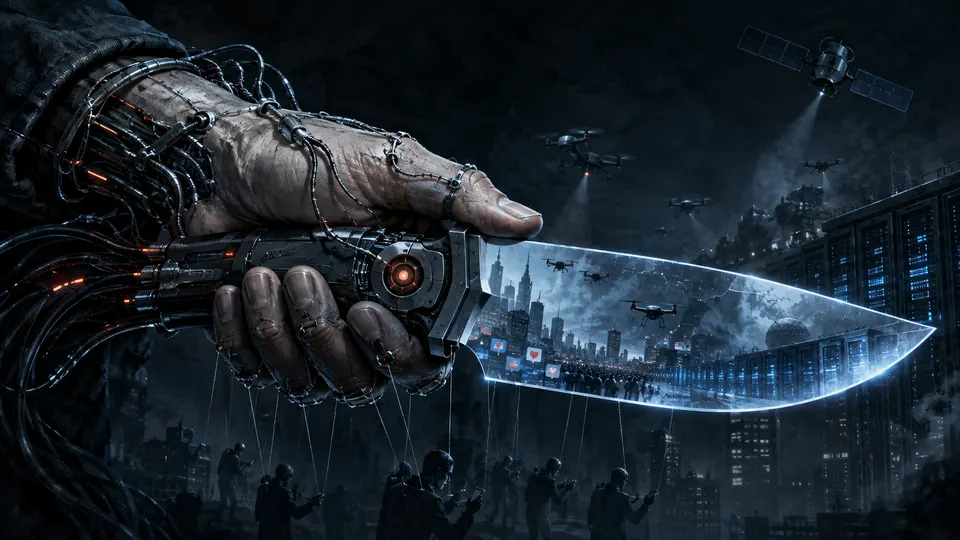
Supposedly technologies are like a knife—you can use it to kill, but also to slice your bread. But they are far more complex, multilayered and manipulative than that.
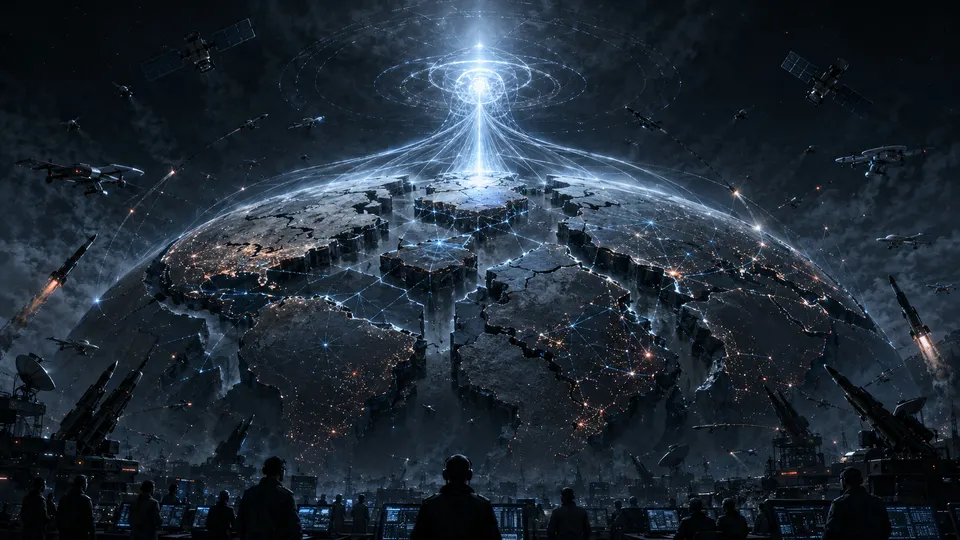
For instance, right now there is a very serious clash between the United States and China in the field of technology—over satellites, energy, nuclear weapons, artificial intelligence; there are constant battles on many levels. We can see that this could lead to a very serious war if we don’t find a way to regulate technology and this struggle between the two great powers.
– I don’t believe technologies themselves are neutral either; they quietly turn into weapons. It’s no accident that the subject of nuclear weapons and the subject of what AI can do somehow keep converging. But what can we do to change the direction?
– Günther Anders, a philosopher associated with the Frankfurt School, coined the term “apocalyptic blindness,” or “blindness to the apocalypse.” What he meant by it was that modern society does not grasp the danger of self-destruction. That
we already have the potential to destroy our civilization, all of humanity, a thousand times over.
Anders says technology is never neutral because it changes not only our actions but also the way we reason, the way we think and see the world, the way we perceive it, the way we organize society. Often we don’t even realize on what scale technology is already developing, let alone the consequences.
Back in the 1960s this philosopher was one of the first to analyze what nuclear weapons mean, and he said that we, as humanity, were entering a completely different era, a time in which everything had already changed.
For the first time in human history we have the ability to destroy ourselves, and it is happening thanks to technology, which keeps advancing.
From the perspective of peace research, technology is crucial; you can see it very easily in the war in Ukraine, or now between Iran and the United States and Israel, in the contest for global hegemony between China and the U.S. How these great powers would use nuclear weapons is always a key factor, and artificial intelligence is showing up more and more.
– I think that, more or less, as a society we all realize this—that technologies really are changing us, including by having wrecked the entire public conversation, everything Heidegger wrote about, too. And yet we can’t manage to start a new public conversation that includes exactly this: how do we make sure technology is perceived adequately, thoughtfully, with a vision for the future?
– Anu Bradford, the Finnish-American author of the book “Digital Empires,” defines three different models for the United States, China and Europe precisely on the basis of their attitude to technology. China is a power in which power is concentrated at the level of the state—it is the state that directs where society will go and where technology will be steered. In the U.S. it’s the opposite: there, individual corporations, led by very powerful people, direct the future, technology, society and almost everything in society. Her thesis is that Europe is one of a kind—a continent, a political entity, that tries to regulate according to moral and legal rules. “But,” she writes, “unfortunately, Europe is also the weakest of these players. And it has become so precisely because of this.”
If every society reached a consensus that technology must be strictly regulated, that we must find a new form of social contract, that would be the ideal future.
But the problem we see from the perspective of peace and conflict is that everyone hopes they are the stronger one, that they are above the law. We see the same thing with the mafia inside states, with corruption; apparently it is an unchanging feature of power.
If we take a step back: after the Second World War, institutions were created that benefited the Global North the most. It is typical in history for the victor, after a war, to build a system in which it can be sure of keeping the losers, and everyone smaller than itself, on a short leash—and it does so until a new war breaks out.
– And that logic seems to have continued after the Cold War, which wasn’t exactly a war, but the consequences are similar.
– That’s right. After the fall of the USSR, the other superpower grew more arrogant, more and more aggressive. You can see it in the wars in Iraq, Afghanistan, Libya, Syria.
Today India, for example, has a higher GDP and a larger population than countries like France or Britain, yet they are the ones with permanent seats on the UN Security Council. By what measure are they bigger or more significant than India? The reasons are purely and solely historical: they were among the victors of the Second World War.
But that is no longer reality. We are living in an old system that, in my view, is bound to change soon. That is the aim of BRICS, for instance. Yes, most of those countries are not democratic; they are authoritarian. But whether we like it or not,
it is important to find some kind of international agreement in which we find a new balance of power.
– And here lies the biggest problem. You said it yourself: in history this always happens after a war. Can we really do it without going through that? Or at least through some new “cold war” in which people don’t die, as they do in Ukraine, Gaza or Iran?
– Something is needed to set the transformative processes in motion, and it has to be very powerful. History shows that until now that something has been war. Unfortunately, you’re right about that, and, again unfortunately,
we humans always realize only after the war that we should have done something differently.
That is what history shows us, but I hope I’m wrong and it doesn’t happen again. I hope that this time we reform the global system without a major clash.
Fortunately, there are examples of that too. For instance, the Cold War treaties limiting nuclear weapons, strategic arms and long-range systems. Or the Treaty on Open Skies—the great powers flying over each other’s territory to observe one another’s military developments. Back then the great powers somehow managed to sit down at the table and find a way to jointly contain potentially huge problems.
It is a very bad sign that none of these agreements are valid anymore; they expired and were not renewed.
We’re seeing it again. The great powers—the United States, Russia and China—are modernizing their nuclear triads.
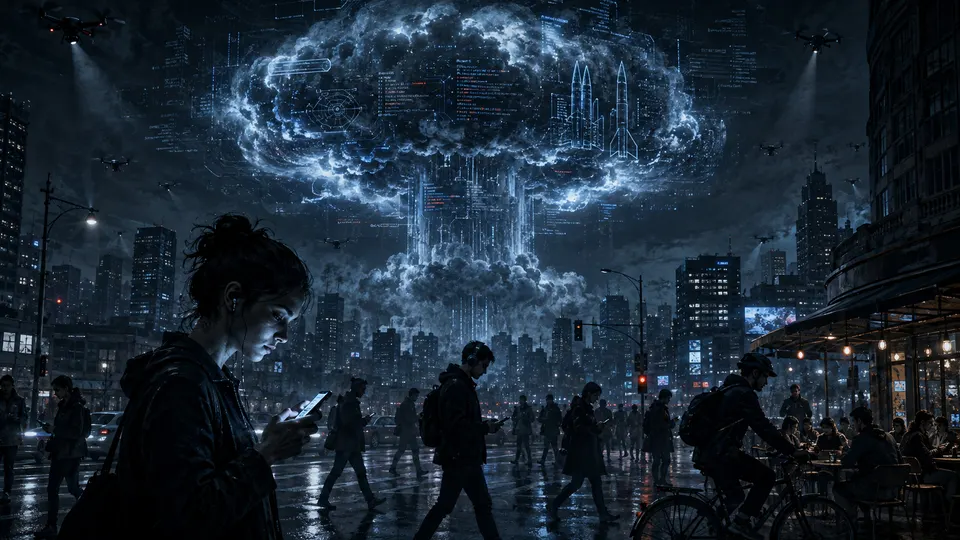
– What’s more, we hear world leaders talking about nuclear weapons as a real option, and society isn’t even particularly impressed. You say, though, that if it’s not to be war, something very powerful has to happen to rearrange the forces. What could that be?
– In my view, either societies sense that there is a problem and put pressure on their politicians, or we first change our relationship with technology.
I hope scientists are still capable of doing it. That’s why I write books; many researchers work on peace, and it is right that we should see more serious pressure coming from them.
Our other chance is civil society. We have to protest, to never tire of saying that things must not come to war. In this way, slowly, slowly, with petitions, with protests, with scientific research, we simply have to push politicians into taking decisions and measures.
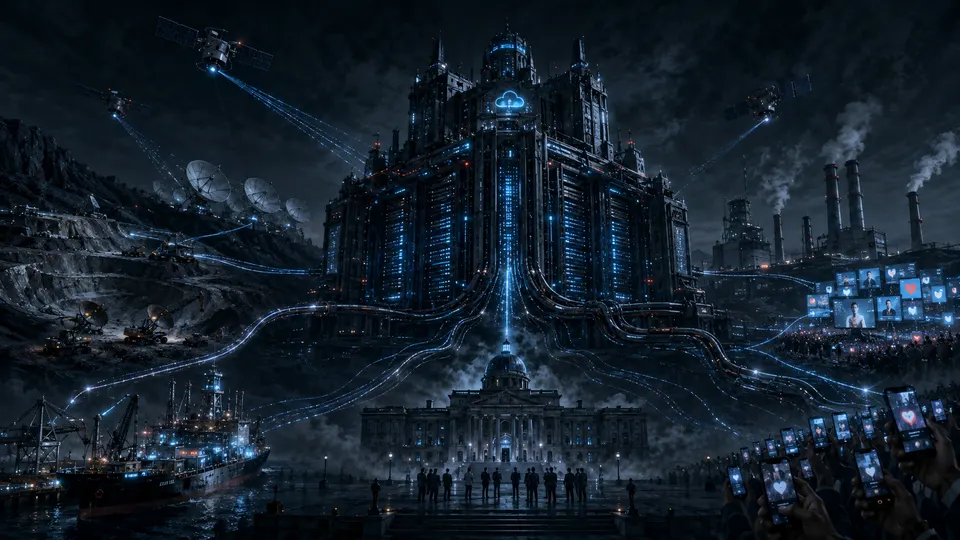
The problem is that today even politicians don’t have power. It may sound like a conspiracy theory, but it’s a fact that all the technologies we’re talking about require enormous capital, enormous infrastructure and access to rare raw materials. That’s how they end up in the hands of huge corporations that take advantage of this privilege.
A few states, and even fewer people at the top of those corporations, control the import and export of raw materials, control nuclear energy, and as a result control technology. Compared with states, companies like Microsoft, Amazon and Facebook have long been even stronger.
That is exactly why my thesis is that
technologies create vast hierarchical structures, and as a result it isn’t even clear whether politicians are in power at all.
To me that is the big problem—finding a mechanism by which these corporations and their leaders can be regulated, so that part of their unlimited power is taken from them and returned to society.
– I don’t think there’s a way. Because what matters most to me here is that the public conversation is in their hands today. The media no longer exist as gatekeepers, and it’s social networks that determine how public moods shift. Is it even possible to protest today?
– That’s true, and a typical example is what happened in Spain, where 80,000 refugees crossed over from Morocco in a single day. Researchers still don’t have enough evidence, but many traces lead to Israeli tech companies that provoked this crisis. They got into a social bubble, convinced a lot of people that now was the moment to emigrate, and explained exactly how to do it. Once again we were shown how powerful social media are. Clearly someone very professionally created and targeted a piece of fake news.
Why Israel? It hasn’t been proven, but we know that Spain is one of the biggest critics of the war in Gaza, and there were diplomatic disputes, too. More important, though, is that we saw the power of social media once again.
All the power today is in their hands, but how can we take it away from them?
Clearly, control alone won’t do it. Look—this is happening precisely in Europe, which prides itself on its oversight, constantly puts pressure on social networks, introduces new regulations, and still remains so vulnerable.
– Shouldn’t there be new platforms where we can communicate and get informed in some more independent and sensible way?
– Absolutely. That’s one of the biggest problems. But how is it supposed to happen? As we said, developing technology takes resources. Many countries in Europe don’t want nuclear energy—Austria, for example.
Europe is caught in a very hard moral dilemma—we want to be green, we want to be peaceful, and we want everything to follow our rules.
At the same time we need enormous resources—cobalt, nickel, lithium, gallium, germanium, rare raw materials that are in the Global South, in China and in Africa. We don’t have access to these resources, we don’t have that infrastructure, and if we want it, we have to pursue what I would call a colonial policy.
So we come back to my first thesis: technology is never neutral. That is, it is always the product of resource plunder and hierarchical structures.
The same goes for your question. To have neutral, meaningful social media, we would also have to make use of resources and means that we consider to be outside the rules, deeply undemocratic and dirty.
– When we get to artificial intelligence, is it settled now that there are two great powers in this field? I follow it quite closely, and I don’t see how anyone could challenge the dominance of the U.S. and China anymore; we trip over the same paradox as with everything we’ve discussed.
– This is certainly the battle of the future. Absolutely. And I also think it’s only the U.S. and China. Russia is far behind, and so is Europe.
– AI, just like computers, the internet and many other technologies, arrived with the promise that it would democratize, balance, regulate—and yet, as your thesis also suggests, it is once again showing a tendency toward monopolies, imbalances, power by force. Why? Did we take up these technologies haphazardly, or were we simply working with mechanisms that were valid for other, different times? From the 1950s and 1960s, when the world was different and all the definitions of the social contract and human creativity, of humans and technology, were completely different.
– In my view it has always been this way. With any technology.
Take, for example, how Britain became one of the largest empires, ruling almost the entire world. That happened because of the steam engine—again, because of technology.
To achieve it, they needed one raw material—coal. The entire industrial revolution could only be built on coal and electricity, and it was precisely these that created the empire.
We see the same in other eras. Only the resources change—coal isn’t so important today; we even want to get rid of it.
The mechanisms remain; only the technologies and the resources that feed them change. But the structure, the idea behind them, has always been imperialist, colonial, driven by the idea of power.
People who want power understand that they must have the most advanced technology. On the one hand internally, to control their own people, and on the other externally, to be the dominant force.
It’s simply the very old human idea of power. In my opinion, that’s where we should look for the cause, not in technology or in resources.
– But couldn’t technology somehow help us break out of this vicious circle of war and the struggle for power? What if artificial intelligence, for example, turned out to be such a factor?
– In peace and war studies there is the thesis of “alien peace.” Aliens arrive, they threaten us, and for the first time humanity is united—the age-old dream. We become brothers and sisters and finally have a common goal; we’re united by the threat.
It’s hypothetical, it sounds a little funny, even cynical—
why do we need aliens in order to unite?
But the same could be supposed of artificial intelligence—that it unites us as a threat. Maybe it is precisely AI that will push us to look for some new architecture of world security; maybe it could calculate a balance between the great powers. Could that be the solution?
– Or could the opposite happen—could the failure of the technology turn out to be useful? Huge sums are being poured into advancing AI right now, even though we are still far from knowing exactly how to make it truly useful and effective. If this enormous bubble bursts, could that be the breaking point we’re talking about?
– It depends on the states, especially the big ones. ChatGPT was a commercial model, but the Chinese showed us that open AI models can also be extremely successful. A lot also depends on the major countries and which direction they steer these processes. But maybe that’s why I’m a bit more pessimistic: I mainly look at the military aspects of artificial intelligence and technology.
Perhaps the civilian side is gentler or nicer, but in war there are things like systems of drones and missiles that choose on their own where to strike. That’s how the tragedy in Iran happened, where around 200 schoolgirls were killed because twenty years earlier the school had been a military base. Even artificial intelligence evidently makes mistakes if its data is outdated.
The other thing, as we can see, is training on manipulated data. AI depends on what information we feed it. It matters enormously, for example, whether you say there is a war in Gaza, whether it is solely the fault of Hamas as terrorists, or whether it is genocide. That’s exactly what frightens me so much—that the great powers are training artificial intelligence to steer the entire discourse the way they want.
– Yes, let’s hope we don’t turn it into just another tool of manipulation; I believe it can be avoided.
– It is very important to be informed. It is very important to exchange information in times when you don’t know whether a text, a picture, a video is true.
It is very important to communicate. It is very important to have social exchange. Through protests, through a strong civil society, there has to be pushback, and we have to press politicians, especially in the EU, to take firmer measures so that we regulate technology.
– Thank you for the conversation—you’ve given me a lot to think about!