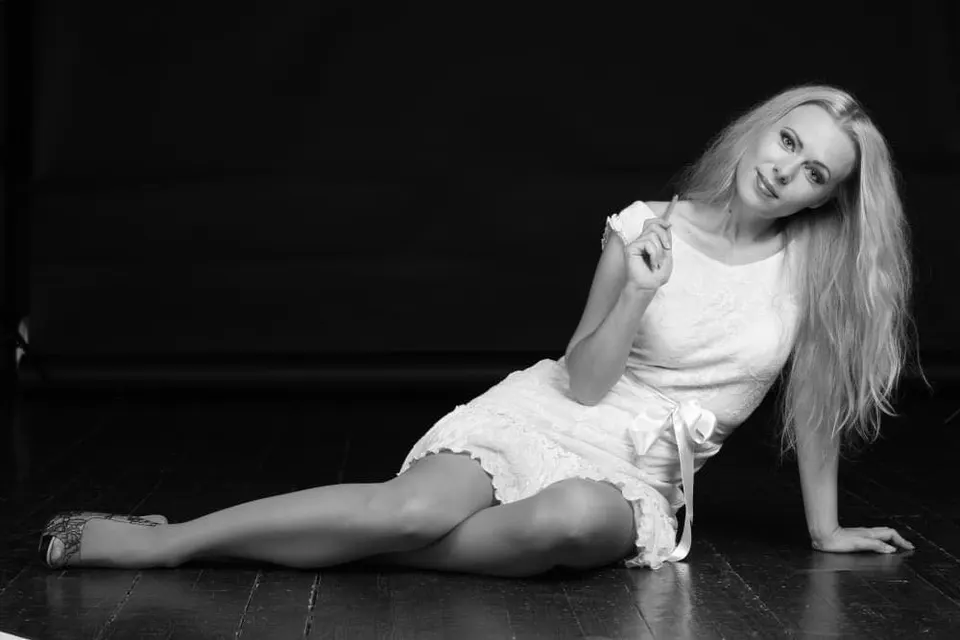
Lyudmila Filipova is among the most widely read Bulgarian authors of the past two decades. Her novels span an enormous range of subjects, and she never stops seeking new literary challenges: the distant past of the people who lived in these lands, the challenges they face today, the great riddles life sets before us.
Her search reaches well beyond books, too, all the way to distant worlds. She graduated in economics, specialized in creative writing at Oxford, and earned a master's degree in astronomy with honors from Sofia University. She has taken part in several Bulgarian Antarctic expeditions, and in reality shows as well.
After such a colorful palette of interests, it is time for her digital stories. We turn first to the past in order to look toward the future. And finally, most importantly, we dream of the moment when people will once again be stirred not by the news of the day, but by the stars…
– In recent years, the subject of our ancient past has become unexpectedly topical. Why is that?
– Because of the illusion that knowledge and truth lie there. But in my view, the more the exact sciences develop, and above all over the last three centuries,
since the dictatorship of the church was abolished, the closer we come to knowledge and truth.
– Why does it matter so much whether we are the descendants of the people who lived here thousands of years ago?
– Because the past largely determines the present—for the individual as much as for nations and societies.
– What makes the civilization that existed before the Thracians, the ancient people of these lands, so interesting?
– The proto-Thracian civilization, which existed in what is now northeastern Bulgaria, is interesting because it is the first developed civilization known to us in the world. They were the first to work gold, they had a proto-writing, a large-scale salt industry, even astronomical knowledge. They also had a religious concept that lay at the foundation of the civilizations that followed.
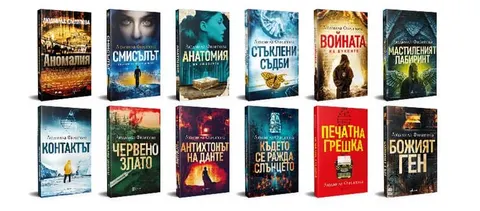
They developed metallurgy, shipbuilding and an advanced state structure. I have written about them in detail in my books Mastileniyat labirint (The Ink Labyrinth), Bozhiyat gen (The God Gene) and Kadeto se razhda Slantseto (Where the Sun Is Born).
– Will the written word endure in these online times of the image?
– The word will endure, regardless of the form through which it is passed on
– a form that evolves constantly.
– Today writing is a kind of mass obsession; everyone writes online. What gives you the strength to keep writing?
– A sense of duty to gather knowledge on various subjects and pass it on to people through my books. And the feedback from my readers.
– What sets a strong story apart?
– How far it has managed to change something in us for the better.
– How are stories born?
– For me it is the moment of inspiration—when the idea for a new story is born in my mind.
– Is there a limited number of plots and ideas, or are they infinite?
– If you look at them as writing schemes, they are limited to fewer than 10.
But if you look at them as a whole, down to the details, they become infinite.
– Is “writer” a profession?
– No—it is the reader who makes you one.
– Is it words that make us human?
– Only our deeds.
– What is the greatest success you are proud of as a writer?
– I don't like to be proud. But dearest to me are the letters from readers who tell me that a book of mine has been useful to them, has helped them, that they learned something important, or simply that they found it interesting.
The hardest thing is to write an interesting book.
– In your books you often bring together the past and the future, history and the new knowledge of science. What is the most important thing we should remember from the past while we build the technological future today?
– It is good to be able to learn from our mistakes, but sadly, people and history alike, we forget them and repeat them. But
the more technologically advanced we are, the more terrible the mistakes we forget.
– What is the most important thing to teach artificial intelligence?
– Whatever we teach it, sooner or later it will evolve into something different and self-developing. It is very likely to threaten us as a species, but knowing this will not stop humans from experimenting with artificial intelligence out of sheer curiosity. My novel Anomalia (Anomaly) is devoted to these themes.
– Will it have a religion? Faith?
– Quite possibly—they are born wherever there is ignorance. And it is impossible to know everything, if only because
knowledge is as infinite as the Universe.
– Will the novel ever lose its power as a genre?
– Every genre inevitably evolves. But I sincerely hope it won't be lost, because it is my favorite.
– Why have we lost interest in space? It isn't fashionable, children today don't dream of becoming cosmonauts, while the news drags us back into the colors of a past we believed we would never return to—wars, diseases…
– The people who have lost interest are those with no inclination toward the exact sciences and toward information that is harder to take in.
I live with space. I earned a master's degree in astrophysics with honors, and I devoted my books Smisalat (The Meaning), Kontaktat (The Contact), Otgovorat (The Answer) and Pechatna greshka (Misprint) to the subject. Together with a business partner I founded the space food company “Antarta.” I am constantly reading about space and following it.
– Will we return to the stars?
– We are made of stardust, literally! All the chemical elements are created in the cores of stars and in supernova explosions, and at the moment of a star's death, as it explodes, they are scattered across space.
Each of us is made of stardust.
– Will a human soon fly beyond low orbit again?
– We will reach Mars in the near future.
– Do we know the Universe we live in?
– To a large extent, but every day we learn more and more. And that will be an endless process, because the Universe itself is changing too.
– Is there intelligent life beyond our planet?
– Very likely, but it is a hard fact that we still have not a single piece of evidence for it—only fantasies and speculation. This is largely explained by the Fermi paradox.
– What kind of world do you dream of the next generations inheriting?
– A world in which people live in harmony with nature and at peace with other species. But sadly, that is not possible, because of human nature.
By destroying nature, we destroy only ourselves. Nature will recover even after we are gone…