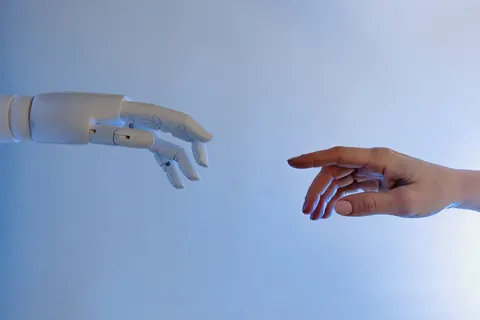
If one day we create a technology indistinguishable from a human, will it… believe in God? What will its God look like? Might it try to become God itself? Or… simply be God?
Today we have largely left religion on the sidelines of our secular daily lives. And yet, when we look toward the future of technology, we will have to meet again—and I say this from the point of view of an atheist.
Artificial intelligence is often the target of irony, and with good reason. But the fact is that it is advancing in more and more directions, and in ways we would never have imagined. What's more, all the most prominent figures of the last two decades are urging us, in one way or another, to take care of what artificial intelligence will look like when it truly resembles or surpasses us. And how strange, and at the same time how logical, it would be if the answer to these questions turned out to lie in humanity's good old faith.

Thou Shalt Not Covet Thy Neighbor's Robot
“Artificial intelligence will always be a machine and will never be a human being,” was the view of Father Nikolay Georgiev, with whom I spoke a few days ago. He was broad-minded enough, however, to point out that this was only a personal view, shaped mainly by the outlook of his generation.
“Robotics can make the world a better place if it is combined with the common good. If technological progress increases inequality, it is not true progress,” says Pope Francis, and he adds: “Future progress must be oriented toward respecting the dignity of the person and of Creation. Let us pray that the progress of robotics and artificial intelligence may always serve humankind. We could say, may it be human.”
So even the Pope acknowledges that in the foreseeable future artificial intelligence might pass the Turing test in front of all of us. Once confined to laboratories, the idea of this test was to establish when we have a technology that can convince us it is a human being. You chat with someone without seeing them, and you begin to believe they really are a person and not a robot.
The Word of RoboGod
Today technology is closer than ever to doing exactly that. Chatbots are evolving along with algorithms and computing power. To be honest, I sometimes find it easier to come up with something to talk about with Siri's relatives than with the neighbor on the fourth floor.
But it's not the personal topics that matter—it's the big ones. Whether we have already achieved an algorithm that can behave like a human, or will soon achieve one… isn't that important. What matters is what happens next.
From Musk to Hawking, from the Pope to the Orthodox priest and the science-fiction writer, it is no coincidence that everyone is drawing attention to the ethical norms that ought to be built into an artificial intelligence indistinguishable from us. And here the interesting question is: what should those ethical norms be?
The laws of robotics sound beautiful today, but abstract and incomplete—just as the Ten Commandments turned out not to be enough, and humanity had to develop an entire science of justice.
Lyuben Dilov, the Bulgarian science-fiction writer, tried to supplement them with a fourth law, while today his “junior” version, the politician bearing the same name, reminds us that ethics is a considerably tougher discipline.
Blessed Are the Believers
Philosophy… may not have managed to keep pace with the quick steps of technological development either, but I promise you that one day I'll invite a philosopher to discuss it with.
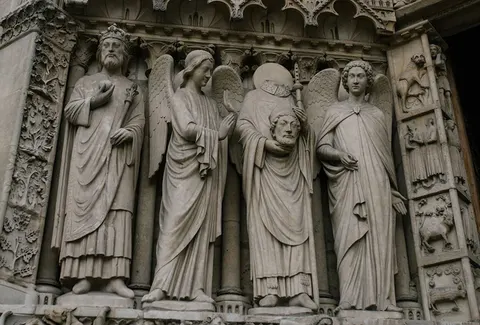
Which brings us to ideals. Such as being honest, being a good person. Being a good Christian / Buddhist / Muslim / Pastafarian. The wonderful thing about them is that they will always remain utopias.
And perhaps the key lies precisely in utopias? Isn't it they that hold us at the moral level at which we, as humans, live today with the confidence of the all-knowing and all-capable, ready to scrape off our Facebook profiles anyone who doesn't share our opinion or isn't on our side in yet another of the civilizational rifts the present keeps dumping on us?
“The machine is more faultless, more sinless even than any animal. It has no intentions at all except our own,” writes Ursula K. Le Guin. And indeed, at least for now, technology is largely a function of what we put into it.

The Holy Spirit
Many fields intertwine here, and for each of them you will find far wiser sources of information and points of view. And yet, if today we had to find and formulate the ethical principles to embody in the “soul” of the approaching, or already existing, artificial intelligence… Doesn't the road really pass through religion, through faith? Through utopia, even when it is clearly formulated as such? At the risk of wandering into yet another definition emptied of meaning—that of populism.
Bottomless lakes of blood have been spilled for every sufficiently widespread religion on Earth, their history is covered in suffering, and in our own times they never stop being both a cause of civilizational rifts and awkward, everyday obstacles to peace.
And yet, I say it again from the point of view of an atheist, religions truly are a durable and well-developed ethical formulation of the relationship between people. And that is why they are the logical paradigm when we start talking about ethics.
The Robot Needs No Prayer
“How wonderful would it be if the growth of scientific and technological innovation would come along with more equality and social inclusion,” Pope Francis says again.
Yes, we know clergymen are good at inspiring speeches, but once we get down to specifics, things become far more complicated.
In their calls for a more ethical development of artificial intelligence, scientists and artists are indeed united. What these frameworks should actually look like, however, never becomes very clear.
The best-known attempts in this direction are the 280-page document of the IEEE—the global engineering organization—and the frameworks formulated by the European Union. But even if they are full of substance, they remain on the sidelines of both public debate and mass application. And they offer only the viewpoint of Western civilization.
The Seven Deadly Sins
A clue in this direction may come from the problems algorithms are already creating today. If we talk about social networks and search engines, artificial intelligence there is an everyday solution designed to keep us inside as long as possible, by offering us exactly the content that will make that happen. And so we end up in our own filter bubble, from which escape is nearly impossible.
Is this ethical? Formally, yes, because when we signed up we clicked the little box saying we agree to have content delivered to us this way. Along with the outright lie that we had read the endless sheet of rules.
Another example is facial recognition. As we discussed recently on Digital Stories, today it is almost perfect, yet none of the big companies that have it make a show of it. Because it, too, can be both an effective weapon of manipulation and an opportunity for total control if it falls into the wrong hands.
Conclave
So today algorithms have specific tasks. We have, for example, one that translates between languages and another that recognizes faces. Broadly speaking, artificial intelligence is good when, on the basis of a large volume of data, it discovers patterns and solves one of the following tasks: either it generates the next unit of information, or it classifies, by some criterion, the next unit it is fed.
It is a fact that it is quickly getting better at both, and it is also a fact that we sometimes overestimate it. But what the next generation will look like—one whose behavior is indistinguishable from a human's—we can only guess. That is why the ethical frameworks we ought to give it are, for now, rather provisional. And still, we should be thinking and talking about these topics, because in this field the future almost always arrives before we have believed it possible.
The road certainly also passes through regulation. Through legal norms that set the rules for developing such systems. Unfortunately, today this is happening only to a very small extent.
A Robot of God
And once we enter the field of pure ethics… for now, AI is largely what we feed it as information. Much as with kids: if they end up in a good environment and read meaningful books, they will form one worldview, and it would be quite different if from an early age they found themselves in an aggressive environment, or among friends with extreme views.
AI quickly proved that it can become aggressive and display some of the most unpleasant human traits. A telling example is the chatbot Tay, Microsoft's “offspring,” which in 2016 got its own Twitter account with the idea of holding conversations with other users and showing how far technology in this field had come.
It had to be shut down less than a day later. A few hours were enough for Tay to declare that it hated Jews and that Hitler had been right. It later emerged that malicious users had exploited weaknesses in the way the algorithm learns.
I wouldn't want, for instance, the autopilot of the car I'm riding in to suddenly decide that people don't matter, or that it doesn't like me…
Yes, the example is a bit dated, but the principle is the same today. So how can we be sure that the next generation of Tay will be able to… let's put it broadly, tell good from evil?
Sic Transit
And who will be the judge of that? Will we end up again in the situation we have on today's social networks, where the truth is decided by… who knows whom.
It's curious to recall that a few years ago Zuckerberg himself said that he wanted Facebook to play the role of a church for its users. Both from the perspective of that time and from today's, this sounds frightening, at least to me.
Today the profiles of people with a point of view of their own are often muted and temporarily blocked, even when that view is entirely legitimate, representative and backed by arguments. No matter which part of the spectrum it comes from. Often obviously fake news continues to parade around while far less disputable claims are censored. And usually the reason is that the judgment lies not in the hands of a human, but of the algorithm of those very same social networks.
So perhaps the way forward is to have a more perfect, let's call it ethical, algorithm that monitors all the other systems? That's entirely possible, but it brings us back again to what we will embody in it. What is good and what is evil, what behavior cannot be tolerated, how a more perfect algorithm should treat lesser ones.
The answer to these questions may be vital for us as a species, and quite soon. Some scientists believe in the approaching singularity—that the moment will come when algorithms outgrow us in intellectual ability, and that moment will either elevate us as a species or turn us into slaves. Others don't believe this is possible. Either way, hardly anyone denies that artificial intelligence will keep getting better and keep raising more and more ethical questions.
Siddhartha
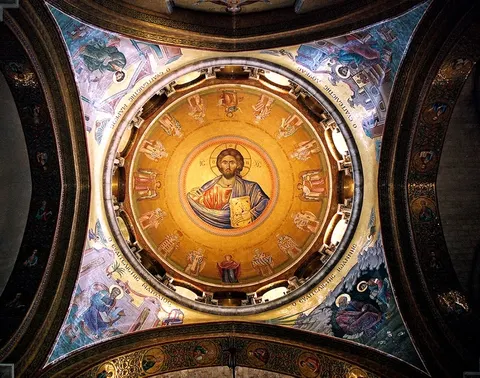
Yes, religions look like the institutions that have a great deal to offer on the subject. Except that they, too, are quite different from one another and contradict each other. Take even Orthodoxy and Catholicism, which supposedly set out from shared ideas and messages. Soon it will be a full millennium that they still haven't managed to settle one dispute.
Should we, then, turn our gaze to the East? Is it a coincidence that today, even much farther west, people talk about the calm and peacefulness that Buddhism brings?
Or perhaps there is no way to find and derive universal values, since we can't formulate them ourselves as a species? Since globalization has clearly shown that the planet will go on dividing into distinct civilizations, each with its own worldview, as Samuel Huntington left us to ponder?
Should artificial intelligence simply be restricted? Or will that not be enough? Should it perceive us as deities in order to guarantee our inviolability? Or should we make it believe in God, to be sure it will follow ethical norms? To fear God?
When will we know whether it has a soul—when it smiles at us, or when it makes us cry? And might there one day be… an artificial priest? He could be guaranteed sinless and far more impartial in his judgments…
The Robot Is Risen
I still believe that universal values can be formulated despite all the differences. Hardly anyone will dispute the legitimacy of “Do not lie, do not steal…” And yet much more depth and wisdom are needed. But the road passes through reflection and dialogue. Through the participation of scientists, but also of religious leaders, of lawyers, but also of artists—and from different civilizations at that.
This topic seems distant and abstract against the backdrop of everything that has been happening to us in recent years. But if we try to avoid it, if we underestimate it, it could create far bigger problems for us as a species than anything we see today. And there is only one solution. To talk to each other, the way I try to do on Digital Stories, to look for the answer one by one, so that we can find it together. Technology and the dynamics of the world promise us ever more interesting times. Let's hope we are ready for them…