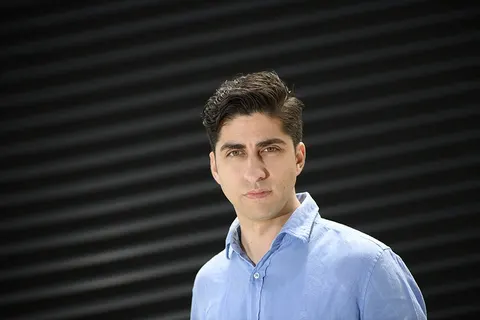
1,000,000,000: that is how many visits a month the websites looked after by today’s guest and his team receive. Mario Peshev is an impressive figure for his story, for his successes and, above all, for his outlook on the world.
WordPress made it possible for anyone today to have a dignified place of their own on the web. And Mario is the author of “pieces” of the code used today by every single one of the hundreds of millions of sites built on the platform. His company DevriX is among the 20 most sought-after WordPress agencies in the world.
His path as an entrepreneur began while he was a student at TUES, a vocational high school for electronics and computing in Sofia. He built his first website in 1999, and in 2010 the idea of WordPress won him over for good. Ever since, he has done everything in his power to help the community—anyone who wants to contribute to the platform or simply use it to the full. At the same time, he managed to find his market niche, building modules for corporate websites.
A programmer, a marketing specialist and an entrepreneur with serious successes behind him. Mario writes on his blog, teaches, runs a consulting company and helps startups.
What is it like to own your own “little piece of code” in WordPress? What changes when an enthusiast suddenly finds himself at the head of 50 people in his own venture? What does the future of the digital world look like to Mario? And… will his beard still be his trademark a decade from now?
– You can both program and write gripping texts. Why do we usually assume a person can do only one of the two?
– You know the saying: “Everything new is something old, well forgotten.” Over the years society goes through different phases, including that of the narrow specialists and that of the “generalists.” Fifteen or so years ago it was more prestigious to be an expert in your field, but with the rise of social networks and personal branding,
complementing expertise with public speaking and communication skills opens up broader opportunities for growth.

– I read in Forbes, where you are also a global consultant, that they call you a “poet of code.” Is there poetry in code?
– “Code is poetry” is the motto of WordPress, which is why Forbes associates the platform with my career path. My own view is that technology is a combination of art, science and craft.
Art, because solving problems still demands creativity. And there are plenty of innovations behind the sector’s remarkably fast growth over the past decades.
Science, because the foundations are clear and extremely useful for building a good environment for growth.
And craft, because it takes years, if not decades, and even after that the learning never stops.
– While we’re on the subject of art… will software one day write poetry?
– It already does. Language models such as GPT-3 or GPT-J are already writing whole articles with minimal (or even zero) editing. Code can also write code on its own, so we’re making real progress in that direction…
– GPT-3 really does write “something like” poetry, but… for poetry, and even more so for code, we still rely on people. Things in this field are changing terribly fast, though. I, for instance, am a front-end developer, a profession that didn’t even exist when you were building web pages. How did you start?
– Back then the vast majority of little sites weren’t dynamic. In Bulgaria there were free hosting services with 10 MB of space for static pages. Somewhere around then I stumbled upon “Dave’s Site,” where I started learning HTML from the very beginning. It looked more or less the way it still does today.
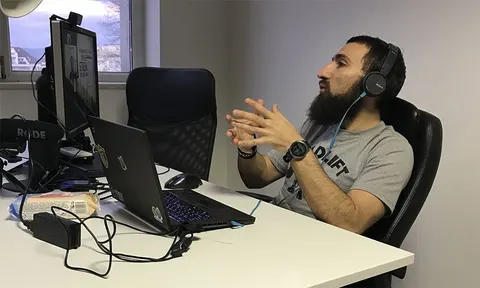
– What surprised you most about how technology developed over those years?
– It certainly happened incredibly fast. Computers at home were a rarity even in Sofia, and the internet was a mirage. In those days we used modems to connect, and phone lines were mostly “duplex,” shared between two households—when you were talking, your neighbor got a busy signal and had to wait for you to finish before making a call.
Back then there were no MP3s, and many machines had no sound cards. For those that did, a single song took 25 minutes to download. So… having gone through the stage when the internet was paid for “by the hour,” all the progress since looks cosmic.
The kind of problems we faced back then is impossible to imagine for today’s kids, who start screaming if the Netflix clip on their tablet lags or the TikTok filter doesn’t look exactly the way they pictured it.
– As someone who quickly went from freelancer to the head of a company of 50 people, what were the most important lessons you learned about managing teams?
– Gary Vaynerchuk has a popular concept on the subject: “You work for your employees, not the other way around.”
Especially in the digital world, where intellect is valued enormously and competition is global, capable employees can work practically anywhere.
Demand exceeds supply, and motivation to work is in short supply.
Competitors actively and deliberately try to poach talent in every possible way. If the company’s mission and vision make sense and the example set by the bosses is in tune with them, the core team is hard to break up. That shared mission and teamwork build and develop a culture that the right people appreciate. And working together leads to great results, which brings in more happy clients, more work and more referrals.
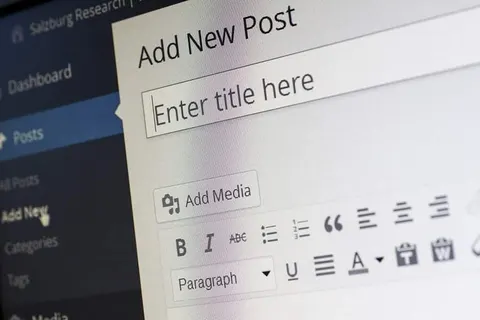
– You’re willing to make time to advise anyone who needs guidance in any of the fields you work in—programming, entrepreneurship, marketing. I took advantage of it myself in the blogging course at SoftUni, the Bulgarian software academy. Isn’t that a somewhat unusual initiative?
– That’s how I was raised—to share and help whenever I can. Some put it down to karma, others to faith, religion or some cause.
I’ve had the fortune, or the luck, to break into the industry over the years. I owe that to my mother, to teachers, academies, clients, to my first freelance projects that believed in me, to employers who gave me a chance, to colleagues who helped me and so on. I’ve had mentors, I’ve learned from people who shared their knowledge for free.
I certainly find reciprocity to be the only right approach.
– Today’s society doesn’t exactly encourage sharing. Why is that?
– Because it’s easier not to, and because there’s no visible “result.”
It’s easier to lie on the couch eating chips or McDonald’s than to work out and eat healthily. It’s also easier to rest after work instead of studying, developing further and investing in yourself. In those cases there’s at least a cause-and-effect link and some foreseeable result.
Sharing, though, is a value. It
requires you to outgrow yourself and accept that you are “a drop in the ocean,” that results are teamwork,
that the progress of the human race is a joint effort.
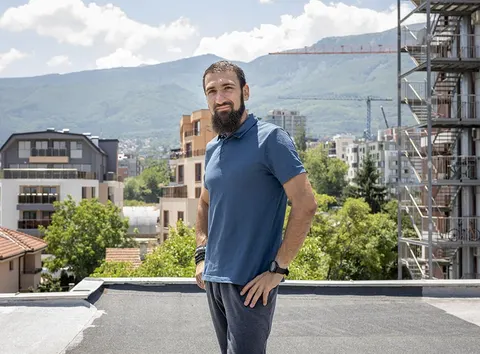
– You’ve written a book on entrepreneurship. Is there a spirit of, and room for, entrepreneurship in Bulgaria?
– Certainly. Although my book is more about “the dark side of entrepreneurship” and aims to bust some myths about how to become a millionaire over a weekend while you sleep.
Otherwise, we have the foundation and the opportunities, and the ecosystem keeps developing.
– What kind of people succeed in today’s dynamic, globalized world?
– Creative, driven, patient people. Successful entrepreneurs invest tirelessly and methodically in the right direction, listen to feedback, put lessons into practice, react quickly, and build teams through motivation and vision.
The enemies of future entrepreneurs are impatience, the hunt for quick profit, a lack of focus and persistence, ego or selfishness. Good entrepreneurs understand that teamwork lies at the heart of success, that the client’s needs are the main currency, and that building trust and a brand takes years.
I’m a workaholic and sometimes I tip over into one particular extreme, but only because there is a complete match between what I do and my value system. Putting in 70 to 80 hours a week for more than 15 years can’t help but lead to better results, to layers upon layers of knowledge and skills. Especially
when you apply the concept of “compound interest” to knowledge and skills.

– What will the media of the future look like?
– I’m fortunate enough to analyze a portfolio of more than 500 million unique users a month across the various ventures I’m involved in.
On TikTok and Snapchat we meet 13- to 24-year-olds looking for entertainment and laughs. In some of the online networks we have both 20-year-old students looking for cheap solutions and 45- to 50-year-old women of modest means who shop for discounts and deals.
In some projects we target athletes, in others business owners, from freelancers to serial entrepreneurs. Nine of the ten most active followers of my email newsletter are successful business leaders around 60.
The digital ecosystem looks extremely interesting. The needs of different generations differ. The internet lives in Snapchat and TikTok—the 16-to-24 audience—and that generation will grow up. It’s normal for 16-year-olds not to be interested in career advice, investing and pension plans.
The media will probably depend on the devices we use.
But reading will remain. Whether as books, newspapers or websites,
the model will go on existing, and the same goes for audio and video. Virtual reality is an interesting concept, but I don’t know whether in the next 10 to 20 years it will allow enough interaction for more than an hour without taking such a toll on eyesight and the sense of balance.
– What are the core values that keep you moving forward?
– I love learning, and I feel personal fulfillment while I learn. That means getting better at what I do and understanding the world better. National psychology, macroeconomics, the development of nations over the centuries… Once you dig deeper, the amount of information becomes infinite!
The easiest way to learn is by solving complex problems, and that requires teamwork.
Teaching is one of the best tools for learning. As the saying goes, if you can’t explain something, you probably don’t understand it well enough. Working in a team environment lets us learn and teach one another, which is a wonderful opportunity.
– What are you proudest of?
– One of the downsides of the philosophy of teamwork and collective effort is that you identify less with specific results. High goals don’t help with satisfaction either.
What makes me happiest is seeing my students, trainees, followers and readers of my blog or book grow successfully and learn things from me. They call me for advice ten years later, or become senior managers at corporations and invite me to train their teams.
– What do you dream of?
– It’s a cliché, but of a better and more honest world.
Fewer lies, intrigues, dramas, screwing over competitors, hunting for loopholes.
More motivation for what we do.
Less “I want to become an influencer” and more “I want to do work that gives me satisfaction so I don’t ruin my life.” More loyalty and reciprocity. Less selfishness and more teamwork.
There’s nothing wrong with ambition or a competitive environment, but not when it comes at the cost of trampling on people, undercutting the competition or luring in clients. It’s exhausting, and that is what saddens me most.
– What do you hope the internet will look like a decade from now?
– The internet is just a tool; everything depends on people. But I don’t believe they’ll magically stop watching TikTok memes and start learning useful things.

– And what will you be doing then? Do you still plan to keep your beard as your trademark?
– The beard has to stay, no way around it!
Otherwise, I hope I’ll still be able to work on interesting problems, to teach and to help on a broader scale. There are various ways that could happen. Where there’s a will, there are ways!
– I’ve saved the subject of WordPress for last. Today 40 percent of the world’s websites are built on it, including Digital Stories. What does it feel like to have written some of the lines of code that hundreds of millions of pages… and ideas rest on?
– I’m definitely glad I can help develop software of such scale worldwide. A huge project of WordPress’s caliber develops specific skills—large-scale thinking about the whole ecosystem, good usability practices across more than 70 languages and their peculiarities. You have to make decisions with very diverse audiences in mind—from startups and bloggers through corporations to the biggest magazines and universities in the world.
Over the years we’ve taken part many times in discussions about the software’s development, and they bring a rich perspective. Conflicting points of view get discussed that aren’t obvious at first glance—for example, advancing the technology by using the latest versions of programming languages. When small businesses, corporations, the technical team, entrepreneurs, theme and plugin authors, translators, hosting companies and other market leaders come together in one place, examining a platform of that scale takes on a different meaning.
– In your view, what lies behind WordPress’s success?
– A lot could be said on the subject, but here are some of the main points as I see them:
- The right moment—in 2004–2005, right after WordPress was created, the blogging market and the other solutions went through a restructuring. Some of the leaders switched to a paid model or stopped being maintained, which opened up a niche.
- Matt Mullenweg, one of the two creators, credits the success to the “famous 5-minute install.” Back then it wasn’t famous at all, but the marketing message, combined with a fast and trouble-free installation, helped with adoption.
- The right technologies—most of the market leaders at the time were based on PHP, the most flexible and easiest-to-maintain language and ecosystem, as well as the most cost-effective.
- 100 percent design flexibility. Some systems, such as Drupal and Joomla, imposed a particular HTML standard or structure on the generated code for menus and components back then, which required quite a bit of extra work. WordPress had practically no restrictions from the very start.
- A free ecosystem—starting a project is easy, which leads to a huge user base.
- Enormous flexibility of themes and plugins—building an ecosystem is one of the most important things for a product like this.
- Excellent built-in SEO support. Semantic HTML by default and built-in basic practices made WordPress the preferred choice for bloggers and magazines, on top of everything else.
The fact that small sites can keep growing—including thousands of magazines generating tens and even hundreds of millions of visits a month—broadens WordPress’s audience. It’s easy to start with zero budget and it scales as the business grows.
– Are there ventures it isn’t suited for?
– Purely in theory, all else being equal and with unlimited time and budget, solutions built from scratch are always tailored to each user’s needs. WordPress includes quite a few built-in functions and libraries that aren’t necessarily used on every single site.
A site of medium complexity that takes between 3 and 5 months with WordPress might cost roughly between 10,000 and 40,000 leva (about $5,000 to $20,000). But with other technologies
it would require a team of several people and more than a year of work, which would mean a budget ten times higher.
– Even so, there seems to be a cliché that any larger-scale online project needs a more “expensive” solution than WordPress.
– There are two ways to read that—does a professional solution have to be expensive, and is WordPress fit for big projects.
On the first point—usually, yes. It’s easy to start with minimal effort and work, but that doesn’t mean professionals don’t need professional solutions. There are stores like Jumbo or IKEA, but boutique hotels don’t shop there. There are stores like Decathlon, but professional athletes use the best on the market. Craftsmen don’t do renovations with tools from the “Everything for 1 Lev” (about 50 cents) shops.
When we make money with a project or product, we reach certain limits that call for high-level professional solutions. That also means a more expensive solution to specific business problems.
At DevriX we’ve helped more than 10 online magazines with over 100 million monthly visits. We’ve worked with banks and telecoms. We’ve built networks for brands such as Audi. Right now we’re working with Fortune 1000 companies, including a subsidiary of Meta.
So is WordPress suitable for big projects? Yes.