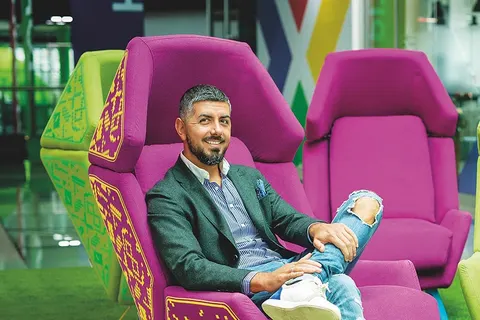
Do you know what it's like to build a startup out of nothing and sell it a few years later for more than $37 million?
Mihail Stoychev does. His experience is inspiring, and so is his desire to convince more people to start their own projects in the world of information technology.
In 2011, he and his university friend Georgi Petrov decided to set up a business of their own. Over the following years they created no fewer than 140 new ventures, until two of them broke out and grew impressively.
In 2020, the text-message marketing platform SMSBump was bought by the unicorn Yotpo, and the two entrepreneurs turned their efforts to NitroPack. Their goal: to turn this product, developed in Bulgaria, into the most successful platform for making websites faster.
But why is today exactly the right moment to start a venture of your own? How do we create more, and more successful, Bulgarian software products? What path did NitroPack take to become a Google partner and an indispensable helper to more than 200,000 websites? And why does speed matter so much online—both for websites and for making important decisions?
– You follow Bulgarian ventures in information technology closely. Where do you expect the biggest news to come from?
– The sector connected with artificial intelligence will grow, as it will everywhere in the world. A lot of money will certainly vanish, but the big winners—the new Google, Facebook and Apple that will define the next ten years—will be AI companies. I expect this to keep developing in Bulgaria too.
But in my view something else matters more. Today is the best moment to start a startup. I expect big news from everyone who is saying to themselves right now: “I want to start something of my own, to do something meaningful.”
Right now the bigger companies are letting people go, and capable people are coming onto the market, ready to build the next big thing. I watch the ideas that surface, and I truly think that
in a crisis people are at their strongest, and that's where they are best tempered.
I'd like everyone wondering whether to give it a try to hear me. Be brave!
It could be a company that offers services—you learn a lot there too, it's just that the growth can't be as big. That's a business you buy at one value and sell, at best, for two or three times more.
It's a different story, though, if you're developing your own product. At the start of 2020, SMSBump grew from 20,000 to 50,000 users in less than six months, and with a team of just 25 people. That's huge! When you work with professionals devoted to an idea, things work out. A good additional incentive, for sure, is the chance for people to get a share of their own. That makes a big difference at the moment the company reaches and even exceeds its goals.
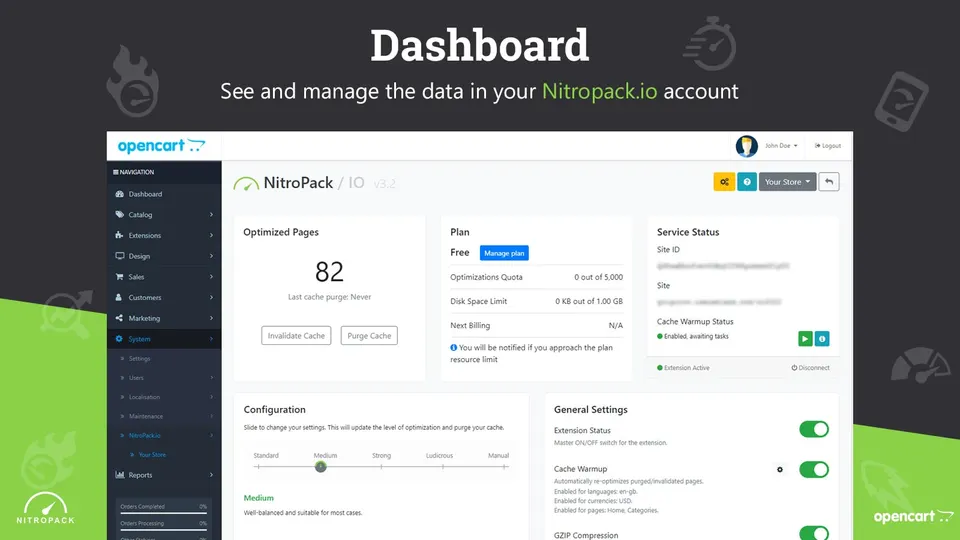
– You're currently at the helm of NitroPack, a company that helps websites be faster. I tried the plugin myself—my site is built on WordPress, and your add-on definitely made everything faster.
– If we open the Core Vitals Technology Report that Google generates and compare NitroPack with the other technologies on the market, we'll see that our product stands out with a competitive advantage. This is official data collected from Google Chrome users. The difference between our platform and the rest is more than visible. Thanks to it, we cut in half the volume of information that travels across the network, which speeds up page loading.
But that's not all. When we started out, our focus was on loading speed; now we're building on that with the whole experience of visitors to your site. Helping businesses meet the requirements of Core Web Vitals—a set of metrics chosen by Google that show how usable a website is.
– Let's go further back, though. How was the idea born?
– It really is a long story. In 2011 we founded our first company, iSense, which soon became iSenseLabs. We added “labs” because we decided it would be a laboratory where we test different things and see which ones work.
For a long time we built websites with OpenCart, a free, open-source e-commerce platform. We chose it because we judged that it had big, untapped potential.
And also to try to make those sites better and better. That's how we wrote the first version of NitroPack in 2013—
it was the very first plugin that could improve a page's speed score in Google.
Right at that time Google realized that a slower website gets in the way of a good user experience, and decided to encourage site owners to check how fast their sites were and, if needed, to take action.
While we were in OpenCart, we rose to the point of working with companies like Facebook, Amazon Pay and Mastercard. Until 2019, NitroPack faced almost no competition on the platform. Gradually we realized we had outgrown the category we were operating in, and we decided to open our products up to all platforms of the Shopify, Wix and Weebly kind, which were growing faster than the market. In 2017, after a number of quite big projects we managed to deliver in OpenCart, we saw that we were first in sales and outselling everyone from second to sixth place combined!
– And apparently it was time to move on…
– Yes, it was a privilege for us to be in the lead, but… after about 20 seconds you say to yourself: OK, but how do we help more online businesses? How do we survive on this platform if we're limited by its small market?
We were in a market that wasn't growing the way we wanted. So we decided to take two of our best and most-used products—SMSBump and NitroPack. They, too, were positioned mainly in OpenCart and had no room to grow.
I'm very glad these two solutions bring real value to users. One is about marketing, the other more about website speed.
– How did you settle on those two in particular?
– Until then we used a licensing model—you buy a piece of software and use it. Well, we threw that down the drain and decided to build two “software as a service” products. It was almost spontaneous. We went to Google Trends, typed in some keywords, saw which platform was growing how, and that was it. Later it became clear we had made the right decision.
We chose the SaaS model with WordPress, with the idea that our application would integrate with more than one platform. We put six years into research and development, but it was worth it.
We launched NitroPack as a SaaS product in 2019, and in 2020 Google introduced Core Web Vitals, aiming to measure the real experience of website visitors. It's a comprehensive system that collects much more data, and they added specific metrics. We were the first company to embrace this approach, and we shifted our focus. We managed to apply all our knowledge to these requirements.
– That's fairly specialized programming. You're not just looking for programmers with traditional front-end or back-end skills; you need people with deep knowledge. Is all of this developed by Bulgarians?
– Only Bulgarians—the colleagues who have been at the core of the product from the very beginning. Right now we're 53 people, most of them based in Bulgaria, and we recently opened an office in the U.S. In WordPress we started from zero, and today we have nearly 200,000 customers.
The goal is to reach 1,000,000 active websites over the next three years.
– Speed is definitely very important for every website today; I've gone into the subject myself. Still, what makes your project so different? And what are the next steps?
– What sets us apart from the other solutions on the market is the way we measure loading speed—namely, through the eyes of the visitor.
We believe a website is fast only when its visitors experience that speed. We focus on the data Google Chrome shares from real visitors. That's how we manage to find an effective fix for slow pages and help online brands increase their sales.
A defining trait of NitroPack is innovation. The technology we use to optimize fonts and images achieves drastically better results than all the others.
Not long ago we were invited to Google's annual Google I/O conference—something amazing!—and it definitely showed us we're moving in the right direction. We met with companies like Disney, Bank of America and Cloudflare. The conference had 1,500 participants, and partners like us were less than 10 percent. We were the only Bulgarians and the only product from our sector. A really cool feeling that gave me extra courage that we're on the right track.
Core Web Vitals are an important metric, even with the advance of artificial intelligence. There's a joke: “If you want to hide a dead body, the right place is the second page of Google.” Everyone opens the results on the first page, and that's directly tied to a site's speed and the other ranking factors.
Right now we're doing a series of webinars with Google on these topics. How these metrics relate to real business measures. How to improve them and how that would affect conversions, the time a user spends on the site, the number of pages they visit before placing an order.
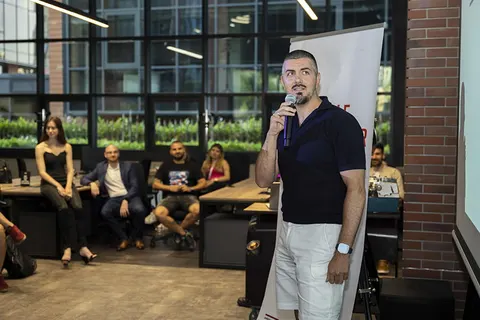
– Having grown and sold your first venture so successfully, isn't it tempting to do the same with NitroPack?
– We've already had several offers, but we turned them down. Because we believe we can build a much larger business. The problem we're solving is quite big, and big problems have complex solutions.
What we learned from the Shopify ecosystem is that
people prefer pushing buttons to writing code.
That's what we want to do with NitroPack 2.0—a very simple platform for people who aren't programmers.
Yes, it's tempting. But we don't look at every venture from the angle of what to do in order to sell it.
– You started with 140 ideas and picked two. Is that the hardest stage—choosing the venture that will turn out to be successful? How do you recognize it?
– When we were choosing, we were guided by which of the ideas we thought would have the biggest impact, so that we could become a cool, sustainable company able to work with the best talent in Bulgaria. We looked for the ideas with the greatest potential to create a big product, and the ones we were personally most passionate about. After a lot of conversations we concluded it was precisely these two.
Now, with so much experience, working in an organization of 1,000 people, we've certainly seen the other side, where very thorough analyses, financial models and research are done. Decisions aren't as straightforward and take a good deal longer. Our model was much simpler. Looking back, it worked—but that doesn't mean that when you have to make a very important decision and have the chance to work with all those smart people who specialize in research and financial modeling, it isn't better. On the contrary, we've seen it work brilliantly, but
when it comes to startups, I think less is more. Sometimes you just need one or two metrics plus your gut.
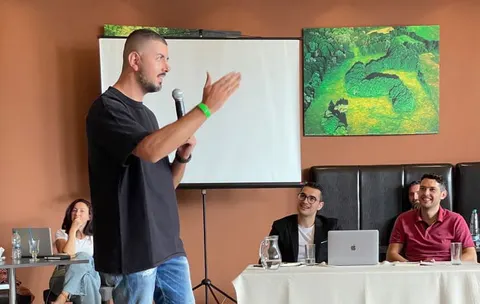
– What do you think is the path for the sector to create more products, to have more startups? Right now it's dominated by service companies, whereas this way we create a product that wins abroad.
– In my view, the path is for
people to be more open to risk and to the unknown on a personal level. To believe in themselves,
that they can make something with high added value. Not just to cut down trees in the forest and sell them as timber, but to make furniture out of them—that's where the high added value is.
We have more and more product companies that are succeeding; it's enough to mention Telerik, Payhawk, SiteGround, GtmHub. When you see a company that started in Bulgaria reach a valuation of a billion, you say to yourself: “OK, someone has done it, so I can too.”
I think all the knowledge people gain in service companies can very easily be carried over into building products.
Israel started out the same way, as an environment with lots of services, but over time it reoriented itself completely toward a product economy. At some point programmers become so expensive that being a service company simply doesn't add up. I'm very happy to see examples of companies that are raising the level of the whole market here.
For me, the path is more publicity, more conversations and more visibility for the companies
that create a product, whether or not it's backed by investor interest. More sharing of failure stories and more investment. I'm very glad that in recent years there have been many funds in Bulgaria investing in products, and I think it's a matter of time before we shift from a service economy to a product one.
Some send satellites into space, like EnduroSat; others are like Dronamics; but most don't involve hardware, only software. It's not that hard to create a product. All great artists, at the start of their careers, began by copying, by drawing inspiration, by borrowing. It's not a wrong way to start with the idea: “I see this product, I use it every day, but there's something I don't like about it. I think I can sell it better, make it prettier, add an important feature, build a much better relationship with customers, or point it at a different segment of the market.”
You can always find some niche to specialize in—it's not even that hard!

– You mention storytelling. I also think it's very important, and yet it still isn't happening. Most people you meet on the street have never heard of Telerik or Payhawk. Why is it so hard for our sector to talk about itself?
– I'm glad there are media like yours, The Recursive, Trending Topics—specialized media we didn't have five years ago! I see that mainstream media, too, are gradually starting to bring these topics to the fore.
It's important for people to hear that it's possible to do something so colossal. Young people have access to a sea of information; the question is for it to be shared in the channels they care about.
These stories are starting to reach classrooms, to reach someone scrolling through Instagram while wondering whether to move back to Bulgaria. Everything comes through layering. And through finding the right formats.
We've reached the point where we don't read. We're learning to optimize for time, because sooner or later we realize it's the most precious thing. For me, we simply need to present the stories in different formats, in the right way. If we succeed, I think the media will be the first to catch the trend and put it on a pedestal.
That, I think, should be the leitmotif—the people who don't stop.
The moment you stop, life stops too. When you stop watering beautiful flowers, they die. You have to do it every day, little by little, for them to grow. That's how our ecosystem will blossom, too.