The development of artificial intelligence is confronting us with an unprecedented, all-encompassing social transformation. While we shrug off the progress in this field, big companies are investing in multibillion-dollar projects through which machines could replace a third of the jobs on the planet in the near future. And this time without new professions being born, as has always happened before. Yes, technological progress in this area sometimes looks like science fiction, except that it is already here, as will become clear from the conversation with today's digital guest.
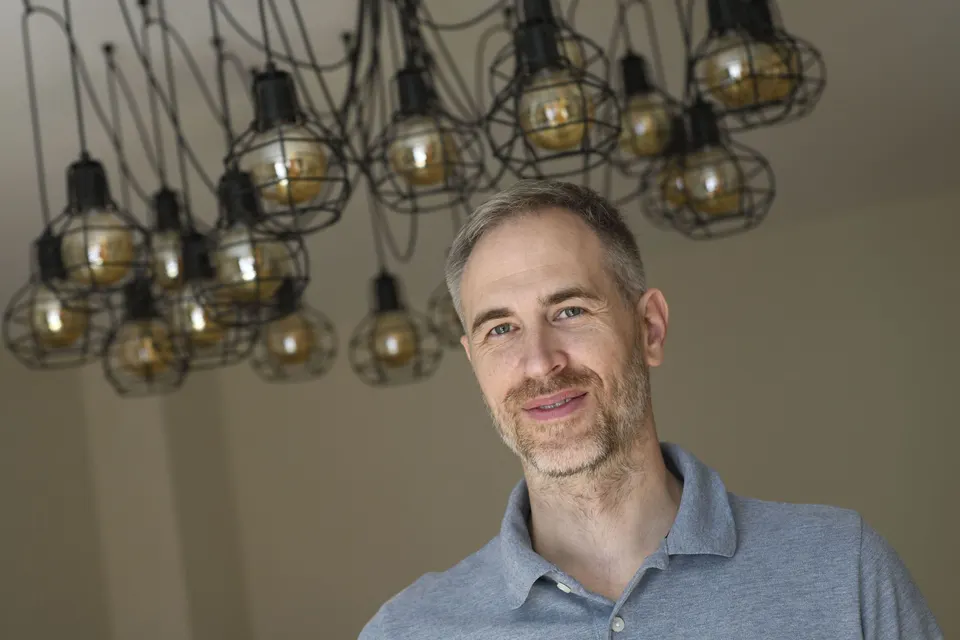
Petar Petrov works professionally on bringing artificial intelligence into practice. He heads the AI team at Eleven VC, the fund that brings together some of the most promising Bulgarian startups, among them the first Bulgarian unicorn, Payhawk. His first book, Izkustven intelekt: dusha i silitsiy (Artificial Intelligence: Soul and Silicon), came out recently.
How do we break the clichés and start the important dialogue about the future—the very conversation this site exists for? How do we prepare for the immediate future, in which artificial intelligence is changing so many areas of life and confronting us with challenges that were unthinkable until recently?

– You say part of your job is to talk about the social transformation that comes with artificial intelligence. That is my cause too. What do you think are the most important aspects of this change?
– The most obvious is the loss of jobs, but there are other aspects and dangers as well.
If AI surpasses us in capacity, it matters a great deal whether it will develop and display consciousness. That may decide whether we control it or it goes its own way.
Another aspect is the many changes in education—is there any point to it anymore?
If you have no job, and there is no other job you could learn and do, what do you need an education for?
Clearly it won't be vocational, it will be personal—how to perceive the things that are happening. How to be well, how to take care of your health—all things that have nothing to do with work. From there we can talk about other changes, in medicine, for example, that could improve our lives.
There may be social changes in how we live—that we will no longer be surrounded only by people, but by machines as well. Will they have their own societies? Will we want that, will we regulate it? Will we be able to choose between places where such machine societies are allowed and places where they aren't?
All sorts of changes could happen that we can't possibly imagine right now, but the first signs are clearly visible.
– The loss of jobs really does seem the most obvious. Yet almost two years have passed since “the ChatGPT moment,” and the effect still doesn't seem to be visible…
– On the contrary! Look at “support,” for example—the technical support specialists. That profession is melting away!
Call centers are disappearing as an industry right now. What's left is some 5 percent for the more complex cases, and in time those will be smoothed out too.
There are already examples—in the Philippines, where this industry used to be very strong. There are also advanced projects where phenomenal things are happening: shorter response times, more satisfied customers, cases resolved through support.
The fact that a person hasn't been fired because ChatGPT came along doesn't mean the work isn't becoming more efficient and that this isn't reducing jobs overall.
And all that efficiency invariably translates into fewer people, fewer jobs and more efficient businesses.
Lately there have been constant waves of layoffs in the tech world, and part of the reason really is that the models are becoming more efficient.
– Most people in the sector say the reasons are mostly economic and that it's too early for these to be the consequences of artificial intelligence. But I see it in my own work too—how much more efficient AI systems make me as a programmer.
– Absolutely! Take the arrival of a platform like Devin. They claim that
13.9 percent of a software team's tasks are completed successfully, entirely autonomously.
But if we break the situation down, another share of the tasks are 80 percent done, 60 percent, 40 percent. There's a pile of tasks that are partly done, and they also add up to a certain volume of useful work. On top of that, there are tasks completed not autonomously but with a human's help. And when you add up all the productively performed work and it turns out the system does about 30 percent of the total… that is enormous for the industry.
Tell me there won't be layoffs with 30 percent less effort!
– All the more so in an industry that is mostly about the value of labor.
– This is the very near future. The company that built Devin was founded three or four months earlier and they've already shipped the product. Imagine another three months—won't they improve it further? The overall contribution could quickly jump to 45 percent, and that would mean almost half of all programmers are no longer needed.
At the same time, it's very logical for this to happen, because
the professions more likely to disappear or be replaced are those for which there is data you can take, structure, process and feed to the model.
Programming is exactly that kind of profession, because everything you do is clearly reflected in the files, in the changes, in the outcome of whether the software works. In more serious software there are tasks, QA specialists, you accumulate all the data you need and you can train the model.
Maybe not many jobs have been lost yet, but we can see how this process of replacement is unfolding. Everyone is trying to systematize the data from a given profession, and once they do, there's a model that works. Yes,
it probably won't replace you completely, but if today you need ten people, you'll soon need two to do the same thing.
– As one of my guests put it, the paradigm is flipping in almost every task—we humans become the client and the inspector, because the model makes mistakes, but it becomes the main performer of the task.
– I call it a new kind of management. Like designers who used to love drawing and creating, and are now commissioning the work and becoming managers of AI. If you make games, you're the manager, the AI creates, and you just have to check and polish, but a large part of the creative process you can already do with various tools.
AI doesn't have to do 100 percent of our work for us to reach an extremely large replacement of labor.
– I talk to a lot of people about this, but for most of us it's somehow abstract. Whereas your job is precisely to introduce these kinds of practices in real, working startups. Tell me about some interesting applications, some successfully introduced processes.
– The truth is that it's very hard to bring AI into processes. When I started at Eleven, I imagined I wouldn't be able to keep up. That there would be so many companies, each running its own processes for adopting artificial intelligence in parallel. Suddenly it turned out this was very far from the truth, because for all sorts of reasons they can't or won't.
One of them is that it takes money, and startups don't have a particularly flexible budget—they usually plan about a year ahead. If you tell them a slightly more serious, slightly more strategic AI integration is possible, it turns out they can't afford it because it wasn't budgeted in advance. For the future, we now know this has to be budgeted, but those who raised money in the past didn't foresee the rapid changes brought by generative AI.
– But then the whole point of such innovations is to save resources in the long run…
– True, but the problem is that you have to invest first. And it's not just money—it's training people, changing attitudes, setting aside time, prioritizing. There's a whole pile of things you have to put in at the start, while you still see no benefits at all.
Over time that cost will go down and the benefits will start to grow, once the machinery is oiled, the data is connected, the people are trained and start using the right tools. At some point it all turns around, but the thing is, the gap between the moment you commit the resources and the moment you start reaping the benefits is large—from a few months to a year, which for startups is critically long.
Right now we're trying to make sure that all startups still raising funding have it in their budget that they'll need money, effort, time and focus for artificial intelligence.
– Maybe another downside is that, as you say, it takes a year to roll out, while things are so dynamic that new models come out literally every week.
– That's a separate problem. You decide you'll do something, you start, and meanwhile an updated version of whatever you decided to implement comes out.
But let's say it's not all that fatal—you can carry on with what you started. Once you've done it, once it's part of the company's processes, the cost of replacing it will be lower. Training people, getting them to decide to use it, getting them not to be afraid of it—that's no small thing.

– Besides technical support, which specific applications are we already there with, ready for this kind of integration?
– Most of them aren't universal. Support is a very interesting intersection of something that's universal for everyone, has data behind it, can work regardless of the language, and brings benefits.
Many of the things being implemented are specific to what you do, and an individual solution gets developed.
You have some system, you take an inventory of what data it generates, what it collects, what comes out of it. What data you can take, buy, connect, enrich.
And once you have it, you make a list of what you can build and which AI features to introduce.
– As Petar Tsankov from LatticeFlow told me, even companies that lay parquet floors can now use such systems… But do you think new professions will appear? Because until now, whenever an innovation took hold, jobs disappeared, but new ones appeared that balanced out the labor market.
– Yes,
there are new professions, but very few of them, and in my view there's no way they'll become more numerous.
I'm skeptical of the opinions that weigh job losses against the appearance of new jobs. That's when I look at the numbers—how many will be lost and how many will appear? There are new positions, but you can count them on your fingers. First of all, the people who create artificial intelligence. Those who think strategically about implementing it. Those who work directly with using it. And I can't think of others. Which comes nowhere near the number of people who look set to lose their jobs in the near future.
I did a rough calculation related to the Stargate supercomputer—a $100 billion project that OpenAI and Microsoft have announced is under construction. At full capacity
it should replace 250 million jobs!
If we imagine that Microsoft won't be the only ones to build such a center, that other companies will too, it turns out we could reach roughly a billion jobs. If they're done by computers, that means they're not done by people. If there are 8 billion of us in the world, and there are roughly 3 billion jobs, it turns out that
a third of all jobs are planned to be performed by supercomputers and AI.
We can speculate that maybe they got it wrong—that Microsoft and OpenAI will put in $100 billion and artificial intelligence won't actually be able to do the work. I don't believe it. On the contrary, they know things we don't. In their labs they're developing projects we haven't seen yet.
We're expecting GPT-5 any moment now. There are many signals that general AI has in fact been achieved—yes, it's just speculation, of course, nobody outside OpenAI's doors can say anything concrete. But at least judging by the indications I see, AI will develop both in breadth and in depth, which you can tell from the enormous investments. And that means there will be huge, monstrous replacements of jobs.
– What also frightens me is that, once again, these developments are concentrated in a few big companies. As if we haven't learned our lesson from how technology has developed so far, with a handful of enormous giants…
– That's undeniably so, and more than ever. And it brings its own problems—I don't like it one bit. Even the fact that OpenAI has certain views on what's allowed and what isn't. What ChatGPT will answer and what it won't, where the answer will be softened or distorted—that's already worrying. At the very least, their views on life may not be the same as mine, and we have no way of correcting them. There are many irritating moments. For instance, a teacher from Egypt complained that it wouldn't let her discuss the Quran at all.
All that power, and decisions being made by one centralized system run by a handful of people… that's not good.

– We saw it with the OpenAI “soap opera” too—it was revealing about the level at which decisions are made. But many people say every technology goes through a boom and a winter. Could there be a winter for artificial intelligence too? Or are we just trying to squeeze everything into old frameworks, which isn't always right…
– I studied finance, and one of the basic rules of financial investing is that
the past is no indication of the future.
If you invest because something was successful in the past, that doesn't mean you'll get similar returns in the future. That's one of the first rules you have to learn.
I avoid reasoning that way. AI itself has had its winters; there were moments when people gave up and said, “There's no way this will work.” “We don't have such a method,” or “we know the method, but it needs such inhuman computing power that we won't have it for decades.”
But look—the decades have passed, the power is here, and it works. Will there be another winter? To say, we'd have to discuss whether there are holding-back factors. Whether there's hype that outweighs the practical benefit. The productivity benefit is indisputable. And if anything is typical of the situation, at least in my view, it's that
AI isn't talked about enough, about the impact it has. That's the exact opposite of a bubble,
where there's a lot of talk but no benefits, whereas in this case I believe the changes are much bigger than what's being discussed. I don't think there will be a winter.
On the technology side, my job is to follow what's happening every day and write about it. I see what comes out of the labs, what projects are presented, and the speed at which new things are invented and research papers come out is astonishing. Nothing suggests to me that there will be a technological halt.
In my presentation there's a slide listing
all the holding-back factors we face—regulation, lack of data, a shortage of specialists to develop AI and integrate it. But not one of them is insurmountable at the moment.
You could talk about energy, for example. Fine, but the latest generation of Nvidia chips is 30 times more powerful and at the same time 25 times more energy-efficient. And what if there's one more generation of chips that are another 25 times more efficient? The balance changes completely; suddenly it turns out electricity won't be the limiting factor. And one more generation after that?
Many people say general AI won't be achieved with large language models. Fine, it'll be with other technologies. But where's the evidence that it's impossible? There are many angles from which you can approach it and achieve something close to general intelligence. Even if not in its absolute form, then something far broader in the range of actions it can perform. We're not talking about self-awareness at all.
Yes, cataclysms can happen. A war between China and Taiwan would stop the only company that actually produces the chips for AI—TSMC. That's something that could certainly happen. But for now I don't see how there could be a winter.
– You say we underestimate the transformation and don't talk about it enough. I absolutely agree, that's why this site exists. It's clear that you and I are sure of it, but how do we convince everyone else—the people who write in the comments under my articles that I'm bothering them with nonsense and fantasies?
– With a lot of publicity, conversations, discussions, awareness. For now
everywhere you get fragmented, partial, unclear information about what's happening.
Which is why I wrote a book too—exactly that kind of explanation of what AI is, why it's happening now, where it came from, where it's going. What the consequences will be and why they'll come. A systematic look at the whole subject. So if you read this book, many things will become clear to you and you'll realize what's going on. For me that's the way—a systematic, organized, comprehensive approach, not scraps of information tossed out for a few minutes in a radio interview, grinding through the same questions, with simply not enough time for anyone to grasp the concept. It's a complex subject, and if you want society to understand it, you have to put in the necessary resources—time, money and education.
– That's exactly what I'm trying to do on this site, by offering different perspectives on the subject. My texts are long on purpose too, which certainly puts off a lot of readers.
What are the next big steps in the world of artificial intelligence that you can't wait to see taken?
– I'm not impatient. I think there are already many exciting technologies, but we could live perfectly well without them. I'm not looking for or waiting for some grand changes, even though they keep coming all the time. There's nothing I'm eagerly awaiting, except one thing—being able to beat some grave diagnoses in medicine. Defeating cancer, for example. Everything else, to do with productivity, with making some process faster and more accurate, is great, but I don't know if it's worth the price we'll pay.
– All the more so since we already have technologies we haven't yet learned how to use.
– The perspective of people in the developing world matters here too. For us, many things are taken care of—water, electricity, shelter. And if you also have a good job, you get luxuries the world has never seen before. Every kind of food from every corner of the globe, products, deliveries, little indulgences, technology, entertainment…
But there are people who don't live like that—some have no internet, can't afford smartphones. There are people who have no water! There's great potential there for improving human life, but unfortunately there's no potential for profit, and that dampens the interest.
– Bill Gates said, back when ChatGPT came out, that it's a revolution precisely because it will help us improve healthcare and education for the third of the world that has never had access to them. But again, alas, it comes down to profit…
Before we part, I'd like to ask you one more thing. What do you think we should do so we can rest assured that ten years from now we'll still have jobs? That we'll still be relevant on the labor market….
– Regulation. Only regulation.
– Is that even possible? It's subjective, it could slow down progress…
– That's exactly what regulation is. It has to rest on a global agreement that there are serious dangers that could arise and that we don't want them.
As long as there's no global agreement, everyone will fight for their own position.
– But what have we achieved globally so far? We haven't managed to agree on nuclear weapons alone in 80 years.
– I think we have agreed, more or less.
– But the weapons are still there, and at any moment they could bring about the apocalypse.
– Yes, but they're not being used. Maybe AI models will also just sit there, with labs where they're used. But as long as it doesn't come to something that takes control and breaks out of its constraints, then with the right attitude and regulation, people will live well. In my view, that's the only way.
As long as there's no regulation, it's every man for himself. But it's a hard task, and as a concept it hasn't yet matured in society, because society isn't educated about it. Regulation often happens after something goes badly wrong—then things move very quickly, as happened with COVID.
– Again, like with the nuclear bomb.
– Yes, that's right. In Europe we've set off in the right direction. The problem is that it isn't global, which means we're slowing down technological progress in the name of a better quality of life. But that way our economy will suffer compared to the US and China, and we're doing it fully aware of that. I believe the most important thing right now is for people to have it explained to them, in an understandable way, what this is all about…