Which fields of medicine will artificial intelligence enter soon? Are there AI-based technologies that are already part of everyday practice? Does it look more promising in diagnosis or in treatment? What are the next big steps on the horizon?
With today's guest, we take a peek into the fascinating near future in which medicine meets the possibilities of artificial intelligence.
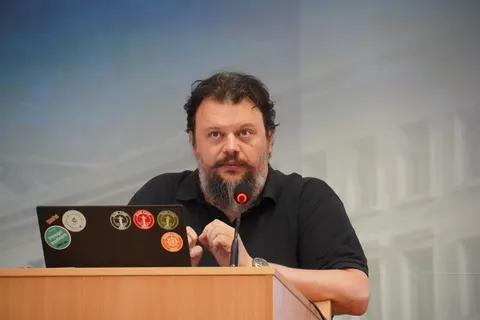
Stefani Paunova is a programmer with experience on “both sides” of the code—she builds backend technologies with Java and frontends with React, and she is part of the team at TINQIN. And even though she has this much sought-after profession, for four years now she has also been teaching database seminars at the University of Plovdiv. She is currently preparing her doctoral dissertation, which deals precisely with the arrival of artificial intelligence in medicine.
Over the past few months she has buried herself in the latest research on the subject, so it is more than interesting to see what is coming…

– You've chosen a very interesting research direction. Could you tell us about some of the applications of AI in medicine that impressed you while you were doing your research? Ones you never even suspected existed…
– A lot of methods are being integrated, but not for making the final decision—rather as a consultation to help the doctor. In the US, for example, technologies for detecting cancer cells in the lungs on an X-ray are already widely used. The Food and Drug Administration there updates its list of intelligent systems that can be used in medical and hospital care every few months.
There are already systems in which smart devices record various patient data and make a prediction of when you will recover from a given illness. The prescribed therapy can be changed depending on how the treatment is going, or a signal can be sent to the doctor. But we still can't fully trust these systems, because, as with everything else related to artificial intelligence, we're dealing with a black box. You don't really know how they work, and people don't have enough trust to rely on them alone when deciding on treatment.
Some systems can compare the patient's physiological indicators, the illness and the treatment applied, and make a
prediction of when the patient will be cured and what side effects might appear.
Besides making decisions easier for doctors, this keeps the patient informed.
Artificial intelligence is also already actively used for testing and discovering new drugs, and for analyzing the data of patients taking part in such trials. It is making its way into image processing and big data analysis. An interesting example is detecting lung cancer on X-rays or CT scans and searching for metastases.
In China, which has its own traditional medicine, I came across advanced projects that use AI to combine it with modern methods.
So far, the US Food and Drug Administration has approved no fewer than 692 medical devices that use artificial intelligence methods!
– As far as I know, the difficulties with introducing artificial intelligence into medicine are very often related to a lack of data, and especially of data that is sufficiently standardized and systematized.
– That's right. The problem here, in my opinion, is that there is currently no clearly developed unified system for collecting, storing and processing medical data. Medicine is a very broad field, influenced by many factors, and some of them are far too subjective. For example, everyone rates a headache in their own way—I may say my head hurts terribly, while for someone else my headache would be an ordinary, everyday condition.
According to my research, most of the algorithms developed this year are built on the idea of
striving for maximum objectivity and asking as many questions as possible,
so that the patients themselves can define their symptoms. In the past, most algorithms didn't even take a person's sex into account, and that is one of the main markers in various diseases.
– Can this data be standardized? Who does it depend on more—the technical side or the medical side?
– Medicine is a huge field—for one thing, it depends on geography, since every country has its own norms. I think it's possible to consider building some kind of unified system, but it would have to be at quite a high level—the World Health Organization, for example, as happened with the COVID vaccines.
If more scientific papers come out saying that a global data repository should be created, sorted by disease, sex and age group, that would be within that organization's capabilities. We're still quite far from it, but given how fast these systems are developing, it's entirely possible.

– What about the question of who is to blame for a wrong diagnosis made by AI—the doctor, the algorithm, the developers?
– For me, the answer is unambiguous. It's hard for an ordinary person to understand how these systems work. At the moment, in all applicable technologies, AI always comes with the mandatory caveat that it
only assists, it's not the final word, and the doctor must make the final decision.
The doctor can get help from the application, but the responsibility is entirely human.
– Could that change?
– In my opinion, the human factor always plays a role in decision-making. At least for now, there is no system that monitors the patient and combines all the algorithms that have been developed. Meanwhile, an experienced doctor notices even changes that seem incidental at first glance but which, combined with certain symptoms and an age group, may be important for the diagnosis.
For now, we can't let these systems decide autonomously, at least as far as medicine is concerned.
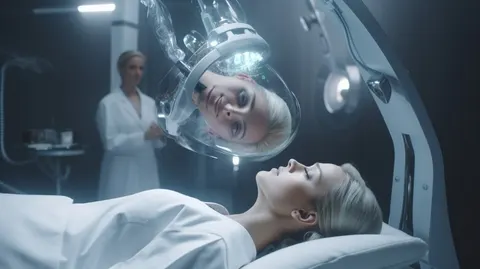
– At the start of the big buzz around artificial intelligence, Bill Gates wrote that healthcare and education are the areas where the biggest changes will happen. Because it already gives access to “something like a doctor” to several billion people who have none. Will that really happen?
– I think that in more conservative countries, like those in the Balkans, it won't happen for at least the next 10–15 years. Relying on a system for complete treatment is, at least for now, not a serious option. There's no way to be sure that the data it uses to reach a conclusion is reliable; medicine is still too complex a field for algorithms. That's why I think the application is more for specific cases, for diagnosing particular diseases.
And if we do reach that point, I think it will happen first in more developed countries. People will be able to choose to be treated by artificial intelligence, but they'll sign some kind of agreement that it's at their own risk. I don't think many people would take that risk, but it also depends on how well informed they are.
– And what can medicine offer, for example, for incurable conditions? There was a lot of talk that the attention drawn by COVID would give a huge boost to medical technology. Why haven't we seen it so far?
– I think there is a delay, and it's mostly due to a lack of qualified people. There are very few sources of information and technology courses that can pass on this knowledge, so the people who have it are a limited circle.
The other thing is the attitude toward these systems—are there people willing to invest in them? Developing them requires quite serious funding and highly paid teams.
– If we step out of science and into fantasy, how do you imagine the medicine of the future?
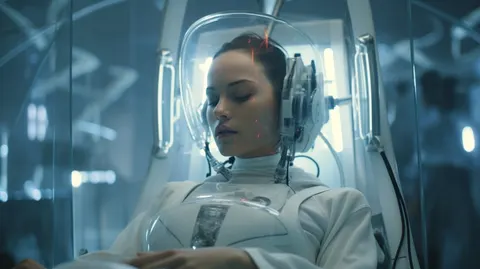
– I imagine designated places, booths with an interactive monitor—you go in, the computer scans you, asks you about your symptoms, runs various checks. Finally, it analyzes all the information collected, what the illness is and how to cure you.
After making the diagnosis, these robotic doctors will “mix up” a blend of the right substances to cure you. It will be strictly individual for each person.
I think that in the future more people will have access to all kinds of smart devices, which will be combined with these robotic doctors, collecting information and monitoring the course of treatment. They'll track readings in the person's home and send the information to a unified data processing system.
– Why did you decide to focus on medicine for your dissertation?
– I wanted to develop something that isn't common, to run into different problems and learn something new. Medicine connects people. If you can help others in some way by discovering something, even something small, that improves medical care, that would be wonderful.
– What is the topic you're working on?
– I started with my master's thesis, which was developing a web application to make communication between patients and doctors easier during the COVID pandemic. Later I expanded it, and now it can be used for any disease. The patient fills in the indicators chosen by the doctor—blood pressure, oxygen saturation, headache, any possible symptoms. The algorithm weighs the importance of each symptom entered and how it develops, and calculates the patient's state of health, which comes down to three types. Normal; mild symptoms but requiring monitoring; and severe—in which case the doctor must be notified immediately to take action, for example to issue an e-prescription.
That's where the idea for my dissertation came from; since March of this year I've been gathering up-to-date information on artificial intelligence in medicine. Those are the rules: before you write a dissertation, you have to get acquainted with what has been developed so far.
The next step is to start looking at implementing an algorithm that processes data for a specific disease—I've settled on kidney failure. There are already algorithms that analyze data from routine checkups and show whether a person is prone to developing this problem, but I'll focus on monitoring.

– As someone who already earns a living as a software engineer, what makes you keep studying?
– There's always been something that wasn't enough for me; I've always wanted to learn more. One of the lecturers says we're like doctors.
If you want to always keep up with technology, you have to keep learning, keep digging,
keep reading, because new things come out all the time. I love my work, it gives me pleasure, I find it interesting and I want to grow.
– Does a university education help in our profession?
– Many people will say we don't need it to do our jobs. And in one sense they're right, but in another, those years at university, studying subjects from different fields, give you a bigger picture. If you take a Java course, you won't be familiar with the principles, with the smallest parts of the various technologies. Whereas over those four or five years you encounter all sorts of topics and meet people you can have discussions with. And
in our line of work, being able to hold a discussion is also a very important skill.
– I think so too. But can education in our field be adequate enough, given that things change so fast?
– I don't think it's dynamic enough. It's true that changes to the university curriculum and course materials happen conservatively; it's very hard to create something new and innovative and introduce it into our system. Many of the people who make the decisions aren't actively working in the field—they're “bookmen.” When you haven't encountered new technologies in projects, at work or in a side activity, you have no idea about most of the things that have come out and can be used.
– How do we turn this around? How do we bring more people from industry into universities?
– By giving opportunities to younger lecturers, even part-time teaching assistants. When the person in front of you has real practical experience, it's completely different. They haven't just read books—they give you everyday examples. Besides, young lecturers allow more discussion with students, while older ones often see themselves as the only source of information.
As for me personally, what energizes me is communicating with young people and learning a lot of new things from them. It's happened that they've asked me a question I couldn't answer. The first time, you panic, and then you say: “I'll look into it and give you the answer next time.”
There's nothing better than learning new things every day!