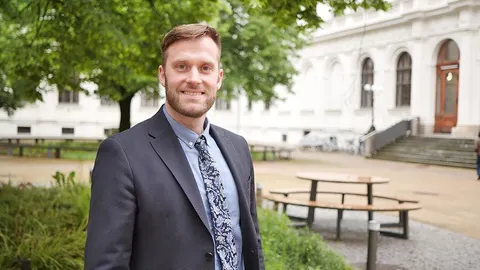
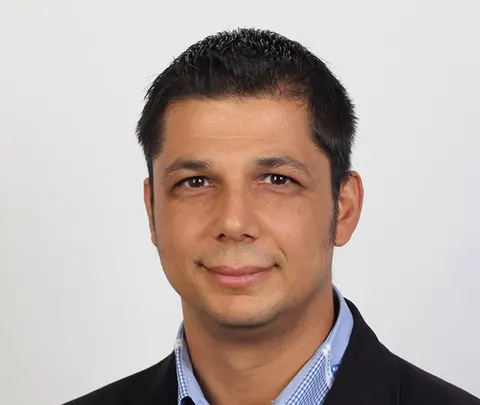
Prof. Stoyan Stavru, DSc, can immerse himself in subjects we usually find dull, fill them with meaning, explain them in an accessible and engaging way, and find an unexpected angle on topics that matter to all of us.
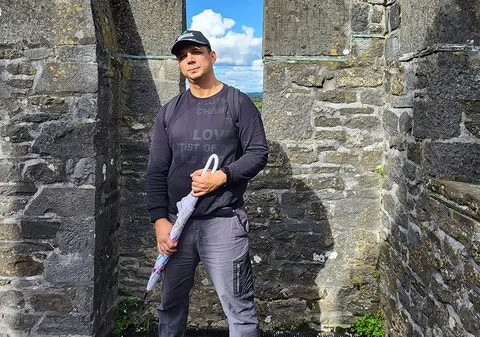
“Challenge the law!” the legal scholar urges on his dedicated website. A graduate in law and psychology, he has a special relationship with technology and many unexpected roles. He is a certified mountain guide, a teacher of the Japanese martial arts jodo and aikido, host of the podcast Vox Nihili, where you can hear “whispers from the future,” and editor-in-chief of the expert legal system “Lexebra.”
When and how will we divide up ownership of the stars? Are we, as a civilization, doomed to be driven by an endless desire to possess? Why is artificial intelligence a powerful tool and, at the same time, a fantasy destined never to become reality? Is it time to bring algorithms into humanity's eternal battle for justice?
– Technology is changing the relationship between humans and nature very quickly and drastically, and that is exactly what you study in your doctoral work. In which direction is this mostly happening?
– There are many vectors, but one of the key trends is the strengthening and multiplying of ownership, of the ways in which we possess nature. Technology provides an enormous toolkit for this and reinforces the characteristic “object–subject” axis. The subject is the one who has somehow been given the ability to control and own all the other objects.
In law, and in economics too, there is a key term: “goods.” These are the objects that ultimately interest us, that we can use or store. It is good to have an instrument through which to own them while excluding everyone else's access. We own all kinds of things; at first they were material—land, movable property, horses, tools, weapons.
Over time, though, they became more and more abstract. So-called intellectual property appeared, along with its objects. And here, with the development of technology over the last 30 years,
so-called intellectual property creates far more objects of ownership than there are things to be found in the material, real world.
What matters is whether this ownership, which turns out to be critical in our relationship with nature and beyond, can help us find some kind of balance that will make us sustainable over time. Because it is clear that the way we own things today—so-called extractive ownership—leads to the depletion of the land and the destruction of the ecosystems that make our very existence possible.
In recent years, the day on which humanity uses up 100% of the Earth's resources has been arriving around July.
By the seventh month we have already exhausted what nature has produced in the given calendar year, and for the months that follow we live in debt.
– Why isn't this changing, even though we talk more and more about sustainability and about the irreversible damage we have done to the planet?
– There are changes. In my view, the problem is that we don't talk about it enough, and the regulations being introduced are often not understood. They usually come from above: from the European Union or from the guidelines of other international institutions.
We don't understand them because in more peripheral countries, such as Bulgaria, we simply receive a ready-made task that we have to carry out. Until we take an active part in devising it, in understanding it, we cannot be effective in carrying it out.
Otherwise, the tools exist. A very clear example is the transformation of certain traditionally owned things into services, the so-called as a service (aaS). A car can be a service: instead of buying one, you take it, use it and leave it. That way you share a resource without owning it and without excluding others.
A much older form, for real estate, is nature parks, where we can see so-called defensive ownership “live.” The idea is to exclude others, but not in order to use the land, that is, to extract something from it, but to preserve it as it is. To lock the land in its wild state and limit human impact on it.

– Don't we end up with some kind of mania for ownership? To the point of buying plots on the Moon and handing out names of stars…
– Yes,
we are creatures of that kind—possessive, as if this were our mode of thinking about the world.
To own it somehow, to lay our hands on it, so that from then on it is (only) ours. Rousseau said there were always enough fools to believe the first man who said “this is mine.”
Ownership goes hand in hand with power. When we talk about the Moon, first some sovereign has to set foot there, some state has to establish its authority. Then comes occupation, which is important from the standpoint of property law. It is the first moment when you come into contact with the matter and can exclude others, because you were first in time.
We have played this game many times. It was the same with the discovery of the Americas. Now the technological bar is much higher, but at some point it will be cleared.
Occupation exists among animals too. A wolf or a dog marks its territory in a particular way, and it does so using its own excrement, that is, things its body expels. It is very curious that the body's waste products themselves can be a way of marking ownership.
It's in our blood—to be territorially dominant subjects.
– Could we say the same thing happened to the internet? It was meant to be a democratic network where everyone is equal, and today it is a machine for inequality. There are four or five huge players who, one way or another, control data, advertising markets, profiles. Are we in some kind of imperial phase here too?
– The internet is a rather complex thing, and more or less it doesn't lend itself to the kind of possession we know in the property-law sense of the term. Only the servers are the Achilles' heel of this invented world. If I get to them, I'll seize them and can do whatever I want, including destroying that world. That's why they are duplicated, and there are many tools to limit this materiality of the internet, but in the end we are talking about cables.
What you are talking about is different and has to do with monopolies. They are a somewhat more abstract form of ownership, without any physical effect on a specific material object, but they are also very characteristic of our economy. It is no accident that, from Marx's insistence up to the present day, some form of antitrust legislation has existed: regulations that try to prevent such a concentration of economic power in a single entity.
Europe is extremely careful, because this really creates very large distortions and great power. America tries to present itself as more flexible, offering greater “freedom.” But I think Europe is a workshop for regulations, and what we mainly export to every part of the world is regulation. That is why I would support a much more detailed, at times even complex, model for regulating monopolies. But yes, monopoly is one of the mutations of ownership, and yes, it applies to the internet too. Monopolies exist wherever there is interest and the economic factor is dominant.
– But for an ordinary user like me, such detailed regulations don't work. GDPR is the example that immediately comes to mind. Has it made our data more secure? Supposedly the most precisely drafted regulation, and it has turned into a formality.
– That is again an example of a regulation that was simply “transposed,” brought down to the local level without being understood. In reality, there is a huge stake behind GDPR! Information is another object of ownership—it raises very big questions about how we own it, which information is mine, personal, and therefore cannot be owned by anyone else. Information is a very serious abstract object, and it is a matter of personal privacy.
GDPR tries to provide protection: to have freedom of information, and at the same time to protect the information that is personal, that is much more closely tied to me. From there comes the moment for dialogue. In Bulgaria, in my view, that dialogue has never even begun. This failure to grasp the stakes prevents people from understanding the essence. And, accordingly, from proposing changes, because every legal framework is a dynamic regulation.
There are many such examples, and I think that here
the big debt lies with the media, which busy themselves with all sorts of nonsense, things of no importance, but never take a systematic, serious approach that gets ahead of events,
to hold discussions on topics that are truly worth thinking about long before we adopt them. We are not used to talking before something has happened.
– That's exactly what I'm trying to do—to create a platform on technology where more points of view can come together. But isn't part of the problem that the law has drifted away from people? We see it as something distant, abstract, utterly subjective…
– And you are succeeding at it. You know,
the law claims to be perhaps the most objective thing ever invented.
In theory, a judge must be absolutely independent. The law provides grounds for recusing any judge who has a certain connection with the parties or with the subject of the case and might act in bad faith, that is, subjectively. Regardless of how indisputable the rules on recusing judges are, I believe a judge is good if he is subjectively engaged with his cases. Objectivity is not always a guarantee of a sound judgment, or of sound law in general.
And this is where we come to the subject of
artificial intelligence, which can offer a kind of fantasy of objectivity—a huge but powerful fantasy.
If it achieves it, I think that would be rather sad for the law. The law claims to be very objective, but it is good for it to be healthily subjective at the moment it is applied.
– The debate in journalism is the same. There is a widespread view that a journalist must be objective, absolutely impartial. I don't think so; journalism by definition must also be personal, and therefore subjective. You mentioned artificial intelligence—do you think the trend is for the natural and the artificial to become more and more indistinguishable, for us to merge them?
– The trend is more toward imitation. Artificial intelligence imitates very well more and more things we thought were only human and that only we could do. But what I believe it cannot imitate is our flow of life. A phenomenological approach cannot be created by technology. This is where the big question of the Chinese room comes in—if someone speaks to me in Chinese, does he actually know Chinese? To me, this is a typical example of an artificial experiment that misses the most important thing.
We are living biological beings, extremely vulnerable.
Our existence can end in literally a few seconds. We have to sleep, to rest. When we are in severe pain, we stop thinking about high technology. Our mode of existence, which is tied to embodiment, makes us a particular kind of being, a particular kind of intelligence.
It is no accident that AI will have the hardest time replacing the craftsmen on construction sites, while what is supposedly the highest form of humanity, intellect, turns out to be easy to master. Take chess: suddenly nobody can beat a program anymore.
I would add emotions, which are an entirely bodily experience. However well it imitates any emotion, an artificial intelligence without a body cannot come anywhere near it. Although there is talk of AI carriers that would be biological. Let's see
how far we will go with cyborgization and this fusion of the biological with the metallic, of carbon with silicon.
It would be good for psychoanalysts to take part in conversations like this, because Freud, even though no such case existed a hundred years ago, can explain a great deal. Artificial intelligence is one enormous phantasm of the superego, which has its psychological explanations and reasons for existing.
It is not reality, at least not the kind it seems to us, the kind an apple is, but rather a very serious fantasy of ours, which is currently mutating in every direction, and we are seeing what the human imagination is capable of.

– If we let this fantasy loose in the search for justice, in which directions do you think it is wise to trust technology? When it comes to law, the administration of justice, the fight against crime, fairness…
– There are many things in which we can trust artificial intelligence. I am editor-in-chief of Lexebra—an expert legal system covering the case law of the Supreme Court of Cassation, Bulgaria's highest court for civil and criminal cases. Literally every day I work with a colleague who is an artificial intelligence. He is an editor and processes, in real time, all of the roughly 80 to 100 decisions issued every day.
These decisions run from 5 to 20 pages; if a human did this work, they would have to spend literally all their working hours reading. That is the enormous amount of text produced by just one court in a not particularly large country.
My colleague was trained on 10,000 of my summaries—I highlighted the passages I considered most important and added markers for what they relate to. Now he does the same thing extremely successfully. At first I was much more careful, going through the other decisions too, to make sure nothing was missed. Then I became convinced that the system handles it almost without error.
While I was training it and marking up the decisions, it cost me six hours a day. Every day for nearly 20 months. Now, as a result of my interaction with this artificial intelligence, I need between 40 and 50 minutes to get acquainted in detail with everything most important for the day.
Now we are training the AI to answer questions—something like ChatGPT, but let's call it ChatSCC.
In the Bulgarian legal system, a cassation appeal in civil and commercial cases is in most cases admitted on the basis of a formulated question. Very often, to get the court interested, you have to act a bit like a journalist. You need to be able to phrase the question in the best possible way, so that it intrigues the panels of the court that specialize in the relevant fields. To develop that kind of sensitivity, you need to know the whole body of court rulings very well. Artificial intelligence does this in the best possible way.
Another example: with the help of AI you can look for so-called odd decisions. There is established case law on a given question, and at some point a decision appears that clearly contradicts it. That is how precedents arise that change the law. They are critically important, because how many cases in other courts will develop depends on them. And you have no other way of finding one buried in millions of characters of case law. Until now it was done through the collective efforts of many interns and assistants.
AI is extremely useful for these mass tasks, enormous in volume and time. And with some human supervision, it can work wonders.
– In many fields, the paradigm already looks like this—the human role is shifting toward commissioner and supervisor of tasks that algorithms solve. But are we late with regulation in this area, in your view?
– Regulation certainly presupposes that you know your subject. That is why we have to regulate, in stages, the parts of the process that we understand. Right now, however, there are parts we don't fully understand and perhaps never will. Which means we have to regulate differently. If something is too dangerous, the law usually bans it at first. We live in a much more liberal world, where competitiveness implies greater freedom.
I'd say we are not really late with regulation. We see people who are deep inside this process, and their panicked reaction was “Regulate us, because otherwise it gets scary.” Maybe they should explain it better; maybe this dialogue needs to be more intense. But regulating is no easy job, and there have to be mechanisms for correction.
I think we have to start with the biggest risks. That's how regulation works: something new appears, the ten biggest risks become visible and are banned, and the other applications are permitted. Meanwhile, for the banned ones, people consider whether the ban might be lifted, for example by introducing some form of licensing.
Now the European Union's AI Act classifies technologies in exactly this way—by their respective risks—and introduces rules on that basis.
I would like to think we are not too late, but I really believe it is good to talk about this, to test, to introduce and to amend regulations already in place, without turning them into the same dry matter that GDPR has become in Bulgaria. Because there is a great risk that we will once again turn something we don't understand into bureaucracy.