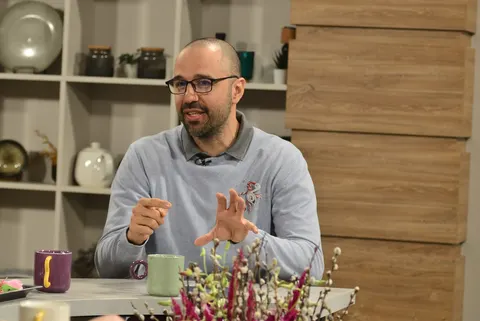
Today's guest on Digital Stories has changed the lives of tens of thousands of people for the better. Mine included. My own Digital Story began when, purely by chance, I ended up in a course at SoftUni, the Software University, and discovered that programming is a wildly absorbing pursuit and that (most unexpectedly) I was actually good at it. I was lucky enough to have that course taught by none other than the founder of SoftUni, Svetlin Nakov, who has an incredible talent for teaching and inspiring.
But that is not all Nakov can do. He can talk about today's (and tomorrow's) computer world for hours. Engagingly, with a sense of humor and real insight. Without fearing that online nobody likes authorities and there is hate in every kilobyte.
– We keep repeating that we live in an information society, and yet we don't value the information we receive, we don't sift it. We have more and more data and less and less information. Why is that?
– I think that when people are oversaturated with something, they stop appreciating it and paying attention to it. Back in the day, when we had three or four books at home, I knew what was in every one of them. Now I have thousands, but I also have internet sources, and, honestly, I haven't read all the books at home—some I haven't even leafed through. We are buried in information.
The great skill of the 21st century is to separate from all the chaff the information you need in order to grow. The battle for the user's attention today is especially fierce.
Holding out, motivating yourself to work on something that is truly significant and meaningful against the backdrop of everything that floods us, is becoming an ever more difficult skill.
Yes, there is data, but digested information—knowledge, let's call it—is getting harder and harder to gather.
– And do you think some new form of media will appear that can do this—process and select information adequately and well?
– I think the future of finding our way through this enormous conglomerate of information lies in developing certain skills as human beings. Skills that are learned at school:
to save our attention for particular things that matter to us, not to get distracted, to learn how to search. To learn how to learn.
And then comes technology, which will simply help us be more effective. I think that's the direction—machine learning. Or artificial intelligence, although I don't like that term, because these days it gets used for all sorts of nonsense that has nothing to do with its real meaning.
– To what extent will we merge with computers?
– I'm not sure it will happen soon. But one day we probably really won't need to read or look up the weather forecast, because everything will come to us on its own through the so-called human-machine interface. The computer will probably be able to read our minds too, so that everything happens even faster. Imagine: while you're driving, a map just pops up in your head—what would you need a screen for?
But these things also open up chasms in information security.
To allow technology to help you, you actually hand over a great deal of your privacy.
That's also a big question—the whole matter of the security of your data: where it goes, who uses it. It will become an even bigger problem. Because the wars over data are only just beginning. Until recently wars were fought over oil, over food, before that over slaves. Now they will be fought over users. Interesting times are coming.
– Perhaps a little too interesting… There will be plenty of things to get used to, and one of them really is protecting our data.
– Data collection will definitely become an ever bigger business. The bad news is that it's open only to a few—Facebook, Google, Microsoft. You have to be very powerful for collecting people's data to make real sense. I could make a little website and start doing it too, but I couldn't decide an election with it, the way it already happens.
It's no accident that China has an entirely digital development strategy. Starting with digital money—people there already pay almost exclusively with their phones—and going all the way to total surveillance of people. If you behave badly—if you get drunk and do stupid things, if you cross on a red light—your rating drops. After that, your purchases become more expensive, some things are no longer allowed to you. Or, if you're a model citizen, you get rewarded. In other words: a gamified system.
That's an example of how technology can be used for control in a totalitarian state.
In a democratic state they'll do it too, just not quite so openly.
– How did we get here? In the beginning, the internet looked like a very democratic system. One person could decide to build a project in high school to chat with his classmates. And within a few years we had all ended up inside his project. How did things change so that this “little social network” now decides who will be the American president? Did nobody see it coming?
– It's hard to say how it happened—perhaps a combination of circumstances. Perhaps some people turned out to be smart and far-sighted, invested and made it happen. Here we have to wander slightly into conspiracy theories and think about who actually stands behind Google, Microsoft and Facebook—
whether it's the state or some supranational organization.
But it's logical that once people's lives become this digital, many will want to use that for control.
– Sounds a bit sinister…
– I often tell a story like this. Let's say you're a political activist and you're inconvenient to one of the big players. One day you come home, and the door doesn't recognize you, it won't let you in. You take out your phone to see what's going on—it's locked and everything on it has been wiped. You have no money, because paper money disappeared long ago; it's all in your phone. Your fingerprint isn't recognized. You go to look for help, but the police stop you, and it turns out you're a wanted person.
And all of this because your identity is electronic and can potentially be controlled. Your money is electronic, your home, your property.
Just think about what this dark side of digitalization could look like!
– Freedom, Siri, lies at the tip of the spear… Is it too late to fight for our freedom in this sense? And does anyone even want to?
– The fight for freedom arises from the drive of some people to dominate others, to rule them, and from the drive of the others to seek their freedom. This concept is eternal; it existed back when humans first started walking on two legs. Then it was a fight for resources—some people, the stronger and more powerful ones, let's say, wanted to hold on to the resources. Others didn't agree and rebelled, and states came into being. Now this is moving into the digital sphere—
some people want to hold our data, and others want that not to happen.
And what do they do? Some build a browser that tracks you, and others build a browser that doesn't.
– And only they use it, and you can count them on your fingers… That's why this battle seems lost to me today. Because this kind of power is less noticeable, it gives you comforts and boils you like the frog in the pot. You're warm, you're comfortable, and suddenly you find yourself in the scenario you just described.
– Everyone wants comfort. Me included. I know very well that right now Google knows I'm at home, knows exactly where I am and that I'm there every night.
But for now that doesn't bother me. Maybe a moment will come when it will.
I know people who use open-source alternatives to all the Google, Microsoft and Apple devices, but those haven't become popular. I don't know how the question will be settled. But in my view, the role of the state and of legislation will come into play. The state tries somehow to keep a balance, not always successfully. Take GDPR—a good idea, but I'm not sure it had the intended effect.
It's a very thick topic, but there will be many more like it. Here's another one. Once autonomous cars hit the road, what will the ethics of the autonomous driver be? If it has to plow into a crowd because the brakes have failed, whom exactly should it kill? Questions like that will keep cropping up, but they will also get resolved.
At first everything just happens as it happens, because technology outpaces the law. Then some regulation comes in, and things get a little less pleasant for the technical people. It's not perfect, and there's always a game of outwitting each other. Like in the financial world right now—some clever people look for legal ways to launder money, to avoid paying taxes. I suppose the same will happen in the tech world, including on the subject of our data, the ethics of cars and information security.
– But right now most states don't seem at all capable of controlling the tech giants, do they?
– Yes,
and I'm seriously worried that corporations are becoming supranational,
more powerful than the state. I'm not sure that's a good thing. In my opinion, any such overly strong centralized power is a threat to society. You saw what happened—a private corporation decided to suspend the American president's account. You can't get more telling than that… It means they already consider themselves stronger than the state. Maybe not stronger than the law, but where there's no law, they take advantage.
– The imbalance of power is enormous, like never before.
– Well, I don't think we should underestimate states either. Because if a state singles out a company, it can ruin it. Jack Ma's troubles in China show that very eloquently. And in other countries too, if someone decides not to listen to the big brothers, bad things happen to them.
I think there will be a fierce battle, but I don't believe the corporations will win in the end.
– Those are rather different countries, though. The ones in the West, the so-called liberal states, seem far more helpless.
– That's true. But I think this diversity we have—liberal and totalitarian states, a lack of technology, an excess of technology—gives birth to other innovations. After all, people become very inventive precisely when you forbid them something. Clearly the Chinese model is different from the American one. Only the European one is unclear… It looks like there isn't one at all. In my view the Asians are furthest ahead, but I don't mean China so much as countries like Japan and South Korea, which are largely democratic but also civilized and organized. They don't mistreat their citizens as much, they have technology and they use it for good. I think we should learn from them.
– Musk's idea of joining humans and technology with a chip in the brain looks increasingly serious. Do you believe it's possible?
– These things are getting closer. Every technology has its own life cycle, in which it first comes out with hype—“Come on, miracles are going to happen here!” Everyone invests. Then it turns out it was overestimated, and disappointment sets in. After that it starts working as promised, and if it really delivers, it gets adopted. Take even today's most ordinary touchscreen—it was invented long before the iPhone; they just couldn't find a mass commercial use for it.
Even now you can control certain processes with your brainwaves—the technology is still at an early stage, but it already exists, and it may well go mainstream someday. Maybe at some point we'll let the TV monitor our mood and switch the channel if we're bored.
But I think it's also important to preserve the human being.
Too much technology ultimately turns us into robots, too.
And we are human; we need other people. Even the pandemic showed that. People get gloomy cooped up at home. Not everyone does well on their own.
– Machine learning, artificial intelligence… What are the next big things coming to change our lives? Or should we expect something completely unexpected?
– There are many. I strongly believe in intelligent technologies in medicine. This pandemic shows once again that medicine has fallen completely behind in digital transformation. There's modern equipment, but people keep going for checkups in cases where there's simply no need—it's really dumb.
Genetics, for example—they can already “download” your DNA, analyze which diseases you're predisposed to, what you should watch out for, what foods to eat. This field is advancing very seriously, and I think it will explode in the coming years. Personalized medicine will develop, personalized drugs and technologies that analyze genetic predispositions.
The first artificial viruses have already appeared. No, I'm not into conspiracies. The leaflet for the AstraZeneca vaccine says: “This is an artificially created virus, an adenovirus taken from a monkey, which has been genetically modified: one ‘piece’ has been cut out of its DNA and another inserted—the so-called spike protein of the coronavirus.”
I expect digitalization in every sphere; now it's time for the less traditional ones too.
Computer technology and cars are somehow traditionally technical fields, but if we go to tourism or agriculture, those are areas that aren't heavily digitalized yet. Right now something big is happening, called “autonomous farming.” A satellite takes a picture, it gets analyzed, and you can see where the pests are. It's calculated automatically what to spray with and how, and you send out autonomous combines to do the job with no driver. Fantasy? It's already happening, in 2020, and Bulgarian companies are doing it in Dobrudzha, the country's northeastern breadbasket.
– And did we overestimate the potential of blockchain as a technology that would change a lot of things?
– Blockchain is gaining speed, even if only as infrastructure for decentralized finance. A time will probably really come when we won't need banks—there will be agencies that vet you in some decentralized way and give out loans. There will still be mortgages, because otherwise there's no way to secure them, but there won't be banks. And you won't be obliged to choose from, say, the 20 banks on the Bulgarian market. You'll be able to borrow money from China, from wherever you like.
Many things will develop. But when it comes to technology, I don't think a revolution awaits us. Technology has always developed through evolution—in the most ancient times someone made a cart, someone else improved it with better wheels. Every so often there are moments of a strong push—when we swapped horses for engines, for example; then the change happens within a decade. In that sense the next big push may be autonomous cars. We'll remove the drivers, and there simply won't be any need to own a car. You'll order a car through your phone, get in, and it'll drive you. Why would you need your own car? What you need is mobility as a service, and to me that's the future of transportation.
– Why do you think online hate is such a strong and tiresome phenomenon?
– Because people feel anonymous. If you went up to someone you'd call a “total moron” on the internet and looked them in the eye, I don't think you'd have the nerve. And not so much because they might punch you, but simply because people don't behave like that face to face. Online you have some sense of anonymity, of safety behind the screen. “Look, I'm at home. If I swear at him, he won't beat me up.” It's the law of nature. If animals had the internet, the little lion cubs would be mouthing off at the big lions and telling them they're idiots.
That's what we see on the internet. Is it good or not? We get used to it, and that's that.
But it's a fact that
the internet has become a very unpleasant environment. All those trolls, fake profiles, haters… it's become terribly toxic.
And fake news is getting very serious too. Yesterday my mother sent me some article about some doctors. Just one look at the domain told me what kind of article it was, and I told her—check whether these doctors exist and what they've published.
One of the new skills, which will become ever harder to develop because the other side keeps upgrading its arsenal, will be filtering information and judging what is probably fake and what isn't.
Learning to recognize not only fake news but misleading news, too. Sometimes it's for marketing purposes, sometimes it's distorted truth, sometimes outright lies. There will always be propaganda. It's on every TV channel. If the national television is run by one group of people, they'll be the cool ones and everyone else will be the bad guys. And vice versa. Who's in power will always matter. But people have to develop their own skill at filtering information.
– You said that with too much time at the computer, we start to miss people. How do you save yourself from that?
– I go out into nature. I also have a little garden; last year I harvested at least 20 crates of homegrown tomatoes. Everyone finds their own way—personally, I try to stay closer to nature and the soil. Just like that: to mow some grass, to touch the earth, to take a dip in the river, to climb up to some waterfall. Sports, too, at least twice a week. I go out with friends less because of the virus, but everyone has their own way of coping with it.
– You have two sons. When did you give them computers?
– To be honest, I'm still shielding them a bit. They're 7 and 9 right now, and they play now and then, but within reason. I believe that at an earlier age children should learn to think, to communicate. To learn values, manners, good behavior, and less about computers. There's time; they'll get to them.
If one of them shows a remarkable genius for programming or something else in the digital sciences, of course I'll support him, but if he shows it for drawing, I'll support him there. I believe a person has to find their own path, and to do that they have to try different things. Children included.
Our role as parents is to help them try more things, to find what really thrills them, what they carry inside themselves. Not “his grandfather was a doctor, so he'll be a doctor too, and out comes the stick until it works.” And then he'll either become a talentless doctor, or tell everyone to go to hell once he grows up and can make his own decisions.
– Besides, professions today aren't for life. I became a programmer after 15 years in journalism; I know a colleague who used to be an airline pilot, another is a former tennis coach…
– Not only that. I know the reverse, too—someone who was a programmer and now sells car tires. Because he was building software for car tires, he realized how much money they make in that business, and he got into it. I have a programmer friend who now runs warehouses. But in cases like these, through programming you get to know a particular industry, you come up against it, you see that you can have a technological advantage and do things better. For example, run a doctor's office in a smarter way, or a tourism service.
This is where entrepreneurs come in. In Bulgaria this group may be growing, but it's still far too small. If we compare ourselves with other European countries and America—there, every third person wants their own business. Innovation and entrepreneurship are definitely the areas we need to develop and support as a society if we want a better future. Personally, I'm a strong advocate of us as a society, and tech people in particular, developing in the direction of creating innovation, intellectual capacity and our own world-class products, instead of simply being contractors, however high-tech.