Elon Musk says that within five years it will be perfectly ordinary for each of us to have a chip in our brain. That we will finally merge with computers and unlock an incredible future for humanity as a different biological species. More than that—that this is the only way we will survive.
Frankly, to me it sounds like (not overly) science fiction, at least as far as the timeline goes. But from there on, it is frighteningly logical.
It is worth taking seriously the claims of a man who said he would put people into space. And managed to achieve something the most powerful country in the world had failed to do for decades. Before that, he promised to build a mass-market, sexy-looking electric car at an affordable price. He did that too.
Of course, with other ambitious ideas of his he has run late or even failed. But you can never be sure which of the two will happen, and here we are talking about the future of all of us, of our entire species. That is why it is worth summing up what we know about the ultra-ambitious Neuralink project and what is expected to happen in the coming years.
Brains, Breaded
It is strange that conspiracy lovers are so fond of Bill Gates, when the chief enthusiast for chipping us is in fact not him. And the one on his way to doing it quite literally and deliberately is a rather more current tech genius.
Musk first spoke about Neuralink exactly five years ago, in 2016.
The reason this Digital Story was born, however, became clear a year earlier. In January 2015, Musk, together with Stephen Hawking and dozens of other world-class scientists and celebrities from various fields, published a symbolic open letter. In it they warned that artificial intelligence could save us from disease, from poverty, from almost all of humanity’s problems. But it could also turn into an enormous danger if it was developed without oversight and without thought for the future. Musk likes to repeat that the logical outcome would be for us to become artificial intelligence’s pets.
A few years earlier, the futurist Ray Kurzweil had popularized the idea of the singularity. We will talk about it in more detail separately, but in short—it is the moment when artificial intelligence surpasses the capabilities of the human brain. Then it will continue its exponential development and… either grant us immortality or enslave us. Suddenly we humans will no longer be the smartest species on the planet. And what comes after, we can only guess. According to Kurzweil, the pace at which technology is developing will allow this to happen in 2045.
Chip-Chirp
And so in 2016 Musk announced his new venture. The chip in our brain, he said, is the only way for us humans to keep control over artificial intelligence. By simply merging with it.
In the years that followed, the creator of Tesla never missed a chance to say more about his idea, often during his regular appearances on Joe Rogan’s podcast. There, besides the big goal, he painted many other beautiful possibilities. With the help of the little chip in our brain, brain conditions that are untreatable today will be cured. We will listen to music straight from our computer, without “the sound itself having to sound” somewhere in between. (Obviously, this will make us much better neighbors for the grumpy lady downstairs.) We will communicate at a distance. We will say goodbye to countless tedious obstacles that, according to Musk, the analog world puts in our way.
He often points to the alternative, too. In recent years, Google’s flagship in artificial intelligence has been DeepMind. The idea is to develop a new generation of “computer brain” that will help us solve all of humanity’s serious problems. But, as Musk notes, in order to keep getting better at its job, DeepMind has access to all of Google’s servers. Which raises the question: what happens if the neural network really becomes so good that it simply takes them over?
Alpha Centaur
Yes, once again we have to stress that we are not talking about a fantasy author with a feverish imagination, but about the man who “reads” technology and sets its agenda today.
“It’s very important that artificial intelligence not be ‘other.’ It must be ‘us.’ That’s the only way we survive,” says Musk.
It sounds frighteningly logical. And also just plain frightening. Hardly many of us will be thrilled by the idea of a chip in the brain. What about free will? Where does the soul go then? Not to mention the hackers.
You may remember how in 1997 Garry Kasparov lost his famous chess match to the program Deep Blue.
Probably few have heard that in the years that followed, the chess player began working on a system that combines the skills of human and machine. And in every interview on the subject, having ended up as the defeated representative of all humanity, he repeats his thesis. We have a chance only if we unite the computing power of machines with the sensitivity of people. If we create a centaur that takes the best of both. Only in this case not the fast legs of the horse and the nimble hands of the man, but the soaring, uncompromising power of machines and the judgment and free will of good old humans.
Well, Kasparov did not manage to make that system revolutionary, and so far he is not having much luck toppling Putin either. But the idea deserves attention. Because in practice it is the same as Neuralink’s.
“The best solution is to have an AI layer. A next, digital level that augments our cortex, working in symbiosis with the body,” says Musk.

Chip ’n Dale
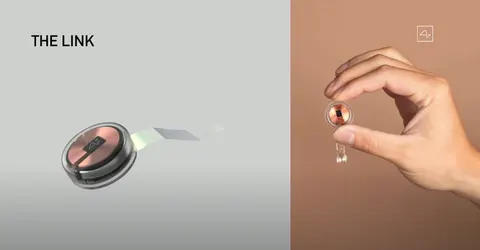
The device we will put in our heads is simply called the Link. Like the link we click to open a new page—only this page looks rather large.
The Link is the connecting piece, the centaur’s waist between the horse’s lower half and the human torso. But also a rather heavy cross to bear into the future. An interface that connects the brain to the computer while keeping them independent, so as to combine and amplify their abilities.
It already exists. So far, though, the small prototype chip has only been slipped into the heads of animals. Last year, in one of his typical media spectacles, Musk showed how Neuralink can be implanted quickly and safely in a pig’s head and then removed just as easily, all in about an hour.
The pig is the usual suspect for technologies being prepared for use on humans. We share far more biological similarities with the grunting charmers than we would like.
Two centimeters, about the size of a large coin, and some pigs become more equal than others because they can log into Facebook… No, there is time for that—the piggy Belka and Strelka of digital space, named after the Soviet dogs that orbited the Earth in 1960, showed more modest skills, though to the horror of PETA and other animal rights defenders.
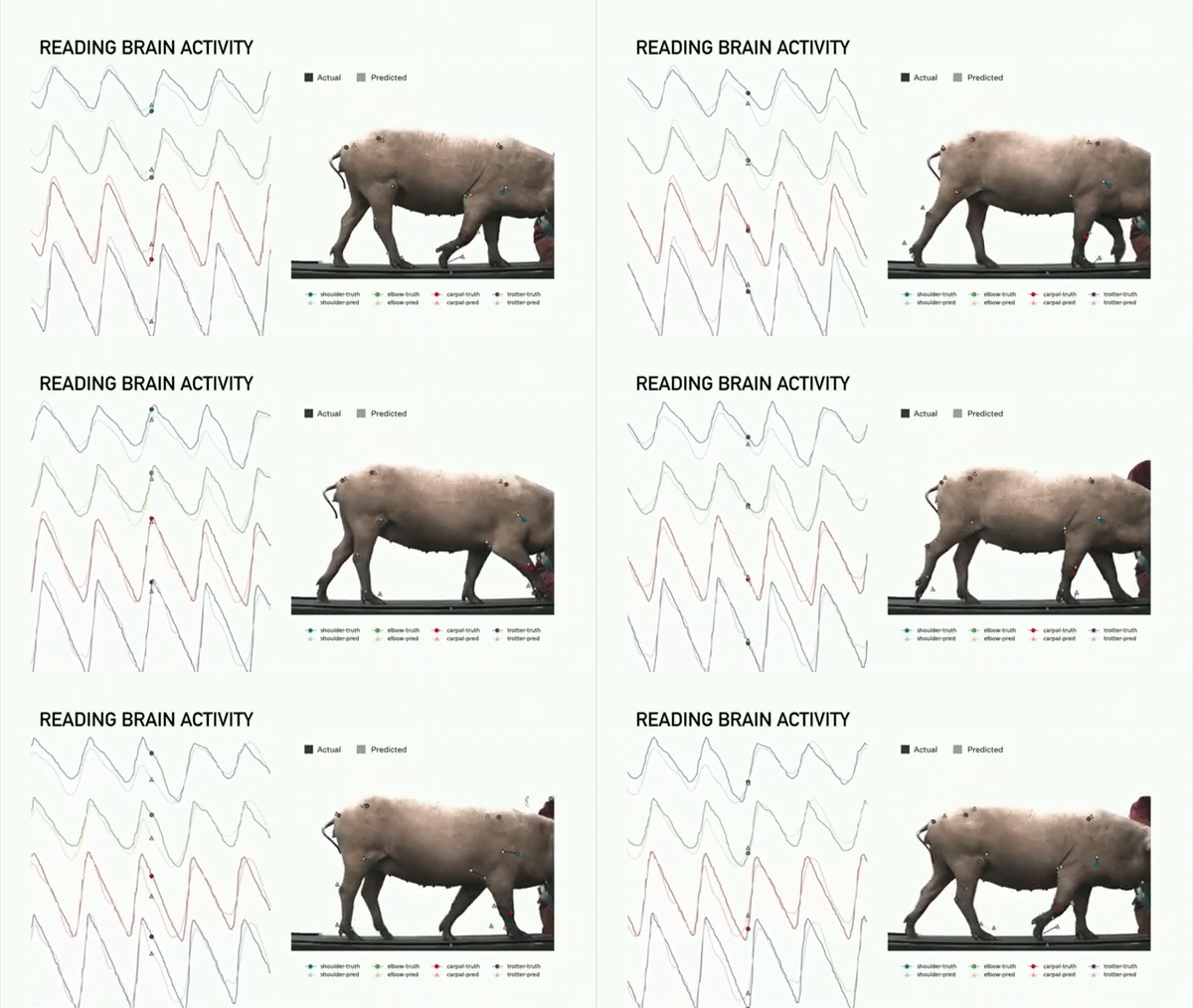
On demonstration day, three pigs ran on a treadmill and did all sorts of other tricks. We saw how the machine tracks their brain activity, with the data overlaid on a prediction of what it should be. The message: the information read by the Link is reliable.
Hard to Be a God
After the pigs came our good friends, the monkeys. On February 1 this year, Musk boasted that they had successfully put a Link into the brain of a primate, which had then learned to play video games. “This is definitely not an unhappy monkey,” Musk said in a discussion on the much-hyped social network Clubhouse. “You can’t even see where the implant is. The little animal just got a mohawk.”
A little later, on April 10, 2021, the promised video appeared, showing the game itself. At first the macaque plays with a joystick, then switches to direct control—through the signals of its brain. Nine-year-old Pager has had the Link for six weeks by then. After completing the task successfully, he gets a banana smoothie as a reward:

Musk’s plan is for the first human trial to take place this very year. The company has had approval from the US health authorities for limited studies since July 2020. The first big goal is for the chip to become a solution for severe spinal cord injuries. Even now, people who cannot control their limbs directly because of such a problem have ways to operate electronic devices with their thoughts, on the principle of neurofeedback. But this happens nowhere near perfectly enough.
“When users think about moving their arm, we will be able to decode that signal and send it to their prosthesis, which will respond like a real arm,” the company promises.
Get Chipped, Get Schooled
Then comes the defeat of a number of severe brain diseases, incurable until now, such as Alzheimer’s. Musk claims that the same will then happen with paralysis and severe visual impairment.
After that—the sky is the limit. And speaking of the sky, the similarity in name with another of Musk’s key projects, Starlink, is no coincidence at all. The satellite system aims to make the internet faster and more accessible than ever. And when the two ventures complement each other—when the chip in our brain can connect anywhere on the planet over a high-speed link to the network—the results could be impressive. Want to fly a plane? No big deal, the interface in your head “pulls” the necessary information in fractions of a second and feeds it to the brain. Fancy learning nuclear physics? Want to play the guitar like a virtuoso?
You connect over the network with a friend to hear how he is doing and… you hear his thoughts? I believe that used to be called telepathy in good old science fiction and in the skills of fakirs…
Chip? Hip!
Let’s keep going. Toward nothing more and nothing less than immortality. According to Musk, at some point, after many more steps, an interface will be developed that is perfect enough to read information from every single neuron in our brain. And by then the reverse process will also be possible—sending signals to every neuron.
Can you imagine what that means? If we trust the evolutionists, everything that we are could end up on a hard drive. And then—we could be cloned, practically become immortal.
It may sound like the very distant future, but things are moving quite fast. Although it is already five years old, the company began operating in earnest in July 2019, when it received $158 million in funding, 100 million of it from Musk. Leading neuroscience specialists from various universities were hired; today the company has more than 100 employees.
Of course, like any ambitious venture, this one does not escape serious criticism and skepticism. Quite a few scientists warn that the ambitions are excessive and unachievable, including in publications in respected journals. They call them speculation and “neuroscience theater.”
According to rumors, working in the team has been difficult too, which is hardly surprising given the character and insistence of the big boss. Today, of the eight leading scientists originally involved in the project, only three are still working on it.
Golden Thoughts
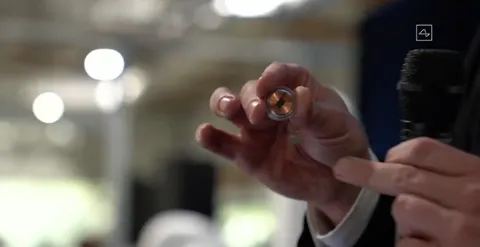
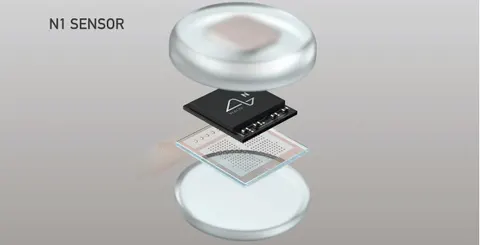
What is the Link itself? Essentially, it is just a small computer. Quite similar to… the little chip you use to open the front door of your apartment building. Yes, perhaps you never pictured it in that role. This one, however, is made of polyimide, a biocompatible material protected by a thin gold coating. This matters so that the body does not reject the implant as a foreign object.
That, by the way, turns out to be rather difficult. The environment in our brain is highly aggressive—salty and acidic—and it is not at all easy to find exactly the right materials to keep, say, the chip from rusting.
It measures 22.5 by 8 millimeters. Since it is not convenient to keep poking around in your brain with a charger, it charges wirelessly, by induction. It communicates with the outside world via Bluetooth.
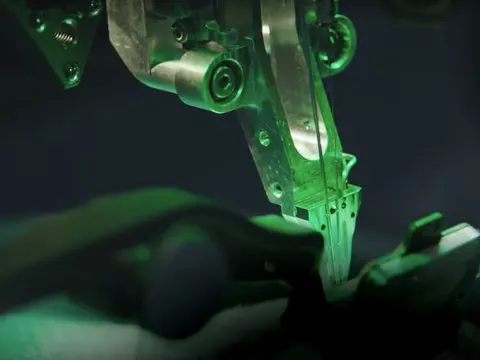
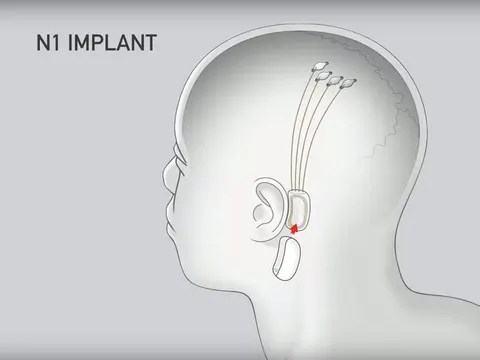
The Links will be implanted automatically, by a robot surgeon that first inserts a thin 40-nanometer needle carrying the electrodes. A 23 mm hole is drilled in the skull, slightly wider than the device, which itself stays in place where the opening was made. Since the opening is relatively small, everything is planned to happen under local anesthesia. In the morning you go to the hospital, and in the afternoon you are home with the internet in your head.
The Link’s electrodes can deliver brain signals and are equipped with sensors that pick up the neurons’ messages. Going deep into the brain are 48 or 96 tiny threads, each with 32 independent electrodes. For now they are too large to pick up the signals of an individual neuron, so they rely on the messages of whole groups.
Chipped In
This gives a total of 1,024 communication channels, gathering information from millions of neurons. That does not sound like an awful lot against the average of 86 billion neurons in each of our brains. Neurons come in different types, but broadly they have three parts. Dendrites receive the signal, the cell body processes it, and axons pass it on. The connections between axons and dendrites are called synapses, and every task our brain performs passes through them.
In any case, 1,024 channels is twice as many as all the other technologies that have so far managed to read brain activity. And it is only the first step.
Until now, a similar principle has been used in deep brain stimulation devices, which treat diseases such as Parkinson’s. But they modulate the activity of entire regions of the brain and are not designed to transfer information to and from our most important organ. They use between four and eight electrodes.
Ticket to Chip
The idea of a chip in the brain really does require us to seriously change our paradigm and worldview, our attitude toward ourselves. Pioneering projects are gradually appearing that show many people are willing to do so.
In Sweden, 4,000 people already have chips between their thumb and index finger, implanted by the company Biohax. Thanks to them, they no longer need to carry ID documents, house keys or car keys. The chips are installed under the skin by injection and can send signals even to mobile phones. The system is recognized even by the Swedish railways, which accept the chips instead of tickets.
Almost like on Sofia’s trams, right?
According to a study by Kaspersky Lab, about two-thirds of Western Europeans would accept machines in their bodies to improve their health and everyday life.
An Inch of Chip, a Yard of Trouble
Musk figuratively calls the Link “a Fitbit in your skull.” We have talked a lot about the enormous prospects he attributes to the little device. But it is only right to mention the dangers too.
Ask any cybersecurity specialist whether anyone has ever built that network-connected device which cannot be attacked and hacked. It would not be very nice to have our brains hacked one day, would it?
And that is far from the only danger; much more perfidious ones lie in wait, next to which both 1984 and the most brutal totalitarian regimes pale. In recent years, for example, it has been claimed that the Pentagon is researching how a suitable interface could be used to influence brains in order to calm aggressive crowds. And what if they were given the ability to connect directly to our brains and control them? Whether they are states, organizations or mammoth companies like today’s rulers of the internet. Without exaggeration, this could mean the end of human free will.
So whether we choose artificial intelligence as the technology of the future, or try to become part of it, questions of ethics and mechanisms of control must always come first.
Jobs.musk
If everything so far has filled you with enthusiasm… it is not too late to join the project. On February 1, Musk posted a recruitment ad on Twitter: “Please consider working at Neuralink! Short-term: solve brain/spine injuries. Long-term: human/AI symbiosis. Latter is species-level important. Work at our offices in Austin or the San Francisco Bay Area. [email protected]”
Musk also says that the number of communication channels the Link has with our brain will grow in proportion to the number of people working for the company. Sounds like quite a promising line of work…
12 Monkeys
Before we part, let us add a much more negative piece of news from February 2022. It emerged that the monkeys used in the experiments were far from as happy as Musk claimed. What is more, at least 15 of the 23 primates involved in the trials between 2017 and 2020 died “in extreme suffering.” The reason, according to the Physicians Committee for Responsible Medicine (PCRM), is that experiments were carried out before the chips had reached a stage of development advanced enough to be safe.
“Pretty much every single monkey that had implants put in their head suffered from pretty serious health effects,” says Jeremy Beckham, research advocacy director at the PCRM. “They were, to put it simply, mutilating and killing these animals.”
Still, the data date from well before the major successes and are aimed more at the ethical side of the experiments than at the future applications of the technology itself. Musk’s team left them without comment.
Link, Blink
“Well, we’re already cyborgs,” Musk reassures the worried, referring to the fact that our phones and computers are an almost inseparable part of our bodies. “I could have a Link in me right now and you wouldn’t know,” he jokes.
“We’ll be able to save and replay memories. The future is going to be weird.”
Indeed. In the end, Neuralink sounds like the next logical step in humanity’s long relationship with digital technology. Just two decades ago it was a miracle to have a phone at all that connected wirelessly to the network, and computers were massive boxes enjoyed by a handful of enthusiasts who used them to run some antediluvian game.
Then the television and the computer, with all their vastly improved functions, fit into the phone in our pocket. Gradually we began to rely on them for everything—from work to keeping in touch with friends to everyday tasks. There is no reason for the process to stop, and simply faster computers are no longer a sufficient evolutionary step.
The question is: are we ready for this? And do we know how to protect the human in the moment when we turn out to be the weaker link in this connection? The little Link is only one of the possible answers.
Published: April 2, 2021
Last updated: February 14, 2022