Where do the paths of religion and artificial intelligence cross? And those of God and social media?
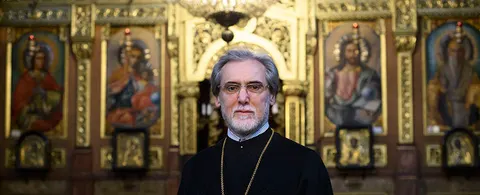
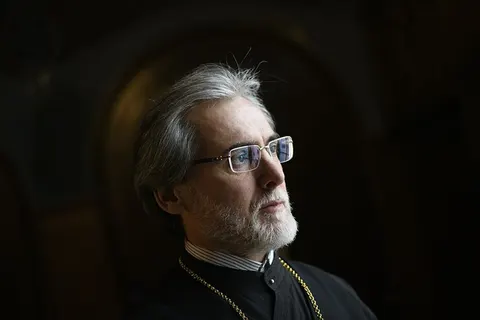
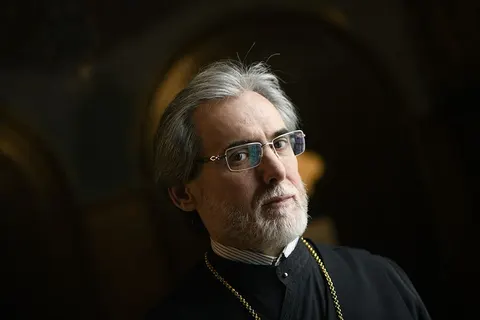
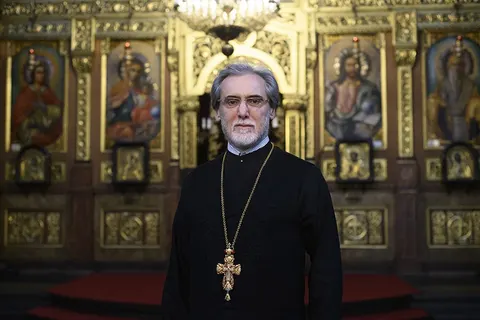
Father Nikolay Georgiev is just the right person, with a worldview broad enough to offer a meaningful perspective on the subject.
He chairs the church board of St. Nedelya, one of the oldest and best-known churches in Sofia, and until a week ago he headed the public relations department of the Holy Synod, the governing body of the Bulgarian Orthodox Church. He was ordained in 1989 by Neofit, today's Bulgarian Patriarch.
Father Nikolay was the first Orthodox priest to enter the prison system as a confessor after the fall of communism in 1989. He is the priest of the family of the last Bulgarian tsar. He is married, with two children.
We talk about Facebook and faith, and our words echo off the walls of St. Nedelya, a church that has seen so much of Bulgarian history…
– Let's start straight with the big question. Will artificial intelligence manage to catch up with and overtake human intelligence? Will it one day have a soul?
– I discuss this with a lot of people, and so far the answer has always depended on age. On nothing else: not money, not culture, not intelligence, not education, not even religion. Older people believe that artificial intelligence has certain limits it cannot go beyond. For this group, to which I belong,
artificial intelligence will always be a machine and will never be a human being. Personally, I believe it will never have a soul.
That is, the moral categories that are a product of the human soul will not be present there. Even if they are calculated, even if they are computed and built in, they will be used as the result of an algorithm, not of an emotion.
The young generation, on the contrary, believes artificial intelligence has no limits. It can develop, improve itself, reach heights beyond humanity and the human.
– As for me, since I'm somewhere between the generations, I have no answer for myself. So I prefer to look for the important questions and try to get more people asking them.
– Let me open a parenthesis here. We must treat order, nature, the planet and all our obligations in the right way. The interesting question, though, is what is right and who decides it. The development of something a human has created is inevitable. A human cannot surpass his Creator; he can become like God, and that is one of our purposes on Earth. To become godlike, to become as good as possible and almost as perfect as the Lord.
I believe that in the same way, a human creation cannot surpass its creator.
Different points of view. That is what I think; some say it's because it's easier for me. Perhaps, but I consider myself bold in my reflections, and as far as I have been able to go, that is how high my bell tower reaches, that is how far I can see ahead.
– In the end, though, into a creation that will resemble us quite a lot we will have to build some moral categories as well. Especially at a certain point, once its decisions start to grow more and more complex.
– Today there is a war in Ukraine. And for some people the black and white is very clear: there is an aggressor, a dictator. Others say: oh no, it's because America provoked him, we made him what he is.
Values and morals are getting blurred. So who is going to create the moral categories for the machine?
That is what frightens me. If Hitler created the moral categories of artificial intelligence, they would differ from what Einstein would put in. Or one of the great composers: Mozart, Bach, or Bach's favorite composer, whom I love listening to—Couperin. What would his moral categories be?
In any case, I don't believe humanity will come together and set up a commission to define the moral categories of artificial intelligence.
For us it's easy: the Lord gave the Ten Commandments. They are perfect.
One of the marks of their perfection is that they always protect the weaker.
They don't simply strip rights from the stronger, the more capable, the bigger, but they protect. Thou shalt not steal, thou shalt not covet anything that is thy neighbor's. The category “thou shalt not covet,” I think, artificial intelligence will never be able to grasp.
– Still, there ought to be some form of regulation. At least for certain red lines that must not be crossed.
– It's good that these conversations are happening; it has to be settled one way or another. Let us remember Isaac Asimov and his Three Laws of Robotics and develop them further, but not only in the labs that program artificial intelligence.
Artists, for example, matter. You can build a perfect, agile robot. But will it dance like a wonderful ballerina? I have seen robotic hands playing instruments, but I will always recognize a human performance. At least for now, in 2022; maybe by 2033 it will be different.
These categories—soul, soulfulness, desire—cannot be reached. And one more thing:
artificial intelligence will never be able to reach the category of readiness for sacrifice and self-sacrifice.
That is a typically human trait, a product of love for someone, for one's children, for one's homeland. To give your life, to lay down your soul for your neighbor. There is no way artificial intelligence can do that, because part of its very being is to exist.
Otherwise, this conversation has been going on since the days of Fyut, the little devil of children's tales, whenever human imagination crosses certain boundaries. Note this:
stories about devils are exactly as rich in detail as humanity is advanced in its technology.
When electricity appears, the devil starts acquiring such powers. After the first flights beyond Earth, he flies too. In other words, humanity's notion of evil somehow keeps pace with its level of technology.
– Do faith and religion, with their thousands of years of experience, have a place in such a discussion?
– Yes. Faith is one thing; practice, religiosity, is another. Religion means the bond between a human being and God. It is the feeling that connects me with my Creator, with my heavenly Father. He loves me, as a result of that love He blesses me, and I thank Him. In the cycle of this goodness, of this grace, I have my own personal life of grace and my own morality.
But let me try to speak from another angle. Slaves. The idea of artificial intelligence, of perfect machines and robots, is for someone to do our work—whether to ease human labor or to serve us. It is as if slavery as a phenomenon is meant to be replaced by a number of robots doing the hard tasks. So that people don't suffer that way, and probably so that they fight wars for us too.
But the notion of slavery is described; we have moral categories and very precise prescriptions in the Bible. And all of them are humane, protecting that position. The master must feed his slave, treat him as a human being, give him work, a place in life. In the Bible, slavery is not a bad category. If we think of robots as our servants, we come up against yet another moral question.
A free man dreams of freedom, and a slave dreams of slaves of his own.
If I am a free man creating the algorithms of artificial intelligence, I will probably try to make it free as well. But if I have the mind of a slave, I will make it obey me. Dress right, attention, end of story.
– You mentioned art. Do you think algorithms will one day truly create?
– Say I have a music algorithm. What happens if I tell it: “You were created… or should I say she—you see, even the notion of gender gets lost—you were created for this. Play me something beautiful!” And it will ask what beautiful is.
The notion of beauty changes even among people—just look at fashion. Sooner or later we will return to Michelangelo's David, but until then, the big earrings, the tattoos, the bodybuilders with their body proportions… What is beautiful to people today, and who will write the algorithm for beauty?
That's why I think the process of creating artificial intelligence, if it doesn't get out of hand, will be difficult, because we have no consensus on many categories. On the other hand,
I am always for freedom. And just as it has led to the endless development of art and science, technology will probably contribute a great deal to humanity's well-being.
At least I hope so. As long as sick minds don't use it to destroy.
– Do today's technologies, social media, online communication, draw us away from God and from faith?
– It depends on the person. Just as in the seventeenth century someone could fulfill his moral, ethical, religious and family duties without being distracted by anything that made daily life easier, he would do the same today. If someone on social media can control himself and give it, say, an hour a day, it's a matter of discipline.
I don't think their mere existence is a cause for separation from God. On the contrary, there are wise clergymen who use social media for preaching,
and foolish ones who use it to show off some personal religiosity—not preaching, just the empty banging of a drum. But if my inner measure can tell me: give this much time a day to that, this much to prayer, to self-improvement, to charity, then technology will only do me good.
I love technology. I use all of it that my wits can reach. There are some I can't use, but I think that's my shortcoming, not a shortcoming of their existence. Abuse does not cancel use. The fact that a person can be killed with a big knife doesn't mean we should ban kitchen knives. You understand me.
I have never worried that my children would abuse the technology available to them; they went from the gramophone through the first computers all the way to today. They handle today's technology perfectly, yet they have kept their own moral character. Their face is their real physical and moral face, not an avatar hidden behind some daydreams. For me, life is real when I can take part in it with the senses God has given me. That other thing is not the same. It resembles it a lot, but it's not the same.
– Except that it will resemble it more and more, and make it ever harder for people to stay close to themselves.
– Let me go back to the point that God's commandments were made for the weak. How much can we expect a person to withstand that temptation—to be shown a reality so similar to ours that it can't be told apart? Then those people will bear responsibility, because the Lord says: “Woe to him who leads astray one of these little ones.” They may be little in years, in strength, in reason, in means. Who will bear that responsibility?
I would not judge a person who lives more in virtual reality. I would even say that we, as spiritual shepherds, ought to try to speak about this in our sermons too. It still seems a little strange to me, ahead of its time, but maybe I'm wrong, maybe someone somewhere is already suffering from it. He'll come and say: “Father, I'm lost. I had to leave the virtual world to eat, but otherwise I feel good there, I like it there, that's where I belong. Here they lie to me, there are wars, problems, while there I feel fine. There I am who I am.”
Where, then, is the moral judgment of the one who created that temptation? It's a trap. Someone might say it isn't, purely technologically. And it is a technological achievement, but one with moral consequences. I keep coming back to that—to moral principles and consequences.
I would never replace live human contact in any way.
Today we talk online on our phones, via FaceTime, Skype, Zoom, wherever we are. There are even people who drink together online, saying “Cheers!” to the other side of the world. But that is not live communication, it's not the same. We can still look each other in the eye, but it's not the same. Live communication is different. We can only imitate it very closely.
– Do you think some future saint has a Facebook profile right now?
– Yes. Yes, because I know people who have been canonized as saints. From my own generation, and not just one or two. I am sixty now, and I have had the chance to meet, even briefly, people who were canonized over the last thirty or forty years. So why not? A person who is good, who meets all those wonderful expectations of holiness—why shouldn't he have a Facebook profile? It would even be a good thing.
– What kind of people choose to become monks today?
– The same kind who always have; it's a calling. Monasticism is a withdrawal from the world, even a withdrawal from technology. Let's say without a phone, very moderately, but from this world as we know it. It is solitude, labor and prayer.
It has always been so, and monasticism will always keep this rhythm of life. I don't know whether that means monks will be further from understanding these advanced technologies, or whether the people who use them will be just as close to their spiritual elders, the monks. They will certainly be close, because the moral categories remain—do not lie, do not steal.
– And what kind of people become priests?
– Again, it's a matter of calling. I'm not talking about those who treat it as a trade; there are all kinds. I'm talking about the best possible kind. Again it's a matter of dedication, of self-denial. We priests might very much like to go about more freely, even to wear more modern, more comfortable clothes. But we can't; it's a tradition we must preserve.
The bar has been set high. If we can't reach it, let us at least not lower it. “Do not do to others what you would not want done to yourself,” says the Old Testament. Christ turns the paradigm around and says: “Do to others what you would have them do to you.” That is: be good, lend a hand, a shoulder, a kind word, advice… Be good! It's getting harder and harder.
One of the reasons is the blurring of moral categories. Today, who is good: the one who supports the war or the one who supports peace? The one who supports freedom and the right to choose, or the one who says someone can play policeman to the world? I don't think so, but that puts me at odds with people I was close to a week ago.
Suddenly it turned out that black and white are not so clearly defined. There's always some “because,” some explanation.
That's why the choice of monks will remain the same as it has been for all the centuries until now, and that of priests—with a few more conditions, but still a kind of deprivation and self-sacrifice. In the hope that with us, the moral categories are precise and clear. But also with the help of technology.
– But these technical tools have made such rifts even deeper. They push us toward aggression, toward extremes, toward an inability to hold a normal, reasoned conversation instead of cheering for our side. They also cut the ties between people.
– The Bible says: “A good man out of the good treasure of his heart bringeth forth that which is good.” If we bring forth the good we have inside us, we will always speak the same language. In the realm of the good there is no disagreement, and even if there is, it's only about the definition. About whom to help and with what, not about whether and why. I'm sure the people offering humanitarian aid right now don't ask who is who.
– But aren't the nuances lost?
– They get lost even without technology. If we say that the enormous amount of information reaching us thanks to technology confuses us, I'll again raise the subject of those moral pillars that must exist, including the church. Although it has never stopped being that same moral pillar. Jesus Christ is the same yesterday, today and forever. The moral categories of the church will always remain what they were two thousand years ago. The question is with what eyes we look at them.
There are already people reviling me for my position. For now my soul is at peace. Of course it's unpleasant, but I don't flare up, I don't get worked up. And if tomorrow I lose my temper, will it be because of technology? No, it will be because of my own personal inability to be good.
– But technology pushes it to the forefront, because that's how it profits; its algorithms are designed to provoke extreme emotions in us.
– A thesis defended on social media doesn't carry much weight. There, anyone can revile more boldly. That's exactly why I'm convinced that personal contact will always remain. When I look a person in the eye, I think I try harder not to be nasty, to weigh my words. I'll try to bring an argument to the discussion, not an emotion. Not to tell him, “You're stupid,” but to set out my view and, if he's smarter, let him refute it.
That's how it is face to face. Not that people don't fight, but hidden behind a keyboard we more boldly say words meant to insult, to hurt others, to punish them. That is not love, but I don't think technology is the cause either. Just as for bad driving I would blame the device behind the wheel, so here—the device behind the keyboard.
– The church in Bulgaria today doesn't have the public influence it has had through almost all of our history. What would it take for it to regain it?
– You speak of the church as an institution run by some elite that decides things. Let's say my parish is in the center of Sofia—my parish is as big as the people around me are moral, and I have no need for influence.
The church has no need for influence. What it needs is to be a lighthouse in the darkness
and always to point to Christ and His moral commandments. There is no other need for influence, and woe to churchmen who use their positions for influence. That's why I find the expectations strange, and the question “what will the church say about vaccines?” We can say nothing; we're not doctors.
– Yes, but you influence a great many people through your opinion.
– My opinion is what I have received from the Bible. I don't create it now with regard to one moral dilemma or another. I simply have to adapt my wealth of words to the ears of those listening, so that they grasp what Christ says on the matter.
The church's influence extends only so far as not to lose the preaching of Christ. That is the most important thing, and we do it; that's why we exist. If we take the body and blood of Christ out of the liturgy, that's it, the church is finished. Even the memory of it will disappear.
The church's influence is a paradigm I find strange. It comes from expectations. Something like: the Bulgarian Patriarch will come out and say, “Get vaccinated.” When the health minister goes on television and says, “Bulgarians, go to church,” then the Patriarch might do it. Let each of us stay in our place and do what we can.
Not that we don't have half-educated clergymen who bang the drum and hand out advice on anything and everything from their position. But let us look at what the Holy Synod does. There is a great deal of preaching in the Synod's silence, too. Not taking a stand on some important issues, not voicing an opinion, is very important. It doesn't come from dullness—we have things to say—but silence is a more important sign, so that we can do what we can.