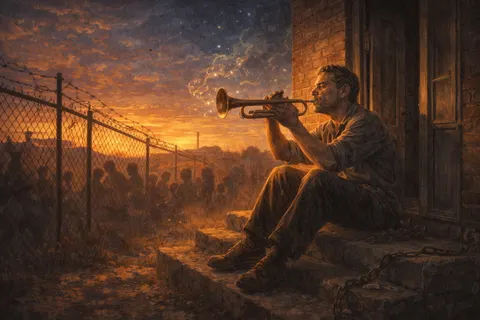
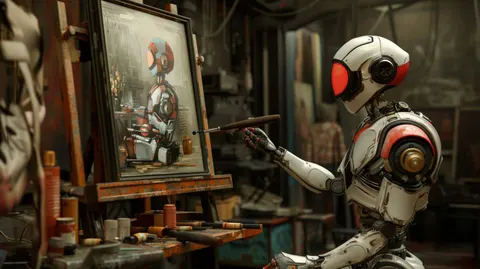
So here is Márquez, alive again, back in his prime, only working millions of times faster. We get book after book, after book… A dream come true. And if long sentences aren't your thing, or literature at all, just replay the same example with Salinger, Dostoevsky or Debelyanov, the Bulgarian poet who died in the First World War. Or with Freddie Mercury, Bach or Van Gogh.
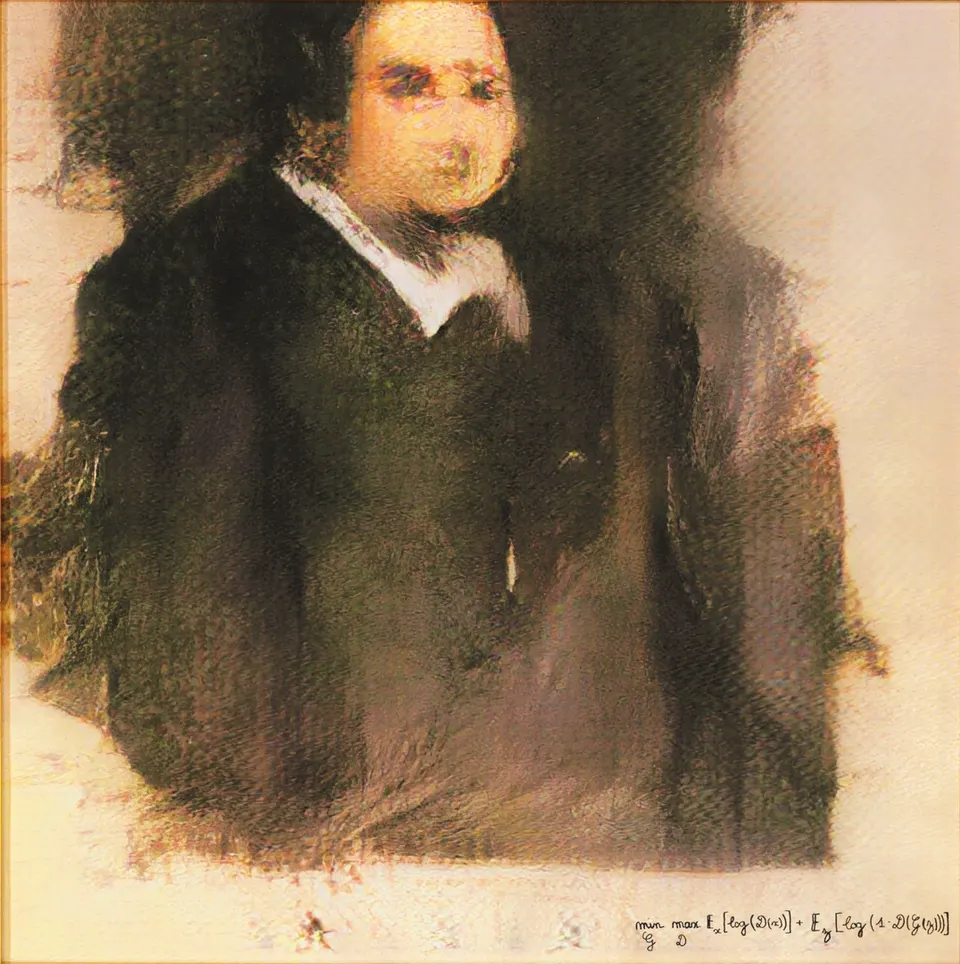
On October 24, 2018, at Christie's auction house in New York, bidding opened for a slightly strange (even by the standards of modern art) portrait of one Edmond de Belamy. The expected price was $7,000 to $10,000, but the contest heated up. Collectors threw themselves into a fierce bidding war until the most stubborn of them finally shut out the competition with an offer of $432,500!
Frankly, if you saw the painting, you probably wouldn't take it even for free to grace your cozy dining room. It shows a peculiar portrait of a man whose face looks as if someone had wiped it away by mistake with a wet rag. We would let the artist himself explain what he had in mind, but that won't work. Because he doesn't even have a name. He isn't a person, but a computer program.
The Creation as Creator
Is it mostly a marketing trick, or will artificial intelligence soon paint like a master? Can we teach a computer program to create music, or literature?
For a long time we were certain that this is one of the things that set people apart from machines—the lack of imagination, of artistry, of the ability to express oneself through art. But is that really so?
The creator of the technology that in turn created Belamy was Robbie Barrat, then 19 years old. He showed his project online, and another group of programmers—Obvious—took a more pragmatic approach and, with small changes, built the particular program that daubed the charming-in-his-own-way Edmond de Belamy.
There are attempts to make computers create in every art. In 2017, a piece of software wrote a sequel to Harry Potter, and lately some very convincing electronic composers have appeared. Arguments are starting over who the creator is in such cases—the computer or its maker—and, accordingly, who deserves the copyright. Such arguments flared up after the Edmond de Belamy story, too.
Sometimes the machine and the human complement each other. The American singer Taryn Southern released her album I AM AI, composed and produced entirely by software.

Artful
And what would you say to… a new Nirvana song? Yes, Kurt Cobain has long been gone, but an artificial intelligence tried to “step into his shoes” right on an anniversary in April 2021. The Over the Bridge project used Google's AI platform Magenta, which was “fed” a great many of the band's songs. The algorithm analyzed the vocals, the chords, each of the instrumental parts separately. The result is an entirely original song in which the only human contribution is the voice—a singer named Eric Hogan. But here, listen to Drowned in the Sun for yourself:

Computers are relieving us of more and more human tasks. We're not talking here about being better at assembling cars. They already remember for us. And not just phone numbers or birthdays: they keep our memories of the most important moments. They know where we're going, and soon they'll be driving our cars on their own. They are on their way to “steal the bread” of journalists. So why not give them the right to create as well?
And are they capable of it?
Computers can already learn from what they see, accumulate knowledge and analyze. It's clear they are better than humans at chess; those spectacular tournaments are a thing of the past. In 2016 the last fortress fell, too—AlphaGo defeated Lee Sedol. The software challenger made short work of the human, the undisputed champion of Go. This is an ancient Eastern game with far more possible combinations than chess, and, according to the people who play it, it demands a fair amount of intuition and tactics.
In one of the games, on its 37th move, AlphaGo made an unusual play. “It wasn't a human move. I've never seen a human play this move,” Sedol said later. “But it was beautiful…”
The Art Critic
A man from an entirely different trade had a similar experience—Reeps One, the first beatboxer to go into battle with an artificial intelligence. And he won convincingly. (If you meet him, don't tell him about all the defeats computers suffered at Go and chess before the tables turned. Slowly, bit by bit. But irreversibly.)
His opponent tries to imitate him. It learns from him, improves and… loses.
And as a result, as a gift, Mr. One receives the analysis his rival made during the contest. “I was blown away when they told me that in ten minutes of performance I'd produced 140 drum-like sounds. Far more than I could ever perceive as a human,” he says. In other words, instead of replacing them, artificial intelligence could help musicians, and other people in the arts, by helping them learn more about their skills and develop them.
The Artificer
It would be really cool to teach computers to make art! If we could load George R. R. Martin, the author of Game of Thrones, into software, we wouldn't be waiting eight years for the next volume of the series, let alone having to resign ourselves to the bland ending served up by his bungling successors in the screenplay.
What does every writer wonder? Whether you'll find it interesting. And… surprise! That's exactly what Facebook wonders! And Instagram, and even Google. If we accept that electronic “journalists” are already here, along with algorithms that know how to show you the most curious, the most important, the most interesting, does the same apply to writers?
It's clear that today art (in its professional forms, not as a personal pleasure) is driven to a very large degree by what the audience is looking for.
Artificial intelligence is still subordinate to us. It doesn't carry within it the complex link between imagination, abstract thinking and episodic memory that, according to scientists, produces creativity.
Sooner or later we were bound to get here. In fact, everything on this subject comes down to the question of what creativity and art are—a natural product of logical thinking, or… magic. The answer depends mostly on whom you ask. I, for one, vote for the second, without having enough arguments to convince you. But according to the historian Yuval Noah Harari, so much talked about in recent years, “humans are essentially a collection of biological algorithms shaped by millions of years of evolution.” That is, everything they do is also the result of those algorithms. And an even weightier argument against the second view is this: if we can create art as magic… we can probably create another magic that reproduces it.
I Want Art
Machine learning through neural networks is a hot field in computer science. Its basic idea is that computers can learn by passing information through their many artificial neurons. They are fed huge volumes of data related to their main and only “profession.” If the software is a painter, it is given works of art to study carefully, selected logically—for example, only Renaissance painting.
Because of all this, it is entirely possible for a neural network to study Monet's style with astonishing precision and even produce a painting by the Impressionist that looks exactly like his, but that won't be creativity. And does that actually matter, once we have a wonderful work of art?
In recent years these kinds of technologies have made serious breakthroughs in many fields. For example, they are getting better and better at finding traces of tumors on X-rays. They can even successfully “catch” fake news. But when it comes to creativity, is it enough to read a few thousand books and analyze them to extract the essence? Is synthesis enough, or is something more needed? We're used to thinking that you also need a bit of intuition, empathy, metaphorical thinking. On its own, artificial intelligence has nothing resembling taste and cannot judge which work has value, yet in many arts, such as film, people are already practically helpless without it.
“Who would have believed just a few years ago that we would be able to get a computer to tell what is cancer and what isn't,” says Arvind Krishna, director of IBM Research. “I think teaching AI what is melodic and beautiful is a different challenge, because it's much more subjective. But it can be done. You can always give the computer a large amount of data and tell it: ‘I think this is beautiful, and this isn't.’ And even though the sense of beauty will vary from person to person, I believe AI will be able to cover a large part of it.”
Temptation
There is hardly an author who hasn't read a single book, who hasn't been influenced by what they read and synthesized it in some way. Besides, sometimes the power of art itself is that it simply conveys—without effects and without artistic embellishment. Here is a field computers could fit into right away.
We have had to change our attitudes more than once already. The aforementioned chess and Go, countless medical applications, machine translation, even software successfully filtering the spam in our mailboxes—all of these we take for granted today, and just two or three decades ago they were pure science fiction.
So philosophizing isn't enough. What remains is to look at more examples and search for clues.
Since we've already mentioned film as one of the arts most transformed by technology (along with photography), let's take a peek there. In 2016, perhaps the most famous artificial intelligence—IBM's Watson project—became the first to create a movie trailer on its own. To prepare the video for the horror film Morgan, the supercomputer analyzed the sound, images and scripts of thousands of films in the genre. Then it examined the scenes of the movie itself and stitched them together so successfully that the filmmakers never quite believed the trailer was the work of a robot.
Hieronymus Comp
The visual arts are a rather conservative milieu, and perhaps that's why the Edmond de Belamy case attracted serious media attention around the world. And it isn't the only one.
In March 2019, the German artist Mario Klingemann presented an exhibition distinguished by its infinity. With the help of programmers, he created an artificial intelligence that paints portraits of people who have never existed. Just as well, because, between us, most of them look rather frightening. But not all: sometimes the software produces surprisingly good hits.

Klingemann trained the artificial intelligence on 15,000 portraits painted by people in different periods. During the exhibition the new people are created in real time, shown on the screen for a few seconds and then vanish forever.
The portraits are created using a technology called a generative adversarial network (GAN), in which two neural networks work in parallel. The first, the generator, tries to generalize and copy the information, while the second, the discriminator, tries to tell the new information apart from what was fed in; it hunts for what's unconvincing, for the mistake. The generated images pass from the first network to the second and back again many times, until the discriminator can no longer tell the difference between the fake portrait and a real one. The idea is that in this way the artificial intelligence develops criteria of its own and learns to choose carefully what it will give us. And… perhaps it edges closer to “creativity.”
“Humans are not original,” says Klingemann. “We just reinvent, we make connections between things we have seen. While we can only recreate what we have seen or what others created before us, machines can create literally out of nothing.” The artist says he loves most the moments when the machines manage to outsmart the system and do something that even their human creators never anticipated.
Compsy
Here's another brand-new and interesting example. $688,888—that's what a rather… artistic 12-second clip sold for in March 2021. It was a joint effort by the rather well-known robot (robotess?!) Sophia and the Italian artist Andrea Bonaceto. Various earlier works by the painter, known for his colorful portraits, were fed into the AI's algorithm so it could try to create its own portrait based on the Italian's style. The result is among the pioneering works sold as a non-fungible token, or NFT. The concept rests on blockchain technology, and we'll tell you more about it soon; it isn't the topic of today's meeting. Either way, those nearly 700,000 dollars were paid for the following clip:
Robot Pavlovich Chekhov
“Our transcendence is touching, a society of stars cannot be a secret.”
What the author meant by these lines, once again, there's no way for them to tell us. You guessed it: a computer wrote them. PoemPortraits is a Google project that, given a word, generates a verse using its neural network, trained on 20 million lines of 19th-century English poetry. You can play with it. Some of the verses certainly sound pretty good, although it can be lazy and, given the same word, will return the same result.
But poetry, especially free verse, seems easier to pull off with a little help from chance. If you ask me, it would be even easier to build a robot literary critic and let it loose on Facebook. Things are much harder for our artificial colleagues in prose.
The Day a Computer Writes a Novel is a story about an artificial intelligence that abandons its duties to humanity after suddenly discovering it has literary talent. It was written by a computer in 2016, assisted by its creators—Japanese scientists from Future University Hakodate. The work was entered in the Hoshi Shinichi Award, one of Japan's most hotly contested short-story competitions, and even made it past the first round. The next year it became a fad, and of 1,450 entrants, 11 were no longer exactly human. The organizers decided not to reveal to the jury who was what, but the pioneer's success hasn't been repeated so far—the “artificial” stories have since stayed outside the winners' list.
AI Petrov
We should also note that the author of The Day… wasn't entirely honest: the protagonist's gender and the plot were devised and supplied by the scientists, along with a fairly detailed vocabulary of words, phrases and even whole sentences with which to assemble the story. “The protagonist didn't develop much over the story, but the text was well structured,” says Satoshi Hase, a writer on the jury.
And what if such a project really succeeds? Won't today's literature, already battered quite a bit by modern technology, be completely devalued if we have authors who can write wonderful texts, and at a speed of thousands of pages per second?
The Japanese software got a lot of help from its creators, but there are some quite good ideas running the other way, too. Nearly all writers complain that they have no good idea for their next book, that they're blocked, that they don't know how to continue the story. That's when the computer can come to the rescue, chipping in with ideas even without a particularly sophisticated artificial intelligence. Kevin Crockett of the Australian National University created an interesting piece of pioneering software. You enter part of your story, describing the main characters, and the program takes care of giving you various ideas about what happens next and how.
Once we turn our gaze around again, why shouldn't our friend replace the so-called literary ghostwriters? Many of today's best-known writers don't actually write all that much; they simply come up with ideas that are then fleshed out by their lesser-known colleagues, sometimes credited, other times left in the shadows. Today a large share of the journalistic content at the world's leading news agencies is created not by people. Couldn't this be one more way for human creativity and computer stamina to complement each other?
Software Amadeus Mozart
We've saved music for dessert, where interesting things involving artificial intelligence are also happening. Back in 2015, a study was done in which more than half of the participants could not correctly tell which music was composed by Johann Sebastian Bach and which by a special piece of software.
You can try for yourself how AIVA works—software that composes music for films and commercials and scores computer games. All it takes is setting the key parameters: the style you're after, the emotions and mood you want to evoke. It can start from scratch or rework a piece you pick for your purposes. The list of satisfied clients features the names of global companies.
In 2016, scientists at Sony's research lab developed software that creates a melody in the style of the Beatles. The composer Benoît Carré finished the song, which is called “Daddy's Car.”

Let's say the algorithm has found it. That thing, the most important thing, that turns generated text or music into art. You have 100 new Beatles songs, 10 bloody Shakespeare tragedies, at least as many 1,000-page works by George R. R. Martin, all in the time it took your computer to boot up ten years ago. Won't that change everything all over again?
Zen and the Art of Art
I was in the kitchen, wondering why my two-year-old son had gone quiet at the other end of the room. When I looked at him, he was absorbed, methodically and diligently picking little sticky bits off the label of an 11-liter bottle of mineral water and sticking them back on—up and down. “Daddy, drawing,” he explained to me, and although his work hardly stood a chance of fetching as much money as Monsieur de Belamy, daubed by artificial intelligence, it struck me as considerably better.
I also remembered all those moments when I myself had sat in front of the blank screen (once a sheet of paper) wondering how to make it mean something. Art is creation, but it is also emotion. Will we ever teach the human embodied in the machine to do it better than we do? I believe it's possible. But only once we also teach it that particle of emotion, spontaneity, sincerity, sharing, meaning. The spark that turns a drawing into a painting and a book into an adventure. Are we capable of it? Perhaps, as long as we ourselves don't forget what the secret is, absorbed in the magic of technology…
Published: Dir.bg, August 6, 2019
Last updated: April 26, 2021