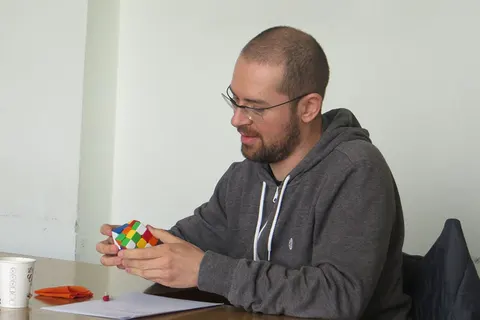
A cooperative with no bosses and no subordinates, no working hours and no salaries. And yet the work gets done, and the income is distributed by a fair algorithm. Is this a utopia or the near future?
Todor Kolev is a programmer with vast experience, an entrepreneur, and a mentor to remarkable young talents in information technology. But he is also a man with his own, deeply curious view not only of technology but of how we are evolving as a civilization.
He grew up in Karlovo, a small town in central Bulgaria, and from an early age competed in informatics olympiads, regularly finishing among the winners. For the past 15 years he has headed Obecto, a boutique software company that works with startups from all over the world.
The future that arrives with technological progress is what excites him more than anything else. For several years he immersed himself in cognitive psychotherapy, and then in… theology.
Are we ready for the next step in evolution that technology is bringing? Why don't we think about the enormous challenges ahead? How is the future leading us toward ever more decentralized solutions? Today's economic model is gasping for breath under the challenges of our time, but what is coming after the end of capitalism?
– You say we shouldn't be a cog in the system but an engine. That people are not executors but creators. That the world is changing and we are not ready for what is coming. What kind of times are we living in?
– In recent years I've been disappointed that people don't see the world they live in. There is some kind of
smoke screen that keeps them hypnotized, tossed back and forth by the mainstream media,
so that they don't notice what is happening to them. 2014 was a real turning point for me. I've always been curious, but until then I'd been buried in business, and I told myself: “It's time to find out where the world is heading. I'll read every book I can, watch every film, to see what awaits us in the coming years.”
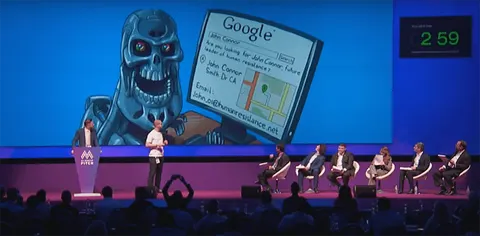
That's how I learned about Ray Kurzweil's theory of exponential development. He has a list of technological predictions going back to the 1980s that have come true, and they keep coming true now—technology grows exponentially. For 2045 he predicts the singularity, the moment when artificial intelligence becomes uncontrollable. At first he said that by 2029 we would have computing power equal to one human brain; later he revised that forecast to 2023.
Since then I've been waiting for 2023… and last December ChatGPT came out and caused a huge sensation. It is based on the GPT-3.5 algorithm with 175 billion parameters. In 2023 we're expecting GPT-4, which, according to unofficial statements, will have 100 trillion—more than the number of neurons in the human brain. By all appearances, we really are going to cross that line.
– Yes, we're expecting quite interesting things from GPT-4, although it seems the parameters will be more modest, and that is turning out not to be such an important measure after all. But then again, speaking of the singularity… Kurzweil will be proven right once more. What does that change?
– Here's an example. We work on intelligent assistants, dialogue systems aimed at specific tasks, and we have a commercial project for voice bots. We're developing them together with another large software company, which will sell them.
If it works, call center employees become redundant.
There's a very mistaken popular belief: people think artificial intelligence will replace construction workers. I recently had some renovation done, and it won't replace them in a thousand years—all that hammering, swearing and figuring out the knack of things is not something AI will fix. It will replace the wise guys in the offices—
from call center staff to incompetent programmers, unemployment looms over them in the next few years.
And this is only the beginning. But there's an instinct that makes people say en masse: “I can do more than this AI.” “Oh, but ChatGPT makes mistakes!” Yes, as if you don't make mistakes! Except its growth is exponential. Next year people won't be twice as good, but artificial intelligence will be.
Here's where the problem comes in:
people equate the meaning of their lives with carrying out tasks.
A huge mistake! And the fact that AI is starting to carry out tasks as well as they do really stresses them out. They start to wonder: what's the point of me? And the answer is: none. As long as you are something that carries out tasks, believe me, there will always be a technology that carries them out better than you. But humans have one quality that I have no idea how AI could acquire: having a goal, the desire to achieve it. And that goal isn't to fill your little quota, collect your little paycheck and live your little life, but something beyond that.
– But creators seem always to have been a minority, whether in the broader or the narrower sense.
– In theology there's a thesis that man has been touched by God. Think of the image of the Creation, where God stretches out his hand to touch him, and man does too, but his finger is slightly bent. He has to make an effort, he has to want it.
Being touched by God means that man is a creator by nature.
If we don't fulfill our role as creators, we become a biomass that may truly be superfluous in its present volume.
That's what world politics is telling us. We are entering turbulent times, in which it seems nothing good awaits the middle class and most of the population. Pandemics, wars, inflation, food shortages. At the same time, the world's elite seems to have no interest in fixing the problem. If it does anything at all, it's more like pouring oil on the fire—take the war in Ukraine.
People in the past had a stronger sense of creating. When you live in a village, nature is right in front of you and it knocks you around, so you start looking for ways to cope with life without following recipes. Today's society lives in an artificial environment created in the twentieth century, with a centralized economy and a hierarchy of bosses and workers.
A few years ago I believed people could understand all this. That's why I set up a cooperative—to do something, to show that it's possible. To work together, to have a goal, and for that goal not to be collecting a paycheck and getting your job done, but something beyond the norm, beyond what is familiar.
Unfortunately, over the past five or six years I've realized that this is a chimera and most people aren't interested in these things. The masses may have been touched by God, but they've forgotten it and don't want to stretch out their little finger. The situation is rather hopeless.
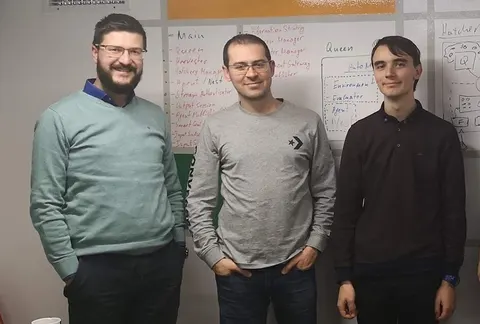
– You mentioned the cooperative you founded. It's quite an unusual venture—an organization with no employees and no bosses, no salaries, where everyone receives what they've earned through their work. How did things turn out?
– Yes, that's Comrade Cooperative—an experiment we started in 2017 based on the ideas and concepts I'd been telling the others about. I have this problem: people very quickly get carried away by what I say and want to join in, but they don't always understand what I mean.
Many came to work—they thought it was a startup, an ordinary company. I'd sit there explaining that the idea was an organization nobody owns, one that belongs to everyone and at the same time to no one, autonomous, cooperative, and they'd come to be on a salary. It really annoyed me that everyone expected me to lead, when my goal was exactly the opposite—to take part in an organization where we share a common goal and nobody is the “savior” leader.
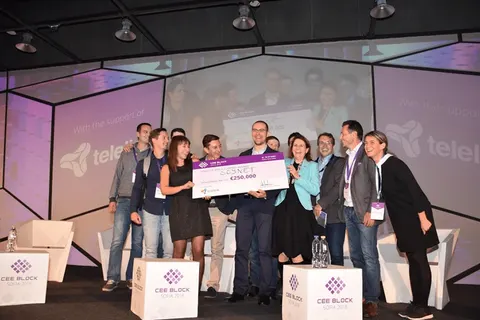
We attracted a total of about €400,000 in investment, which was impressive—and in return the investors didn't even get equity, because we're a cooperative, not a company. We spent some of the money and did projects with good ideas behind them, but people saw them as a job, not a cause. In 2019 we decided to freeze the cooperative, but there was money left, and soon afterward new like-minded people began to appear and the idea was revived.
– What are you working on now?
– Together with two of my colleagues from Obecto—Branimir and Bozhidar—we decided to build something that is an entirely new concept for a blockchain network. It's called Apocryph, and we're developing it within the cooperative, because one day we want a decentralized autonomous organization, not a company, to stand behind the project. We've been working on it for three years, and the concept is getting clearer and clearer. One of my dreams has also come true—someone else has become chairman of the cooperative; now it's Bozhidar.
The aim of Apocryph is to become a decentralized cloud, where you can upload applications just as in other clouds, but they don't run on a single machine or cluster—they run on an entire network.
We're building Apocryph piece by piece, with the idea of assembling the pieces at the end. We work like a true blockchain project, the way Ethereum once was. Later all sorts of charlatans showed up, but that was its idea—an open-source network that is uncensorable and unstoppable.
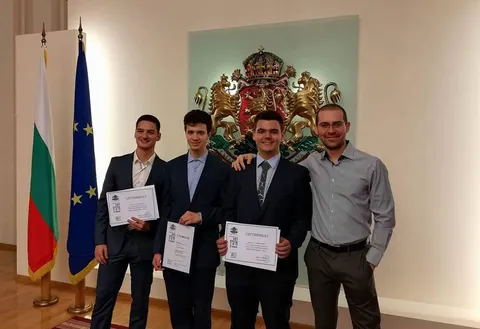
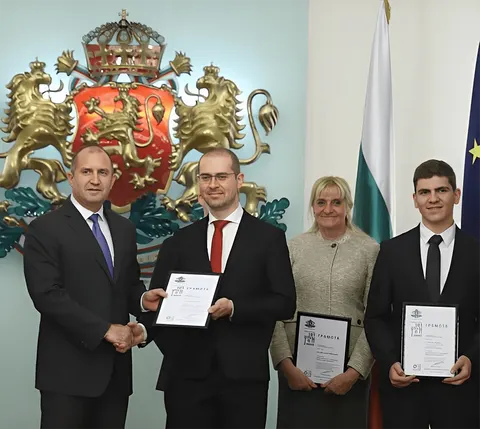
– You mentor young people like Zvezdelin Besarabov and Radostin Cholakov—two very young people who are extraordinarily promising and have already collected impressive awards…
– Yes, they're the better-known ones, but I have quite a few other students too. For example, three homeschoolers—they've never been part of the traditional education system. One of them, Bozhidar, is exceptionally good, yet he's been rejected and cast aside by the system. We met at one of the few competitions that accepted him; the others wouldn't let him in, because he isn't a student here but studies remotely in the American system. Interestingly,
these young people turn out to be better than the ones who go through the schools; it's just that nobody knows about them.
Now I have a new student—Petar Petrov from Svishtov, a very interesting kid, 12 years old. He's completed SoftUni, the Bulgarian programming academy; Nakov recommended him to me. He already wants to work and is far ahead of the material.
When you're a homeschooler, seeking knowledge is your personal responsibility; otherwise someone makes you do it. The others are very curious too, but they have a framework.
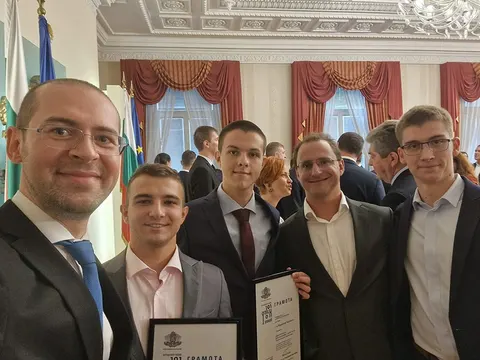
– In that context—isn't it society itself that destroys creators? I'm thinking, for example, of the comments on Facebook when I published the piece about Radi; they were gratuitously appalling.
– Yes, that's exactly what we do. Since antiquity there's been a philosophical divide between society and nature. There are even interpretations that society is the work of the devil and nature the work of God. All of man's bad traits come from his behavior in society. Of course, in purely evolutionary terms we wouldn't be here if we didn't have societies, but the question is what comes next.
A very interesting scientist, Michael Levin, says that all intelligence is collective intelligence. His theories work at the level of cells; he does impressive experiments and develops very interesting ideas. For example, what is cancer? A group of cells that have cut off communication with the rest of the organism and think of themselves as a separate organism. But they are too small, and so they reduce their existence to the most primitive form, concerned only with survival and reproduction.
On the other hand, why don't robots get cancer? Because in them everything is hierarchical and controlled—there's no room for the individual components to go their own way. But robots somehow aren't alive; they have no autonomy—they have a function and tasks, but not a goal. Each of their components has a function and tasks, but no goal of its own. In living organisms it's fundamentally different: every component has its own goal, and if all the components collaborate well, we have a healthy organism.
Besides, the more complex a system is, the harder it is to manage centrally. According to Levin, with the right environment and signals we can persuade a group of cells to work together to create a complex organ like an eye, but we don't stand a chance if we set out to instruct each cell individually what to do.
Our current society is used to working hierarchically, and the only people whose lives have meaning are those at the top; the rest do what they're told and have been trained to do so for generations.
This system will collapse under its own weight. There is more and more turbulence and trouble on many levels.
A society in which individuals have their own meaningful creative goals would be much healthier. That's the idea behind blockchain, for example—people interact, some of them may even be malicious, but there's a way to reach agreement about the truth without trusting one another.
– Yes, but every attempt to change the system drastically has turned into a utopia and failed one way or another…
– That's true. To beat my chest, wave the flag and say, “People, let's organize ourselves this way!” is utterly stupid. It would fail for the same reason the other attempts did. Because someone intellectualizes what has to happen and starts imposing it through the force of his intellect.
Nothing will happen because someone made it happen; it will happen because it is the natural path.
Not because someone wakes up with an idea, but because it's the natural course of development. Technological progress has been exponential since 1900, growing relentlessly; on the chart you can't see the financial crises, you can't see the wars. Kurzweil says, and proves, that
technology is a force of nature in its own right and develops regardless of what people do.
Society is the same. Right now we're at some kind of limit, where the current system will be destroyed, like, say, the Bronze Age collapse. Then a new one will be born, and not because someone invented it, but because it's the logical step. The more stable state of the system, as Levin would say.
I think about this subject not because I want to wave the flag, but because I want to foresee what is going to happen anyway.
– What do you think this collapse will look like?
– Geopolitically, we're heading toward a multipolar world—there will no longer be one global empire controlling the whole world. Historical revisionists like China and Russia are emerging and asserting themselves as poles. Gradually, the breakup into camps will begin.
Having many empires will change trade as well. Until now we had international organizations and rules that were shared, supposedly global, but headquartered in New York. Now alternative organizations are appearing; the BRICS countries, for example, are creating parallel structures. We're getting more and more little islands.
But to have a global economy, we'll need to find a way to a common truth without trusting each other, which is the definition of blockchain. Yes, of course, where there's easy money there are schemers, and they're the first to thrive there. But the foundation of this technology is precisely that—being able to arrive at the truth without trusting each other, even while being fully convinced that everyone else is malicious.
The world of the future will first start running on blockchain as a technology, and second, people will adopt this worldview in their relationships with one another. As we split into smaller groups, some simply won't survive, because they can't cope with this new world. But what goes on living will be small and autonomous. Because there will be no hegemon, we'll learn to work independently in all sorts of forms, both as individuals and in small groups that we might loosely call cooperatives. That was the aim of my experiment too.
The coming atomization can go two ways. What the empire is trying to do is use it for control. That is, dividing people in order to control them, with the awareness that not everyone is needed in a future economy driven by artificial intelligence.
On the other hand, atomization could tip the scales toward autonomous systems. That's why we're at a bifurcation point: we could go either into Orwell's dystopian world or into another, better one. How things turn out depends on all of us—let's hope we realize it after all…