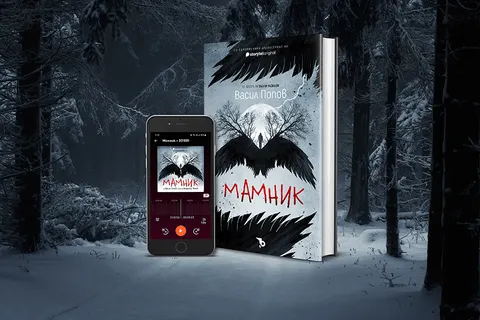
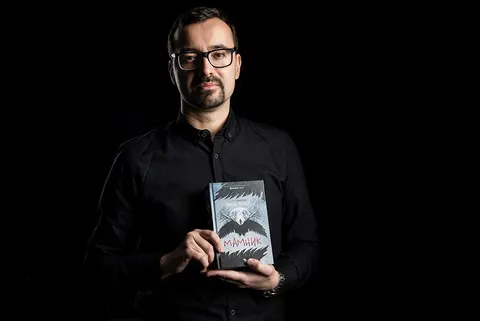
“Mamnik”—such a melodious, expressive word. And lately, much more than that. The fearsome mythical bird of Bulgarian folklore took flight as an audio series on Storytel and then carried on as a novel on paper.
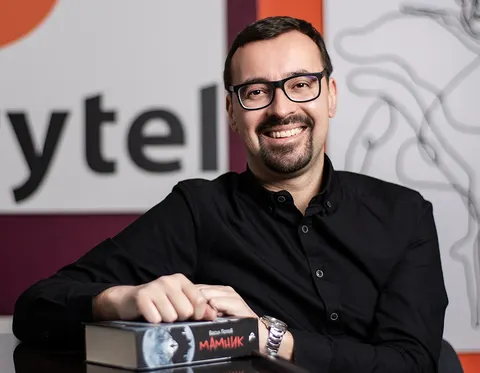
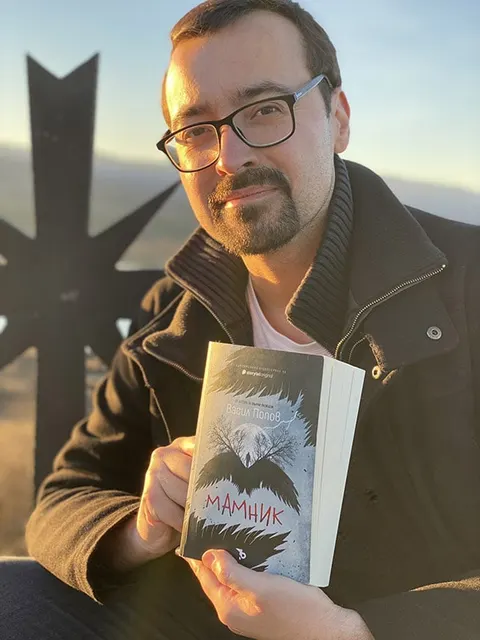
If you have yet to read (or hear) the book, I envy you. In it, Vasil Popov shows how Bulgarian folklore can be told in a modern, gripping, thrilling way, with taste and literary skill.
We invite the mamnik to our conversation, too, as a vivid character and a powerful metaphor: the terrifying bird that is almost immortal and whose feathers keep changing color.
Why do we so rarely manage to turn the stirring images and stories of Bulgarian folklore into art? And why, at the same time, do legends from distant times feel so close to us? Where is the thin line between patriotism and flag-waving jingoism? Here is what Vasil Popov and I had to say about it.
– To me, Mamnik showed what incredible possibilities there are for telling Bulgarian folk traditions in a gripping way. Why do you think this doesn’t happen more often? Even our classic literature has few examples.
– I can’t speak for the classics. But in recent years there have been some attempts, and yet it seems that when people write about folklore, they idealize the subject. Very often, to my regret, it starts to smack of pseudo-patriotism.
Besides, people mostly write about figures and characters that are already quite familiar.
We all know about samodivi and karakondzhuli—the forest nymphs and the night goblins of our folk tales. I’d like to read about the lesser-known sides of folklore, too, like the monster called the mamnik.
At one of the book’s presentations, Todor Stanchev from the Erove publishing house, who is an ethnologist, said that in his field there is a kind of pyramid. At the very top are the samodivi, and at the bottom are the monsters, the least-known creatures of folklore. That was exactly where the mamnik sat when he looked at the pyramid two or three years ago—almost nobody talked about it, nobody knew what it was. Now it’s at the top, too. I think that’s the way to revive people’s interest in these forgotten sides of our folklore: to build them into books and films.
– I have a favorite figure like that, too—the zdravichki, little spirits from the village of Yugovo near Asenovgrad. Can you think of others?
– There’s Kutsulan, who appears in my other book, Valchi razkazi (Wolf Tales): a terrible wolf who leads the pack and comes out during the wolf feast days. He’s lame and one-eyed—frightening!
There are many. Somehow, when we talk about why people don’t write much about Bulgarian folklore, I get the feeling that most of them simply don’t know these figures. I remember when I read about the mamnik, I told myself: this alone is the foundation of a story! You just have to fit it somehow into a more contemporary plot, so that people can feel it.
I think that if we stop treating our folklore only with the idea that we are the greatest, our folklore is the greatest, it holds nothing but beautiful and good things—if we also see its darker sides and start writing about them, very interesting things can come out.
– This happens all over the world; it’s enough to mention Tolkien. Or even The Witcher, which is closer kin to us, Slavic mythology. But looking at it from the other side: why do such themes still stir us in a modern society so different from the times in which they were born?
– It’s distant and yet universal. In Mamnik especially, the story is as distant as it is true. I wanted to create a story that doesn’t revolve only around how to kill the monster, but also around what led to its creation. In the end you realize that the cause is a family story, a drama with nothing supernatural about it.
Why do they stir us? The battle with evil is something that, in every era, in every book, always touches us.
I wanted the mamnik to be seen, in a way, more as a metaphor for the evil that grows inside people. For the need each of us has to fight that evil, because otherwise there’s always the risk it will grow into a boundless monster, the way the mamnik is.
The book combines many genres; it isn’t only fantasy, it isn’t only horror—there’s a love story in it, historical moments, and comedy.
– I read that among your favorite writers are Remarque and Simmons, who are favorites of mine, too. And I definitely felt them in the book; there’s something of the Shrike in the mamnik. But you say you don’t believe in such things, while I’ve seen very serious ethnologists who sincerely believe in all the folklore characters they describe.
– I’ve been asked in all seriousness: “Does the mamnik really exist?” No. It’s fiction, imagination; I hope nobody believes it exists. On Facebook there were people picking fights with the book, and one woman wrote: “I know someone from the Trun region, and she told me there are no mamnitsi there.” I hope there really aren’t.
– Let’s hope so! If there are, they might well turn up demanding a cut of your royalties… You say it’s a metaphor for evil. Do you think we will always need something like that—that evil will always exist for us to make sense of?
– Unfortunately, yes. It’s an endless battle. In the book, one of the characters also says that
if you knew that all the evil happening came from a single monster, it would be very reassuring.
Telling a monster apart is easy, but telling apart the evil in people, recognizing it and fighting it, is desperately hard. It’s scarier to know that every person is capable of evil.
– Does this metaphor live online in some way? It strikes me as a fitting catch-all for communication on the web. A mamnik is always lurking there, too.
– In online communication, absolutely! Just watching how people talk to each other on social networks makes me despair. In Facebook groups—how is it possible to fall out over a book, any book?! Now, with Time Shelter, I keep telling myself:
Damn it! Something so wonderful is happening in Bulgarian literature, and once again we manage to quarrel. It’s downright absurd!
Sometimes I wonder what causes it. When Mamnik started gaining popularity, there were people who hadn’t read the book but were irritated that it was talked about so much. There’s nothing I can do; I can’t tell people not to share. But reading those arguments, I thought about a paradox typical of Bulgarians: on one hand we suffer from a complex that nobody in the world knows us, and we want everyone to know us because we’re so great; on the other, when someone succeeds—like Georgi Gospodinov now—we turn against him. I can’t make sense of it!
– Why do you think it’s easier to be frightened by fictional characters in books than by real ones—climate change, say, or wars?
– Many people say that when they read a book, they find a kind of safety there, even on subjects that are otherwise painful for them. People who have lived through trauma have no problem reading about it, because they know it’s fiction.
In a book you have an imaginary safety that lets you deal with the problem.
– And yet you empathize, and you’re even literally afraid when reading frightening things that, rationally, you know perfectly well are made up.
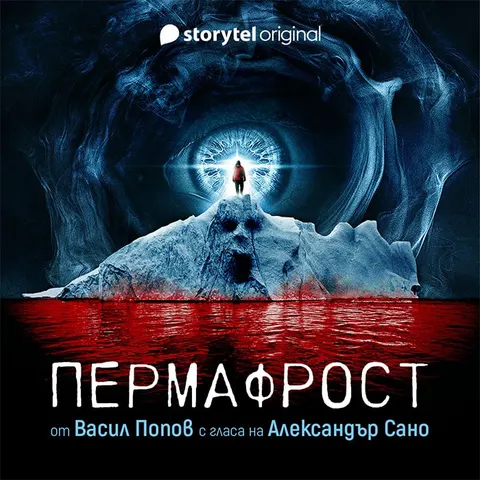
– That’s different. In my latest book, which came out as an audio series on Storytel—Permafrost—there were things inspired by real events I had read about or seen. A few years ago—I still wonder why on earth they broadcast it on television—I saw kukeri catch fire in a village in the Petrich region. Kukeri are masked ritual dancers who wear huge costumes of fur and bells to chase away evil spirits.
To preserve the kukeri costumes, people rub them with naphthalene, and they become highly flammable. Whenever I see kukeri smoking and imagine what could happen, I freeze. That’s what had happened: one man flares up like a torch, another tries to put him out but catches fire too. For me it was deeply traumatizing. I knew it was real. That panic, that chaos—this was happening to real people.
I included that story, but while I was writing I kept telling myself: how much easier it is to write about something made up than to watch, knowing it happened to real people.
I suppose it’s the same with the big things, as you say, with climate change. But in that case, I think, many people simply don’t think about the future, don’t try to look at tomorrow. Everyone tries to get through today, and as for tomorrow, or a hundred years from now—who gives a damn…
– Why is that? Given that it’s a problem that will ultimately affect our children?
– I don’t know. I’ve thought about it, too. I think it’s selfishness to some degree. Why aren’t people scared? It really is strange.
– And what are you most afraid of, since it isn’t mamnitsi?
– Lately, thunderstorms. I hike in the mountains, and several times there were very strong storms, and up on the ridge they’re terrifying. There’s nowhere to hide, nothing you can do.
– Why are you drawn to plots whose main aim is to scare people, rather than to make them smile or cry?
– There’s something cool about scaring people with words.
Stephen King used to say he wanted to frighten his readers literally to their hearts, to their souls. That kind of excitement can only be achieved through fear. Lovecraft, for his part, says the language of fear is universal, because every person feels some kind of fear. We are born in fear; if you’re afraid of nothing, something’s wrong. That’s why everyone can relate to it in some way.
Maybe also because I have fears of my own. People don’t realize it, but when you’re an author writing such scary stories,
you yourself have to summon some of your own fears.
Three or four pages where something happens in the book you can read in five minutes, but to write them I have to spend a whole week summoning some emotion that is frightening, nasty. It can be very draining.
– I was very struck that after hearing the audio novel, you dreamed your own plot as nightmares. I still can’t get used to the idea of listening to audiobooks; somehow I feel I’m betraying the others. What am I missing this way?
– With Mamnik in particular, you really miss a lot, because Vlado Penev gives an incredible reading. He practically acted out some of the characters. In the part I had written as an incantation, which had to sound like a folk song, he came up with a melody himself. He sang it! And while I was listening, I got so tense that every now and then I took off my headphones…
The experience is completely different from the book. I believe the two formats are great in their own right.
The audiobook isn’t meant to replace the paper one. I think it’s good for a story to exist in every possible format
these days, so that it’s accessible to people. Whether it’s audio or an e-book—if it allows it, why not?
– Apparently they don’t differ that much. Your book is successful in both formats, and I suppose there are no major changes to the text itself.
– No, there aren’t; they’re very close.
But before Mamnik I was a complete unknown. To a large extent the success is owed to the fact that it came out first as an audiobook, because people with a Storytel subscription can just try one of the episodes and, if they like it, keep listening. The book came out at around 700 pages on paper. I’m not sure that, had it appeared on paper first, so many readers would have taken a chance on an unknown author.
– Quite a few people have told me it would be a good idea for some Digital Stories to appear in audio format too, because they would reach many people who don’t have time to read.
Why did you choose ecology for your university degree rather than philology or ethnology, which are obviously your great interests?
– Originally I wanted to study directing, but I wasn’t admitted to NATFIZ, the National Academy for Theatre and Film Arts in Sofia. Then
I had a chance in Berlin, but I preferred to come back and study something else; I wanted to stay here.
After that I applied and was accepted for both journalism and ecology, and I had to choose. That’s how I decided, I don’t know why.
People have asked me what the connection is between ecology and my interest in folklore. I think that if you love Bulgarian folklore, you can’t help loving nature too, because you see how many things in the legends are inspired by it. The two are closely linked.
– Lately we keep talking about artificial intelligence starting to generate literary texts. If all stories and all plots really boil down to a limited number of templates, is there reason to think algorithms will replace us as writers?
– It depends on how far it develops. Screenwriters in Hollywood have also grown worried about the arrival of artificial intelligence, and the protests are ongoing. I tried ChatGPT to see what scenes it could write for certain situations. It actually does quite well, both as a script and with conflicts. But at this stage it seems to me it comes up with overly basic things.
But… We humans are social animals, and
a large part of the pleasure we get from a painting, a poem or a book comes from knowing it was created by a human being.
It’s no accident that at school, before we read a work, we first study the author’s biography. If you don’t know it, you might miss the meaning entirely. Imagine an AI writing “Don’t weep, mother, don’t grieve that I became a haydut”—it would look ridiculous. But if you know about Hristo Botev, the poet and revolutionary who joined the outlaw rebels against Ottoman rule, and the times in which that poem was written, then it takes on meaning. Van Gogh’s paintings are beautiful, but they’re even more beautiful if you know what a sad life he had. I think at some point people will have had their fill and will need to know that behind every work there is a human being.
– Are you at all interested in folklore’s present-day dimensions—memes, say?
– I hadn’t thought about it, but yes, they interest me. And regarding folklore I often think: fine, when I write a book based on folklore, isn’t that itself a kind of folklore?
– And future generations will remember your mamnik, not the one from the sources that only steals milk.
– Exactly. It’s the same with the bands that have emerged in recent years—Oratnitsa, Isihia. I really like them; they take a base from Bulgarian folklore, build something of their own on it, and it becomes something very different. Isn’t that also a kind of folklore?
Reading collections of folk songs, I’ve seen how a song starts in one region, then someone develops the plot further and it grows to four pages. By the time it reaches Macedonia, it’s 20 pages.
But it’s fascinating how the good gets sifted out in folklore. Everyone tries to add something, but whatever wasn’t a good idea falls away.
The people are like an editor who chooses the good plots and keeps only what makes sense.
I often tell people I talk to about writing that folk songs can serve as an example of how to write, how to build a plot. Very often there’s a twist at the end that changes the whole message. Or it simply ends in the right place, sometimes with an open ending, without dragging on.
– The metaphors are also strong and clean; you have to say a lot with few words. As far as I understand you, you think writing is learned as a craft rather than being a talent—is that right?
– I think so, especially when it comes to prose. In poetry there are things you can learn, too, but I think there you need a bit more talent. In prose, much of it is a matter of discipline. Figuring out which techniques work for you. Being curious, and about absolutely everything. Margaret Atwood, for example, says she often opens newspapers and reads the back pages with the little stories. Because in a few sentences you can find a story that inspires you to something big.
You have to be curious, I think, and not only about big things and events, but about the small stories. The directors Kristina Grozeva and Petar Valchanov do the same with their recent films—The Lesson, Glory, The Father: they are based on stories they read or saw on the news.
– I also think of Yovkov, one of the great Bulgarian short-story writers, who likewise drew his works from newspaper items.
What is your personal razor, the criterion that separates patriotism from jingoism?
– I think that when you write on such subjects, it’s enough to treat the characters as if they were real people. Mamnik is set in the Trun region, where I have roots. And although I love the people there and the region, that doesn’t stop me from being critical of them—they are people. At some point it’s even insulting to the characters, to the history and to the folklore if you try to idealize them.
Very often, when we talk about the past and about old people, we treat them as if they were terribly wise, perfect, knew exactly how life should be lived and could tell you how to live yours. I don’t think they’re like that. They aren’t bad, they aren’t good; they’re people, and you can perfectly well write about them with both criticism and love. That goes for folklore and for history alike.
There’s no need to beat our chests that we have the greatest history and are the greatest nation, because every part of our history also holds things that weren’t perfect, right?
– What do you dream of?
– Quite a few of my dreams have come true lately…
– Great! So you’re a happy man.
– At this point I dream of soon seeing a good screen adaptation of Mamnik. I’d also like some of the books to be translated into other languages. Because I think they’re local, Bulgarian, but understandable to foreigners and could be interesting to them. I’m curious to see how these dialects will sound in English and other languages.
I’m glad about Mamnik’s success not only as its author, but also because it showed that there is clearly a hunger for this kind of book. And I hope readers won’t approach genre fiction with prejudice. More such reads are still to come, which will be super interesting!