The most complete collection documenting the history of Bulgarian technology, and a whole sea of information about its past and present. You won't find them in any museum or archive, but in the home of a young man who, for the past 12 years, has put in superhuman labor to gather them and preserve them for those who come after us.
Today he is only 30, yet he is surely the person with the broadest and fullest knowledge of the technological stories from our country's past, and of its digital ones in particular.
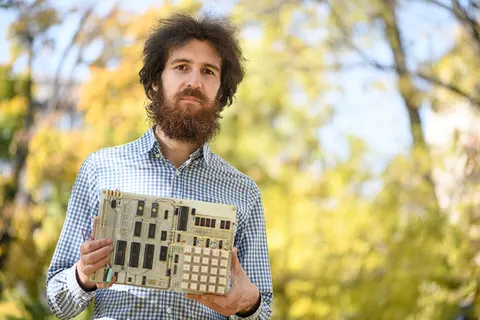
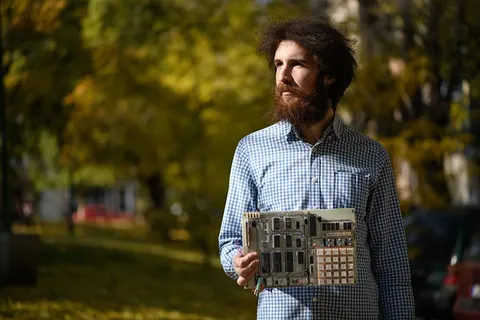
Anton Orush is the biggest collector of Bulgarian technology, and he is… a rather unusual character. His work is downright enlightening in the old sense—you'll soon realize just how colossal an effort we are talking about. His aura is, on the one hand, that of a man of the Bulgarian National Revival, the nineteenth-century awakening of Bulgarian culture; on the other… that of a barbarian.
When he isn't at his main job—in the library of Sofia University—he does other things too, such as working as… an extra in film productions. His looks easily transform him into a barbarian storming a fortress, which is exactly what happened last summer, leaving Anton with great memories and stories.
Or he is simply preparing his next publication. He has written more than 2,000 media pieces on Bulgarian technology, most of them on subjects no one else has touched. He regularly gives presentations at popular science events.
He created the remarkable Golyama kniga za balgarskata tehnika (The Big Book of Bulgarian Technology). He also keeps running the web portal—a treasure trove with the resonant name Sandacite (The Chests), where it all began. And, on top of that, you can most often find him in all sorts of unlikely places, trying to rescue yet another unique exhibit to join his collection.
Science and Technology for Youth
A post-apocalyptic, suspiciously quiet morning, a nondescript Sofia street. The wind
cuts like a poacher's chainsaw, even in the sheltered alleys of the most preserved part of the city. The pricey boutiques aren't that far away, but I have passed through the little tunnel into the courtyard… and into another time, and I am in the world of patina.
The patina has swallowed the intercom too, which is unlikely to work again anytime soon, so I call on my cell phone. The rusty door opens by itself, and I peek in. As a parting gift, the wind slashes at the peeling paint of the entrance and the stairs to the basement. There is no elevator: “back then, they were only installed in buildings with more than five floors,” Anton explains.
The hallway is narrow, the perfect backdrop for a Saturday horror flick. But I step into the apartment and it gets even narrower. In the hallway stands a huge printer box stacked with yearly volumes of the once cult newspaper Avto-moto svyat (Auto-Moto World). To the right is a wide coat rack from a tubular furniture factory, and next to it two enormous wall units—real tanks made of particleboard. And in front of them: doors from the time of the kings. The light switches are old and, of course, Bulgarian. The goal back then was for things to be sturdy, not fashionable.
At first glance, it doesn't look like the most complete museum of Bulgarian technology that has ever existed. More like an overstuffed warehouse. I've landed in one of the three apartments Anton has packed with technology to the rafters—and I mean literally. Thousands of books, magazines, newspapers and countless “gizmos,” as my host colorfully puts it, kept in a 52-square-meter Noah's Ark. A small corner is set aside for clothes and the bed, another for the computer, and everything else has been swallowed by objects… The bed, incidentally, is neatly made, with warm Rhodope blankets spread across it (from the “State Economic Enterprise Dekoteks – Sliven,” if you ask the host).
And this is just part of the museum. It already has two “branches” in prefab apartment blocks—more apartments filled with the vast collection, for which the first one proved woefully inadequate.
Then it stops being quiet, stops being gray. The thousands of volumes come alive, the hundreds of machines start singing their colorful stories in the voice of their owner.
Stories from the Chests
Sandacite—“the chests.” Behind this chirpy-sounding word, my host has tucked away so much meaningful history, and he often adds to it on the portal for old Bulgarian technology.
Anton grew up in the center of Sofia. He graduated from the Classical High School, Sofia's school of ancient languages and cultures, and was quick to start working. He had loved books since childhood, so he decided to set up a street bookstall. The world of secondhand booksellers awakened an even stronger love for the past. A few years went by like this, during which he even completed a master's degree in information technology in librarianship.
That is how he later ended up at the library. Today it is not just his workplace but an invaluable helper. In its vast stacks he finds priceless information about Bulgarian science and technology, and more than once they have been his last trump card. He considers it his home, thanks also to his wonderful colleagues.
Enchanted since boyhood by the patina of old-time machines, he started collecting old televisions and radio sets as early as 2003. Then, almost imperceptibly, the hobby grew into a passion. In 2009 Anton noticed a huge gap: there were countless collections, yet nowhere could one find systematic information specifically about Bulgarian devices and technologies. And not just televisions and radios, but everything. That was when he decided that these were precisely the things most important to collect, because they were threatened with oblivion and disappearance.
“Forget those chests of yours, Anton! You're just wasting your time with them!” his grandmother kept repeating. Her role in this story is especially important: she is the one who steered him toward science and technology when he was still a child. “She believed I should read not only made-up fairy tales but real ones too—about nature and science.”
Well, Anton liked the word and decided to name the portal he created to tell everything about old Bulgarian technology The Chests.
The first Bulgarian tank isn't anywhere around, but in one folder everything known about it is meticulously filed. The Chavdar buses, made in Bulgaria, are missing too, but their absence is made up for by some 5,000 volumes of technical literature and 6,000 technical magazines from the end of the 19th century to 1991. Plus thousands of folders with original technical descriptions of various devices, factory catalogs, leaflets, brochures… Everything that goes by the name of “company literature.”
Pass It On
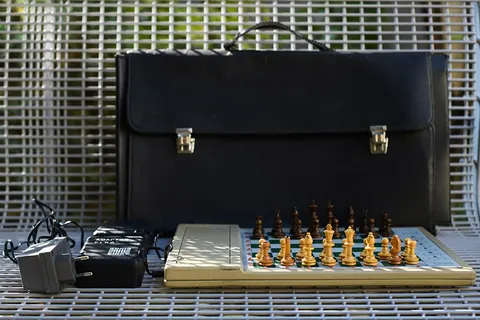
Today Anton's collection includes more than 550 different devices made in Bulgaria, but the point is not the number, it is the idea: to collect absolutely every possible model and modification, with the sole exception of the fields of chemistry and metallurgy. There is everything from skis and poles from the 1930s to electronic chess sets; from a metal detector to a computerized telephone dialer.
Over the past 12 years he has seen just about everything. And still, something always comes along to surprise him. He comes across an item he never suspected was made in Bulgaria—a multicooker from 1959, for instance! Anton loves to trace the processes, to read how an idea was born and how it moved on to production. How various mechanisms and devices worked.
Many of the products he researches or collects are extremely hard to find; others, sadly, are lost forever, such as the big Bulgarian computers of the 1970s and 1980s (the so-called mainframes and minicomputers) or the first Bulgarian dishwasher. Some old televisions and radiograms are turning up more and more rarely, not to mention those from the 1930s… “All this means that these are the last years in which something serious can still be done to save the vanishing history of Bulgarian technology, because there won't be another time. Now is the time for concrete deeds. And this is not a task with a deadline—as long as any remnants are left, it has to be done,” says Anton, carrying on this work, which continues to cost him enormous personal sacrifices.
The Unforgettable Past
As I mentioned, computers hold a special place in his collection. Unfortunately, there is no way he can own the first and largest Bulgarian one. Vitosha, from 1962, was a metal mass measuring 4 by 2 meters and weighing about a ton. To run it, you needed a room of at least 60 square meters with precisely controlled temperature conditions, plus a separate room for the device that stabilized the mains voltage. Sadly, it existed in a single copy and was “dismantled” long ago.
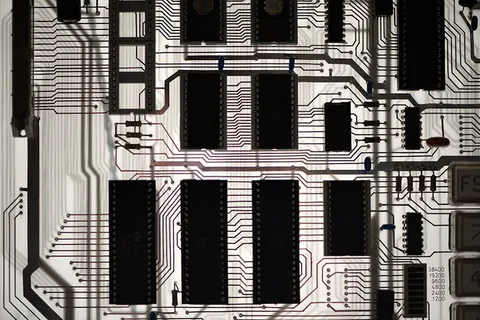
Among the largest items in his collection is an IZOT ES 9004 computer magnetic tape unit from 1981. It consists of a mechanical block, a keyboard for entering data to be recorded on tape, and a monitor for tracking its operation. And it still works!
Bulgarian Heating Coil
The stories of how he acquired particular machines could fill a book of their own. He tells, for example, how he managed to find a rare Mizia television. He often walked past a glassed-in ground-floor balcony in the Hipodruma neighborhood, and the TV just kept sitting there, only the layer of dust on it growing thicker. He asked around, and it turned out an elderly woman with hearing problems lived there. She couldn't hear the doorbell, and the only chance of getting her attention was from the kitchen balcony.
So one day Anton found himself in front of her balcony, explained why he had come and offered a good deal of money, the kind that would delight almost any pensioner. “Hold on, no! The TV is in use!” the old woman snapped, although it was obvious that wasn't true. He had to meet her son to persuade him to close the deal.
There are still items the collector can't find despite persistent searching and despite having often appealed for them on national television. Besides the big Bulgarian computers already mentioned, these include other magnetic tape units and hard drives from the ES 506x series, which are the size of a washing machine… He is also looking for the first Bulgarian personal computer, IMKO 1, and some Pravets models. “Pre-personal computers have always interested me, and they let us show the history of hardware going much further back,” says Anton, and he asks anyone who owns one and would sell it to get in touch.
Young Constructor
Drawing on my host's knowledge, what would our country look like if we had kept our position in electronics to this day? “Bulgaria had dozens of electronics factories, which it let be destroyed with ease. And we could have been, for example, where Poland is—home to the only European maker of RAM modules today, Wilk Elektronik,” Anton sums up sadly.

Another field we should be especially proud of, according to our interlocutor, is space technology. He gives the example of our participation in the late 1980s in the international Phobos program, which studied Mars and its moons. Bulgaria created the instruments to determine the elemental and isotopic composition of Phobos's soil, equipment for spectrometric research, and gear for navigating the spacecraft. We pulled it off after serious adventures, which Anton has described in detail in one of his articles. But the result is that, thanks to our technology, on February 28, 1989, the probe sent back the best images of Mars and its moon that humanity would have for the next 20 years.
Another inspiring example is our first space satellite, Intercosmos-Bulgaria 1300, launched into orbit on August 7, 1981. The data it sent back over a year and a half was used by science worldwide for the next four decades and cited at international forums. In the Astrophysics Data System, the scientific publications resource of NASA and Harvard, a search for “Bulgaria 1300” brings up more than 200,000 results from all over the world.

Let's Build a New Life
Despite his unconcealed love for analog times and early computers, Anton likes some of the possibilities of today's digital world too. For instance, the chance for one person to find and publish information that will interest others, and the ability for more people to connect and exchange information. From there they can create something together. “The fact that things happen faster also matters to me. Through all this, unexpectedly valuable facts and objects come to the fore, and we discover new knowledge.”
And yet, even from artificial intelligence, what he looks forward to most is… the chance to improve the quality of the old photos of Bulgarian technology he has.
“A few years ago I heard someone call me an influencer for the first time,” Anton smiles. “Honest to God, until then I had no idea what the word meant. I found out there are people who, for money or freebies from manufacturers, pose with herbal elixirs and cosmetics or wave miracle frying pans in front of the camera. I've seen posts by such influencers and I think most of them are pretty artificial. It's strange to me how they do it—are they convincing in their messages? I don't understand who believes them. I wouldn't agree to do anything like that. These are no longer ordinary people but advertising faces, and it shows.”
He says he was raised to respect people who know and can do things beyond his own abilities. “For example, I hold people in engineering, medicine, finance and law in extremely high regard. Which turns out to go against the prevailing mentality here—‘what's that guy even doing, just sitting there.’ That's so us—‘I can do it all, I know it all, I'm a great big wizard.’ And then we wonder where the problems came from?! Wait, aren't we supposedly building a knowledge economy? Where is our respect for knowledge and skill, then? I admire people who have proven their knowledge and skills, especially in the professions we can't live without.”
Mission Reported
What gives him the strength not to give up? “I know that assembling the most substantial and informative possible collection of Bulgarian technology, and thoroughly publishing the interesting topics from its history, is a very important task for Bulgaria in general. Other countries do the same for themselves, and we don't. I've written more than 2,000 articles. While I'm preparing and writing them, I feel I'm fulfilling a national duty. Is it right that there's more information about Bulgarian cars abroad than in Bulgaria? Or that we don't know which was the first Bulgarian computer, or about the production of, say, skis or watches in the Kingdom of Bulgaria?”
The awareness that he is doing something important enough is another reason he doesn't give up. “The history of Bulgarian technology isn't a case of ‘I want it today, I don't want it tomorrow’; it's a long-term task of fundamental interest. Carrying it out is one of those things that make us equal to the other European nations,” Anton is convinced.
“And then there's the researcher's curiosity, digging through sources, the desire to understand more—it's a tremendous thrill, and I wish it on everyone. Do you know how satisfying it is when I look at the screen with the finished text and know it's a new, genuine contribution to the history of our technology? That's when I feel truly fulfilled.”
And what is Meaning to him? “For a person to feel satisfied and fulfilled by what he does, for it to be useful and to benefit society. If it's really done, and not just left standing as a slogan, that gives things a lot of meaning.”
We part with the promise to meet again soon, so that he can show us some of the quirkiest specimens in his bottomless collection related to information technology. What could Anton have in store for us? Just be patient a little, little while longer.