These young people love nothing more than debunking clichés. A few examples:
– The new generations don't care about Bulgarian history.
– Publishing is a dying trade with nothing in it for the young.
– Patriotism has been irreversibly emptied of meaning after a spin through the centrifuge of politics.
In a matter of months, the Bulgarian History association will turn ten. Yes, they are that likable group of young people who tour schools to charge tens of thousands of kids with the magic of history. You have surely come across some of their impressive books from recent years, and their increasingly thorough and professional video productions too.
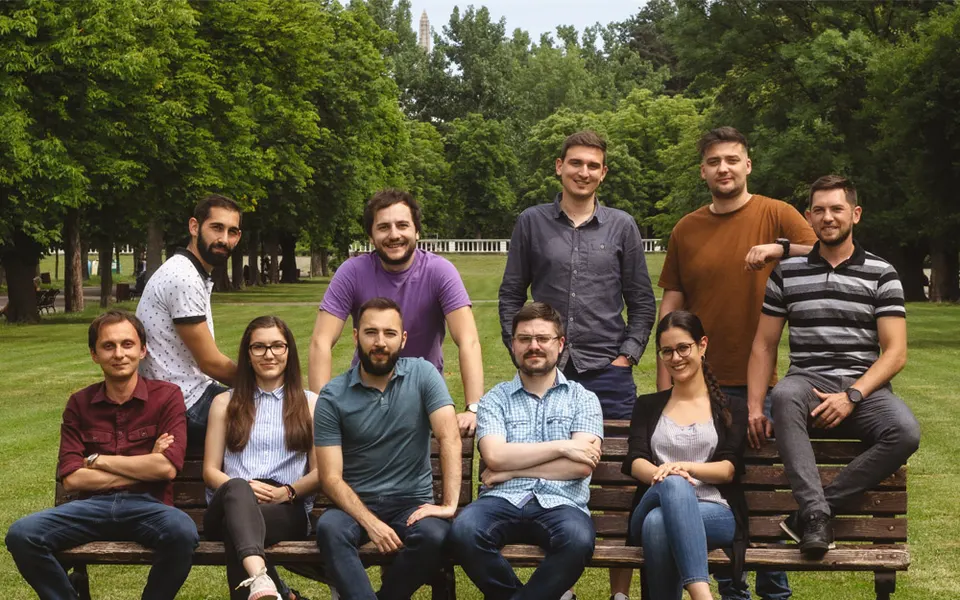
The whole adventure began for Mario Mishev, Ivan Kanchev, Martin Stamatov and a few of their friends in March 2012, with a Facebook group created almost by accident. It went on to become a purpose and a cause. And, at the same time, a successful project that today puts bread on the table for 10 full-time people and many more collaborators. People who do nothing but create meaningful books and popularize Bulgarian history, with all its highs and lows, without bias.
History without hysteria
“A hushed classroom in a school in a small town. A handful of young men, barely past 20, stand to one side while the fifth graders watch a short film. Then a lively discussion begins—the guests slip into the role of ‘big brothers,’ telling the kids about Bulgarian history in plain words, about half-forgotten heroes, about how we might bring their example into everyday life.”
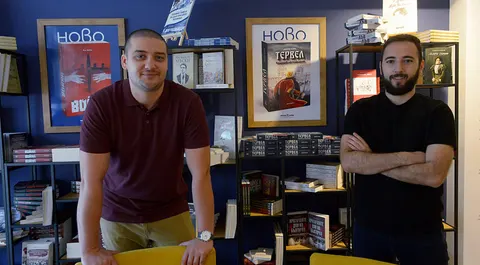
That is how the piece about their project began in the pages of 8 Magazine when I first met Mario and Ivan, eight years ago. It is easy to draw on the enthusiasm of fired-up young people who have taken on a meaningful venture. The much harder part comes later, for them. Keeping that enthusiasm alive, building on it and turning it into a project that works and matters. In this case, against the general trend, the project wasn't forcibly dragged from the “old” world into the digital one. Quite the opposite: it gathered strength in the digital present, only to outgrow it by returning to… books.
So, March 2012. Mario, Ivan and Martin are in 12th grade, their final year, at the French Language High School in the capital, Sofia, preparing for their university entrance exams. They are studying history; a year earlier their teacher, Nikola Dyulgerov, had won them over to the subject.
They have gathered quite a few curious historical facts and… it occurs to them to start a Facebook page to post about the events and figures that have impressed them most. They call it Bulgarian History and, with unruly enthusiasm, start filling it with texts and photos.
The idea is to share what they have collected with friends. But something rather different happens.
A week later the page has 1,000 followers. A month later: 10,000. Facebook soon proves too small, and a Bulgarian living across the ocean, impressed by their enthusiasm, builds the first version of the website, which still lives on the same domain today—www.bulgarianhistory.org.
The rest is history
A few months later, the venture's followers reach a six-figure number.
Somewhere around then, the young men realize things have become a lot more serious. Although they are already busy with all the joys and woes of student life, they devote a good deal of time to making sure the content is far better than those first schoolboy posts—they even delete 450 of the first 600 articles.
Gradually things get more serious still, and Bulgarian History becomes a recognizable name. Two years after the project's launch, their first book comes out under the brand, collecting 100 stories of figures important to Bulgarian history. They also make their first short film—about Col. Vladimir Serafimov, the liberator of the Rhodope Mountains.
Either way, the internet remains the main place where they keep growing. They produce a huge volume of content and invite more and more collaborators, many of them professional historians. They themselves choose other humanities majors at university, but as the project develops they pay ever closer attention to the accuracy and independent perspective of each undertaking. They seek out the most suitable specialists for every individual topic.
A beautiful story
At some point, though… the carefree student years fly off into history, and the time comes for the three to decide. Where do they go from here? Can they turn their fascinating venture into a career?
Yes, the online success is considerable, Bulgarian History already has a huge audience and has become a recognizable brand, but… you also have to eat.
That is when these young men from the first truly digital generation… decide to try their luck offline, in a profession that not long ago was thought to be all but doomed—publishing.
“In 12th grade it cost us no effort at all to make a Facebook page and, with a bit more drive and work, to spread it. What was hard was the transition to expanding our activity and organizing it offline,” Mario says today. “We simply had no other choice. That was the moment to decide whether Bulgarian History would be our main occupation or would not be at all. The answer was publishing, because our particular niche still hadn't been developed.” And they really do love niches: the Facebook page appeared to find its specific audience, and later the publishing house did the same.

Story, history, histories
In recent years, countless books covering different periods of our past have come out under the Bulgarian History brand. At first they focused on reissuing titles that had gathered dust yet still had plenty to say to today's reader. Some appeared for the first time after decades (and even a century!) of oblivion. Gradually they added new, original books. What unites them all is the pursuit of a professional and objective perspective.
At least 30 titles roll off the presses every year. The genres are varied—from the memoirs of some of the greatest figures in our history, through collector's albums of restored old photographs, to fiction. More and more of their editions are prized for their printing craft and count on an added collector's value.
The team also remains actively present online, gathering kindred spirits there. Its profiles on every social network draw huge numbers of people of all ages. On Facebook alone they are liked by more than half a million people! For now, the only network they are prejudiced against is TikTok.
They put serious effort into video. Their YouTube channel started with short clips made with the help of sponsors, and today it is growing into a media outlet of its own, developed with the help of donors. They no longer make short videos about single events, but much larger projects that pack broader themes into 20 minutes or so—the Bulgarian uprisings, for instance.
What will you give us, History,
from your yellowed pages?” asks Nikola Vaptsarov, the revolutionary poet executed in 1942, in his unforgettable lines.
Well, many students ask exactly the same thing, if perhaps less poetically—students for whom a history class is just another tedious 40 minutes to be endured. The Bulgarian History team has an answer. And it has been giving it for 10 years now.
Just a few months after the Facebook page was created, when Mario, Ivan and Martin had only just stopped being students themselves… they were invited back to school. And so it went for almost a decade. They travel around the country and meet children from different grades. They present various historical topics with passion, hoping to spark their interest in our past.
These events are a huge thrill for the team and help keep them going down the road. They have visited hundreds of schools; at some point they stopped counting.
Sadly, the pandemic has forced them to put the visits on hold. Unlike many other ventures, they are adamant that these simply can't happen online. “Going to schools is more about inspiration than education. In 40 minutes there's no way we can teach anyone anything; we can only inspire them, and that can't happen unless we're there in person.” The team hopes to be able to light the flame of curiosity about history in kids again soon, because they truly miss it.
Stories about history
Otherwise, troubles aside, last year was a strong one for the team. It brought them the prestigious Golden Lion award for the publishing project of greatest public significance, as well as the lifetime achievement prize in the Site of the Year competition.
And the greatest pleasure for these now grown-up young men is that they publish books they are proud of, books they themselves dreamed of reading.
They brought the eternal Inspector Strezov, a classic Bulgarian detective, back from a long retirement by collecting his adventures. In April this year, for the 200th anniversary of the birth of Georgi Rakovski, they published his poem Gorski patnik (The Forest Traveler) for the first time since 1958. “Rakovski is something like the father of the Bulgarian revolution, and anyone who wanted to take part in any kind of armed resistance back then read this book; it is of enormous historical significance,” Mario says.
Among their other new titles, one stands out: a History of Bulgaria from 1761, written a year before Paisius of Hilendar's foundational chronicle by a Franciscan monk on the territory of present-day Romania.
History will tell
“On the one hand, we try to fit the cliché—to have the books we know will spark interest, like Istoriya Slavyanobolgarskaya (Slavonic-Bulgarian History), Levski's letters, Botev's journalism. But we also try to have rare, valuable editions that are, to a large extent, a publishing risk,” Mario adds.
Sometimes, though, it is precisely those books that surprise them with serious interest. The biography of Todor Aleksandrov came out as a luxurious hardcover volume of no fewer than 700 pages. And even though he is not one of the figures expected to draw a large readership, plenty of readers appreciated it.
One of their interesting ideas from last year was a collection of Bulgaria's constitutions. “The constitution is the core treasure of any state, alongside the anthem, the flag and the coat of arms. It offended me that someone could get up in the morning and announce we're changing it, without any vision whatsoever,” says Mario, a political scientist by training.
In just a month and a half, with the help of two professors, Milen Lyubenov and Vladimir Stanev, the team produced a thick volume containing all of Bulgaria's constitutions, supplemented with historical commentary and the stenographic records of the debates in the chamber. “As a book it sounds very dry and legalistic, but we caught the moment and people appreciated it,” Mario says.

History and truth
“Our main competitors publish good history books, and sometimes we envy them a particular title. But the difference is that history is simply not all they publish,” Mario sums up. “We could never release more commercial books under the Bulgarian History logo. Besides, it is a pleasure to have a niche that is yours alone. And then to become the emblem of that niche. Just as people online already associate Bulgarian history, in some way, with what we do, I'd like them, when history books come up, to say: the Bulgarian History publishing house makes the best ones.”
Over these 10 years, interest in historical subjects has come and gone in waves, Mario says. “When we started, there was a very patriotic, even somewhat harmful environment on Facebook, with heaps of pages and groups spewing fake history. Back then people were somehow far more susceptible to patriotic manipulation,” he recalls.
In recent years, however, the wave seems to have subsided. “But this is a very subtle subject; you can't sense it that easily. I used to see a lot more people on the street wearing ‘Bulgaria on Three Seas’ T-shirts, but maybe that's part of growing up. People stop getting inspired by isolated facts and somehow take a more pragmatic view of history, which genuinely makes me happy.”
Polit-history
Of course, politics inevitably matters too, Mario adds from his political scientist's point of view. “It's quite interesting to watch. I don't fully understand it, but I feel it as part of our work and of the interest in us. Mostly in particular topics. Say, two or three years ago our military videos became hugely popular. Then in the last few months we made a similar series and hardly anyone watched it. We immediately changed the angle and started presenting stories about science and culture.”
And yet, despite the “patriotic” political waves, no one on the team has ever felt the urge to go into politics. “Politics is not a dirty business; that's an inaccurate cliché,” Mario says. “But it is certainly a rather unfair profession. In the end, it hardly matters what you do, good or bad; at the end of the day you're the hero today and the villain tomorrow. It's no accident that once you enter politics, you start to get warped as a person. You become more callous, arrogant, more or less a misanthrope. You can see that warping in most Bulgarian politicians: compare interviews from the beginning of their careers and they are far more socially minded, thinking about the citizen, the little guy. Then at some point their behavior becomes downright arrogant. But it's a natural process, part of our human nature, and of course it cuts both ways.”
A different story
The ten members of the team are spread across different tasks, each knowing what they do best. Teodor Borisov is the “staff historian,” always ready with his opinion, and he knows when to seek that of specialists in a given period or topic. Martin Chorbadzhiyski, meanwhile, is almost permanently on duty at the library, whether he is working on a book or hunting down the answer to a reader's question.
“For me it's so interesting to be in the private sector, doing something in culture and education and earning from it,” Mario says. “It's a big cliché that you can hardly create something that isn't hack work and still make a decent living from it. That's a pleasure, and it's a challenge. To do things in a way where we earn money the hard way, but it still works out. To be pleased with what we leave behind. In these ten or so years, the most important thing we've achieved is that people have come to associate the name ‘Bulgarian History’ with us. That they know our goal is to present the past objectively and reliably.”
Today some of the kids from 10 years ago have kids of their own. And, you can be sure, they will teach them history and raise them to love their country. In a balanced, intelligent way, at that. Which holds true for everything this team has created over the past decade.
Technology changes everything, but… some things survive and will remain unchanged long after it. Because whoever remembers the past can read the future. We all live on the back of history, but in some way we are all making history too.