Travel is no big deal these days, thanks in part to technology. The story in the lines that follow, however, comes well before the digital age. I decided to tell it to you because it is very, very powerful in its own right. Because the art in it stirs the soul. Because it shows that dreams and creativity truly know no borders, even in times when the world was much younger and computers had not yet caught us in their net. The painter Boris Georgiev was a remarkable man and artist, one worth talking about again and again…
The Brief “I Am Born and I Pass”
“We, poor apparitions in the brief ‘I am born and I pass,’ are seized by nostalgia and an unattainable love for another, unreachable world. Both the artist and his model feel this—each in his own way—and you should be proud and glad of this mission. May your creative process allow you to achieve as much in this phase of our existence in the future—as much as may be possible at all for us mortals.” These words were written in a letter to an exceptional Bulgarian by none other than Albert Einstein himself. The physicist bowed before the talent of the painter Boris Georgiev, a wise and profound artist who deserves to be discovered, understood and made known. His incredible fate, which gathered within it some of the most important brushstrokes of the contradictory 20th century, is an inseparable part of his timeless art.
Today the world, gone mad, seems stubbornly intent on returning to the bloody beginning of the 20th century—wars are being fought on Europe’s doorstep, hatred and individualism are conquering new territories that seemed to have been won back from them. Divided by ideas and ideologies, we forget what matters more. Humanity seems to refuse to learn from its great mistakes. And this is so because the truth of the individual person is left by the wayside.
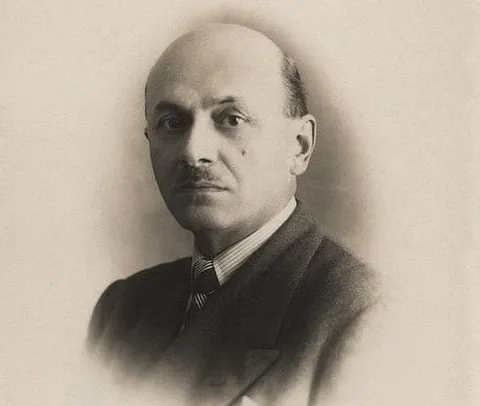
Boris Georgiev was born on a date full of ones and eights—1.11.1888, November 1, 1888. He came into this world in Varna, the Black Sea port where he was destined to spend only a few of his days, but which he would never forget. Wherever fate blew him, he kept signing his paintings “Boris Georgiev of Varna” out of respect for the harbor from which he set sail on his long journey as a lonely wanderer through the world.
When he was very young, the family of his father, a tailor by trade, moved to Saint Petersburg. At 10, Boris got his first album of Renaissance art; at 13 he was already painting, and a portrait of his father survives from that time. His talent was soon noticed, and the boy ended up at an art school where he was taught by leading Russian painters, among them Nicholas Roerich. A quarter of a century later, their fates would intertwine again in a chance meeting in faraway India, and Roerich’s son, Svetoslav, would say at the opening of his own exhibition in Sofia: “My father and I value Boris Georgiev more than ourselves.”
Can Feeling Be Taught in Academies?
Soon his heart pulled the young man outward, toward the next stop on the horizon. He left for Munich, on the one hand to break away from his parents, whose bourgeois ways he felt were closing him in, and on the other to learn from the best German painters. Yet it was not the professors at the academy who turned out to be the true teachers on the road to his distinctive art. That role would be taken by encounters with interesting people, distant cultures and the richness of nature. “In the old days there were no academies; every master took on apprentices who undoubtedly showed talent, and they often surpassed their teachers. How can an academy teach soul, feeling? Can a man become a poet through study? There are no duller and more talentless painters than those who passed brilliantly through the schools. True talents were thrown out as incapable,” the painter believed at the time.
In Germany, Boris met people from many countries, and during his very first summer vacation he set off with nothing but a backpack on his first great journey. He got the chance to come close to the work of the painters whose perfection he revered from early childhood until the end of his life. “When I had the happiness of getting to know the immortal works of the Renaissance of the gifted Italian people, still unsurpassed by anyone, I understood that art is an eternal value beyond time and fashion, an expression of higher culture in the history of nations, and a means, like religion, to answer the needs of the tormented soul to rise into the sphere of the beautiful and the good, to receive a little consolation and joy amid the bitterness and vileness with which life is filled, especially in the era in which we live,” Boris wrote then. He loved copying Renaissance works, and it was then that he chose his favorite technique—pastel and colored pencil.
His vacation travels took him through Greece, Finland, Sweden, Norway, the Netherlands, Belgium, Switzerland, France and Great Britain. He covered the 410 kilometers from Munich to the Italian border by bicycle in four days. “This way one can travel all over Europe without getting tired. Many wonder how I have the courage and will to undertake such a great journey by bicycle, but otherwise we would not get a hundredth of the impressions and pleasures of travel that I get at every step. Truly, there can be no finer way to travel than this,” the painter told his relatives.
Once he reached the Italy of his dreams, his first impressions of his future homeland were curiously mixed. As he wrote to his father in 1910: “I still can’t understand how these Italians eat everything without salt. Their bread has no salt at all, like communion bread. These Italians shout a lot—last night one couldn’t sleep for the racket in the streets.”
Elevation
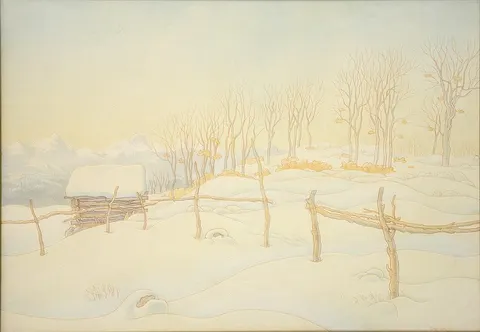
The purity of nature was a great inspiration for Georgiev, which is why the Italian Alps became a beloved haven for him. “In the mountains one feels the elevation that lives in the depths of one’s soul,” he said.
He made it as far as Morocco, from where he wrote: “This astonishingly fantastic country. The whole journey so far turns out to be nothing in comparison. I simply marvel and cannot believe it, looking at everything, as if I were in a patriarchal country 2,000 years ago. The types here are simply a miracle of originality and artistic beauty. Here you can see types from all the African tribes, but the main ones, of course, are the Arabs. This is a true paradise for the painter (…) In Europe all the types resemble one another and live like machines by common rules. Here every person is an astonishingly original type, and the manners and customs are very primitive. This is the real Orient. I love such people much more, because they are far more natural and sincere, and I could not help feeling that the Arabs are very kind and hospitable people. It’s a pity that the French are gradually taking over their country, and this makes the Arabs somewhat hostile toward Europeans in general. I would stay here longer with enormous pleasure, but I must soon return to Munich.” At the end of every summer, though, the student returned to “uninteresting Germany with its cold and unsympathetic houses.”
And although he was not enchanted by academic learning, he completed his education at the Munich academy. “By studying art and treating oneself critically, one can learn much more than by unconsciously wasting time at the academy. Of course, the academy is useful to a certain extent, depending on how I relate to it, not how it and the professor relate to me. In this way I am building a firm and solid foundation of spiritual culture, on which my work will later rest,” Boris wrote to his family in 1912. And over the following years he achieved the goal he had set.
In Germany the young painter actively studied foreign languages, which helped him on his travels. He also acquired a range of skills—he learned mechanics, electrical engineering, tailoring, construction and farming. He began playing the piano, the balalaika and other instruments.
The Pain of the Pariahs
During his travels, his sensitivity to people collided with social injustices that left a deep mark on his worldview. “During my wanderings, the misery and pain of the pariahs were my companions,” the painter later recalled.
That is why, after graduating, he decided to withdraw into the mountains, alone in nature, choosing Italy as his home. “I built myself a hut in the Venetian Alps, to stay forever among the shepherds, the peasants and the animals, and to make my living from the land with my own hands. I hoped that in this way I would free myself from the terrible slavery of society, because it looks upon the artist as a beggar, so that when he has died of hunger it can profit from the works of his suffering. It almost seemed that I had reached the peak of my happiness by simplifying my life and, above all, through intimate contact with pure nature.” The painter had lived in the mountains for two years when his sister came to him, and together they returned among people to live the most fulfilling months of their lives.
Like every man of art, Georgiev was deeply disillusioned by the outbreak of the world war. His salvation was his reunion with his sister Katya, a kindred spirit and inspiration, a poetic image the young Boris would keep in his heart all his life. “What a mortal can receive as happiness on earth seemed to me realized, especially at the moment when my sister, a being of unearthly kindness and soulfulness, came to share the new life with me. Although she was younger than me, she was the one who showed me the possibility of a purer life, of spiritual and moral beauty, and the path by which to find them,” Georgiev wrote. “She was an exceptionally gifted being, as a poet, a musician and a painter. (…) Human cruelty and stupidity brought about, a year after her arrival, the barbaric war of 1914. Our area of the Alps became a theater of war, and we were forced to flee to Florence. Katya’s grief over what was happening was so great that she told me: ‘This world is not for us, and I feel I will soon leave it.’”
Fleeting as a Dream
She turned out to be right. Katya lived with her brother for some time, writing poems and painting, but… “fleeting as a dream is happiness on Earth.” The girl’s great soul was carried by a fragile body. Katya fell ill and died before she turned 20.
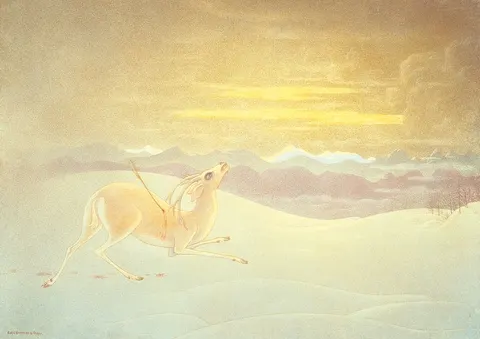
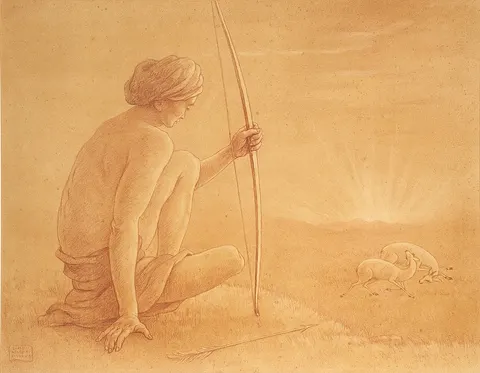
Heartbroken, Boris buried her in Florence, and on her tombstone he placed his painting of a pierced deer. He had created it while living as a hermit in the Alps. One winter evening he was sitting alone in his hut amid the silence of nature when he heard weeping that at first seemed human to him. Surprised, the painter went outside and saw a deer covered in blood. “Walking toward me, mortally wounded by hunters, weeping with a human voice, with large tears in eyes already clouded by death. They asked: Why is there so much cruelty in this world? I have done no harm to man, and instead of being my protector and friend, he kills innocent creatures for amusement or to eat their carcasses.”
The painter felt just as wounded, and for a whole year he could not find the strength to write to his parents about Katya’s death, until finally he confessed: “Ah, dear mother, what can we do, if this world is filled with such terrible torments (…) Ah, how cruel is fate, that the best, the gentlest and the most perfect must leave us so soon! You are right, you are right, unhappy mother, to weep that Katya has not written to you for so long. The poor girl fell sweetly asleep and was delivered from this world back on March 30, 1917, in the middle of Holy Week, as if Jesus Christ wanted to take her with him during his sufferings.”
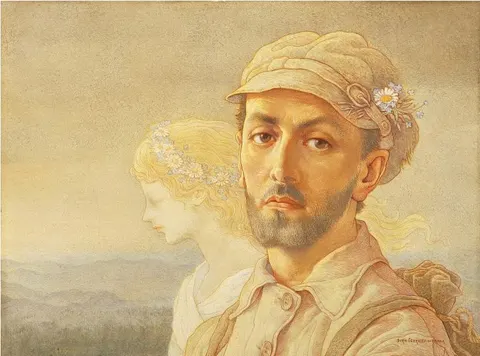
And yet, the personal tragedy turned into a triumph of art. The sister who left so early would be a leading motif throughout her brother’s long creative journey, brought to life as a bright memory he turned to in the hardest moments of his life. The Wanderer and His Sister is a self-portrait, one of the painter’s masterpieces, and perhaps the one that most precisely expresses everything that lived in his soul—the wisdom, the estrangement and the beauty. What is more, in many of his later paintings the Wanderer and his sister appear as a detail in place of the artist’s signature. Nearly three decades later Boris would say of Katya: “Although so many years have passed, she is always near me and gives me courage and help to bear all the torments and sorrows of life, until we too soon reach her in the spheres of eternal life, never again to part from her and from our other dear beings.”
“He Leaps Over the Centuries”
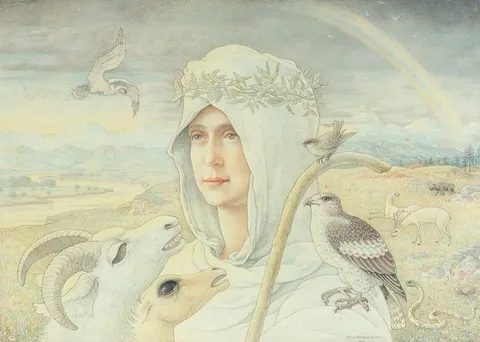
But before reaching that moment, he had a very full life still ahead of him, studded with interesting moments and encounters. Georgiev’s first solo exhibitions, in Rome in 1920 and 1923, drew enormous interest, and he quickly caught the eye of art lovers and critics alike. “Georgiev was and remains a genius; the word should not frighten us. He leaps over the centuries,” said Prof. Ludovico Magugliani, a scholar, art historian and critic, one of the many specialists enthralled by his art.
In 1929 Boris arrived in Berlin wishing to organize an exhibition. He sought help from Bulgarian diplomats but did not get it. It came from the most unexpected place… “If my compatriots did not deign to show the most elementary courtesy and culture toward a Bulgarian who has after all done something for the name of our country, a great man like Einstein was able to humble himself and show the greatest interest in my art and in me as a person,” Georgiev wrote.
The acquaintance came about after Margot, the scientist’s daughter, wanted to see the Bulgarian’s paintings and came to his Berlin studio. His art impressed her deeply; a day later she came again, bringing a lute, and sang and played old arias especially for the painter. Margot said that “never in her life had paintings moved her so strongly with their spirituality and purity” and that her father simply had to see them, as he had a special feeling for art. Because of heart trouble, Einstein could not climb to the fourth floor, where the studio was, so Margot asked Georgiev to bring pieces of his art to the scientist’s home himself.
Dinner at the Einsteins’
And so the painter found himself at dinner with Einstein’s family. Here is what he remembered of the meeting: “He struck me with his simplicity, modesty, childlike good nature and deep wisdom. I felt especially encouraged and flattered that in our conversation of about three hours he fully shared my views on art and ethics. I immediately felt a strong desire to paint his portrait, which would be no less interesting than that of Tagore, because he has an extraordinarily beautiful and characteristically spiritual face. In this great man my art found a strict, fair and enthusiastic critic. Of the portrait of Tagore he said that Leonardo could have been proud of such a portrait. Had these words not been spoken by Einstein, I would never have had the courage to think or write such a thing.”
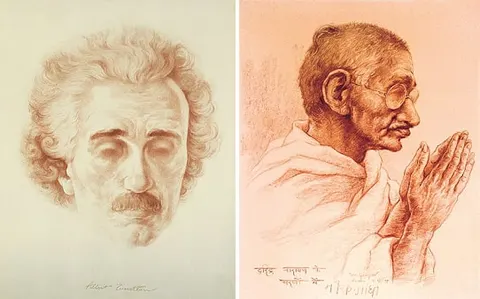
At their next meeting, Georgiev painted Einstein’s portrait, and after a few days of finishing work he sent it to him. The physicist was deeply impressed and wrote to the painter the words we began with, as well as: “My dear Boris Georgiev, after long contemplating the portrait you made of me, I felt the need to thank you from the heart.” He then personally helped him organize the exhibition, which made a great impression. In the magazine Gartenlaube, the critic Hans Rosenhagen wrote: “The works of Boris Georgiev act as heralds of a Resurrection of art and also as a reminder to German painters to turn back and remember that their task is to be guides to all that is great and beautiful, and to remember their great predecessors.”
Back in Italy, more and more wealthy people sought out Georgiev for portraits, through which “without compromise or profanation of art, I could earn my living.” This is how he earned enough to live, to travel, to help his family in Bulgaria, and to paint the art he wanted to paint—art with which he dreamed of uplifting and filling his viewers. At his exhibitions he did not sell his paintings; he sought contact with people and was content when they understood what he wanted to tell them through images. “We artists could say nothing unless we bond with people by blood,” Boris was convinced; by then he had built his own clear philosophy of art.
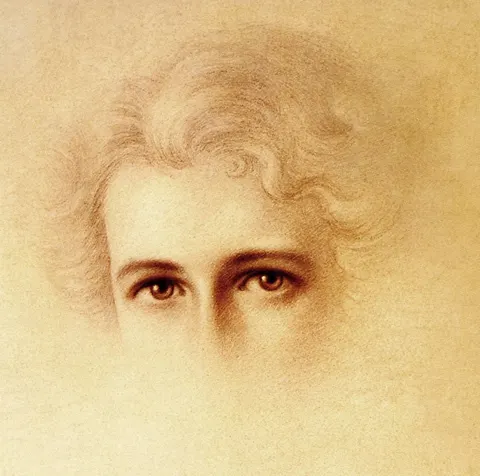
In his portraits, some people have no pupils in their eyes, as is often done in sculpture. Others are painted clearly and distinctly, still others have no clear outlines—in Georgiev’s art, the eyes are more than ever a window to the soul. He also liked to emphasize hands, which he called a person’s second face.
A Book of Paint and Lines
Some of his paintings Boris completed in 10 minutes; others took him six or seven months. He did everything with “the patience of a monk”; sometimes more than 100 sketches were needed before he began a particular painting.
“The book of my life is written not with a pen but with lines and paint,” Georgiev said. In 1931 a long-held dream was written into that book—the painter set off for India, which he knew indirectly from his meeting with the poet Rabindranath Tagore and from his reverence for Mahatma Gandhi. To the painter’s luck, the philosopher turned out to be on the same steamship he was traveling on, but refused to be painted. That would happen a year later; an unforgettable portrait would also remain of Gandhi’s wife, Kasturba, who died in prison a few years after she was painted.
Another interesting encounter took place on the steamship itself. As Georgiev himself recounted in a travelogue published in the newspaper Zora, two princesses famous in their day were on board—the wives of two brothers from the highest Indian society. Their names were Niloufer and Durru Shehvar—the daughter of the last Turkish sultan, Abdul Mejid.
One of the princesses invited the painter to an evening ball, and although he very much wanted to attend, he simply had no formal clothes for such an occasion. He felt “saddened that I too could not delight in an illusion of beauty.” The noblewoman, however, was very insistent, and the painter was forced to find an unconventional solution. “Without thinking too much, I took down the curtains from the door and from the porthole, the bedspread from the bed and the towel from the washstand. I dressed myself up skillfully, but looking in the mirror I wondered whether I would make a fool of myself in these rags. After long hesitation, I told myself, ‘Come what may,’ and at the celebration I entered the magically decorated and lit hall, where the music, the beauty of the princesses and the splendor of the most colorful costumes of the golden-haired Englishwomen had already created a fairy-tale mood. I was almost discouraged, thinking I was lost, when I heard: ‘This is the most original costume, and the most consistent in style.’ The result was striking and completely unexpected for me: the curtains and the blanket won first prize.”
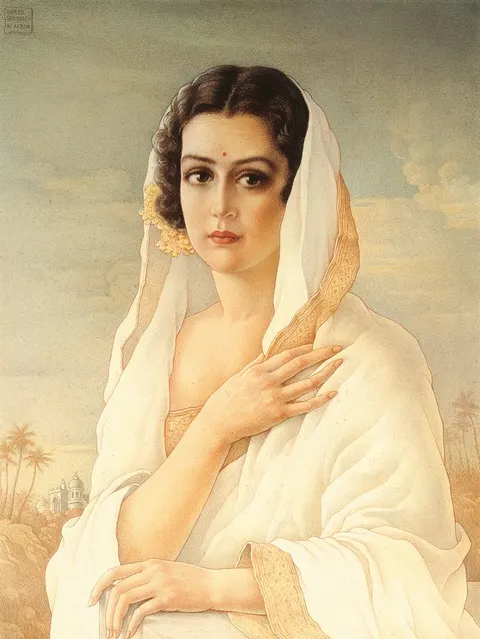
This was only the beginning of the friendship between the painter and the two princesses, whose portraits he painted during his journey. Especially remarkable is the image of Niloufer, with whom the rumors of the day credited the painter with a more special—romantic—relationship. And how could one not think of love, seeing the exquisite portrait that many of his admirers regard as Georgiev’s Mona Lisa?
A Whole Story in One Pair of Eyes
As the art historian Georges Nourijan wrote: “The portrait of the young Princess Niloufer, a divine being from whose deep and wonderful eyes radiates the perfection of her noble origins. Two sad eyes that speak, that describe the whole story of a tragedy lived through. Almost transparent, with an ivory forehead, with refined manners, married against her will to a Hindu prince with coarse, almost barbaric ways. This drawing, into which Georgiev poured himself entirely, he sculpted as if sculpting his own nature, interpreting it above all through the prism of his personality as a great artist.”
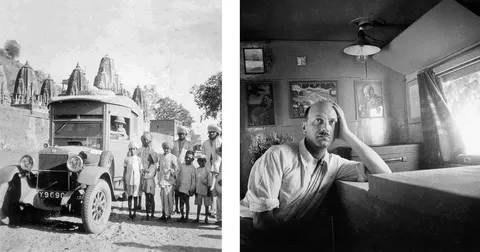
Setting foot on the Indian subcontinent of his dreams, Boris revealed another unexpected talent of his—on the chassis of a Ford truck he had built himself a little house on wheels, in which he set off across the vast country. “I built myself a cozy home in which I lived in the jungles and traveled far and wide. Then I loaded it onto a steamship and brought it to Italy. As soon as I have the chance to move about, I will begin my nomadic life on wheels, because this life is the most ideal for me. I am a very easy and economical guest, because I have stocked up on everything necessary. Like a nutshell, it has a living room, a bedroom, a bathroom, a dining room, a kitchen and all the comforts: a library, a record collection, a radio, a radio-gramophone, a bicycle and a boat.”
Alas, India would shake the painter’s soul; he would be deeply moved by the poverty and misery. His handmade vehicle would also turn out to be a pharmacy and an infirmary for many sick children and lepers. Images would remain in his heart that he would later transform into his cycle of paintings World Sorrow.
The Delusion of the Western World
“I had no fantastic illusions and was well prepared to see the true reality in India. And indeed, I immediately had to see for myself in what delusion the Western world is held by the colossal bluff created by the imagination of various writers, so-called scholars and others, who have planted in all of us the idea of a magical India, of its deep wisdom, its sublime religions, art and so on—in a word, of its great culture that surpasses ours.
One must live in India, travel far and wide across the country, to become convinced of exactly the opposite. This famous culture and wisdom, this religion summed up in one word—Brahmanism or Hinduism—are the expression of such a pitiful and barbaric state of social and religious order, which has brought this unfortunate people to extreme misery, physical and spiritual, to a state of decline, degeneration and apathy that fills you with the greatest sorrow,” Georgiev wrote.
As he traveled, the painter painted portraits of the rich for substantial fees and used the money to help the poor, feeding them and buying them medicine. He traveled for a long time, returned to Europe to earn more money, then went back and completed his grand Indian tour. He spent five years in India, reaching Burma and the distant island of Ceylon (today Sri Lanka). During his odyssey he painted Jawaharlal Nehru and again made a portrait of Rabindranath Tagore, who invited him to stay on as a teacher at his university, but once again Boris chose the road over stability.
The Poet Against the Dogmas
Here is what Georgiev recalled about the poet, still loved around the world today: “I met him in 1926 in Italy and made his first portrait. Then we saw each other in India in 1932, and I was his guest at Santiniketan, his university, not far from Calcutta. He is a very great poet and philosopher and wrote very sublime poetry. The pity is that he, like many Hindus of the high castes, never felt the need to write about the most important social problems in India and to defend the unfortunate pariahs and women against the monstrous dogmas of Brahmanism, which have condemned millions of human beings to the most terrible misery and humiliation—the pariahs, and women as undesirable and harmful creatures who, after the husband’s death, were burned alive together with his corpse. Now this barbarism is forbidden, but here and there such burnings still take place. It took an apostle like Gandhi to fight against these dogmas. That is why he was killed by the Brahmins, like Christ.”
Georgiev considered it a great stroke of luck to be able to paint, and in his own ashram at that, Gandhi himself, before whom he had long bowed. “The impression of my first meeting with this small, homely man, in whose eyes one could read all the sorrow of India, remained indelible in my soul.” “I lived through deep emotions during my frequent visits to Gandhi, when thousands of pariahs came to find a little consolation with the apostle of goodness and nonviolence. This apostle of goodness, Gandhi, worked a miracle: freeing 400 million people from a foreign yoke without using any weapons of murder.”
Despite the hardships and the overall bleak picture, the painter later said that his journey through India was the happiest and most interesting period of his life. “I had the opportunity to be initiated into many secrets. My companions were the misery and pain of the pariahs; I warmed myself at the fire of the noblest souls and drew images from those friendships; I met the illusions of luxury and rejected them. Everywhere a brother, but always on the road,” Georgiev wrote.
War Instead of Peace
During this period Boris often returned to Bulgaria to see his family and his many friends. He kept up a constant correspondence with them, which today tells us a great deal about him and recounts his extraordinary story. Every letter to someone close began with the address “brother” or “sister”—one more stroke in his dream of a world where people live not as enemies but as brothers. “Our appearance in this world is a true mystery. We are born to feel so much pain, sadness and disappointment, caused by the inexplicable malice and stupidity that reign in relations between people and nations and that provoke all these barbaric wars destroying the happiness of millions, instead of seeking and wanting to love and live as brothers in love and peace,” Georgiev wrote sorrowfully.
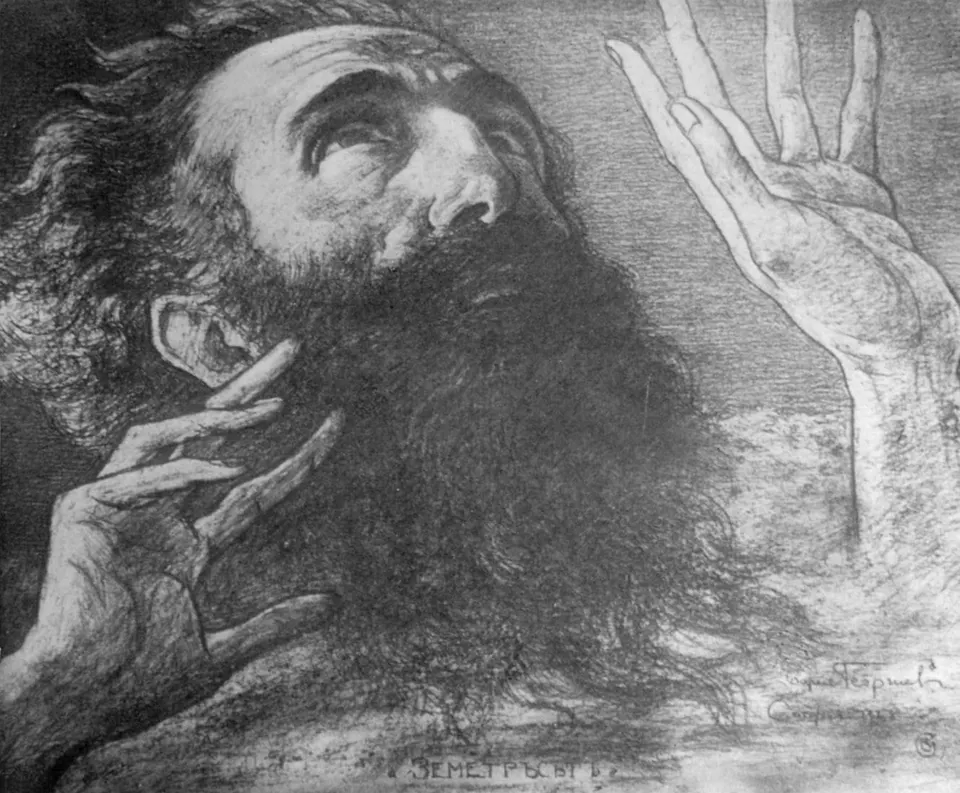
In Bulgaria, too, he painted some of the famous Bulgarians of his time. Among painters, the closest to him was Vladimir Dimitrov, known as the Master, whom he called “a crystal soul and my brother-in-art” and whose portrait, The Earthquake, is one of the most emotionally charged in Georgiev’s long collection. For his part, the Master said of his colleague that “in his art he went further than all the painters in the whole of world painting when it comes to drawing and the psychological portrait.”
A close friend of his was the Symbolist poet Teodor Trayanov, who dedicated many of his works to the painter. Also well known is his portrait of Petar Danov, the founder of a Bulgarian spiritual movement, who in turn said of Georgiev that “in him, art has already been laid down as a religious conviction. Not for anything in the world does he sell his paintings. The Spirit works in this man. When I look into his eyes, he is sincere; he has no ulterior motives.” Georgiev also painted Mara Belcheva, the writer Chicho Stoyan, and Lyuben and Pancho Vladigerov. Among his friends were Sirak Skitnik and Boris Hristov.
In 1932 the critic Stefan Mitov wrote: “It would be hard to find another artist, in the miserable state of purely external and formal problems of modern painting, whose philosophy of life and worldview are so deep and at the same time so intimately bound up with the rhythm of the lines, the conception of the forms, the spirit of the composition and the pure musical abstraction of the chromatic interpretation.”
Build Your Own Car
On the whole, Boris Georgiev’s attitude toward Bulgaria and the Bulgarian state was always ambivalent, just as it is for many intelligent Bulgarians today. At home he was repelled by the philistinism, the bureaucracy and the envy, yet he loved the humanity, the fire, the personalities.
“Let the sages and saints seek meaning in life, in wealth and pleasures. We will seek greater and more sublime spiritual riches. Just not in Bulgaria. Go and talk to Bai Ganyo, the archetypal Bulgarian boor from Aleko Konstantinov’s 1895 satire, about art—for him, money is everything.” “In no country have I endured crueler suffering and insults than in my homeland. I cannot describe in words the horror of the torments I am living through these days… It pains me greatly to write like this, because I have the most sincere and spiritually elevated Bulgarian friends and brothers, but they, as I said, are not Bulgarians but representatives of true humanity, above racial and national prejudices.”
He was drawn to Bulgaria by its poetic landscape and its people; in 1936 his homemade automobile made it all the way here from Italy. It is no accident that until the end of his life the painter kept only his Bulgarian citizenship. He returned to Sofia for the last time in 1943.
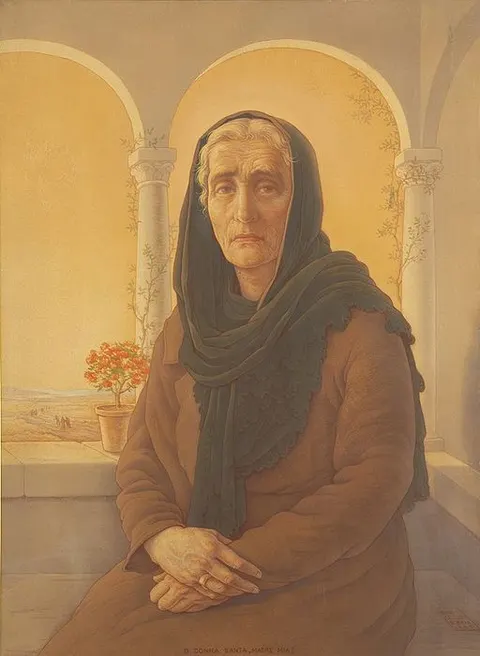
The Second World War found him in Milan, but because of the bombing he was forced to move to Bergamo. He stayed there after the war ended, too, and befriended local families. In 1947 his mother, already very ill, came to live with Boris. During the remaining two years of her life, a girl named Virginia Giacometti, the daughter of a family of friends, cared for her, keeping her company and helping her. In her, Georgiev found his new guardian angel. They began traveling together from city to city; she helped him organize his exhibitions and became his constant companion. “She is a wise and cultured being, and in the atmosphere of my life as a painter she learned languages and delights in culture. Now she takes care of me like a real mother,” Georgiev wrote. When she was 17, the painter adopted Virginia, intending that they face life’s difficulties together and that he help her travel and broaden her outlook.
Passed Over by the Modern
Alas, that never quite happened, because hard years began. The painter was relegated to the background, swept aside by modern art, which he had fought all his life and loved to mock. There were almost no portrait commissions; he was forced to refuse financial help to many people close to him, which wounded him deeply and piled bitterness in his soul. Gradually his health began to fail, too.
His last great adventure came in 1951, when Georgiev set out for Brazil to show his art. Although he stayed there almost four years, across the ocean he felt appreciated but still misunderstood, and he received no serious response from art lovers. Soon his money ran out, so he could not realize his dream of a grand tour of the countries of South America and returned to Italy.
We were fortunate to meet Virginia Giacometti in person and to take her back to those interesting times. Today she is of advanced age and has visited Bulgaria several times to promote her adoptive father’s art.
“I keep many memories of my father, of the years I lived with him. One of the most vivid is when he first showed us the paintings he was most deeply attached to. Especially the ones in which he had painted his sister Katya. As he told us about them and explained them, he himself was deeply moved,” says the elderly woman, who will nevertheless remain forever young, gazing out from the extraordinary portrait Georgiev made of her when she was just 17.
“My father often spoke of Bulgaria with nostalgia and hoped to show it to me one day. Unfortunately, that never happened. In my view he stood apart from other artists, because besides being a painter he was a special person—very generous, an altruist. All his life he traveled the world and had many influential friends, but he also made friends with quite ordinary people,” Virginia recalls. Her saddest memory is of the last days of his life. “His end was agonizing, and he refused to give up, because he was a strong man and had lived healthily—he was a vegetarian, never drank alcohol and never smoked.”
Between Katya and Michelangelo
Boris Georgiev’s last exhibition was in Rome in 1961. A few months later, on April 8, 1962, he died of cancer. At his wish, he was buried in Florence, not far from Michelangelo’s grave and next to his sister Katya. Between the two there is only the suffering gaze of the pierced deer with its questioning eyes. And brother and sister remain among us in the living, eternal paintings of this incredible Neo-Renaissance artist.
Georgiev left behind on Earth more than 500 works, scattered across Bulgaria, Italy and India, which have still not been fully documented. Today the art gallery in Varna bears his name, and it holds a permanent exhibition of his paintings.
Firmly opposed to the concept of art for art’s sake, the painter was convinced all his life that art must not be an end in itself, but must explain the meaning of life—its mission is to work for the spiritual perfection of humanity. “The finished form of perfection that a work or a creation represents is, in its original sense, spiritual creation, not a matter of entertainment. It is the embodiment of true art, which is built on purely ethical foundations and supports the evolution of civilization and the spiritual unity of people,” reads his artistic credo.
And besides his art, he left us his eternal, universal message. Despite his sympathy for the teachings and ideas of Tolstoy, Danov and Roerich, Georgiev did not want to be directly associated with any teaching—because “I am not a theosophist, nor an occultist or metaphysician; I simply want, with my own reason, to explain to myself perfectly simply the phenomena of life and our fate.” “Am I a Tolstoyan? I do not belong to any ‘ism,’ nor to dogmatic religions. Tolstoy is a very great idealist who preached the true ideals of Christ without any of the dogmas of the various churches, and that is why I value him greatly, as I do all the great people who have preached the ideals of goodness. Gandhi was one such.”
The Dictatorship of Cunning Priests
“I recognize no fanatical dogmas of the various religions, founded on idolatry and on the dictatorship of cunning priests who speculate on human stupidity. One of the very great apostles of goodness and of brotherhood among all living beings was the Buddha, who preached the fundamental feelings of goodness, without the fantasies of various deities and without the need for idolatry in various temples.”
For Georgiev, true religion is not believing in fantastic deities and idols, but feeling in one’s soul that “we come into this world to work together with our neighbors for more justice and goodness in a universal brotherhood.”
“I consider art a religious mission in this world of so much vileness, bitterness and destruction of ideal values. Besides its content and spiritual inspiration, art founded on persistent work in studying the technique of drawing and color, as the immortal geniuses of the Italian Renaissance showed the world, must not copy purely visual banalities from everyday prose or combine daubs of pathological absurdities that degrade human dignity; rather, inspired by pure universal feelings and the divine harmony in the structure of nature, it must express in poetic form the nostalgia of the suffering soul, so that it may rise into the spheres of Beauty and Goodness to find a little consolation and respite from the bitterness and vileness with which life is filled, especially in the era in which it has fallen to us to be born and live.”
When Boris told him his story and showed him a few pages of his memoirs, the Italian writer Giovanni Papini said he had never read a more impressive story in his life. He suggested it be published immediately, but the painter was not yet ready to write it. He never managed to finish his autobiography, leaving it to the following generations to tell his story. As he had said earlier, he spoke through his paintings.
And through his wise ideas and words, which remind us of eternal things about relations between people, about the sanctity of friendship and fellowship: “I will spend my life as a lonely wanderer who will roam the world and carry within him the holy friendship of his dearest beings. Life is too short, and the sufferings and everyday cares too enormous, for us to treat our relations with people lightly. That is why for me there is either friendship or an ordinary brotherly disposition toward my neighbors, with whom everyday life brings me into contact and with whom, through no fault of mine, I have not yet bonded spiritually as I have with other brothers, with whom our souls have come into communion.
Friendship for me is a religious cult; it surpasses the ordinary notion of companionship, and that is why it is born regardless of our will and desire, and likewise, when it is true, it is not up to us to lessen its intensity.”
The Artist as Prophet
Boris Georgiev ended his endless journey by summing up what he had achieved: “The wandering of the artist is like that of the prophet: unbridled, without rest, sustained by God but troubled by a longing that is born anew every day. Mine has lasted since the day when, as a youth, I left my father’s house on the shores of the Black Sea and set off far away, among people, through the various countries of Europe, Africa and India. I have preferred to wander on foot and have had the privilege of being initiated into many mysteries. Sometimes, as night approached, I would find work to earn my daily bread. My companions have been the poverty and suffering of the pariahs. I have warmed myself at the flame of the noblest souls and in communion with them have known heartfelt friendship. I have been flattered by luxury and abundance, and I have rejected them.”
And assessing the time in which he lived, which, unfortunately, has kept many of its sad features to this day: “It has actually fallen to us to live in an era that, as modern, carries within it only the disfigurement of the true values of life, and whose marks of civilization are nothing but a glaring moral imbalance. And the painter who does not seek, in spheres actually closer to a psychiatric diagnosis, to come out with some extravagance under the banner of some new ‘ism’ risks being taken for old-fashioned.
The rift between the man and the artist has reached bizarre extremes: sometimes a hysterical striving for something new, modern, entirely external leads to the humiliation of human dignity and brazenly reproduces—with self-importance—madness, shamelessness and vulgarity that desperately remain in a state of utter coarseness and crudeness. Free artistic expression has become so mixed up with the irresponsibility of the artist as a person that sometimes it seems the artist has abandoned the man. Hence today’s wandering and unrest.”
Don’t his words hold true with full force for our own time, too—for today’s mass art, cut off from its core and its fundamental tasks, and for its elite forms, which in turn are cut off from people and are therefore unviable and stillborn? Could a person like Georgiev be born today and have his extraordinary fate? According to his daughter Virginia, the answer is no. “I don’t know whether anyone today could do what he achieved. The times are different. Progress has brought many good things, but life has become more complicated.”
We can only hope she is wrong. And end with one last message from the painter: “Art must not be only for art’s sake, but must be guided by ethical ideals and serve the spiritual elevation of humanity.” Just as the eternal paintings of Boris Georgiev manage to do for all who have the eyes to appreciate them…
If the subject has caught your interest, we recommend two of the most detailed books, which gather invaluable, extremely interesting and complete information about the painter: Boris Georgiev – svetlina varhu tvorchestvoto na hudozhnika (Boris Georgiev: Light on the Artist’s Work), published in two editions, in 2009 and 2014, and Skapi brat. Pisma, dnevnitsi, statii (Dear Brother: Letters, Diaries, Articles) by Plamena Dimitrova-Racheva.
The quotations in this article are taken from these two publications.
Published in: 8 magazine, issue 5/2015
Last updated: September 8, 2021