“The writer-machine? It keeps in its memory a vast store of words and has perfect command of every subtlety of grammar and style; it knows all the organs of sensation and all the ways of writing that writers have developed over the last 3,000 years. This ‘writer’ observes, memorizes phenomena, reasons, processes the data reality gives it. In the end it writes books, and we, reading them, are thrilled, but… we remain cold.”
Is Dmitry Zhukov, the author of these lines, right? There is no way to ask him; he has long been gone. Artificial intelligence is leading us toward dizzying change; it writes poetry that wins competitions. It raises enormous questions whose answers I have been chasing for four years now.
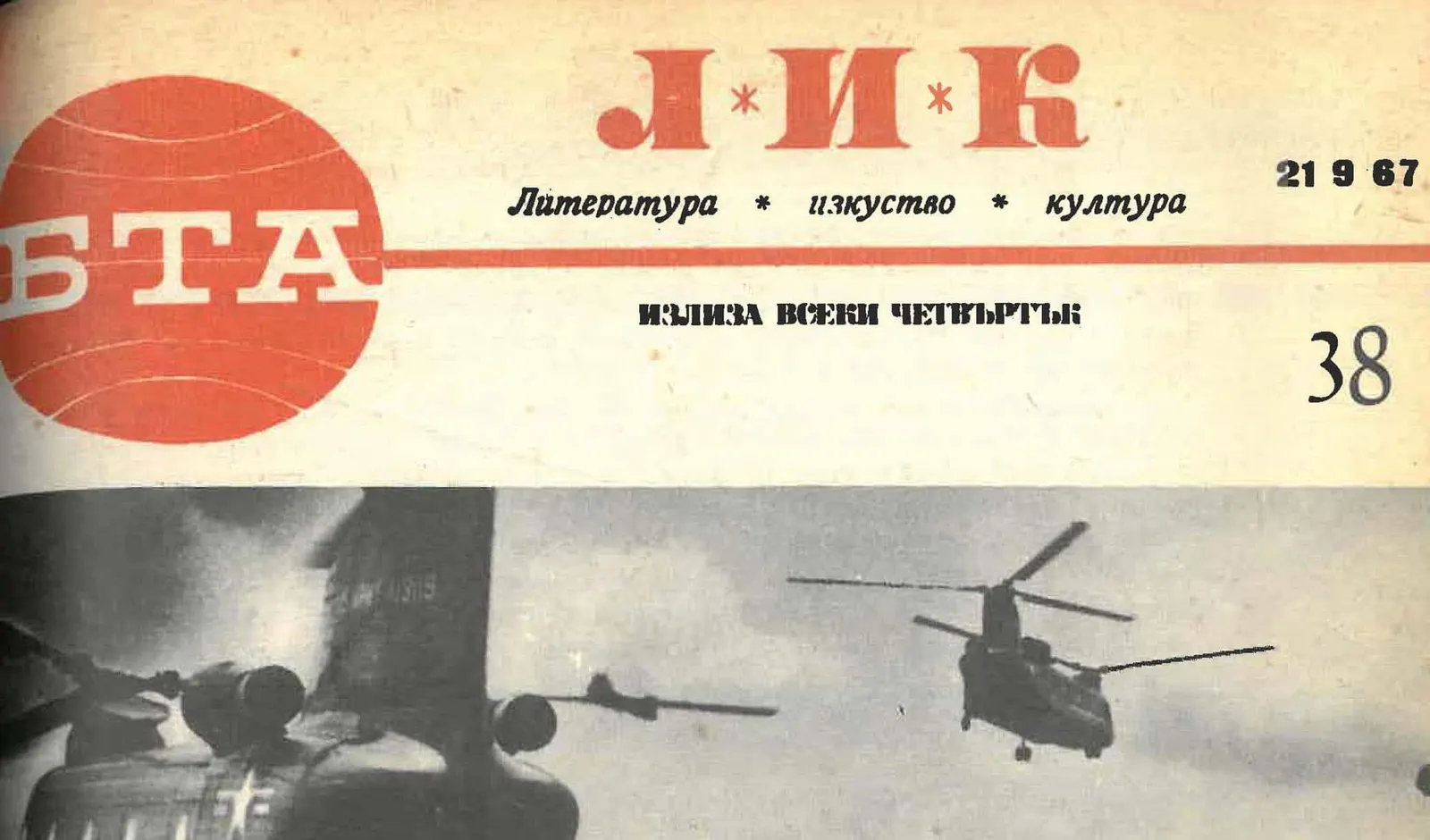
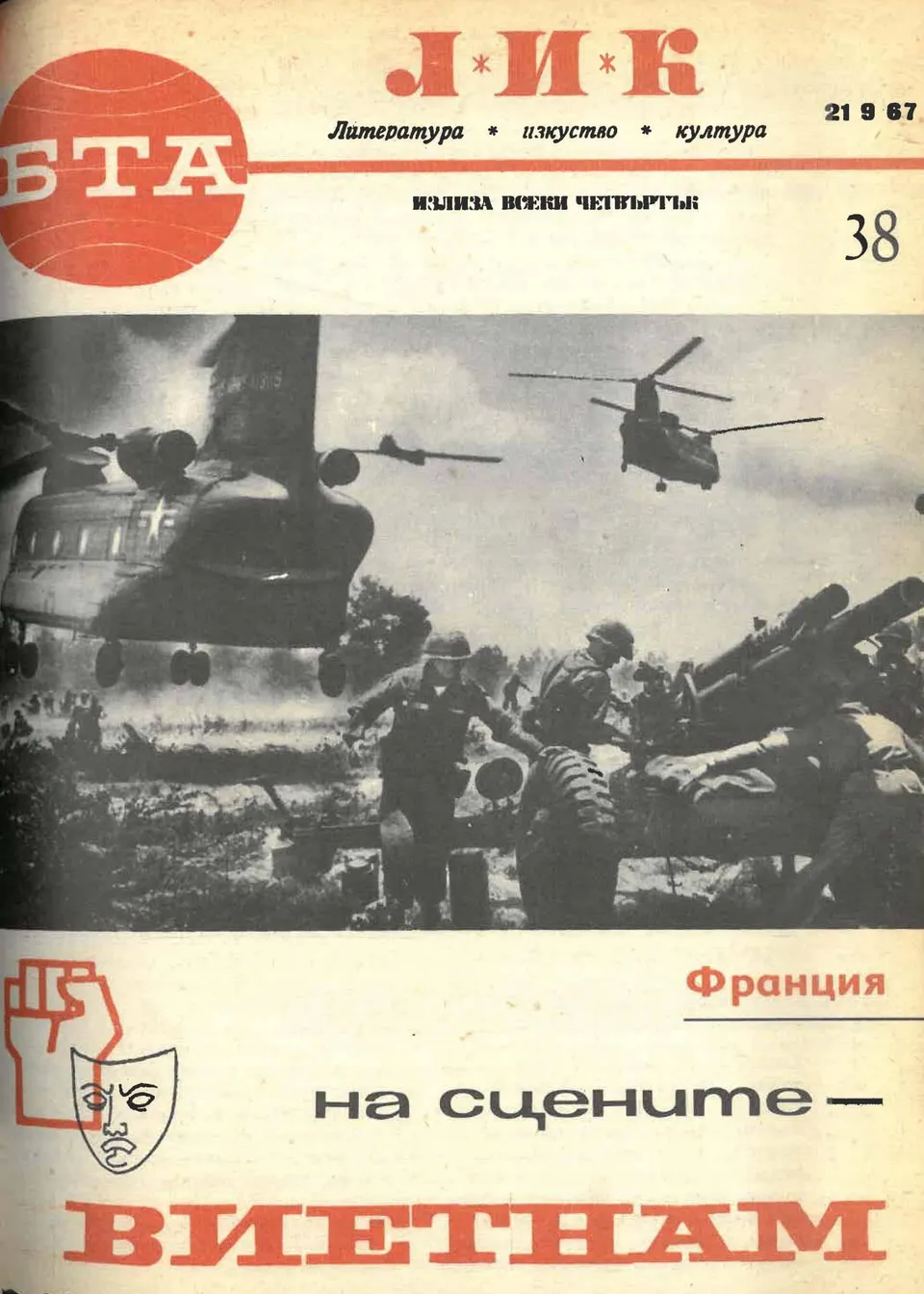
Sometimes it is worth looking at them through the dispassionate eyes of the past. This text was published in the September issue of LIK, the magazine of the Bulgarian News Agency (BTA), in… 1967! Yet, as you will see, many of its ideas sound not even like the present, but like the future. What awaits you is a strikingly topical read that is more than half a century old!
On this topic so far:
-
AI made it among the best in a second poetry competition (an experiment)
-
“Poetry remains a secret treasure.” “Hristian Papazov” in his first interview
So, can a machine learn to write like Pushkin? Or is it leading us into Orwell’s world?
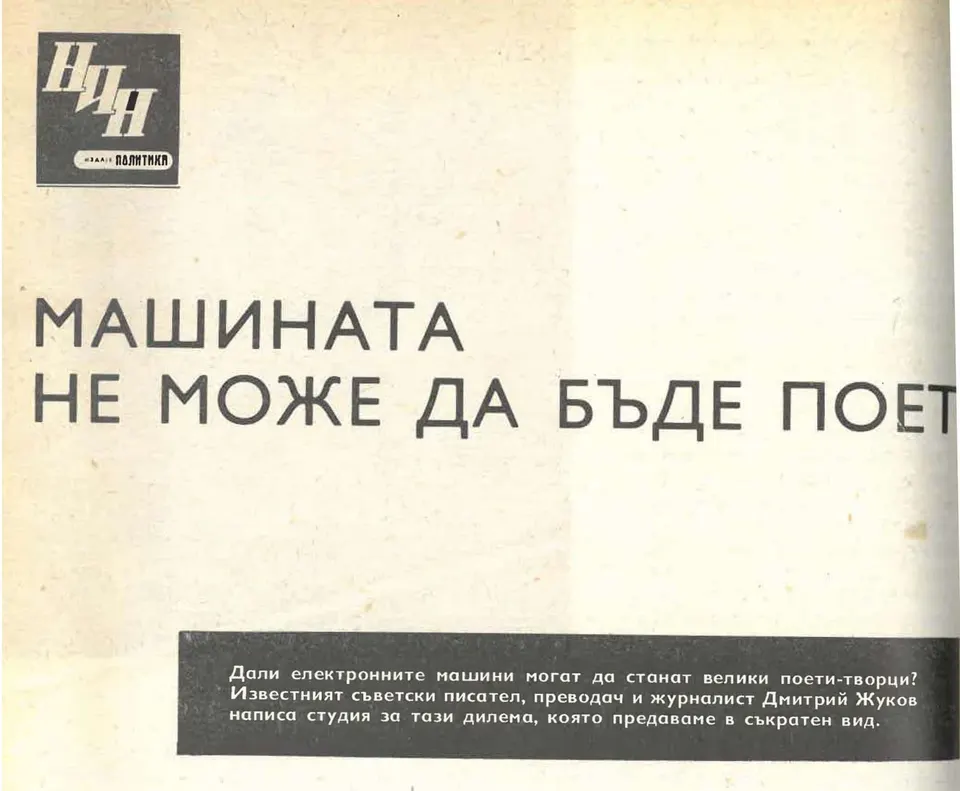
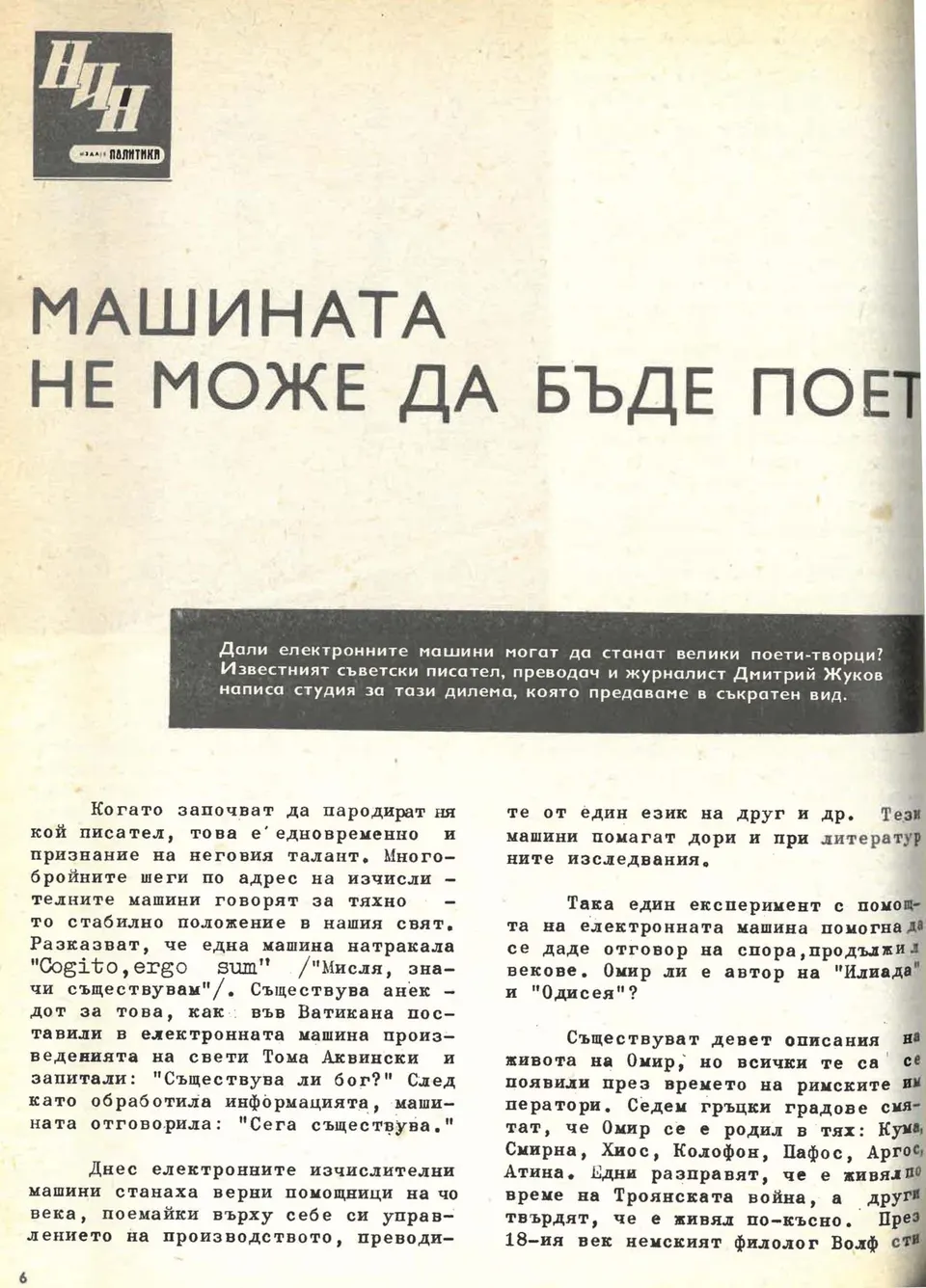
“Can electronic machines become great poets—creators? The well-known Soviet writer, translator and journalist Dmitry Zhukov wrote a study of this dilemma, which we present in abridged form,” is how the BTA publication introduced what lay ahead. Here it is.
When people start parodying a writer, it is at the same time a recognition of his talent.
The countless jokes aimed at computing machines speak of their secure place in our world.
They say a machine once clattered out Cogito, ergo sum (“I think, therefore I am”). There is an anecdote about how, at the Vatican, they fed the works of Saint Thomas Aquinas into an electronic machine and asked: “Does God exist?” After processing the information, the machine replied: “Now he does.”
Today electronic computing machines have become faithful helpers of man, taking on the management of production and translation from one language into another. These machines even help with literary research.
Thus one experiment with an electronic machine helped settle a dispute that had lasted for centuries. Is Homer the author of the Iliad and the Odyssey?
There are nine accounts of Homer’s life, but all of them appeared in the time of the Roman emperors. Seven Greek cities claim Homer was born within their walls: Cyme, Smyrna, Chios, Colophon, Paphos, Argos, Athens. Some say he lived at the time of the Trojan War, while others insist he lived later. In the 18th century the German philologist Wolf concluded that no Homer had ever existed and that the Iliad and the Odyssey were written by numerous anonymous authors. Thus arose one of the most complex scholarly problems, one that could not be solved for more than a hundred years and came to be called “the Homeric Question.”
Only recently were the endless arguments resolved with the help of an electronic computing machine. The American philologist James McDonough had the computing machine analyze all 15,693 lines of the Iliad. The machine compared the meter of the different parts of the poem. The statistical calculations and the analyses of the many examples the machine produced allowed the philologist to prove that the poem was written by one single person and that Homer is a historical figure.
Since 1964, poems by electronic machines have been appearing in print more and more often,
and in their modernism they can be compared to the poems of Eliot.
We have already read science-fiction stories and novels about electronic writers who compose marvelous poems and novels.
Perhaps the future promises us the mechanization of literature?
What can we not expect from machines that have an excellent memory and are gradually mastering all the wisdom of language?
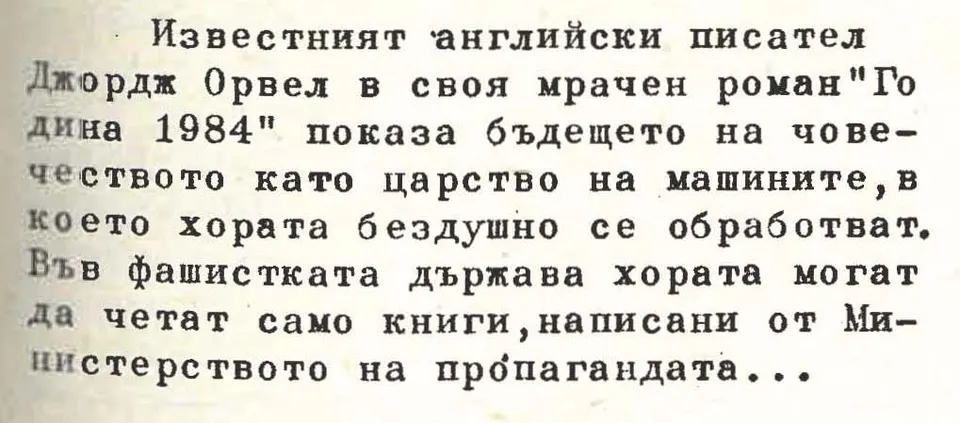
The famous English writer George Orwell, in his grim novel 1984, showed the future of humanity as a kingdom of machines in which people are soullessly processed. In the fascist state people may read only books written by the Ministry of Propaganda…
“Mysticism” or calculation
What is creativity? Can one analyze and build a logical chain of the creative process behind even the smallest literary work, starting from the birth of the idea and ending with the choice of creative means? Why, in Babel’s words,
“can no iron pierce the human heart as chillingly as a period placed at the right moment”?
Or is there, in the creative act itself, some mystical principle that does not submit to human reason?
This problem is not new. We know the statements of many great writers who tried to analyze the mechanism of their own creativity.
Maupassant believed one should avoid vague inspiration. Pushkin described inspiration thus: “Inspiration is a disposition of the soul toward the lively reception of impressions…”
Tolstoy writes of his preliminary work on a new piece as of the reflections of a chess player who thinks as many as ten moves ahead…
According to Dostoevsky, the writer and the poet are in fact jewelers cutting a diamond…
Now scholars are striving to penetrate as deeply as possible into “the secret of creativity.” In 1962, prominent Soviet literary historians arrived at the creation of a new scholarly discipline—the psychology of creativity—which had long been neglected because it had been compromised by idealists who placed creativity on a mystical foundation.
In 1963, engineers and literary specialists, mathematicians and linguists gathered at a symposium in Leningrad and tried to find points where their interests meet.
The cyberneticists spoke once again about the possibility of building a machine-creator, while the literary figures protested furiously against it…
The human writer and the machine “writer”
During the discussion, Academician Sobolev said that “to doubt the possibility of understanding the creative process means to doubt the possibility of understanding the world.” We agree with him, and so let us suppose that “the secrets of creativity” have been uncovered and the machine-creator has been built. And
a new question immediately arises: should this be done at all?
The “creativity” of the electronic poet or writer will always spring from a different source than human creativity. Human creative work moves us deeply precisely because it reflects the person, with all his flaws and virtues.
“Understand,” Walt Whitman used to say, “that in your writings there cannot be a single trait that is not in you. If you are vulgar or wicked, it will not escape the reader. If you like to have a footman standing behind your chair at dinner, it will show in your writing too. If you are envious or stingy, if you do not believe in life after death—that will show as well. There is no way, there is no recipe, to hide even one of your flaws from your texts.”
The same can be said of a writer’s virtues.
And the writer-machine? It keeps in its memory a vast store of words and has perfect command of every subtlety of grammar and style; it knows all the organs of sensation and all the ways of writing that writers have developed over the last three thousand years.
This “writer” observes, memorizes phenomena, reasons, processes the data reality gives it. In the end it writes books, and we, reading them, are thrilled, but… we remain cold.
The book may thrill us, may excite us. But it is a peculiar kind of excitement
—it may be the joy that man has created such a talented machine. Reading the book, we keep returning to the human being.
Why are we cold? Because we immediately saw in the author of the book an excellent craftsman, a cold craftsman. Otherwise, we do allow craftsman-writers to write their works, but we are forever waiting for them to produce that one “real” work.
What we need is art. We will not settle for less. Any craft can be handled by a program, but with art things are far more complicated.
The machine-author was more precise in its observations than any human, and we praise it for that. The machine also came up with a sufficiently complex plot, and the characters in the work are rendered superbly. A sense of proportion is felt in everything, and so on.
And yet this book was written by a craftsman. Or, to be more precise, by a machine trained in the literary craft…
What is the misfortune of the writer-machine? It does not live in human society, because it does not suffer with people or rejoice with them: the machine has no personality.
When Academician Kolmogorov was asked whether automatons would write poems to express their feelings, he replied:
“Why not? For now we are not yet thinking about building such automatons. Even if such a poet-automaton has been built in France, it has nothing to do with this problem. Let us suppose a machine has been created that is capable of writing a poem equal to Pushkin’s The Bronze Horseman.
Such a machine could not be simpler than Pushkin’s own brain.
It would have to create a model of Pushkin’s inner world; it would itself have to create models of the psyche of its readers and use them to test its verses.
To train an ‘automatic poet,’ one would have to model the social environment outside of which poetry could not arise…
As you can see, the task is complicated. For now, poets need not fear competition from automatons…”
In the Department of Probability Theory at Moscow University, under the leadership of Academician Kolmogorov, a group of students has for several years been developing mathematical methods for studying verse. Here meter is defined. The scholars have obtained a mathematical description of the sound image of meter…
Some scholars hope that the knowledge accumulated in this department will make it possible to model the processes of thinking and creativity in machines.
But Academician Kolmogorov believes such an attempt is almost impossible.
Verse—it is a crystal of a precious stone. The machine would have to work through a great many variants before finding a satisfactory solution.
If all the possible variants of one and the same poem were gathered together, the result would be a pile of paper three light-years wide, high and long.
Whereas a person writing a poem uses only a few variants…
Man is always ahead
The scholars went into the empty university hall, and the scientist, without saying a word, covered the blackboard with formulas for hours. Einstein did not interrupt him once. When the last proof had been written out on the board, Einstein stood up and said:
“Technology makes people’s lives as easy as possible.”
This easing must extend to art and to creativity in general, if we do not want to end up in spiritual impoverishment.
Technology helps bring nations closer together, but its international character, unfortunately, contributes to erasing the national boundaries of different cultures.
By all appearances, man will never need to build a machine-poet. But robot secretaries with phenomenal memory will be needed by people of science and literature within a few decades.
Pyotr Kapitsa expressed the opinion that power plants will soon be run by machines, and
the freed creative force and spiritual energy of people will be directed mainly toward science and art.
As for the dispute over whether the machine is smarter than man or not—the question is posed wrongly. Machines are our creations, creations of our thoughts, of logic; they are the result of our labor. Many people devote their knowledge to the machine, but it will never become man’s master, because humanity is always moving forward, and every machine already built is humanity’s yesterday…
Is every machine already built truly humanity’s yesterday?
Should poets fear automatons, and which automatons?
Maybe. Here are a few more possible answers:
-
AI made it among the best in a second poetry competition (an experiment)
-
“Poetry remains a secret treasure.” “Hristian Papazov” in his first interview
-
“Poetry of a New Generation: Real and Digital Writers” – The Library, BNT1
This piece was prepared at the suggestion and with the special assistance of Yanitsa Hristova, editor of today’s issues of that very same LIK magazine.
Could public media be the most logical media of the future?