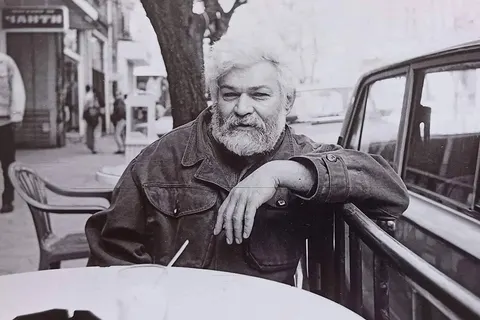
A remarkable master spends years searching for his own way to leave his gaze on photographic paper, and in the end he finds it. He coats his nude heroines in emulsion and “prints” them directly onto the photographic paper. As someone would later write, “he is at once the creator of his own works and a participant in them.”
His unconventional approach and his photographic paintings, which become known as “archetypes,” own their era. And then they seem to vanish, just as archetypes do.
Today you will find almost nothing about him on the endless internet. Takor Kyurdyan died a quarter of a century ago, at only 51. And now the time has come for his singular works to be reborn, dug out of time's memory and the colorful history of Bulgarian photography by a young historian.
It is time for a black-and-white digital story that brings together the fates of three men in a friendship beyond time.
He sells chestnuts
beneath the chestnut trees of Paris,
the flying Dutchman.
Odysseus does not return to Ithaca.
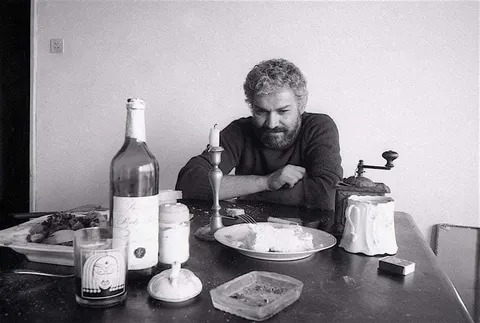
Takor Kyurdyan is a remarkable photographer from a generation that will be remembered for as long as anyone cares about the meaning of what is caught in images. A generation that, before the 1990s, made its way through the world with its own originality, so that those who came after could tell its stories.
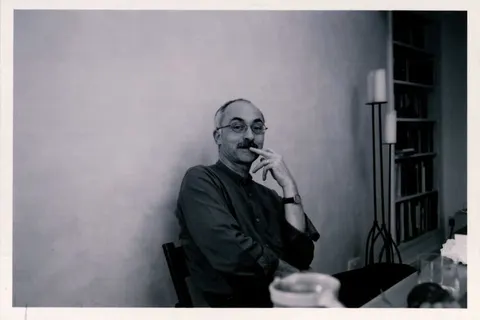
Silvio Tomov is a young historian captivated by the past of photography. Shortly after he came into this world, the photographer whose story he now feels called to tell left it.
Were you struck by the lines of verse a little higher up? They (and all the ones that follow) belong to Ivan Peychev, a half-forgotten Bulgarian poet and a friend of Takor Kyurdyan, whose words carry the same magic of time and also capture the archetypes.
Do not touch
the loneliness.
The loneliness is mine.
My one and only,
tender
and terrible
solitude.
“What a thing time is—when the hero of this story left this world, I was one year old. It is hard to piece together a photographic history, or any other kind, out of fragments, but it is still worth trying,” says Silvio Tomov. “Probably for many people his work remains strange and incomprehensible—both in the time it was created and now.” That is exactly what draws the young man to his story and makes it so fascinating.
Silvio came across Takor's name by chance while he was learning photography. He grew curious about why so little information could be found about him and dug in to fill the gap. He has met with contemporaries and relatives, and he already has a detailed article ready, which is set to appear in the specialist press.
Among the masters of his generation, such as Yordan Yordanov (Yuri), Garo Keshishian, Stanka Tsonkova-Usha and Georgi Neykov, Takor Kyurdyan is today certainly the least known name. Even though he stands out with an originality that still makes his famous “archetypes” recognizable (and incomprehensible).
Inevitably comes the great
gray dawn.
Inevitably I come,
inevitably gray
and lonely, to you.
Born in Ruse, a city on the Danube, on February 1, 1946, Takor, like many of the others on that list, graduated from the Technical School of Printing and Photography in Sofia. As a student he was a loner and yet very sociable; though small in stature, he was always at the center of the crowd.
Then, unexpectedly, he decided to change course sharply. He trained as a dental technician, but photography called him back again, and he never worked a single day in his profession. He looked for different jobs to support himself as a photographer, while also leaving himself time to work on his own projects, to create and to experiment.
As Katerina Gadzheva says of him and his colleagues, they were “a peculiar breed of people who could live without money, on art alone.”
Takor worked as a photographer for the National Theater, the National Ballet and the Sofia Opera. For a long time he shot freelance and moved through several studios, the last of them on Gogol Street in the capital, Sofia. His studio was often his home as well, where he sheltered many cats with biblical and Armenian names.
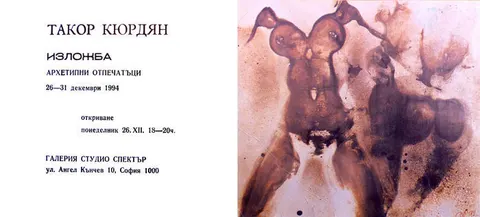
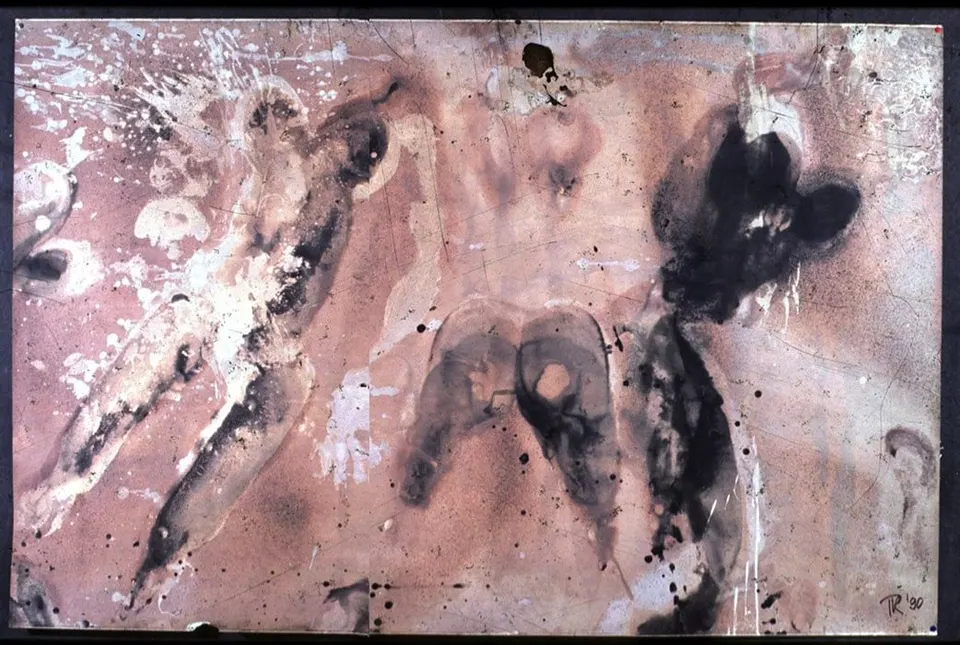
At the end of the 1970s his famous series appeared, the one that became popular as “the archetypes.” It is safe to say that Takor Kyurdyan created his own “technology” for photographs that look more like abstract, futuristic paintings.
I say farewell
to all the sharp
ridges.
I say farewell
to all the winds
that have uprooted
the autumn forests.
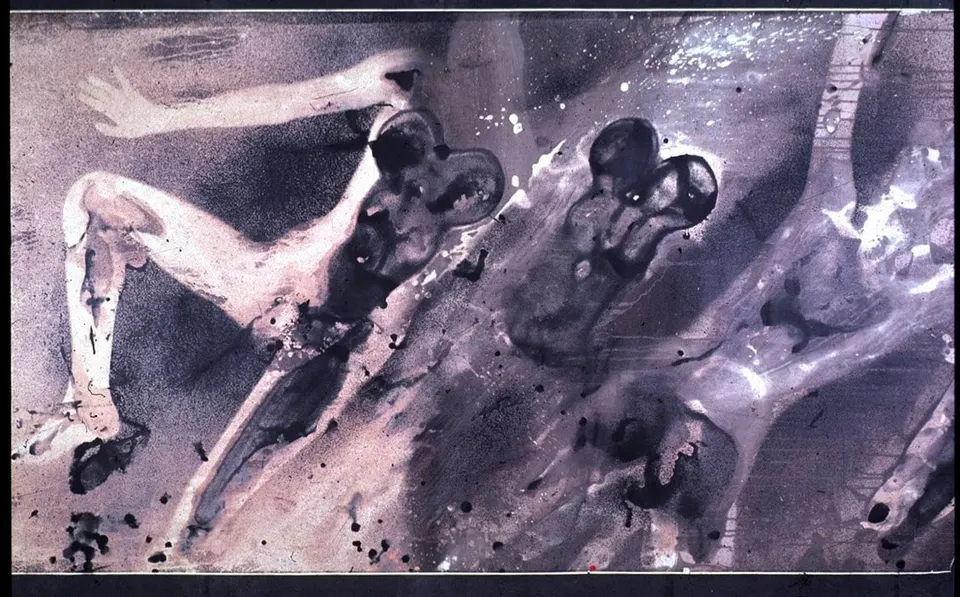
“His works are both personal and anonymous,” says Silvio Tomov. “Every print is unique and cannot be repeated. Human faces are absent from them; only very rarely can you make out their outlines. At the same time, these are the identities of people whose images are sealed forever on the huge rolls of photographic paper. The forms are barely hinted at, and human imagination fills in and draws the rest. Everyone can see what they are looking for.”
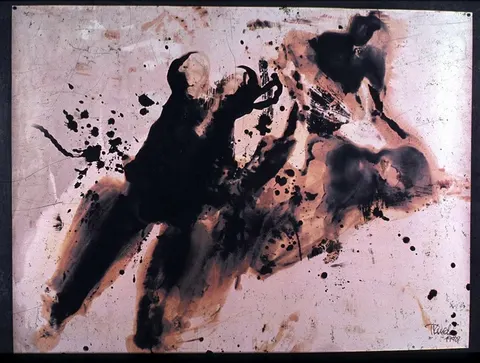
The pictures “happen” in the moment, before the eyes of the photographer and the models. In this case, one could even argue about whether it is really photography at all.
“The archetypes” were created in one of the halls of the Fohar photographic paper factory, where Takor worked toward the end of his life. That is where he got the large rolls on which the nude bodies were exposed. The works are monumental—up to 10 meters long.
“Many people think the effect comes from the models' bodies being wrapped in photographic paper, but that's not true—the models are coated with developer and lie directly on the large canvases. The exposure happens in the light at that precise moment, and then fixer is applied so that the image is preserved in that form,” Silvio explains.
I am waiting for you
to come back
along streets
that have created
solitude and waiting.
Here we can give the floor to Takor Kyurdyan himself, in one of his few surviving interviews. “Every day I photographed the sculptures of Galin Malakchiev. There was talk about Christo, that he had wrapped women too. I wanted to do it as well, but photographically, to have her projections, to have her in three dimensions. She is wet, wrapped in very thin paper, lit in the dark, developed, fixed. That's how I gradually started making some attempts. The first ones were terribly abstract, you couldn't make out anything, but then things started to work.”
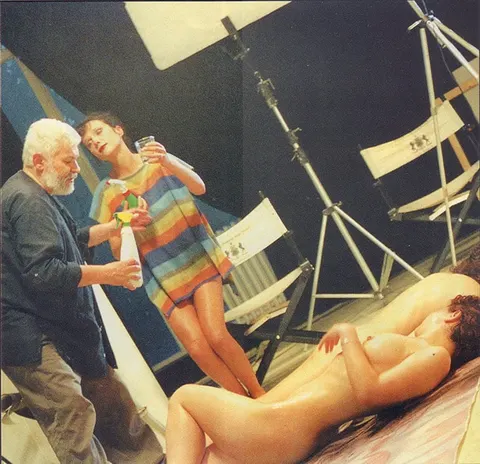
In his view, there is an interesting paradox at play. “This is super-realism, and yet if the canvas hangs in your room, it won't occur to you that it's your wife.”
In another interview, from 1995, he explains why he chose this strange approach. “I wanted to express my tenderness, my love for a magnificent female body. I wanted to preserve the memory of a moment. I thought that I was photographing not what I had seen, but what I would see. It is a memory in the future. I admired the wild pagan dance of the nestinari, the fire dancers who walk barefoot on embers in the villages of the Strandzha mountains. That was in my mind when I made the prints. There is something divine in art…”
“Obviously it's not simply about laying down nude bodies,” says Silvio Tomov. “It's about a philosophy—of life and of creation, well thought out and lived through. The words come straight from the heart; they are genuine and emotional. This way of expressing oneself wasn't invented by Takor, but it suits him best and becomes his visual signature.”
Captain, the ship
is lonely,
and are you the only one who still
does not know,
are you the only one who never learned
what everyone has long known—
the crew is dead.
Takor remains known for these unconventional pictures, although, as his daughter Violeta recounts, all his life he also made classic shots, and he carried his camera with him always and everywhere.
Everyone who talked about him remembers Takor as an all-embracing personality, an erudite, a charismatic figure. It is no accident that his close friends included not only the poet Ivan Peychev but also many other masters of the word and the lens of his time.
The photographer won serious recognition in the early 1990s, when Western galleries opened up to original Bulgarian artists. He showed his works in Paris and Houston, and today they are part of private collections scattered around the world.
Throughout his life Takor was fascinated by technology and tried to keep up with the times. He was determined to buy a digital camera and a computer, but it never happened, because he died suddenly, struck down by a stroke, in 1997.
“He lived only 51 years, but intensely, fully and at high speed,” his daughter Violeta recalls. “In a way some people can't manage in a hundred years. For him there were no such things as ‘a little beauty’ and ‘a little love’; everything was: now and at once.”
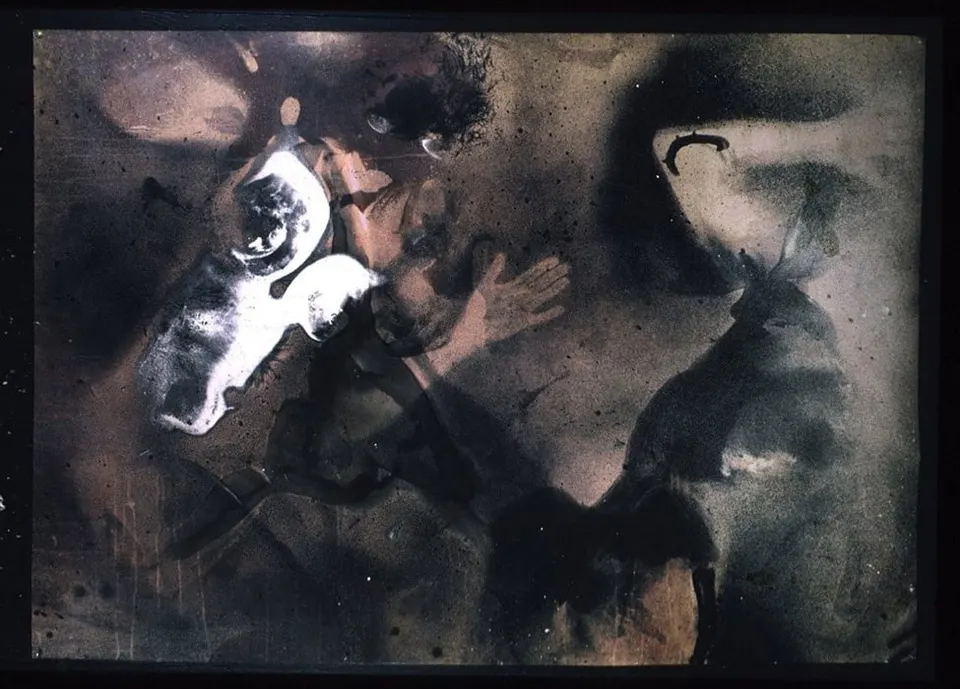
“Always falling in love, strange, hot-tempered, very sensitive, a crazy thing,” is how Garo Keshishian photographs him in words.
And yet what is it about him that draws the attention of the young photographer who has taken on the task of making his story known? “Takor Kyurdyan embodies the word ‘artist’ in the fullest sense. With him it is almost impossible to separate the personal from the professional,” says Silvio. “He lives and burns in his art. The words he uses to describe it are not only beautiful but also sincere, and they come straight from the heart. He combines things that seem incompatible at first glance, yet stays true to himself.”
The internet is a miracle for many reasons, and one of them is that it sometimes skillfully hides incredible scraps of information. That it has the power to give ideas a second life, to resurrect meaningful ventures and people. Thanks to Silvio Tomov, who overlapped on Earth with his hero for just a single year, there will now be a little corner that tells the story of Takor Kyurdyan and the “archetypes.” Because archetypes are what all of us are built from.
No one returns anywhere
because of the inevitability
of its banal
tragedy.