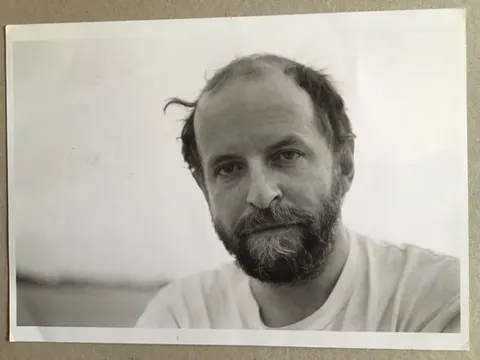
His first memory of this country is of boundless darkness. He arrives on a warm September night in the southern city, frightened, wondering where on earth he has ended up.
The morning greets him with the smell of roasting peppers, and before long he will fall in love with the place, with the country he has landed in. And then he will fall in love truly and forever, with the woman of his life, and a magical story will be born between cultures and eras.
Nothing is eternal except love—just ask Christopher Buxton.
“You’re a shop. I’m from Burgas, the city of dreams,” declares, in his elegant British accent from the other end of the continent, the Burgas native from Essex. (A shop, I should explain, is someone from the region around Sofia, the eternal butt of Bulgarian jokes.) We talk over Messenger—I and the teacher who taught Petya Dubarova, the man who was the first to translate many of the Bulgarian classics into English, who dared to recast in his native tongue even the maddeningly untranslatable Vazvishenie (Summit). The author of several historical novels that tell stories from the Bulgarian past.
Christopher Buxton, who never stops translating Bulgarian poetry, voting in our elections, getting worked up by our passions. Because reason ends where true love begins….
Don’t Grow Old, Love
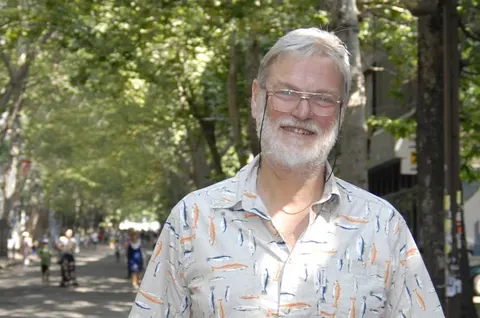
Christopher sits in the early British morning at the other end of the internet, and we travel back to his youth. A true gentleman, he is wearing a Christmas pullover [pʊˈloːvɐ] for a man-to-man conversation. One of his loves, alas, he has lost forever. The other is here, it stirs him and gives him strength.
His father was a theater director, his mother an actress. They send him to a strict Catholic school, but his blood, of course, is boiling. He graduates in English philology at the end of the 1960s and is ready for adventure; life is calling.
“I was young, I didn’t have many ties in England and I wanted to try different things,” Christopher recalls. So he gets in touch with the British Council and decides to travel the world and get to know it.
In 1971, at just 21, our hero arrives as an English teacher in Portugal, at the time a totalitarian, gloomy place in the grip of the dictator Salazar. “It was a fascist state, poorer than all the others, with very low levels of education, fighting three wars with former colonies at the same time,” the Englishman says.
The police keep him under watch—even as he walks from his lodgings to the school, a car full of uniformed officers crawls along behind him. But he is young, curious and not easily impressed. “Once I was even nearly arrested!” He and some other young men went to serenade the girls’ dormitory with Beatles songs under the windows, and the law forbade more than two people gathering outdoors—it was seen as a protest against the regime.
Like Fishing Nets
Then he decides to try something completely different, and his next stop is Norway. There he enjoys the social paradise, the calm, but… in his mid-twenties that is not enough, and he quickly concludes it is time for a new adventure.
Which is how, in September 1977, he finds himself at the dark Burgas airport. The flight lands at 1 a.m., the street lights are switched off to save electricity, and utter darkness reigns.
“After that I remember the fantastic smell of peppers. September, the start of the school year. Burgas was a small town then, in the center there were houses with yards, and from early morning people were out preparing their winter preserves. I’ll never forget that aroma…,” the Bulgarian Englishman says, going back half a century.
He is struck by the long lines snaking in front of the shops. “In front of the greengrocer’s I ‘queued’ too, like a normal citizen, and I brought a book, because I understood it would take hours. The poor greengrocer was all alone with so many crates. He felt awkward when my turn came. People were stocking up with sacks and boxes, and I wanted half a kilo of grapes—I was in a state apartment and the fridge didn’t work.”
And when the season of fresh fruit and vegetables is over, that same “greengrocer” sits all on his own reading a newspaper, while the shelves behind him hold nothing but jars of peas.
To Sir, with Love
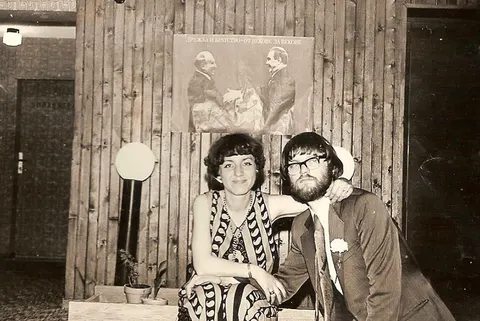
In Bulgaria, Christopher quickly settles into his role as a teacher at the English Language School in Burgas. In the very first class he teaches is Petya Dubarova herself, the gifted young poet. To this day he has a vivid memory of the great poet, of her curiosity, her wisdom, her eyes wide open to the world.
Then, alas, those eyes are closed just as wide, far too soon—she took her own life at seventeen. Christopher says she was the first dead person he ever saw, and it changed him. It made him think about life and death. And about what fills the time between those two endpoints with meaning—love.
The story of how he met Ani—the woman who would later become his wife—is worthy of a film script. Specifically one of the Bulgarian films of the 1970s and 1980s that Christopher loves, which carried both romance and humanity.
In every country he lives in, he sets himself one main task: to learn the local language. That is exactly why he chose to be far from Sofia, full of diplomats and many other people who use English. Back then there were very few of them by the sea (unlike today’s Sunny Beach resort).
At first it is quite hard. So he is intrigued when one day he goes out with colleagues to play table tennis and an unknown girl starts talking to him in perfect English.
One thing leads to another, and Christopher complains that he is sick of eating spaghetti with peas every day, the only dish he can find ingredients for in the local “supermarket.”
You Glimmer Faintly Through My Weary Memory
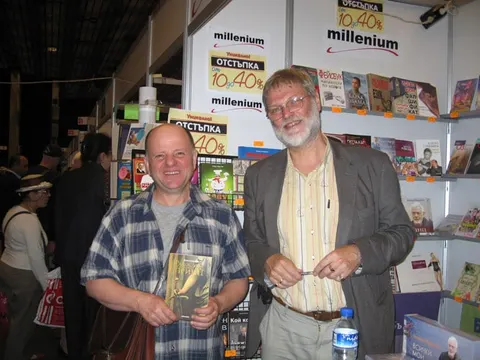
They agree to meet again a few days later. At the time Ani works at Bulgarkontrol, the agency that inspects all goods coming into or going out of the country. And some of those goods “somehow happen to end up” in the employees’ pockets.
“And that day she appeared at the door of my flat with a few pig’s hearts. I had never seen anything like it. But meat is meat, I had oil, a little red wine, onions, and I cooked a very nice dish. And that was it. Pig’s hearts, a true Bulgarian courtship,” Christopher smiles today.
Well, pig’s or not, the hearts become a metaphor come to life. The Englishman had planned for Bulgaria to be just another stop on his journey, which was supposed to continue to South Africa, but he stays.
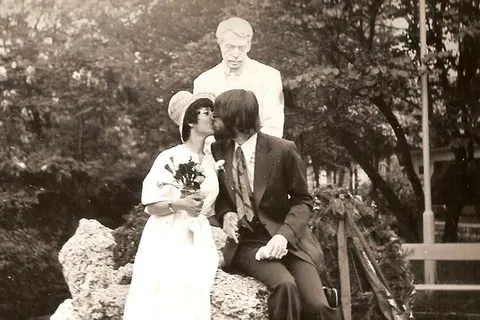
The would-be son-in-law even passes his future mother-in-law’s “oversalted moussaka test,” and they also overcome serious bureaucratic hurdles—in those days it was not easy for a Bulgarian woman to marry someone from the other side of the Iron Curtain. “We had to wait for permits, we had countless meetings with very angry people. Even my father-in-law was summoned by the police to be scolded for letting his daughter go out with an enemy of the people.”
In any case, the 1980s are approaching and a “thaw” can be felt. As the Brit puts it, right then Bulgaria is suddenly flooded with films about love. “I think that was the work of Lyudmila Zhivkova,” says Christopher, referring to the communist leader’s daughter, who ran the country’s culture. “At first sight she reminded me of Margaret Thatcher, she seemed a very stern person, but she really did bring big changes to Bulgarian society. It was 1979–80, and suddenly there was sex in Bulgarian cinema, I nearly fell over in amazement! Films appeared like Something Out of Nothing, Barter, in which Petya Dubarova acted, and especially my favorite, All Is Love.”
The Love We Simply Cannot Do Without
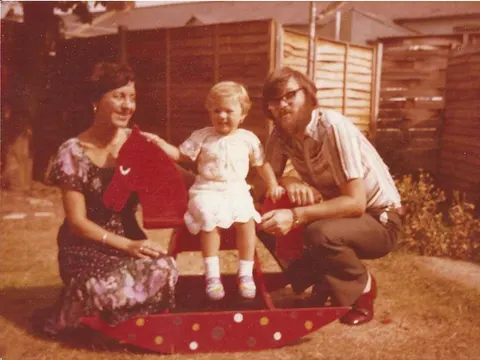
Soon Ani and Christopher are the Buxton family, and their daughter Malina is born. “I’ll never forget the December frost as we stood with other fathers outside the maternity hospital, while my wife gave instructions from a fifth-floor window,” the Brit says.
After three years in Bulgaria the family leaves for England and settles in Essex, where their son Ivan David Vladislav is born. Over the following decades the Buxtons work as teachers and devote themselves to their great passion—literature. They spend a lot of time in Bulgaria and get to know our history and folklore ever better.
They write books about the Bulgarian past; Christopher takes us back to the time of the Balkan War and to the days before the Ottomans arrived. As he says, Bulgarian history holds so many plots worthy of masters like Shakespeare and Verdi, and we ourselves don’t know them. One of the big themes that fascinate him is the encounters and clashes between Bulgaria and the West across different periods.
Sadly, in 2020 Ani passed away after a severe illness, and today Christopher is, as he says, without his guiding light. But he carries on alone with the cause of promoting Bulgarian culture in his homeland. His first homeland, that is, because he has a second one, even officially—for several years now he has held a Bulgarian passport.
No, Now Is Not the Time for Poetry
I stumbled upon his website while looking for good translations of classic Bulgarian poems to “feed” to artificial intelligence, to see what images it would generate from them (you can see the result here).
And indeed, it is easy to see how impossible it sometimes is to convey in English the meaning of classic Bulgarian verses we all know by heart. (Even that same artificial intelligence, as you can see, does a pretty poor job of it.)
So how does my distinguished interlocutor manage it? How did he learn Bulgarian so well, where did he gather such a rich vocabulary?
“In the three years we lived in Bulgaria, I read constantly. I started with Snaha (The Daughter-in-Law) by Georgi Karaslavov, with Osadeni dushi (Doomed Souls) by Dimitar Dimov, then poetry too. And that’s how my love for Bulgarian literature was born, which I made it my ambition to show in my native language,” says Christopher.
The City Sleeps in Soundless Darkness
He too thinks that translating poetry is hard work, in this case partly because of the differences between the two languages. English has much shorter words, and the Bulgarian poets’ fondness for rhyme doesn’t help either. “Although Hristo Botev gave me inspiration with his rhyme ‘patrioti – idioti’ (patriots – idiots), which works perfectly in English too,” the translator smiles.
“But I work by one very strict principle—I won’t translate anything that won’t sound natural and beautiful in English.” He prefers authors who use clear, vivid images—like Atanas Dalchev or Aleksandar Vutimski—because abstract metaphors are much harder to translate.
Which words are hardest to translate? Bulgarian is a very concrete language, the Englishman says. Among the things that trip him up are family relations. “Bulgaria has a fantastically rich vocabulary for relatives, while in English we don’t have words like баджанак (badzhanak, the husband of your wife’s sister), етърва (etarva, the wife of your husband’s brother) and зълва (zalva, your husband’s sister), there isn’t even one for my son-in-law’s mother, whereas Bulgarian has a word for every relative. That reveals an awful lot about the national psyche.”
The first poem he translates is “The City Sleeps” by Dimcho Debelyanov. But he is left dissatisfied, and it takes him five years to return to it and solve his main problem—the change of rhythm in the fourth stanza.
Let There Be Day! Let There Be Day!
Today it saddens him that our books are nowhere near as worthily presented as they deserve. That no anthologies are published in Bulgaria gathering the finest examples of poetry, that there aren’t enough authoritative, significant literary prizes to guide readers. That there is also no worthy, popular criticism whose opinion carries weight.
And yet at the same time we have many talented writers and poets. A favorite contemporary author of his is Milen Ruskov, so it is no surprise that Christopher has translated parts of his best-known novel, Summit. But it is also impressive, because the book is undeniably remarkable, yet it is written in a language that takes us back into the past. In places it is hard to read even for modern Bulgarians, let alone for a foreigner not only to understand it but somehow to recreate it.
Christopher chooses an original approach—he translates into the dialect of his home region in East Anglia. “In the Middle Ages it was very rich thanks to the wool trade. Since Koprivshtitsa was a very similar place for the surrounding villages, I feel my local dialect is very close to that of the little town where the story begins,” the translator explains of the National Revival–era mountain town.
The Master Has Left for America
In recent years he has had his own publishing house, through which he publishes Bulgarian poetry in English—he has put out poems by Debelyanov and Dalchev, as well as a collection of the best of Bulgarian poetry. Many of the works are posted on his personal website. His newest mission is to promote two women writers who live in Brussels—Rusana Bardarska and Irina Papancheva.
Today he keeps coming to Bulgaria, partly to look after his mother-in-law, who all her life has refused to visit England. That is probably why his children don’t speak Bulgarian well enough, the Brit says. Although his son learned the most of the language by reading the sports paper 7 Dni Sport back in that legendary 1994, when Bulgaria reached the World Cup semifinals.
“I have dual citizenship and I feel I have one foot in Bulgaria,” says Christopher. When he is away, what he misses most is our expressive way of living, the warmth in relationships. “Bulgaria is a country of many contradictions I don’t understand. On the one hand, there are pensioners who are very poor. There are people who don’t work, while there are fantastically many jobs. Bulgarians have always found a way to get by, because everyone ‘has a guy.’ At the social security office, at the traffic police, what matters is ‘having a guy.’”
When the Evening Humbly Fades
The Englishman has voted every time since he got his Bulgarian ID card, and he genuinely cares about Bulgarian politics. “There is a very bad cycle, the ordinary person can’t help but lose all faith in democracy. All sorts of criminals set up parties and invent pathetic names—‘Stand Up!’, ‘Salvation!’… There are always new people to show up. First a tsar, now some Harvard people with huge, innocent eyes who were supposedly a platform against corruption, and what came of it? Nothing. One huge figure has to be removed completely from Bulgarian politics, and then things will change,” believes the Burgas native from Essex.
And still, regardless of the times and the events happening around us. Of the wars, the meetings, the partings, the everyday sadness of existence, our hurried lives, regardless of everything. Whatever anyone tells us, there is only one thing worth remembering. All is love. If you don’t believe it, ask Christopher Buxton.