This piece won the grand prize for Culture and Art at the prestigious Web Report 2023 awards. More on that here.
Algorithms that generate images from a description have been a hit in recent months. They are a striking example of what AI is already capable of. It all started with DALL·E, followed by countless other models that gradually became available to more and more people. Even if you haven’t played with them yourself, you have surely come across the impressive images your friends have generated and shared on social media.
The subject is getting more interesting from many angles. It is definitely a revolution in photography and in image-making, but also in creativity as a whole. For the first time, a generated picture won a competition, to the horror of a jury that had no idea. Then the biggest image banks—the stock photo archives—banned uploads of generated images… Even though these very often turn out to be indistinguishable from real photographs.
The questions this field raises are many. No less interesting is that a new skill has gradually emerged: describing images correctly, so that the algorithm generates exactly what is expected. Such descriptions are even sold online now.
So what would happen if we offered it the words of undisputed masters of description? How would it imagine classic lines from Bulgarian literature? What illustrations could artificial intelligence draw from the works of Botev, Debelyanov, Boris Hristov and Georgi Gospodinov?
Here are the fascinating results of the experiment.
For this I used the MidJourney algorithm, which so far definitely stands out as the “most poetic” one—it handles creativity and metaphor quite well, while still managing to find quite different directions.
Alas, none of the algorithms works well enough in Bulgarian yet. So I used English translations of the poems from the website of Christopher Buxton (and my own translations where the expressions are far more obvious). For each prompt, I am showing you one of the first four generated pictures.
1. The Devil, the old Devil…
Prompt:
It was an honor I never had hoped for,
so kind a compliment, so rare:
the Devil—the old Devil—invited me
to his home for a glass of absinthe there.
(“Visiting the Devil,” Hristo Smirnenski)
Illustration:
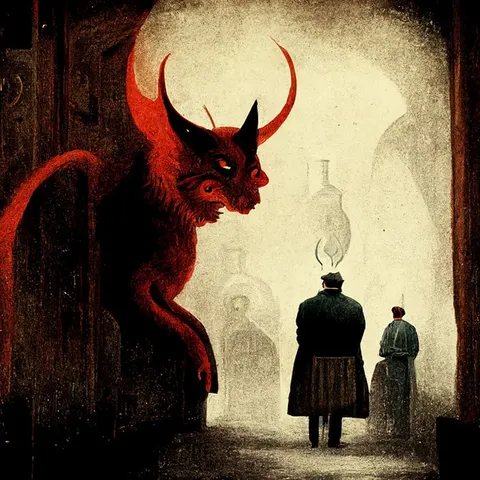
This old devil is rather likable; he even seems to carry something of The Master and Margarita. Where does the algorithm get its association with that retro feel? Could it really somehow be working out when Smirnenski’s verses were written…?
2. High blue mountains
Prompt:
High blue mountains,
rivers and golden plains,
a sky more tender than silk—
this is my homeland!
(“High Blue Mountains,” Mladen Isaev)
Illustration:
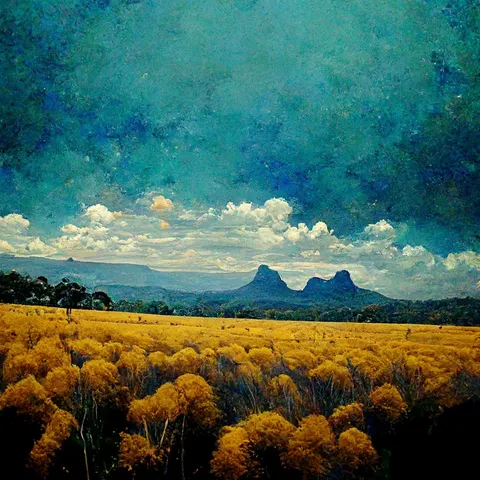
When it gets clear and precise instructions, MidJourney, just like its “colleagues” (the similar algorithms), does a wonderful job. And what message could be less ambiguous than Mladen Isaev’s classic patriotic poem, one every Bulgarian child learns by heart? Perhaps the mountains aren’t typically Bulgarian, and it’s odd that the sky doesn’t aim for a photorealistic style, but… is that where the poem’s message lies? In my view, definitely not.
3. He’s alive, alive!
Prompt:
He’s alive, alive! There on the Balkan crest,
soaked in blood, he lies and groans,
a hero with a deep wound in his chest,
a hero in his youth and manly strength.
(“Hadzhi Dimitar,” Hristo Botev)
Illustration:
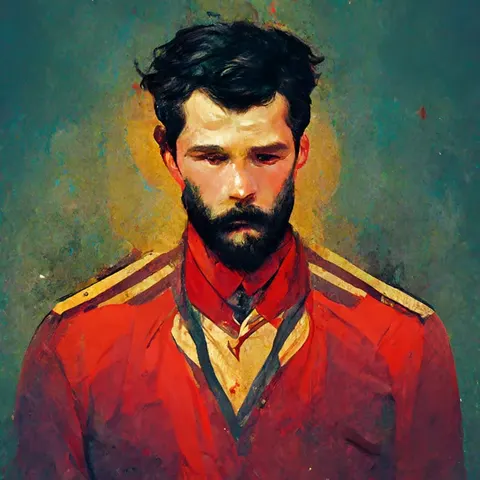
Here, I admit, the algorithm set off in a rather strange direction. It’s important to note that because of the restrictions built in by its creators, I had to hunt for lots of synonyms. Words like “blood” and “wound,” for example, are banned, so I had to take a more descriptive approach—which is probably where the red jacket comes from.
What’s curious, though, is where the halo of sorts came from, along with quite a few features we could definitely associate with Botev himself—the poet and revolutionary who wrote this ode to a fallen rebel leader and soon died fighting the Ottomans. Although, of course, the figure here is far from a portrait of him. And yes, eyes are definitely not our “artist’s” strong suit, but the choice of the uniform and the heart is quite a good one.
4. The white-blossomed cherries
Prompt:
Do you remember, remember the quiet yard,
the quiet home in the white-blossomed cherries?
(“Do You Remember, Remember the Quiet Yard,” Dimcho Debelyanov)
Illustration:
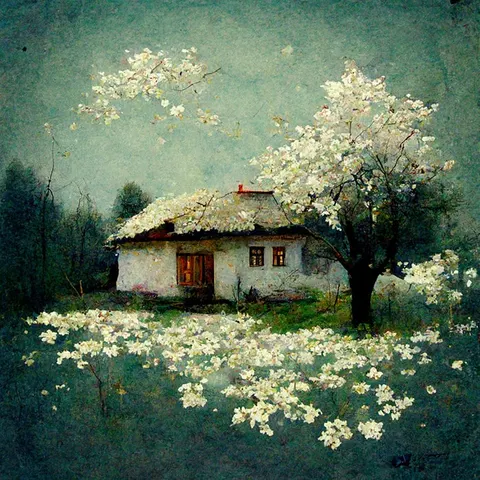
After the sorrowful image from Botev, I decide to pick something more cheerful from Debelyanov… insofar as he is the right poet if you’re looking for cheer.
Is it just me, or does this house really look rather Bulgarian? The flying cherry blossoms are a bit odd, but… the algorithm has evidently grasped the importance of those famous white-blossomed cherries Debelyanov speaks of.
5. The owner has left for America
Prompt:
The windows—shut tight and blackened,
and blackened and shut tight the door,
and on the door, a sheet with the words:
“The owner has left for America.”
(“A Tale,” Atanas Dalchev)
Illustration:
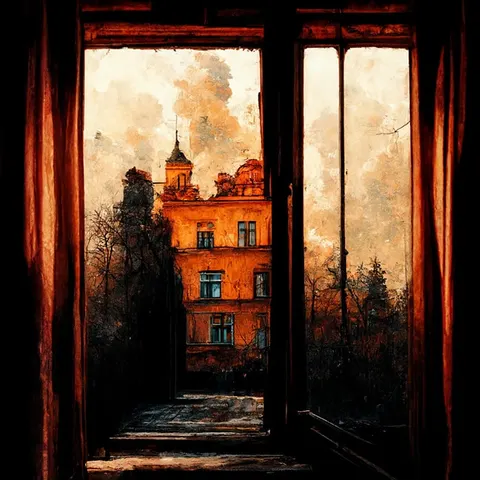
Yes, the algorithm clearly didn’t realize that the logical thing here would be a house door; it started with the windows and decided to build the image from there… one more reminder of how much it needs a precise description before it can let loose at full power.
Beyond that, though, the mood, the palette, the composition, even the building itself strike me as very close to the spirit of Dalchev’s lines.
6. An invisible archangel
Prompt:
I must play in the deaf evening
until I hear, coming toward me,
the voice of a thousand distant trumpets.
Or of some invisible archangel.
(“Evening Trumpet,” Boris Hristov)
Illustration:
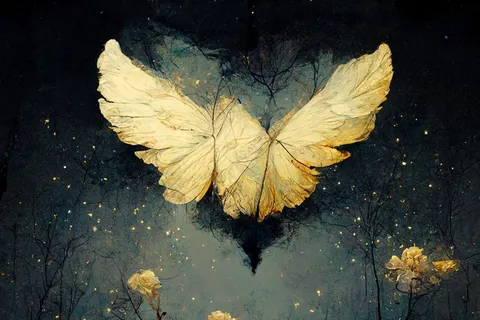
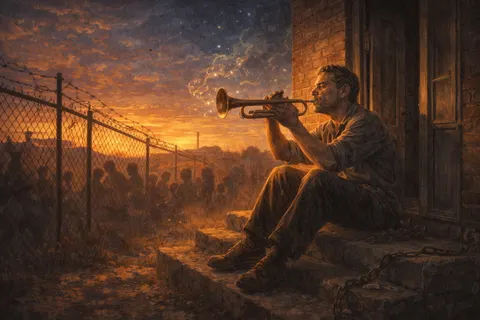
Wow! We asked for an invisible archangel, and well… here he is. He may come at the end of the stanza, but he’s there. Wings are flying, and he himself is nowhere to be seen. Forgive me if the joke is out of place; the truth is I get a rather poetic image, one that is also in the spirit of Boris Hristov’s beautiful verses.
P.S. No trumpets?!
7. The night gives birth to… strange things
Prompt:
Night gives birth from a dead womb
to the slave’s age-old malice:
his crimson wrath—
majestic.
(“September,” Geo Milev)
Illustration:
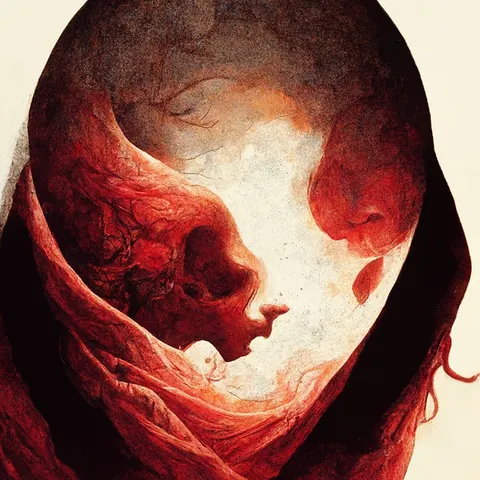
Time for something much more “hardcore.” I wonder whether to try “September will be May” instead, from the same epic poem about the crushed uprising of 1923, but the time for seasonal metaphors will come soon enough.
Do we have a womb here? Obviously. The age-old malice, alas, can’t belong to the “slave” here either, because the algorithm bans that word too, and the “oppressed laborer” I replaced it with is apparently not as strong an association. At least I don’t see it in the picture. Which, nonetheless, steps into the stylistics of Symbolism.
8. August
Prompt:
August. The afternoon of the year.
(All Our Bodies, Georgi Gospodinov)
Illustration:
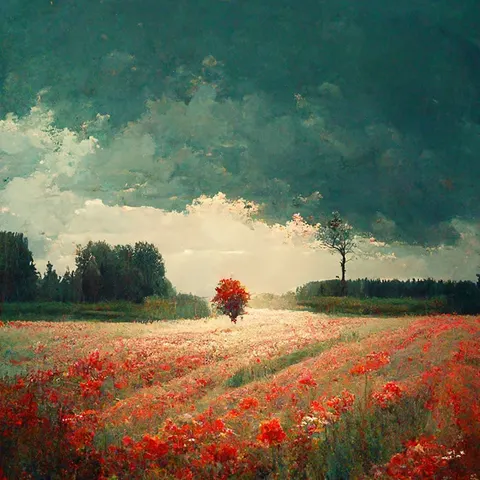
We have an idyll, we have a field of something like poppies… perhaps the metaphor within Gospodinov’s metaphor, which parades across Facebook every August 1, hasn’t been grasped all that deeply. Perhaps the sky leaves something to be desired too, but… it’s August, and the algorithm clearly needs a vacation.
9. Muncho time
Prompt:
That madman was the only man who dared to protest.
(Under the Yoke, Ivan Vazov)
Illustration:
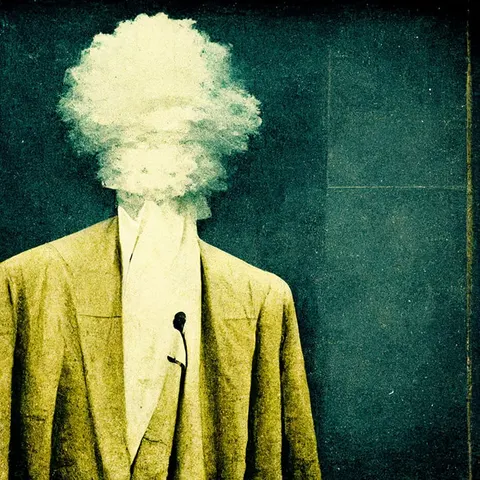
Yes, this isn’t poetry. Yes, this isn’t Muncho, the village simpleton from Vazov’s great novel of the struggle against Ottoman rule. Yes, the algorithm wouldn’t let me write “madman.” Yes, the Patriarch, as Bulgarians call Vazov, the patriarch of their literature, wouldn’t recognize this illustration of the last sentence of his classic work.
But it’s pretty cool, isn’t it?
10. An unexpected and unwanted guest…
Prompt:
Sometimes I’ll come into your dream
like an unexpected and unwanted guest.
Don’t leave me outside on the road—
don’t bolt the doors.
(“Farewell,” Nikola Vaptsarov)
Illustration:
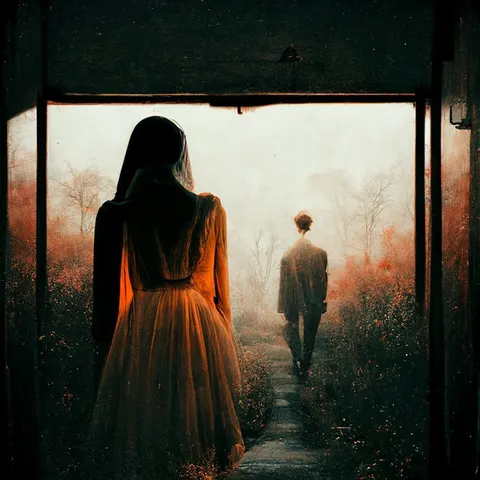
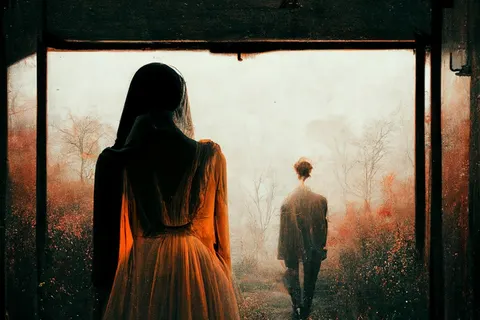
And it really does seem as if Vaptsarov is heading off somewhere, while in the hyper-sharp details of the foreground stands the knife hidden in every word of these otherwise gentle stanzas.
Our artist evidently has a soft spot for dramatic backs; who knows what it was trained on to pull this off.
We’re left to guess what exactly MidJourney understood from the poem, but as an illustrator it has done a creative job here.
10+ …on the guitar
Things have gotten a bit too serious and dramatic, so let’s not part on a melancholy note, what do you say?
For the finale, we leave the world of literature for a brief guest appearance among the memes. We all know who’s on the guitar today…
Prompt:
On the guitar, Vasko the Frog,
he’ll play, dear guests, just for you.
You’ll hear melodies, horo dances, folk songs,
Gypsy kyucheks, and all of them are easy.
Illustration:
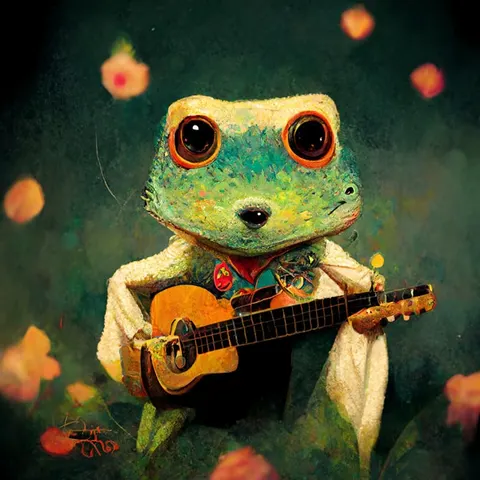
Here he is—the hero of a cult Bulgarian internet meme, a wedding-band announcement promising round dances and belly-dance tunes. As you can guess, the strict restrictions meant I had to swap a word or two here as well, but Vasko… is undoubtedly him, to the delight of all his dear guests.
So, what do you think? Did MidJourney cope with the classic stanzas of Bulgarian literature?
In my view, one thing is certain—it opens up many new directions for reflection, including in the interpretation of the words it tries to understand in the role of a reader… And of an imaginer.