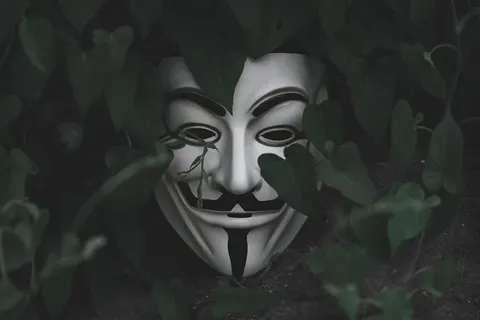
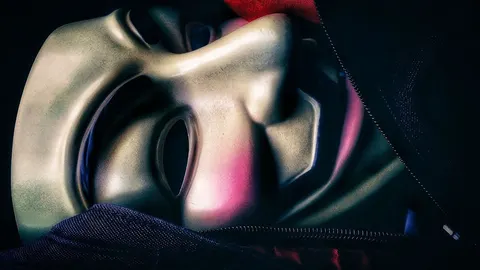
You have seen this face many times. It is the great symbol of the 21st century. It comes from deep within Britain’s past, yet it would never have become the archetype we know today without a pure accident that came from art.
The mask became the symbol of the Occupy Wall Street movement, then of the Anonymous hackers. In recent years it turns up almost every time a group of people rises up against some injustice. Painted on it is the stylized face of a real historical figure.
Who was this Guy Fawkes? How did a mythical figure from Britain’s distant past come back to life to carry so much symbolism? How did his name become a word used every day in English? And is he really someone who deserves to be held up as an example?
Remember, Remember the Fourth of November
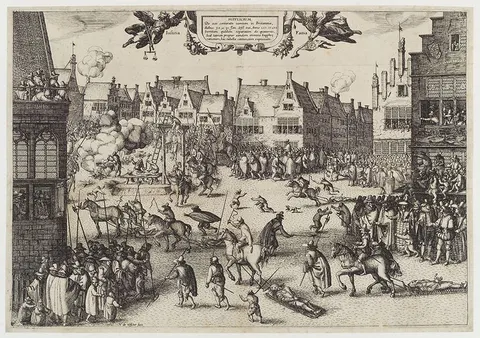
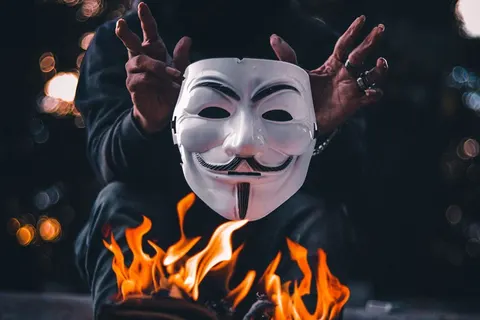
A broad grin brimming with self-confidence, a long mustache curled up at the tips, a thin hipster goatee. Everyone has seen this mask. Guy Fawkes himself was hardly smiling like that in the small hours of November 4, 1605, when the king’s guards found him in the cellars beneath the House of Lords in London with 36 badly hidden barrels of gunpowder, ready to blow the king, his heirs and who knows how many other nobles sky-high.
“Remember, remember the 5th of November,” goes the famous line we associate with Guy Fawkes. On November 5 he was supposed to blow up the elite of his nation, but he was caught the night before.
Even if he was grinning like the face on the mask at that moment, the smile surely evaporated fast over the following days, as he was tortured in the Tower of London. Before he gave up his accomplices and was finally sentenced to “death by hanging, drawing and quartering.”
We will come back to his fascinating story in a moment. The more interesting question here is this: how did a failed mass murderer manage, over four centuries, to turn into a pop icon and a symbol of freedom? After all, what he planned was no different from, say, the 1925 bombing of the St. Nedelya Church in Sofia, Bulgaria’s deadliest terrorist attack, only on a larger scale…
Fire Away, Old Chap!
By an irony of fate, he owes his fame precisely to the people he dreamed of killing and who in the end dealt with him.
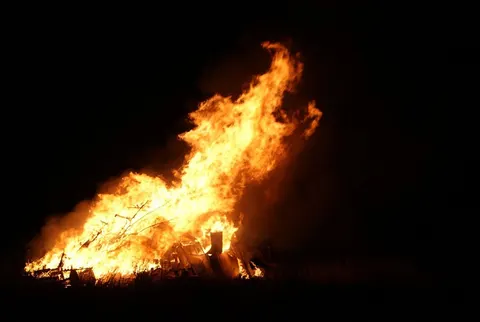
After his death, the surviving King James I decided to hold a celebration every year on November 5 to mark the fact that the attack had been foiled. An effigy of our friend Guy was burned as a symbol, and gradually the holiday turned into a traditional carnival. And the failed assassin turned into a positive hero fighting against bad politicians.
Then came the mask. Over the following centuries, early versions of it were worn by the young hooligans of the poor suburbs. They also gave birth to the English word guy, which at first carried the contemptuous meaning of “ruffian” and today is part of everyday slang meaning simply “young man.”
Then came John Lennon. None other than the most iconic pacifist of the 20th century sang the praises of the man with the gunpowder in his song “Remember,” which ends with the words “the fifth of November,” followed by the sound of an explosion.
Masked Ball
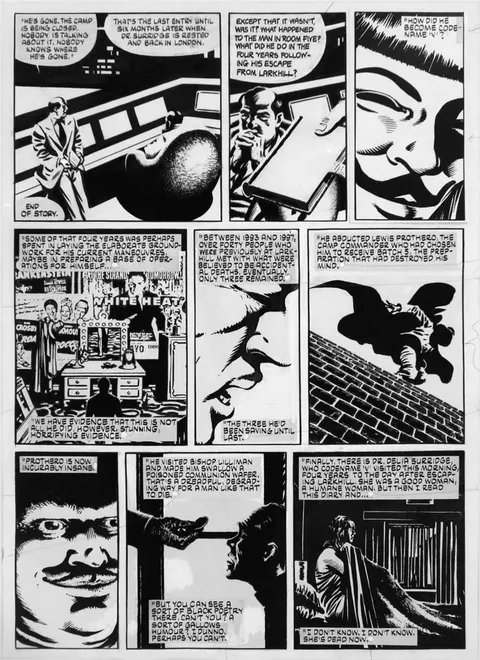
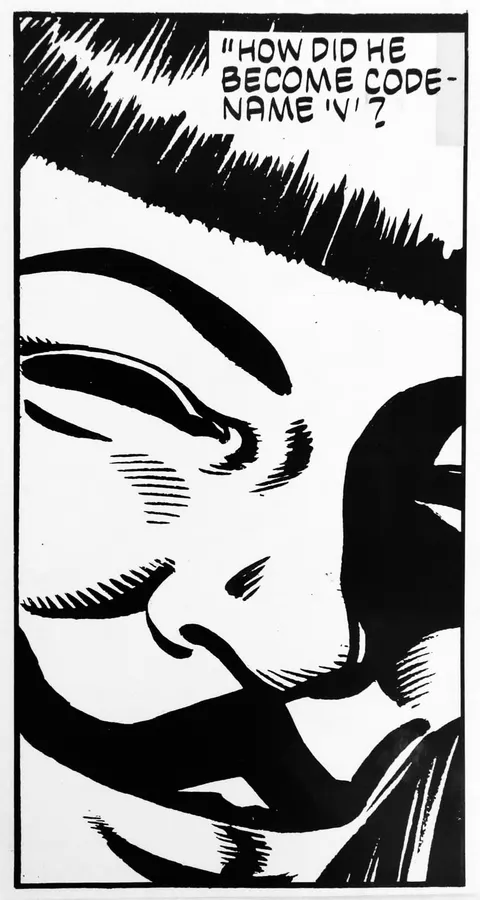
Which brings us to the 1980s, when the writer Alan Moore and the illustrator David Lloyd created the graphic novel V for Vendetta. In it they drew a post-apocalyptic world ruled by a corrupt government. The symbol of the resistance is the hero V, who appears for the first time wearing the famous mask, by now in its present form.
In 2006 the story came to life in a cult film by the Wachowski brothers (a little later, sisters). Although in its day the film was far from the status of their signature success, The Matrix, it clearly became a symbol of its time too. Not least because the mask of the smiling Guy stepped out of it and joined the list of archetypal images of our era.
“I’m very happy with the coincidence that this mask is used today by people who believe they are defending a just cause, that they are fighting against anything they see as a form of tyranny,” says Lloyd today, the creator of the stylized image. He explains that the character came about entirely by chance. He and Moore, an anarchist by conviction, were simply looking for a historical figure who had fought against the injustices of his time. I wonder what would have happened if they had stumbled upon Vasil Levski or Hristo Botev, the great revolutionaries of Bulgaria’s 19th-century struggle against Ottoman rule?
A Gunpowder Primer
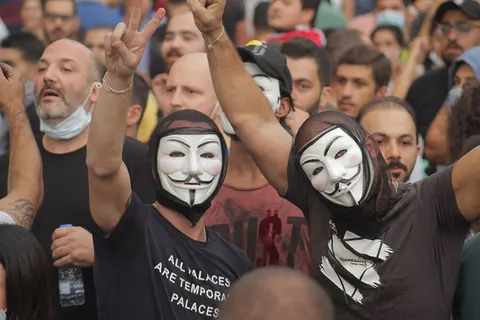
The first to use it were the protesters against the Church of Scientology, then it became a symbol of the Arab Spring, the Orange Revolution… and by now we have forgotten those events, swept away by the next turbulent waves of history, but the mask is not forgotten. It is passed on.
Then came Occupy Wall Street (sadly, having occupied it, they then vacated it), and even Julian Assange appeared in London with Guy on his face (sadly, they then caught him). The mask showed up even when Trump supporters stormed the Capitol, while in Saudi Arabia it is officially banned as a dangerous symbol inciting rebellion.
It has even become a source of profit. As early as 2011, Amazon announced that several hundred thousand of them had been sold. And what’s more… the image is protected, so with every sale Warner Bros., the owners of the trademark, make money.
Ah, that smiling failed terrorist Guy…
Guido the Jolly
What was he fighting for? In those days, and to a great extent today as well, far too many conflicts were tied to clashes between religions.
The champion of the Catholics, ready to wipe out his nation’s elite in defense of that faith, was in fact born in York in the good old year of 1570 into an old Protestant family. His father was even a lawyer for the local church, but he died young, when Guy was only 8. His mother remarried, and his stepfather turned out to be a devout Catholic. Who, little by little, won him over to the bosom of the Church.
At the time, as so often in its history, England was a powder keg, and the biggest conflicts were precisely between Catholics and Protestants.
From an early age Fawkes was a hothead. Or, to put it in today’s Newspeak, a religious fundamentalist. His desire to fight on the Catholic side sent him to the Netherlands when he was only 22. He sold the land he had inherited from his father to join the Spanish forces in the Eighty Years’ War. He distinguished himself with such bravery that “Guido Fawkes” became a mythical figure on the Iberian Peninsula as well. He was described as “a man very pious, of exemplary moderation, with a fine, cheerful manner, an enemy of quarrels and disputes. A faithful friend and remarkable for his exact observance of religious rites.”
It was probably because of the fame he enjoyed back then that the Spanish conquistadors later named one of the Galápagos Islands after him—Guy Fawkes.
Hothead
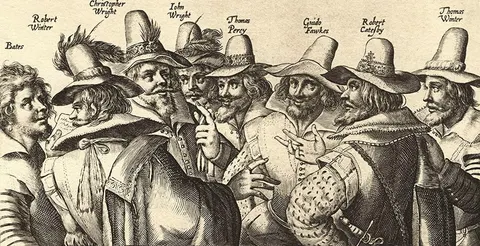
He earned himself the image of a daredevil, which, however, would soon prove fatal. And so we head toward the fateful year of 1605. Fawkes was not among the organizers of the infamous assassination attempt; he was brought in later because of his military experience. The leader of the plotters, Robert Catesby, and his small band were looking for someone with expertise in the field to do the actual “job.” They even sent an emissary to the Netherlands to invite Fawkes, who answered the call gladly.
The man in power at the time was James I, a zealous Protestant who was decidedly not a fan of religious tolerance. The Catholics had expected him to be tolerant—even his mother was of their faith—but he disappointed them. During his reign they were persecuted, and that was exactly what drove Guy and his fellow conspirators to try to take matters into their own hands.
The goal was clear: kill the king and as many of his inner circle as possible, and in the chaos the Catholics would seize power and put a ruler of their own on the throne. They had even sent a lord, Sir Edmund Baynham, to Rome to win the Pope over to the cause once it was clear their enterprise had succeeded.
The Powder Cellar
Every year the House of Lords convenes for its first session in early November. In 1605, however, on the evening before that happened, the authorities received an anonymous letter warning that an attack was being prepared. It said that “they shall receive a terrible blow this Parliament and yet they shall not see who hurts them.”
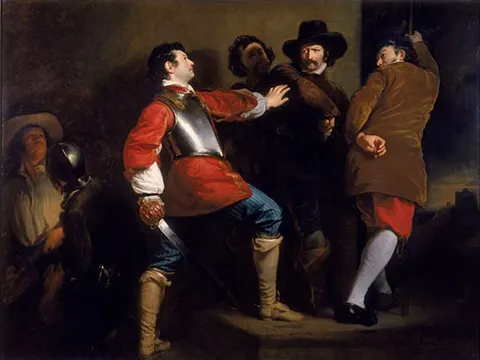
The king’s guards carefully searched the vaults of the building, the most likely place for the plotters to be hiding. The first time they found nothing, but on the second round it occurred to them to open the locked cellar where, behind the famous 36 barrels of gunpowder, a mustached man was hiding who introduced himself as John Johnson. The barrels held nearly a ton and a half of the explosive mixture, more than enough to leave nothing but rubble where Parliament had stood.
“I want to blow this Scottish king and all his Scottish lords back to Scotland,” Johnson told the guards.
And Then the Radetzky Came Thundering In
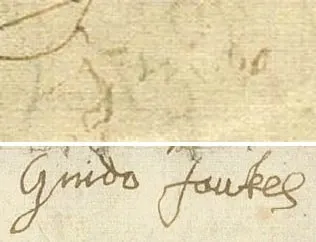
Well, of course, the captive was no John at all, and that became clear very quickly over the following days, when he was subjected to brutal torture. He held out for a few days, but the torment was horrific. He confessed his real name and everything about the failed attack. In keeping with the bloody customs of the time, however, that did not spare him a terrible death.
The confessions he wrote in his own hand are kept in the National Archives of the United Kingdom. The barely legible handwriting shows what the Guy who smiles on the mask went through in those days…
He was sentenced to death in January 1606 in the bloodthirsty manner mentioned above. He was meant to die dangling from the rope right opposite the Parliament building, but he had the “luck” to stumble on the steps to the gallows and break his neck. Even so, they carried out the rest of the sentence and then cut his body into four.
Powder Keg
The fate of the other participants in the plot was not much different. According to one version, the letter that wrecked their uprising was sent to a Catholic lord, warning him not to attend the opening, and somehow it ended up in the hands of the king’s men. Exactly who “betrayed the band,” as Bulgarians say of those who sold out the revolutionary bands of the 19th century, was never established. Traitors don’t like to leave their names in the chronicles.
From the following year the carnivals began. They grew huge and spread across the whole of Britain and its colonies. Everyone celebrated, except… the school Guy had attended—St Peter’s in York.
Our hero is also linked to another typically British, wacky-sounding tradition. Every November, on the night before the first session of the season of the House of Lords, a specially appointed official makes the rounds of the building’s vaults to make sure Guy isn’t down there with his 36 barrels of death.
Good Guy
And so Guy departed in a nasty way, only to become a symbol that still stirs people today. The meaning of the mask as a symbol is clear. You use it when, for whatever reason, you want to hide yourself. Just as it is clear what it means if you choose Guy Fawkes in particular—you are promising to fight against injustice, against bad government.
Somewhere around there, Anonymous appeared too—the mythical group (or groups) of hackers who, one way or another, came to the fore online as the good guys, as fighters for justice. Of course, there are more myths about them than facts, and in recent years they too have lost some of their luster.
But if the power lies in anonymity… what upheavals has our attitude toward it gone through online? When does our name matter behind our image on the web, and when does it become a burden?
So everything said so far is part of another, even bigger subject—anonymity on the internet. When it makes sense and stands to reason to stay hidden. About trolls and the anonymous, about fraudsters and rebels, about total control and about democracy. That will be the subject of the next digital story…