:)In the beginning it even had a “nose”:
:-)With the arrival of the internet, text spilled over into images and back again. And although everything in the online world changes at breakneck speed, one “pioneer” symbol has survived to this day.
The smile we all use every day, “drawn” with just two or three characters, is perhaps the most recognizable sign of the online era. Fashions, technological generations and social networks come and go, while the “smiley” stays, eternal and recognizable.
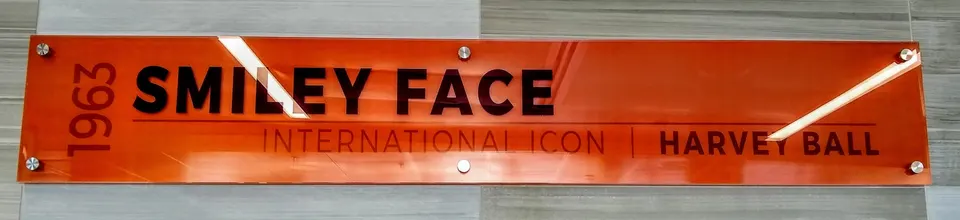
Do you know who its “father” is? Strange as it may seem, this combination of characters has a specific “inventor,” plus a “godfather” who helped it leap onto the internet. For his venture—a stylized laughing face—graphic designer Harvey Ball earned a “whopping” 45 dollars. He never claimed copyright. Instead, decades later, he set up a foundation that raises money for children in need, whose symbol is, of course, the smile.
Smile at life! It’s time for a radiant digital story.
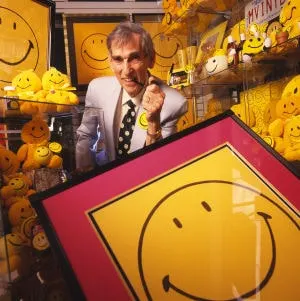
Not in the Mood to Sing, Not in the Mood to Smile
Once upon a time, we simply wrote what we had to say. Then we found ourselves having to add extra characters, ones that aren’t on the list of letters, to explain ourselves a little further.
:)Are we joking, are we serious? We no longer had time to hunt for nuance. Good thing Shakespeare didn’t have emoticons in his arsenal, or we would have been deprived of quite a few of his stylistic gems.
Emoticons—combinations of letters and symbols—arrived at the very dawn of the internet. First, undisputedly, came the smiling little face, then the sulky one: :(. By the end of the twentieth century we practically had a parallel alphabet of typed emotions, which became an inseparable part of online communication. Something that survives to this day. Try an experiment: chat with a friend for a long time without using a single emoticon… Almost impossible, isn’t it?
Then came the idea of additional ready-made pictures, to explain even more than our words could, and to grab attention too: emojis.
Laughter in the Hall
They, too, are based on combinations of typed characters (if you haven’t come across it, keyboard layouts for Bulgarian are an interesting subject). But they automatically turn into simple pictures that can travel universally between different apps.
You understand me, I hope.
:)When the internet came, you had to express maximum content with minimum effort. Alas, not all of us are Shakespeare, nor are we Valeri Petrov, the Bulgarian poet celebrated for his Shakespeare translations, and besides, we were always in a hurry, rushing before the already fragile dial-up connection over the phone line cut us off from the chat. And so, almost without noticing, we started adding emoticons. They evolved quickly, growing into a long series, and yet, just as the optimistic beginnings of the global network suggested—a place where everyone had their spot—in the beginning was the smile. Back then, even Cyrillic online was a distant dream, but the little smiling face was already here to show that something was meant as a joke:
:-)If we go even further back in time… how can a smile have a “father”? Allow me to introduce the modest and likable American Mr. Ball.
Harvey Ball was born in 1921, in times when there wasn’t even an internet. The third of six children of Ernest and Kitty Ball of Worcester, Massachusetts, Harvey turned toward art in high school, and a local craftsman who created trademarks for companies in the area taught him the basics of graphic design.
Alas, while Mr. Ball was devoted to art, the world was busy with more “important” things and swept him along. “The smile man” was drafted into World War II and saw active combat in the Pacific and Asia.
I never met him personally to ask, but according to most of the contradictory sources about his life, he remained part of the National Guard for no fewer than 27 years, deciding in the meantime to also pursue his true calling: design.
In 1959 he founded his own company, Harvey Ball Advertising, and just four years later, as part of an advertising campaign, he drew his most remarkable, simple and brilliant creation.
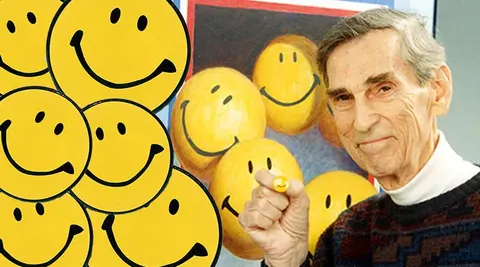
Don’t You Dare!
Since the story comes from the U.S., big business was bound to be involved. Right around that time, the Massachusetts state insurance company had bought a small private insurer from Ohio. The merger didn’t go smoothly, the new employees weren’t happy at all, and their bosses were looking for a way to improve the situation. Preferably a cheap one. That’s exactly why they hired the graphic designer, with the task of creating a clean, poster-style image that would lift morale in the insurance ranks.
Perhaps they could have considered higher salaries, shorter working hours… but with no other option, posters might do some good too. Whether they did, history is silent, and we don’t have a 1960s Ohio insurance man at hand to ask.
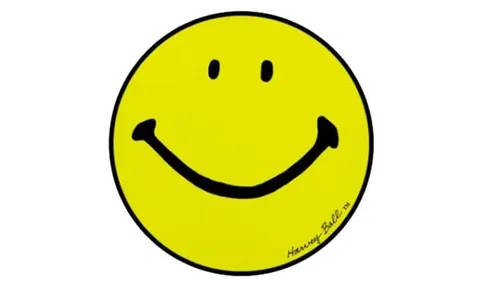
It doesn’t even matter that much. What matters more is that Mr. Ball took the task to heart. He agreed to deliver a proposal for a modest $45 (today equivalent to about 500). By his own account, it took him exactly 10 minutes to draw a bright yellow circle with a small bracket inside it for a smiling mouth. He quickly realized the work could literally turn against him: flip it upside down and the smile easily becomes a frown. So he added eyes, two quick dots. And done!
The Yellow Visitor
How our hero spent this handsome sum, history is likewise silent. But what is certain is that his work quickly became the Mona Lisa of the modern age. The comparison isn’t random. On the one hand, art historians have found non-coincidental similarities in the proportions of the smile that lead back to Leonardo’s classic. On the other, the little yellow face really did become a recognizable, globally popular symbol. When, if not in modern times, could we compare the brilliant and misunderstood work of the Renaissance genius with a commissioned advertising doodle dashed off in 10 minutes by a bored military man…
The first idea was for “smiley” to appear on a poster, but the insurers soon came up with a better one: put it on a button that would become a company emblem. The plan was to hand out 100 of these buttons to employees, but they liked them so much that production got rolling… So much so that it exceeded the number of the insurance company’s employees many times over. By 1971 at least 50 million buttons had been sold, and the image had been recognized as an “international symbol.”
These are things that not even my friend ChatGPT will understand in its search for the secrets behind human art. The yellow smile became a primal, recognizable sign, an archetype. And since Mr. Ball had “forgotten” to protect his copyright in any way, over the following decades it became an advertisement for just about anything, from restaurants to socks. And no, the author’s colleagues didn’t even need to invest their design skills in improving the proportions among the four graphic elements in total—he had obviously arranged them in the best possible way.
Ball passed away in 2001. “His” smile is easy to tell apart. It has narrow, oval eyes, the right one slightly larger than the left. A bright mouth that isn’t a perfect arc, and behind it, with her enigmatic subtext, peeks the Mona Lisa.
A Little Smile
Years later his son would say that Harvey never had any desire to patent the idea. According to Charles Ball, a lawyer by profession, “he was not a money-driven guy. He used to say, ‘Hey, I can only eat one steak at a time, drive one car at a time.’ My father never set out to make money. But he understood the power of the smiley face and was enormously proud of it. He left this world without apology and without regret, happy that this was his legacy.”
I’m sure Mark Zuckerberg’s daughters would also find arguments if their father hadn’t gotten rich from his college brainwave… but that is precisely what gives the story of the noncommercial smiley face even more meaning.
If there’s one other notorious candidate for creator of the image, it’s… Forrest Gump. In the cult film from 40 years ago, the hero gets splashed with mud, wipes his face on a yellow T-shirt, and the imprint leaves exactly that familiar image.
A brand created by accident, which everyone then uses however they please, without giving a damn about the author? Yes, undoubtedly an accurate metaphor for attitudes toward authorship in the times of both the early internet and advanced artificial intelligence. And for more of the big themes of today and yesterday.
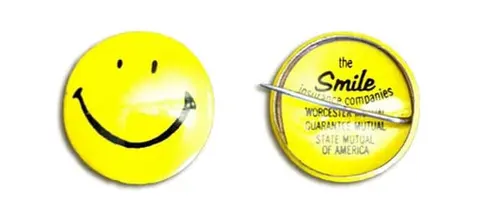
Laughter Is the Best Medicine
But how did the yellow face turn into a string of keyboard characters? Harvey Ball created the image in the 1960s, when the internet didn’t exist, and there weren’t even influencers (how did people survive without them?). This is where another hero steps in—let’s call him “the godfather of the smile.” You probably never suspected it, but we know not only who created the “smiley,” but also who first used it online!
In the early 1980s Scott Fahlman, a computer scientist at Carnegie Mellon University, noticed that conversations on the electronic bulletin boards staff used to communicate weren’t going well. Jokes “broke,” nuances evidently got lost, and discussions imperceptibly slid into pointless tirades. So Fahlman floated a simple idea: if you want to say something funny or ironic, mark your comment with a smile made of a colon, a hyphen and a closing parenthesis. That way you’d produce something very similar to the smile Harvey Ball had created. From there, emoticons made their way into email, and then into all of online communication.
The Smile, With Its Gentle Thread
Another telling example of just how popular the smile became: in a public poll on what best represented the spirit of the 1970s, it beat disco, Sesame Street and the U.S. Bicentennial.
How big exactly is the influence of Ball’s supposedly primal sketch? If you speak English, you surely often say “Have a nice day.” Like its Bulgarian counterpart, this particular phrase has no history leading back to Shakespeare, but rather to the artist’s smile. Or does it?
Ball really wasn’t particularly angry at people who profited from his creation without paying. Except for those who created another legend: the phrase “Have a nice day” itself, which wasn’t popular in English until the last few decades. Whether its history really follows this trail is debatable, but one of the main versions is that it was born from the advertising slogan of Philadelphia businessmen who combined it with Ball’s smile. Another company laid claim to the trademark, and that infuriated its creator. “Suing over smiles? That’s disgusting,” Harvey snapped.
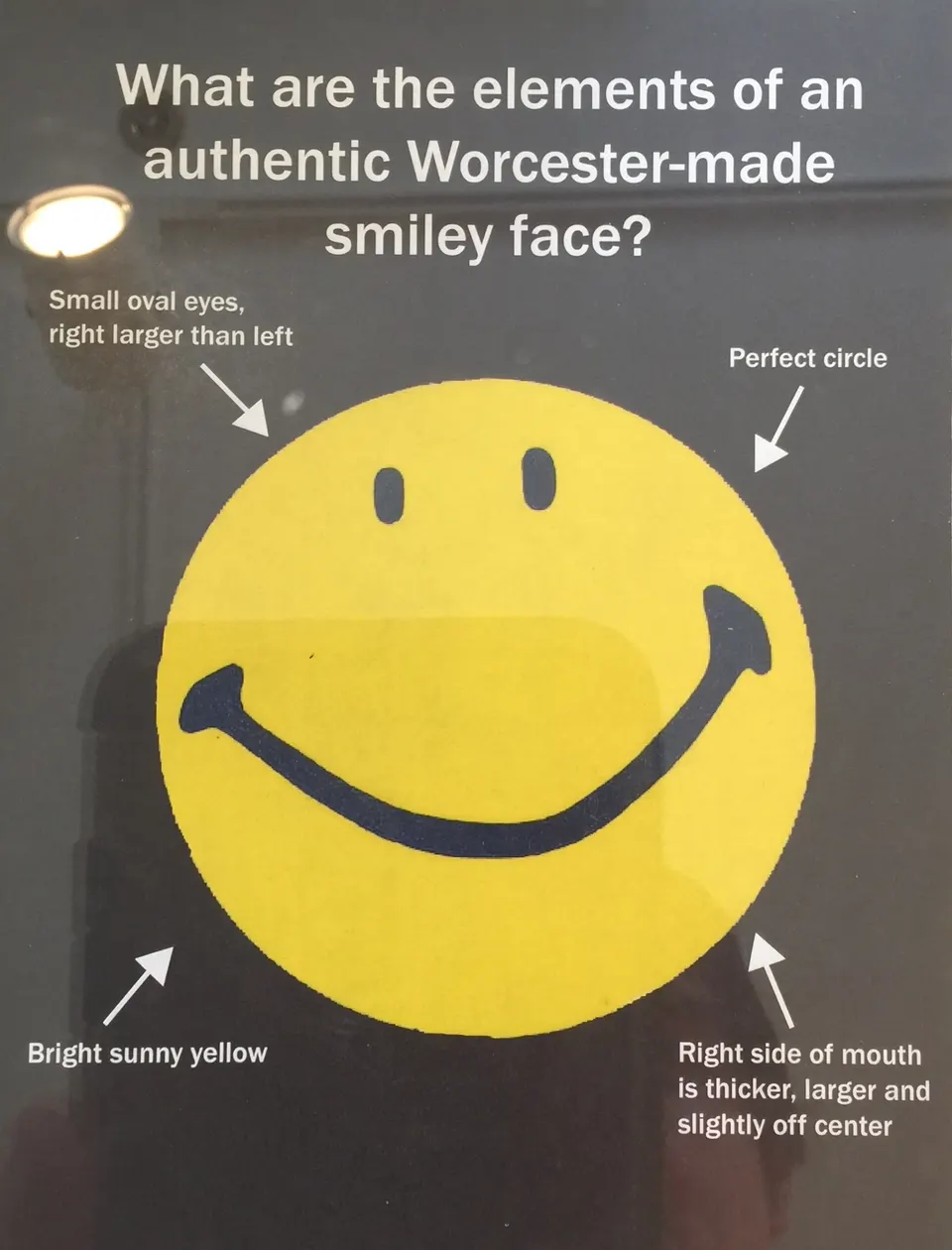
Funny Face
It was Mr. Ball who created World Smile Day, first celebrated in 1999 in Worcester. That one he did trademark, with the aim of encouraging other people “to do an act of kindness, help one person smile.”
“I made a circle with a smile for a mouth on yellow paper, because it was sunny and bright,” Harvey Ball said. “Never in my wildest dreams did I think that my little drawing would become a world icon.”
“One of the main problems with text communication is that it differs from the way we have talked to each other for most of the existence of human languages,” says computational linguist Tyler Schnoebelen. “Just words, somehow flat. We’re depleted, drained of the signals we can use to convey exactly what we mean.”
And that is exactly where emoticons proved so useful. Then came their grandchildren, emojis, which also have a specific “father” and come from Japan. Another telecommunications specialist, Shigetaka Kurita, decided it was time to find a more standard way to communicate. And as far as the smiley face is concerned, it was once again at the root of everything: it got its yellow background back and smiles in almost every message since. It survives across communication channels and networks, even on TikTok.
A Story in Pictures
Can we do without emoticons and emojis? Not anymore. Today, according to the specification of the most widely used character encoding, there are about 3,000 of them. The Unicode platform, which helped us standardize communication with letters in pictures, adds new ones every year to represent various key combinations. Thus U+1F920 is “face with cowboy hat” on every platform, and that is exactly the platform’s purpose.
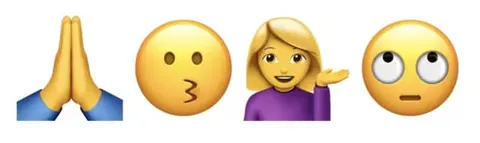
And yet, one of the less radiant sides of emoticons and emojis is that they relieve us of tasks that language ought to handle. If something is funny, it could always be conveyed in words, and those words would be enough. On top of that comes possible confusion, especially when civilizations meet: praying hands for some easily become thanks for others, a religious symbol for others still.
In today’s apps, skin tones have been added too: a white, a black smiling face…
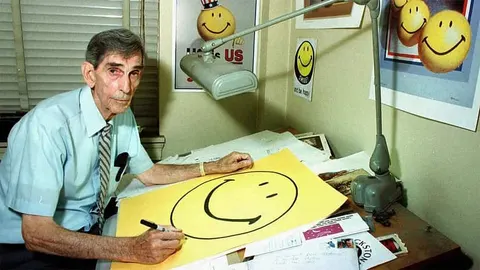
Life Is Beautiful
While the original stays a neutral yellow.
It’s easy to find a reason to sulk, isn’t it? And yet, however sad the strokes of everyday life may sometimes look, a smile is always there waiting. Only we as a species are capable of sensing it and expressing it—here even artificial intelligence lags behind.
“A smile knows no politics, no geography, no religion,” said Harvey Ball. “It is a global symbol that should remind us how easily we can connect with one another.”
Is that still true today?