Let's lie down!
Several generations of Chinese grew up with the “ideal” of “9-9-6”—you work without a break from 9 a.m. to 9 p.m., six days a week. It is the only way to survive the fierce competition and keep climbing the ladder.
But the end of endless grinding may be in sight.
“Tang ping” and “bai lan” are the two names of a movement gaining strength among young Chinese. Lie down and think about life; relax instead of throwing all your strength into meaningless toil.
Are the beatniks of our time coming from China? Will people in the East learn to idle? When can laziness become a constructive force? And shouldn't we all follow their example and prepare for our own future this way?
There is plenty the Shopi—the people of the region around Sofia, the eternal heroes of Bulgarian jokes about laziness—could borrow from the Chinese. But there is one thing the inhabitants of the world's most populous country are only now learning from our people. Why does the Shop work sitting down? He tried lying down, but it didn't work out.
Well, the Chinese keep trying. And so inspiringly that you want to grab the quilt at once…
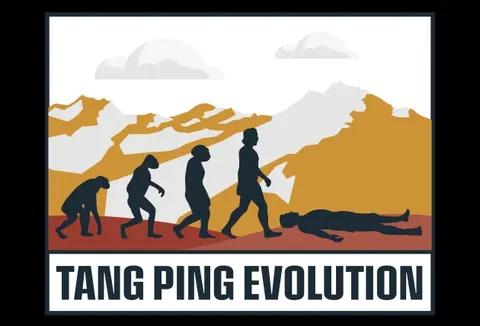
Lying Down Is…
…Luo Huazhong. Under the pseudonym “the kind traveler,” the young man posts a photo of himself on the Chinese social network Baidu Tieba. In it he lies with his eyes closed, dressed as a medieval Chinese assassin. Underneath he writes only:
“Life—that is lying down. On your back, at the bottom. Lying flat—that is justice.”
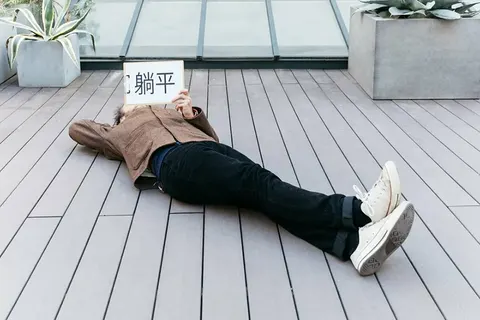
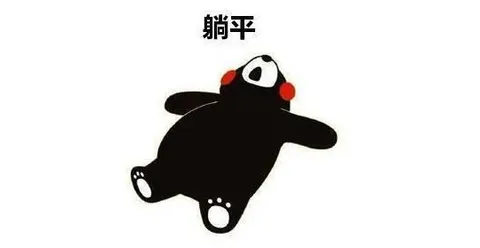
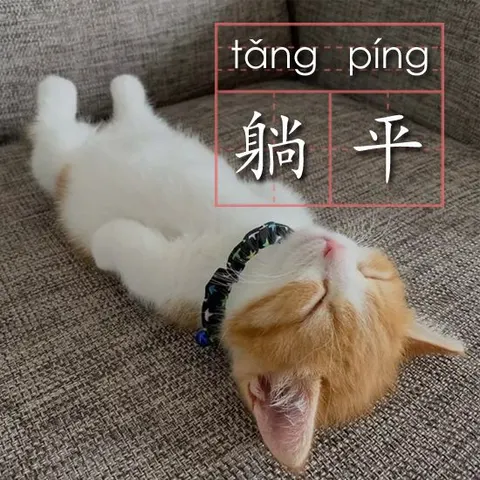
“Lying flat”—躺平, “tang ping.” The words quickly become the symbol of a whole generation. Some translate them as “lie down straight”; “stretch out” or “sprawl” sound just as good.
Until some five years ago, 31-year-old Luo worked in a factory, but he was unhappy, he felt empty, his life was meaningless. He decided he had had enough and set off on a bicycle trip, covering 2,100 km from Sichuan to Tibet. He rode and thought about life. And the more he traveled, the less he wanted to return to his usual routine.
He went back to his hometown, but he had already decided to change everything. He started spending his time reading philosophy books and reflecting on life. Now and then he took odd jobs, just enough to earn about $60 a month, for two meals a day.
In the end he found the perfect job. He specialized in… playing a corpse. He joined the mass battle scenes at a nearby film studio, where extras for this role are always needed. It was “at work” that he took the photo he posted on the social network, along with his reflections. And, as it turned out, an awful lot of people liked the idea; his post quickly went viral. “Tang ping” became a huge wave!

…It's No Hare, It Won't Run Away!
Then, of course, his post disappeared.
No, “tang ping” is not ping-pong for the seated either. Jokes aside, this is a fascinating phenomenon coming out of the Celestial Empire, and although, as usual, it is shrouded in the fog of censorship, it has much to tell about life there.
It is no secret that China's economic miracle of recent years is owed to hard work. More specifically, to the notorious (and, to Western ears, terrifying-sounding) “9-9-6” model. Jack Ma, the head of Alibaba, called this system “a blessing.” In September 2021 it was supposedly officially declared illegal, but by all accounts it remains extremely widespread.
You know how it is on the Chinese internet: the authorities quickly realized that our friend Luo's idea did nothing for the motivation of young workers, and they did what they could to wipe it out. Several groups with hundreds of thousands of members discussing “tang ping” were shut down, and the state mouthpieces began publishing propaganda speeches about how important it is to work hard, how only through tireless labor can a person succeed.
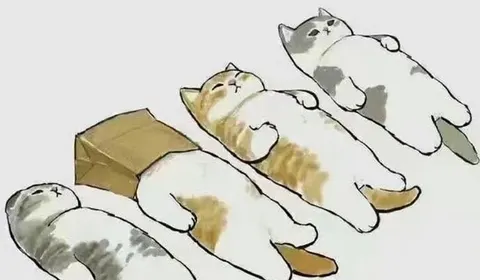
Work, Money, Money
So what's the big deal about lying down for a bit? No, this is not about the need for an afternoon nap, nor about some reverence for laziness. It is rather about a social phenomenon that we will be seeing more and more often, and far from only in those corners of the world. About the existential crisis we have somewhat forgotten at the zenith of overconsumption.
“When I talk about lying flat, I don't mean literally lying around all day doing nothing,” Luo explains. “It's more a way of thinking: I feel that too many things aren't worth my time and energy.”
The last decades in the Celestial Empire were a time of flourishing; people enjoyed a far higher standard of living than they had ever dreamed of. More than that, they advanced with real prospects and the personal peace of mind of knowing what tomorrow would bring.
But now comes the first generation that, by all signs, will be poorer and have weaker prospects than their parents. Of course, something similar is in a sense looming in the West too, but we'll get to that.
In China, on the one hand, came the heavy damage of the pandemic, which continues to this day. Because of the central zero-COVID policy, huge cities were locked down over just a few cases, which hit the economy hard and erupted in protests that forced the authorities to say goodbye to the measures they had clung to so tightly.
Grab the Quilt!
Even by official figures, unemployment among young people under 25 has reached 19.3 percent, a staggering figure for this country. That is 15 million people with no real prospects for development—as many as three Bulgarias!
With all this comes serious inflation. Not only prices are rising, but also the costs of healthcare and education. At some point they begin to look unattainable, even if you work without a break. From 9 to 9, from 9 to 9…
Then comes the fatigue from the constant repetition of the mantra of the “Chinese dream,” of the promises of a bright future.
Put together, all this undermines the environment. Gone is the motivation that by working hard you will rise into the coveted middle class, live a normal life, feed your family. Hence the desire to work disappears, giving way to existential questions about meaning and about what makes you happy…
“Lying flat—that is the approach of the sage,” Luo says.
He published his famous post in April 2021, and after the authorities stepped in, the wave seemed to subside. In mid-2022, however, the next one arrived…
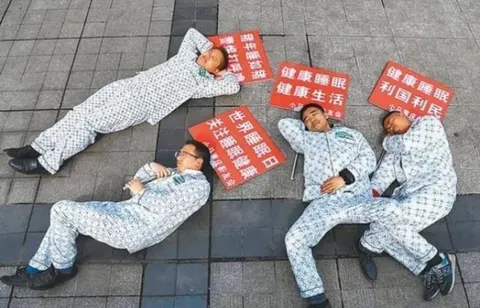
Bai Lan, Have You No Manners?
摆烂—bai lan, “let it rot.” The movement's new name comes from basketball slang: when you deliberately lose a game to secure an easier opponent later.
The idea is to savor a worsening situation, to stand aside from it instead of trying to change it. The new movement by this name has no prophet as clear as Luo, but by all signs the two are inseparably linked.
Of course, there is no way to know how many followers there are, whether they communicate with each other and organize across this vast country. But, by all accounts, the ideas floating in the air are distinct enough. So much so that the top leaders keep explaining with great pathos that “young people must be guided by great ideals on the basis of which to set their personal goals,” as Xi Jinping motivationally puts it.
And he has spoken on the topic specifically, which says a lot about its importance today. “The stagnation of social classes must be prevented, opportunities must be created for more people to become rich. A better environment must be created in which we all participate. Degeneration and lying flat must be avoided.”
Except that an uncertain future and a stalled economy are hard to combine with the ideal of tireless labor. Under these conditions it is very hard to keep spinning the wheel like a hamster, eyes fixed on the bright future. And toiling by the laws of the “9-9-6” “blessing.”
Our Very Own 9-9-6
Clothes bearing the movement's slogans, which had been quite popular, are now strictly banned too.
Online it is hard to make out what is going on (especially if you don't know the language). And the “Great Firewall of China” knows its job. But it seems the movement's followers really are many, mostly young, from all sorts of classes and professions.
Besides, a quiet rebellion is the hardest to stop.
“Lying flat is a quiet resistance,” 22-year-old Leon Ding told The New York Times. The young man chose this path after refusing to study computer engineering, as his parents wanted. He started looking for work to pay his rent but found that everywhere the working hours were endless. “I want a stable job that still leaves me time to rest,” Leon explains.
So he simply stopped looking, and he earns small change playing computer games. “Honestly, I feel very good. I don't want to be too hard on myself.” What does he plan to do with his life from here? He says he won't make plans more than a few months ahead.
I Like Aylyak
A song glorifying the movement also went viral. The singer, Zhang Xinmin, lies on his back on the couch at home and sings: “Lie flat so you won't fall anymore. Lying flat means never falling.”
In our parts, aylyak—the Plovdiv art of unhurried, savored idleness—is not even a state of mind; it is an action you actively “pull off.” It is kin to “tang ping”—a form of social protest that at some point can lead to serious consequences.
But here we are not talking about good old hedonism. Nor about defeatism. But about a conscious understanding that the system doesn't work. And yet the little man is not the one with the strength to change it.
He does have it, but that realization comes at the next stage.
For China, as for China
Once upon a time it was very fashionable to hold up the post–World War II Japanese as an example to us. Marko Semov's Za Yaponia – kato za Yaponia (For Japan, as for Japan) and Vsevolod Ovchinnikov's A Branch of Sakura are typical books about how we should learn work and discipline from them.
Today the Land of the Rising Sun has a phenomenon like “tang ping” too—the “hikikomori” are also young people worn out by the constant battle, who withdraw into complete social isolation and have neither the time nor the desire for friends or family.
It was Japanese experience that inspired the “9-9-6” system, too. And yet the difference is that “tang ping” people are not necessarily isolated. Rather, what unites them is the drive to get by with minimal effort, to put their basic needs first. To place their peace and psychological health above economic materialism.
Nice Work, But…
Yes, the Chinese did not invent lying down. But it is no accident that weary cultures and peoples often resort to this leitmotif in times of crisis. After an illusion collapses comes catharsis, which sooner or later pays off. And artists feel it best.
Take the Beat movement in the United States, for example. Perhaps today, looking east again, the classic novel of that era would be called Tang Ping and the Art of Motorcycle Maintenance.
Vysotsky sings: “I'll lie down on the bottom like a submarine, so they can't sink me.”
In our parts, it's no secret, we are masters of this genre. Not so much of rethinking priorities as of coping with problems in everyday ways, keeping quiet until the wave passes. Shirking.
Not so much the famous “bowed head”—from the Bulgarian proverb that the sword does not cut the bowed head—that is something else. Rather, ducking low, even in the political sense.

An Optimistic Theory of Bulgarian Laziness
Walking the thin ledge. Getting by wherever there is least resistance, just enough to survive.
And still, it is worth looking east again. To ponder whether this might not become a meaning and a motive? A way to cool things down. To be more aware of everything happening around us. To rediscover the pleasure of reading a long text, instead of apologizing that you have no time while spending hours scrolling through the feed.
In the centrifuge of life, we all need to pause now and then, to slow the pace—and far from only at work. We often fail to notice it, because we are distracted by all the lures of consumer society, topped off with the arsenal of technology.
“When the Bedouins crossed the desert, they often stopped, not because the camels were tired. The Bedouins took frequent rests to give their souls a chance to catch up with them,” writes Georgi Gospodinov.

Lie Around a While and It'll Pass
It is no accident that in the West, too, for the first time since the '90s, there is talk again among Generation Z of a “culture of laziness,” of the ever more complicated question of work-life balance. And this time outside of worn-out New Age.
The topic is yet to gain much new significance because of the economic hardships inevitably coming after the pandemic, against the backdrop of problems such as wars and climate change.
To all this we add the enormous progress of technology. As futurologist Assoc. Prof. Mariana Todorova says, within five years artificial intelligence and robotics will change every area of our lives. ChatGPT made even more people believe in this future.
We will have much, much more free time. But how will we use it? Will something like universal basic income come up? Will we spend the extra hours the machines free up on new professions we will invent? (Given that even today there are many that exist only out of habit.) Or on pure entertainment? Or perhaps… on reading, meeting friends, reflection?
Yes, that last one sounds a bit naive, because it runs through “tang ping,” for which we never seem to have time.
There is an interesting 2013 essay by the anthropologist David Graeber, “On the Phenomenon of Bullshit Jobs.” His thesis is that many people do utterly meaningless work for most of their lives and know it. Such work is usually well paid, creating the illusion of a fulfilling life. But it does not make people happy.
At least not as happy as lounging around, at least not as happy as a Saturday morning. Rethinking existence. I don't know about you, but I have been inspired by the Chinese example. The next digital story may take a little longer…