What do you do for a living? The answer is supposedly simple, but in today's ultra-dynamic times, not so much. As so often happens with technology topics, we hardly realize how many professions have already disappeared and how many more are about to follow. Today a huge number of people do work that simply did not exist just a few years ago. Others perform a kind of labor that very soon will no longer be needed. And all we can do is guess at what is looming a little further down the road.
Serious Business
These days you very rarely hear the once-popular story: “My grandfather was a… so was my father, and I've worked as one all my life…” More and more often, people have to change careers, sometimes several times over a lifetime.
Some professions are simply gone. You might happen to see a chimney sweep, but he will be more interested in getting a lev or two (Bulgaria's currency) out of you for touching him for good luck than in sweeping chimneys.
Telephone operators. Remember them? “Hello! Could you put me through to…”
And typists? That profession was not uncommon while typing up text was still a slow and tedious job. If you were born in the new century, you may never even have heard of these occupations. Just as few of us have heard that there was once a profession of the human alarm clock: a person with a long pole who would come and tap on your window at the appointed hour, back before modern devices existed. Or the lamplighters of the city, immortalized in the timeless The Little Prince.

Strange Jobs
“When I was a little shepherd,” as the title of Lyuben Karavelov's classic Bulgarian story goes, there were no electric fences yet. And when many of today's digital marketing specialists were being born, nobody suspected that such a profession would ever exist.
In the end, a profession should bring both happiness and satisfaction, but there also has to be demand for it. Ask Arthur Dent from The Hitchhiker's Guide to the Galaxy: he found happiness only in the fourth book of the series, as a sandwich maker. The Sandwich Maker turns making them into an art of precise proportions. But he would hardly survive with such a profession on Earth today; he was lucky to land on the right, sufficiently backward planet.
Technology is drastically changing the needs of society, needs that must be met by the daily work of its individuals. Or, if you prefer the market's more candid point of view: when business has no need for what you know how to do, good luck to you. Then again, you have a chance to learn something new. Provided you have a knack for it.
Work, Money, Money
Very soon this more blunt point of view will become more and more common. It is not hard to predict. Just as the human alarm clock has long since handed his duties over to our phones, quite a few professions are already redundant but haven't realized it yet. Others are coming to the fore, for a long time or a short one. And still others may appear one day… or perhaps nothing of the kind will happen.
Now it is time for a bit more detail. With the obligatory caveat that the list we are about to offer you is rather subjective; it could not be otherwise. Forecasting processes as dynamic as the labor market is nearly impossible. Still, we draw on global and Bulgarian studies and the opinions of leading futurists. We will be glad to look back in 20 years or so and see what came true and what didn't at all.
We begin with the professions that, it is safe to say, are heading into oblivion.

The Boy Is Leaving
1. Salesperson / waiter / cashier
In the 1972 Bulgarian film The Boy Is Leaving, Ran was supposedly leaving, yet he was only on the threshold, taking the first beautiful steps of his life. And his youth blossomed thanks to a flirtation with the lovely heroine played by Nevena Kokanova, who served “one boza for 6 stotinki” (boza being a thick fermented grain drink, and stotinki the pennies of the Bulgarian lev).
According to various studies, between 3 and 14 percent of people will have to change professions by 2030 alone, and that is just because of automation. The truth is that the percentage may be even higher, or lower, but not everything depends on technology. Because today we already have solutions that have long been capable of making these professions redundant: salesperson, waiter, cashier. Well, too bad for today's Rans, who will have to find somewhere else to flirt.
For quite a few years now, even in the larger Bulgarian stores, you have been able to serve yourself at a self-checkout, with some limitations. And yet these checkouts stand nearly empty, while the majority, in the classic way, prefers to wait in the line snaking in front of the few classically staffed registers.
This is very likely to change quite quickly. Because automation replaces human labor not only when it manages to do so technically, but when there is enough economic logic behind it. At the beginning of the century, for example, the printing house of the newspaper I worked for had a state-of-the-art machine for inserting the brochures and packing the papers. But it sat switched off, because for the owners it was more expensive… to pay for the electricity it ran on than to hire kids to do the job by hand.

No Shame in Honest Work
In Bulgaria and in Western Europe, the demand for labor is an ever-growing problem because of the aging population and its uneven distribution across sectors. That is why, sooner or later, these professions will, if not vanish, then shrink considerably. And all of this is already being dramatically accelerated by the pandemic, which taught us to shop online and order food delivered to our homes far more than before.
2. Driver
You may miss your chances to flirt with the waitress; for me, by all appearances, the more unpleasant moment will be when we lose the distilled worldly wisdom of the “They've ruined this country!” variety that we can always count on during a taxi ride.
A study by the World Economic Forum shows that by 2027 as much as 40 percent of the core skills sought on the labor market will change. In other words, only 60 percent of the knowledge of people working in various fields will remain relevant.
The future of autonomous cars has swung in recent years from overenthusiasm to extreme pessimism. Quite a few successful visionaries promised that by now we would all be riding around in cars that drive themselves. The truth is that the technologies in this direction are quite advanced; their mass rollout seems to be delayed more by bureaucratic procedures and regulations than by the technologies themselves not being ready for the challenge. Even at this stage, self-driving cars make significantly fewer mistakes than human drivers. Driving is precisely the ideal task for algorithms. They are strong exactly where a large volume of data must be analyzed quickly and accurately, the rules are clear, and reaction is decisive.
Like a Pro
By all appearances, however, it will finally happen. And once the pioneering fully self-driving cars appear, the mass-market solutions will follow. This will change the entire paradigm of transportation, because it will no longer make practical sense for everyone to own a car. Not to mention the practice, common among our homegrown elite, of getting behind the wheel after a good few drinks. And, perhaps most important from a social point of view, drivers will slowly but surely have to look for another way to make a living…
Let's just hope the artificial intelligence taxi driver has at least a little of the everyday wisdom of its predecessors.
3. Clerk
Well, this profession sits right at the epicenter of our list, because it has been redundant for a very long time. And yet it holds on, because cutting administration has never been a popular measure, especially in the public sector.
So we will be left missing the sign “This is not an information desk!” But hardly anyone will miss it all that much, except whoever is still sitting behind it.

Never Mind, I'm at Work
The processing of documents, taxes, and all kinds of public services has certainly advanced along the road to full digitalization. Clearly, things in this direction move rather sluggishly in Bulgaria, and still, even here change will come someday.
Of course, we should by no means imagine, for example, that accountants will soon be gone. Still, a growing share of their work will be automated, and the need for them to be involved in the processes will shrink.
The translator's profession also looks largely under threat. Machine translation technologies have advanced at astonishing speed in recent years; you can easily see this for yourself by comparing the results a machine translator gave a decade ago with today's. Unfortunately, this is happening more slowly with languages outside the list of the most popular ones, such as Bulgarian, but our turn will come too.
4. Soldier
And while we are on the subject of the state apparatus, we finally come to a profession that it is wonderful to see becoming less and less in demand. You will agree, even if you are into war action movies and Catch-22. The question is, sadly, especially topical right now. It has become clear that people are still too important a part of the equation here.
Military technology is a very serious subject that we will soon discuss in greater depth. In recent years, no global consensus has been reached on regulating military robots. These are literally killing machines that can settle any military conflict in no time… in a brutal way.
Human force has been gradually losing its influence in warfare ever since horses were replaced by tanks. Then airplanes and nuclear weapons changed that equation forever. Today unmanned drones carry out targeted strikes with incredible precision. The human factor will decide conflicts less and less, giving way to technology.

Workers in Red Tank Tops
You think planning military operations will be left to us? To some extent. After all, AI has already beaten humans at every game ever invented. Why should warfare be an exception?
Speaking of current events… I very much hope that our list of vanishing, or at least “endangered,” professions will not be joined by journalism. Alas, the trends seem to point in that direction. Print media are turning into a boutique accessory for an ever more elite audience. The little islands of knowledge are fewer and fewer. They will probably always exist, because all of us need them. But compared with the positions they held in the past, things are completely different.
The situation in traditional broadcast media is different only at first glance. At the same time, online funding mechanisms are rather limited; we are not used to paying for quality news content, and there is no sign this will change. Still, let's hope this forecast turns out to be wrong.
5. …Programmer?!
Well, the presence of this specialist on the list will surely surprise you. After all, isn't the profession supposed to be in ever greater demand because of the ever deeper penetration of information technology, with salaries rising…
And it will stay that way. Only not for all programmers, just for those who can learn fast, grasp more complex paradigms well, and are ready to move on to the next generation of technologies, which we will get to shortly.
Professionals
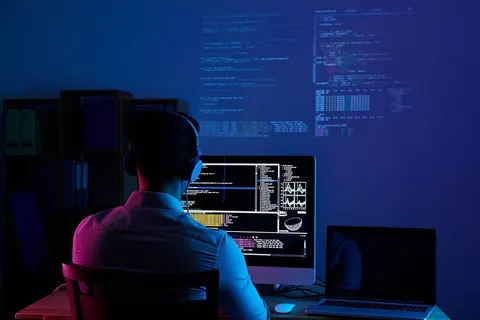
In the middle of last year an application appeared that impressed a great many of the programmers who decided to try it. GitHub Copilot is an artificial intelligence system that generates computer code after being given instructions in natural language.
It turned out to be genuinely convenient and to work surprisingly well.
In that sense, perhaps it is time for IT specialists to stop cheering for artificial intelligence? On the contrary. The fact is that it can replace us in writing simple solutions. And in doing so it actually saves a lot of time and the most tedious part of the work.
But for now that tedious part of the work is done by a great many people. You will hardly be able to find a job soon if all you do is build pages in HTML and CSS, or if you have stayed at the basic level of the job. (Much more on the subject here.)
Specialist in Everything
And so, without leaving the IT sphere, we move on to the professions that look more and more relevant.
1. Specialist in machine learning, applied mathematics in information technology, and algorithm analysis
Yes, here again we are talking about programmers, but ones who really work with the next generation of technologies. We have all grown used to associating machine learning with the endlessly repeated term “artificial intelligence.” The breakthroughs in this field in recent years have been incredible, and the best is yet to come.
The fact is that work in this field requires far more serious knowledge than the basic programming that can earn you a decent salary today. But demand is growing at a dizzying pace, and it will soon reach our labor market too. It could not be otherwise; algorithms are advancing. For now, however, it seems impossible that we will get to the point where algorithms create new algorithms on their own. Here the human role looks irreplaceable and secure, and it promises a brilliant professional future.
People who know how to analyze and process big data will be the real diamonds of the coming years.
We Drill Holes of Every Kind
2. Cybersecurity specialist
According to IBM, the average loss from a data breach today amounts to $3.92 million per attack.
With every new step technology takes into our lives comes a new level of risk. Imagine, for example, how important security becomes once we hand control of our vehicles over to the computer. If today the big risk is hackers draining our bank account or locking our computer, what would happen if they gained access to the controls of our car and the threat were directly to our lives?
And what about the moment when the brain-computer interface advances enough for us to connect our brains directly to the network… that would practically mean someone could “hack” even… our brain?!
Master Craftsmen
Well, after all this, perhaps no further detail is needed on why specialists at the various levels of cybersecurity will be more and more in demand in the coming years. Even today they are scarce; it is a field that requires rather specific skills and knowledge.
Right behind it comes another field: information security. Sooner or later, fake news and the technologies that make it possible to create it, such as so-called deepfakes, will lead to the emergence of this kind of specialist. People who can somehow check and verify information. First, though, we will have to learn to value a little more what we read and see online…
3. Digital marketing
In recent years digital marketing has been a kind of salvation for people with more humanities-oriented professions who found themselves forced to look for a new career.
This profession is at once a kind of heir to journalism and its complete opposite. Because its goal is not the accuracy of information (though accuracy supposedly doesn't hurt), but how information can be used to sell a given product.
Work Will Set Us… Free?!
And if so far this has largely come down to the many techniques of traditional marketing, here too the arrival of technology is expanding and deepening the arsenal. There is more and more talk of marketing built on a symbiosis, combining techniques from psychology, neurophysiology, and classical marketing.
The battle for attention in the online world is growing ever fiercer, and this trend is unlikely to change soon. So more and more weapons will inevitably be added to the digital marketer's arsenal, and for many long years people with experience, intuition, and unconventional skills will be sought here.
4. Manager
You hardly want to imagine the day when your boss will be… a computer. For at least a few more decades, it seems that because of accumulated distrust, and for objective reasons too, leadership positions will be the ones that remain in our human hands.
Of course, algorithms will hardly stay completely on the sidelines here either; innovative management systems are certainly on the way that will help, on the basis of objective information, to make the right managerial decisions.
Including in politics. For now it seems incredible that we would elect an algorithm as mayor. Then again, any mayor would be able to make more accurate and well-founded decisions with the help of artificial intelligence, its impartial view, and its ability to process incredible volumes of data.
The Construction Corps
5. …Handyman
Here you will surely be surprised to find this specialist on the list… at least if you haven't recently had to look for someone to replace the tiles in your bathroom. Joking aside, you'll find it easier to get a programmer to build you a virtual bathroom.
Of course, there is no such official profession as “handyman,” but it is a kind of catch-all term for the specialist who fixes mechanical problems and does repairs.
The biggest competitor here looks to be 3D printing, which is already being used to build entire houses. And yet, if a problem crops up somewhere in that printed house, the human hand and eye remain largely irreplaceable.
No, don't picture the “specialist” who shows up two hours late, makes an expert assessment and, while inspecting the contents of his upper-left molar with the long fingernail reserved for repairs, declares that the previous workers botched everything. In this direction too there will be a lot of additional technology, standardization, specialization. But there will be demand. If your child is good at playing with building sets, perhaps it is not such a great idea to insist at any cost on making a programmer out of them.
The Robots Department
And so we come to five more professions, which we will present very briefly in an attempt to peek into the future. They do not exist yet, and they may never appear… or in just a few years they may dominate the labor market.
1. Medical programmer
I hope you are not reading this text while waiting in line at some run-down Sofia outpatient clinic; in that case you will hardly believe this future is as close as it objectively appears.
Medicine is another excellent field for technology to prove itself, and it is expected to arrive there on a massive scale in the coming years. The process has been accelerated by the pandemic, which drew a lot of attention and money to this field.
Of course, there is a certain art to this profession, but technology can be an incredible assistant to doctors and “take over” a good part of their work. However experienced a pulmonologist may be, and however many thousands of X-rays he has seen and diagnosed, he cannot compete with an algorithm that has “seen” millions of images and can link what it has seen to diagnoses. However precise to the millimeter a surgeon may be, his finger can always tremble, and he cannot compare with a robot that can be precise to tiny fractions of a millimeter.
Human Resources
And then comes personalized aging. On the basis of genetic and epigenetic markers, medicine is able to give much more individual advice to help us secure longevity and far better prevention.
That is why one of the professions tied to this future is the medical programmer. A specialist with knowledge in both fields who can develop such technologies at a high level.
2. Quantum programmer
Quantum computers are the next big technology, which, by all appearances, will allow us to keep up with Moore's Law of exponential progress in technology.
We all know that in the digital world everything eventually comes down to zeros and ones. Well, so it has been until now, but quantum technologies are bearing down on us from the horizon at full force. The main difference with them is that an in-between value also exists; they completely change the paradigm and are capable of producing many new applications.
Only someone has to come up with those applications. For now there are just a handful of programming languages for quantum computers, and the prototypes of such machines are few and extremely expensive. But when that changes, there will be an enormous need for specialists who will literally invent a new world. Here even artificial intelligence will be powerless for a long time, since it has nothing to build on.
The Rhythm of the Algorithm
Algorithms, as we said, are already capable of writing computer code. But what they actually do is analyze an enormous volume of information and look for patterns on the basis of which to return what is expected of them. In that sense, millions of programs for quantum computers will have to be written before AI is able to create similar ones.
3. Virtual dispatcher
You are probably sick of hearing about the metaverse too, but like it or not, there will soon be more and more talk about it. Huge resources are already directed this way, and the labor of a vast number of highly qualified specialists is gradually being harnessed. And the result is inevitable.
Only it is not at all clear what exactly it will look like. We know that we will enter an ever more convincing virtual world with the help of headsets and all sorts of other devices. But beyond that, it is largely terra incognita.
A rather large “terra,” though. The metaverse will certainly give birth to new professions. For people who will have to “live” in it and for others who will “manage” it offline.
Work ennobles man
The exact dimensions of the new professions are hard to predict. There is certainly plenty of room for designers to create a visually, aurally, and later tactilely convincing copy of reality. And then brand-new professions will be born, such as the meta tour guide or the virtual dispatcher. After that, the meta police may well follow.
4. Digital support
In recent years many people found themselves at home all day because of work in the “new normal.” Anyone who has been in that position for long knows that it offers plenty of conveniences but comes with quite a few challenges.
Add to this the future of the metaverse. Well, it is easy to predict that it too will bring not only advantages but also plenty of problems. Psychological ones first of all. Humans were hardly made to stay in one spot; our bodies certainly don't look evolved that way.
And one more thing: by all appearances, technology will take over for us in more and more areas. The result: we will have more free time. So far in human history this has given us a lot, but it has also taken quite a bit away.
That is why there will be more and more digital psychologists, as there are more and more people who have lost their way. And even more of those for whom this can be prevented through human contact, the right advice, and support.

He Who Does Not Work…
Next come online fitness instructors. A sedentary lifestyle is a big problem even today; clearly, as a rule, we are not inclined to tackle this kind of challenge without internal or personalized external effort. For the United States, for example, the forecast is that by 2030 more than half of the population will suffer from obesity.
5. Conqueror of new worlds
Once we would have called it a “colonizer,” but today the word is out of fashion, and with some reason. The fact is, it would be wonderful if the near future finally returned to the light that science fiction writers once cast on it.
For now this profession looks more like wishful thinking. Musk has postponed the promised trip to Mars countless times, but then again he is an ambitious enough man, and you never know.
It would be wonderful to return to space. To start exploring new worlds more actively. Perhaps you remember the meme in which Gagarin asks us whether we have landed on Jupiter yet and is astonished that not only have we not been to the Moon for half a century, but for two years now we… have barely left the house.
The other, pessimistic option is digging into the present. And the even more pessimistic one, to which many great minds turn our gaze, and not by chance, is the scenario of artificial intelligence taking over.
But everything is certainly still in our hands. And we still know how to use them; it was work that made us human. However far technology advances, it is meaningful, conscious work that can keep us that way.
This piece was published in InGlobo magazine
Last updated: March 22, 2022