Almost 40 years on, the original Tetris has finally been beaten!
The triumph of a likable 13-year-old kid turned all eyes back to the good old classic contest from the days when computer games were a perfect feast for the senses.
What does this have to tell us against the backdrop of artificial intelligence? Why, all of a sudden, has the human turned out to be capable of unexpected skills in so many games of the mind? How was the game everyone knows born, and how did it become a legend? What are its fascinating sides and its dark secrets?
This is a long and instructive digital story that runs through remarkable people, through triumphs and tragedies, through cultures and twists…
The Young Ones of Today
“I’m going to die, I can’t feel my hands…” These are the words of Blue Scuti just before he realizes he has achieved what he dreamed of. Almost four decades later, he has beaten, one way or another, the game we have all played.
Perched in front of a retro cathode-ray-tube television, found after countless hassles, clicking the buttons of a retro controller for 42 minutes straight at more than 20 taps per second… Blue Scuti reminded us that there is no limit to what a human can do. That it matters more to choose what we compete with one another in, and what is worth delegating to the machines.
If you don’t believe me, ask the father of Tetris. Today he drives a Tesla, but he learned to turn a steering wheel in a Lada, and he says he still uses the same habits. Because this story begins in a lab of the Soviet Academy of Sciences, where secret technologies for the KGB were also being developed.
Back in the U.S.S.R.
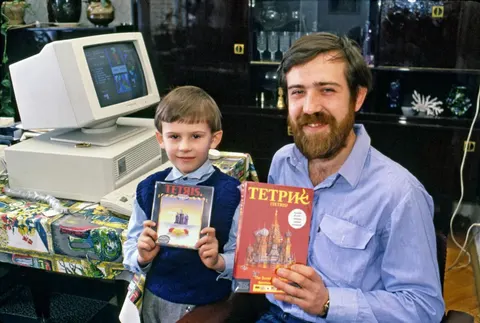
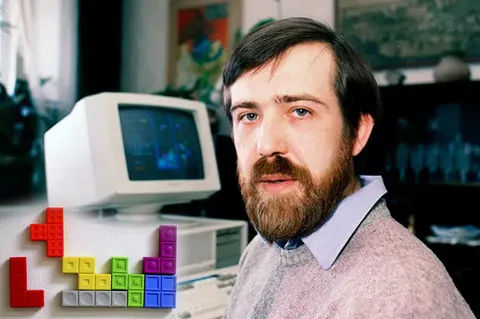
Alexey Pajitnov’s grandfather was a well-known actor of the Soviet era who appeared in the classic screen adaptation of The Twelve Chairs. His father was a philosopher who defended a dissertation titled “The Formation of the Communist and Philosophical Views of Karl Marx,” before being fired in the late 1980s for signing the famous “Letter of the 80,” which called for reforms in the USSR.
The USSR, however, is still one of the world’s globes when this story begins, and the game’s creator graduates in mathematics and turns to computer science. At the time he works at the computing center of the Academy of Sciences, doing pioneering work on using artificial intelligence for human speech recognition. Fifteen programmers work in a room with five terminals and have to take turns—Alexey often comes in after the others have already gone home.
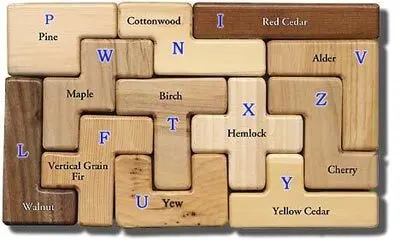
He likes his job, but he never stops wondering: couldn’t computers be used for fun too? It occurs to him to try to recreate on screen a board game he had loved as a schoolboy. It is called pentomino, and the goal is to fit together wooden pieces of various shapes, each made of five squares.
And where there is pentomino, there is tetromino—the same thing, except that the pieces are virtual and made of four squares each. The name Tetris itself comes from the most lucrative move, when you use the long tetromino to “burn” a full four rows of squares.
Brick by Brick, a Block
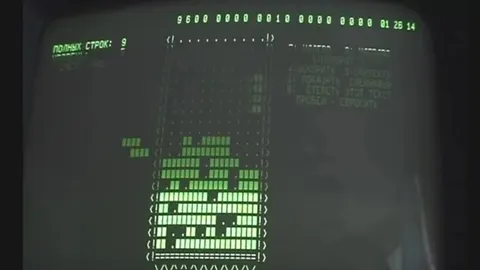
The game is born in the summer of 1984, when its creator is 29. Its first version, written in Pascal, runs on the Soviet Elektronika-60 computers of the day, which don’t even have the graphical interface we know today—the shapes appear as falling letters.
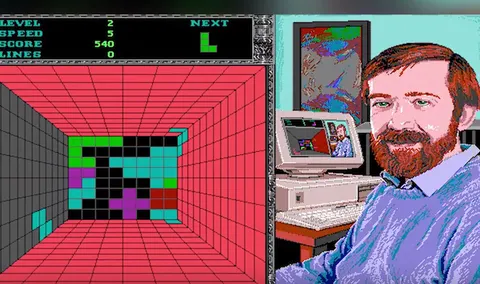
Pleased with the result, Alexey shares it with friends and brings in other developers to make the game better. He “hires” his 16-year-old neighbor, Vadim Gerasimov, to create a version for IBM computers, since he doesn’t know the programming language used there very well. The young man adds different colors to the game for the first time, along with a scoreboard.
This is where the psychologist Vladimir Pokhilko comes in, with the idea that there should be exactly seven shapes—because that is how many a player can best remember. Later Pokhilko will also be the first scientist to use the game for psychological research, and his path will become closely intertwined with Pajitnov’s… right up to a horrifyingly tragic ending.
Tetromino
But how does a Soviet game conquer the “rotten” West at a time when the Iron Curtain still hangs down in full force? Pajitnov asks his boss at the lab, Viktor Brjabrin, who travels abroad often, to help him, and in return all revenue from sales would go to the institute.
The game starts spreading on floppy disks across the former Eastern Bloc, and its road to the West begins in Budapest. There the disk falls into the hands of Robert Stein, an international software dealer from London, who sees huge potential in it. He finds the lab’s phone number, sends a fax proposing a partnership and… after long negotiations, a deal is struck. The Soviet scientists’ lab gets 80 percent of the revenue under a 10-year contract.
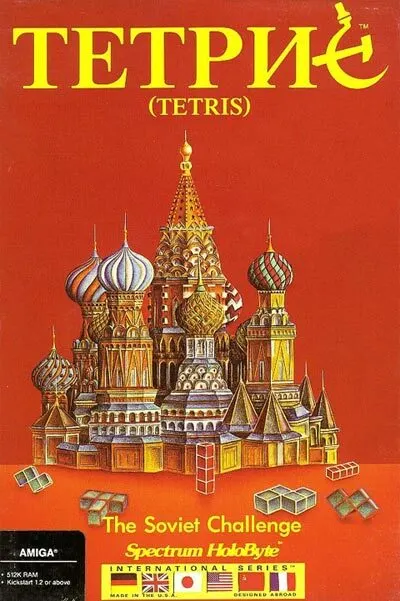
All this happens in 1986, just as the thaw between the two superpowers can be felt. Stein chooses a heavy socialist aesthetic for the presentation, as the official cover shows. A soundtrack is added—the folk song “Korobeiniki.” Cyrillic, the hammer and sickle, the Kremlin… with these the Eastern “Tetris revolution” begins! All that’s missing is the salvo of the cruiser Aurora.
These are the years when computer games go through their first real boom. Before long Nintendo will release the first game console designed to be connected to a TV, and its flagship will be none other than Tetris.
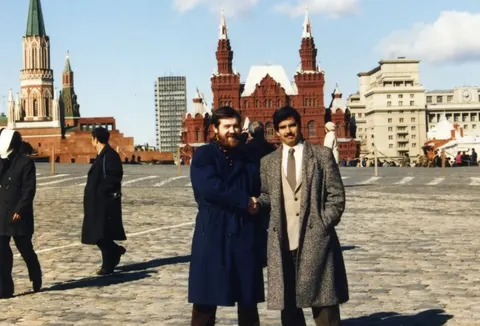
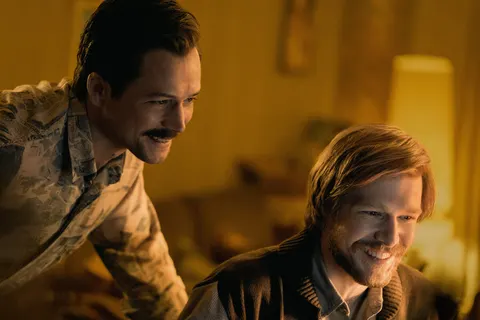
All of this goes through complicated negotiations and legal battles… A series telling the whole saga came out recently, while the game’s real-life series goes on to this day.
Tête-à-Tête
In 1991, Pajitnov and Pokhilko emigrate to the United States. Our hero patiently waits for 1996, when the rights contract expires and he becomes their full owner. Together with Robert Stein he sets up an organization that still takes a percentage of the sales of all the countless versions of Tetris.
His friend Vladimir Pokhilko devotes many years to clinical experiments using the game; he is the very person who encouraged Alexey early on to keep developing it.
Across the ocean, in San Francisco, the two found a software company that works on 3D graphics projects. They create several successful computer games, built on the idea that games should serve as “entertainment for the human soul.” The psychologist takes the helm, they open an office in Moscow as well, and the venture takes off…
By the late 1990s their business has dried up, and Pokhilko is forced to tell some 70 people that they need to look for new jobs. He takes it hard and withdraws into himself. And probably a mental illness is triggered. He stabs his wife and 12-year-old son to death before cutting his own throat. He leaves behind a suicide note that remains unexplained to this day: “They ate me alive. Vladimir. Remember that I exist. The Devil.”
Blocks in Colorful Shirts
Tragedy strikes Pajitnov’s life too—his younger son, Dmitry, dies in a skiing accident, and his body is found months later.
But the programmer overcomes his depression, as he himself puts it, through work—creating new game after new game. For several years he is part of the team at Microsoft. He develops versions of Tetris with various additions, such as three dimensions. He says he sometimes regrets not being born later, so that he could create games with modern technologies like today’s artificial intelligence.
In his view, the great failing of today’s game makers is that they only want to entertain players, not to develop them. That they design games as if for people of low intellect who don’t like to challenge their gray matter.
True, none of his many ventures ever comes close to the success of the first, but then how many people can boast of having created a legend?
Tetris is the best-selling computer game in history according to a number of rankings. By 2011 alone the game had sold 202 million copies—around 70 million on physical media and 132 million downloads. There are no precise statistics today, but the figure is many times higher.
We Played It Well…
The game is thought to be addictive because of a phenomenon called the Zeigarnik effect: the human brain holds on to unfinished tasks and lets go of them only once they are no longer needed. And Tetris never actually ends. The “Tetris effect,” in turn, is a psychological phenomenon in which, even when not playing, the brain involuntarily pictures combinations from the game.
One of Pajitnov’s big ideas is to make a version that can be played in teams—that, too, will happen, after he has worked on it for a whole decade. It comes out in 2019, though it fails to draw much interest. The programmer often says he regrets that the global computer industry is weak at developing multiplayer games. So instead of enjoying the pleasure of connecting with like-minded people thousands of miles away, players are locked into communicating with the computer.
And yet… Tetris becomes a unifier, a pursuit that builds team spirit, a sport—and in a way quite unexpected for Pajitnov himself.
Next Friday, look out for the story of the record that showed there are no limits before the human. That technology simply creates new possibilities for us, which we have to learn to use. And all of it… thanks to a remarkable 13-year-old kid nicknamed Blue Scuti.