Two kids become friends over their shared fascination with computers. Then they start their first company together. Less than a decade later, that same company is the first giant of the modern computer age. And while we know a great deal about one of those kids, who for a long time was the richest man on the planet, the story of the other is far less familiar.
None other than the computer specialist Paul Allen, the “godfather” of Microsoft, turned out to be the owner of the most expensive private art collection ever sold. And this happened in November 2022, four years after he left this world. A connoisseur of art, a man smitten with sports, a huge donor to scientific research. He is also the rich man who awakened the modern interest in spaceflight.
At just 29 he learned that he had a deadly illness, and he decided to live the rest of his life the way he had always dreamed.
There is a lot we can learn from the story and the worldview of this unconventional figure. And, even more, we can ask ourselves: what would today’s tech world look like if its other leaders shared his outlook?
Great Expectations
No, no, just picture it. Bill Gates was paid at school to write a program that would schedule the classes. And he wrote it so that in English class he was the only boy, alongside a dozen of the prettiest girls in school. Bill the playboy, good luck…
While he was at Harvard, he spent many nights at the poker club, sometimes losing hundreds of dollars a night. Perhaps that was when he learned to bluff, which later came in handy at work…
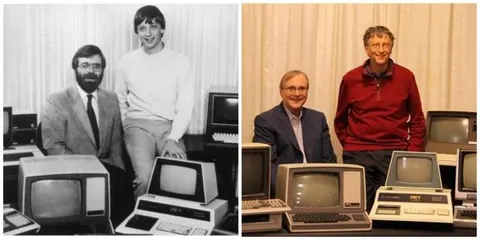
These are the kinds of deliciously curious stories Paul Allen tells in his memoir, Idea Man. And there really is no way to separate his fate from that of his childhood friend. Together they sketch the story of two very different personalities, both of them emblematic of Silicon Valley.
Paul is Bill’s senior by a whole two years.
His mother was a literature teacher, his father a librarian. He kept an exceptionally close and special bond with both of them all his life, and yet… the boy was thrilled by computers rather than books. That is how, at Lakeside School in Seattle, he met the younger kid whose name you know so well.
Especially gifted at writing code, Paul Allen considered himself an artist all his life.
To the Top
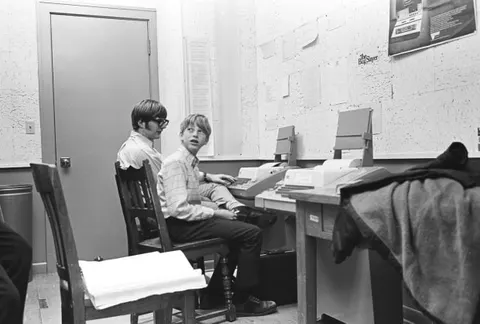
In the late 1960s the two often ended up in the school’s computer lab—back then it was anything but easy to get your hands on the grandfathers of today’s computers. The machines there turned out to be rather feeble, so the kids set their sights on the University of Washington. But there too, as if it were a space telescope, you only got limited access.
Bill and Paul, however, were hackers, and they tried to cheat the system… but they weren’t good enough. They were caught and punished with a ban on using the computers.
So the two of them joined Bill’s best childhood friend, Kent Evans, in a computer club. It would be decades before a profession devoted to this work appeared—QA—but the three kids were given the task of hunting for bugs in the programs of the local computer center, and in return they were granted extra hours to tinker on the machines.
Sadly, at only 17, Kent died in a mountain climbing accident. That brought Bill and Paul even closer, and they carried on together.
Pride and Prejudice
Paul was admitted to Washington State University with a perfect score. But he found it dull and dropped out after his second year to become a programmer—at a time when that was a rather exotic profession, in the strange era of dinosaur computers.
As luck would have it, his first job was at Honeywell, whose offices were near Harvard, the very university young Bill had just entered.
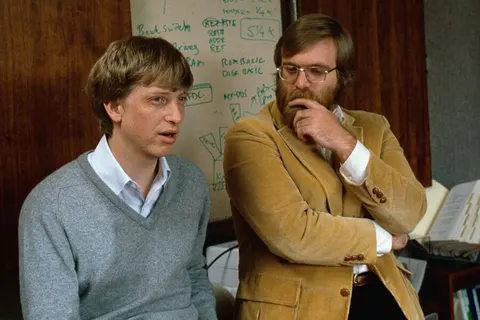
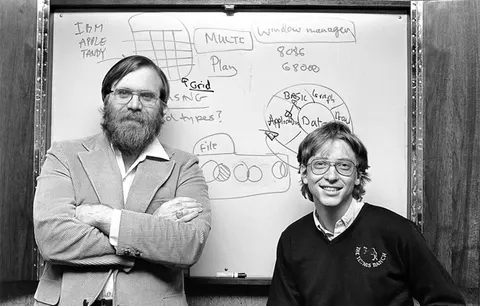
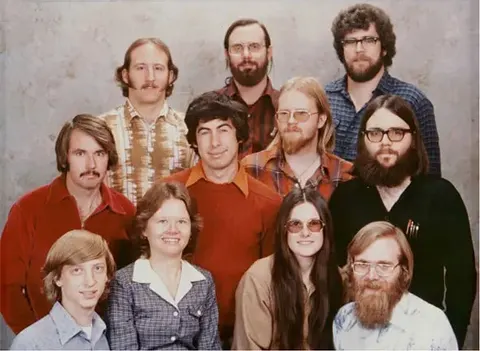
It was Paul who persuaded him to drop out as well, so that together they could start something entirely different. And it was Paul, again, who suggested naming the venture Microsoft—combining microcomputers and software.
We still have much to learn about those times that laid the foundations of the modern computer world. What is certain is that the two young entrepreneurs were enormously lucky to land in the position that would very soon launch them, with a bang, to the top. There is, for instance, the well-known story of Gary Kildall, the computer pioneer who very nearly ended up in their place.
Vanity Fair
The fact remains, though, that Bill and Paul got the incredible chance to offer an operating system for IBM’s new computers, and they pulled it off in the best possible way. All sorts of legends circulate about those days—stolen code, intrigues and other episodes worthy of a soap opera. But many believe the big success came, once again, thanks to Paul and his idea of licensing the rights to the new operating system to their clients instead of selling them.
That is how the first workable MS-DOS ended up on countless computers all over the Earth at exactly the moment they became widely affordable. And from there the road to Windows, the operating system that paved the highway of today’s technology, was quite logical and natural.
Of course, there are equally good arguments that the decisive role belonged to Bill, thanks to his capacity for work and his ruthlessness. He had clearly taken enough useful lessons from poker and knew what he was doing. He worked with endless persistence and expected the same from everyone else.
Another story, also told by Paul, has become legendary: his partner ran into one of the lead programmers, who had worked 81 hours over the previous four days, rushing to finish an important task. And instead of thanking him and congratulating him, or at least asking how he felt, Bill asked: “What are you working on tomorrow?”
Beggarman, Thief
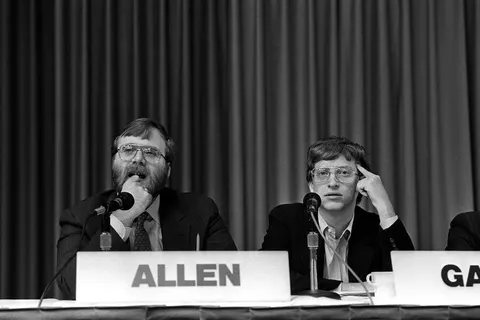
Yes, Paul later wrote that working with Bill was sometimes like being in hell, and that he had a very domineering nature. Yet after Paul’s death, Gates admitted that “Microsoft would have never happened without Paul.”
Somewhere around then the two friends’ paths parted. It was 1982, seven years after the company was founded. Barely 29, Paul Allen heard the terrifying diagnosis: non-Hodgkin lymphoma. He had to start treatment quickly. He had also sensed that he no longer felt at home in a company that had turned into an empire. And yet, one way or another, he remained part of it—until 2009 he held a formal post from which he shared his experience.
While undergoing treatment, he had plenty of time to think about what really matters in life. And so came the conversation with his childhood friend in which the time arrived to part ways. The two had agreed earlier that Bill would hold the larger share of the stock, but now Bill offered to buy all of Paul’s shares at $5 apiece. Paul said a fair price would be nearly double. They parted on bad terms, even though at that moment Paul’s future was uncertain as he faced the fearsome disease. With the help of his new partner, Bill managed to push his childhood friend into the background.
But what matters is that Paul proved stronger than the illness. Radiation and chemotherapy worked, and the lymphoma was beaten. The cancer would return decades later, but he used every moment of those years to spend them the way he had dreamed. Because once you have looked death in the eye, you know that what matters is not money but the days you leave behind.

Be a Bulgarian, Jeeves
The shares Bill Gates had begrudged buying kept piling up value, year after year. Thanks to them, in 2006 Paul Allen was the sixth-richest person in the world, with a fortune of $20 billion.
But Bill is hardly that upset. In recent years he has stubbornly tried to step into the role of philanthropist, a fighter against epidemics, which has earned him mostly… the lead role in conspiracy theories about how he will control us through chips in vaccines.
Meanwhile, the halo of the philanthropist stayed with Paul, even if it didn’t draw nearly as many eyes.
What if they had swapped roles? Would kindhearted Paul have been so brutal with the competition, so tireless, while the foundations of the Microsoft empire were being poured in the 1990s?
We can only guess and, above all, trust fate, which knows its business. Because here is what Paul Allen achieved in those 36 years that fate “gifted” him.

Wuthering Heights
He died of that same non-Hodgkin lymphoma in 2018, at 65, despite the doctors’ more optimistic outlook this time. He had heard the grim diagnosis for the second time in 2009.
And then, in November 2022, his name was back at the top of the news. $1,622,249,500—that was the sum fetched by 155 works of art from Paul’s collection. The auction broke many records: the collection became the most expensive in history, and five paintings went for over $100 million—two by Georges Seurat and one each by Gauguin, Cézanne and Van Gogh. Every single work sold, two-thirds of them above their estimates.
All the money will go to charity, just as the late billionaire’s will stipulates.
The only serious relationship of his life came in his early twenties; he even got engaged. But the girl decided she was too young to marry, they split, and from then on, many say, he lived the life of a recluse.
Though he was a great lover of art and enjoyed stories about love, he never found it himself, and he left this world alone, without a family of his own.
The Sign of Four
It is very rare for someone to know what to do with a vast amount of money and to actually have it at the same time. Well, our hero is one of the few examples. Brace yourselves—the list is long.
Allen amassed serious wealth through various entrepreneurial ventures with the help of Vulcan, the company created to manage his fortune. Thanks to farsighted investments in real estate, internet access networks and a range of technologies, the estate keeps swelling even today, after his death. There was also a strong emphasis on invention—Allen’s companies hold more than 400 patents in all sorts of technological fields.
It is worth mentioning that both in his lifetime and today, the person closest to him, his sister Jody Allen, has played a large role in all his undertakings. After his death she became the trustee of his estate, most of which is earmarked for charity.
It is believed, for example, that her love of cinema is why the producing of Hollywood films made it onto the company’s enormous list of activities. Among the films they made are some that won Grammy and Emmy awards.

Paradise Lost
And yes, if you imagine that a tech person must be far removed from art, here is one stereotype that can go to the movies and watch the films Paul created. Or to an exhibition—we have already talked about his collection.
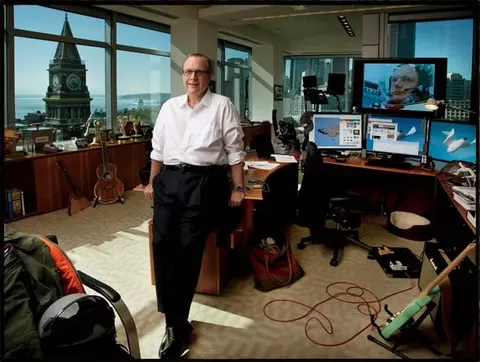
Paul also loved music. He got his first guitar at just 16 and dreamed of being the next Jimi Hendrix. Well, for better or worse, things didn’t quite turn out that way. Still, he fulfilled that dream too, at least to the extent of one album.
Sports were another big chapter of his life. Paul was a yachtsman himself; his last boat, 126 meters long, was called Octopus and until recently ranked among the 20 longest motor yachts in the world—with two helicopters and its own mini-submarine. Every year, during the Cannes festival, he threw famous parties aboard, where he played guitar.
In 1988 he bought the NBA team the Portland Trail Blazers, which reached the league finals twice under his ownership. For a time he also owned an American football team, the Seattle Seahawks, and a soccer team in the American league, the Seattle Sounders.
The Loneliness of the Long-Distance Runner
Space was another great love of the entrepreneur. He was the sole investor in SpaceShipOne, the first commercial project to send a human into suborbital space. It was not only a huge success but, in its own way, it led the charge before the next big Silicon Valley investors in the field arrived, people like Musk and Bezos.
In his lifetime Allen gave more than $2.6 billion to various forms of charity related to science, technology, biodiversity conservation and medicine.
He founded a number of his own research institutions. The Institute for Brain Science came about after his mother showed the first symptoms of dementia. Facing the problem firsthand gave him the push to fund research in that direction. That is also where his largest single donation went: half a billion dollars.
$2 million went to a new library at the University of Washington. It bears the name of his father, Kenneth Allen, who had once headed that very library.
He funded a team that found an aircraft carrier lost in World War II. $7 million went to protecting elephants. Because of his donations to nature research, a species of fly bears his name.
Allen donated to the SETI program, which aims to search for extraterrestrial life. With $100 million, he was also the biggest benefactor in the fight against the Ebola virus in West Africa.
As You Like It
His vision also shows in the creation of an institute dedicated specifically to artificial intelligence research, long before the field gained its current fame.
“No one really knows what it would take to create something that is self-aware or has a personality,” he said on the subject. “Still, I can imagine a day when perhaps, if we manage to understand how the human brain works, it might be possible. But that is a long, long road…”
One more thing. Once enough years had passed, Paul forgave his childhood friend Bill for their bitter split. As early as the late 1980s the two jointly donated $2.2 million to the school where they had met. And so, somehow fittingly, the circle closed.
“As long as we work together—both quickly and decisively—there are no limits to what we can achieve,” said Paul Allen.
What might have turned out differently in this story, and how, is an intriguing question whose answer we can never know. But still: what will history say? Who is the greater visionary—Bill, who built the most powerful company of his time, or Paul, who devoted himself to living the way he believed in? I leave the answer to you…