Can poems be painted? Are humans and algorithms rivals in this task, or is it time they joined forces to create the next forms of art?
Open your senses to an emotional experience in which human and computer, side by side, challenge both your senses and your feelings…
Once we got our hands on algorithms that draw images in impressive ways, the next challenge arrived—coming up with texts inspiring enough for them.
How would they imagine the verses of Debelyanov, Yavorov, Geo Milev—classics of early 20th-century Bulgarian poetry? A year ago, in one Digital Story, I set them exactly that challenge, and the results were certainly impressive, but also thought-provoking. Has a new form of creativity been born, a new art?
And while I simply fed them translated stanzas as food for thought, at the same time a visual artist came out with an exhibition built on a similar project. Tsvetomil Semkov showed his striking pictures, painted after poems. And today, a year later, he is ready to show how completely he has devoted himself to the subject with his debut solo exhibition, “Svetogled” (Worldview).
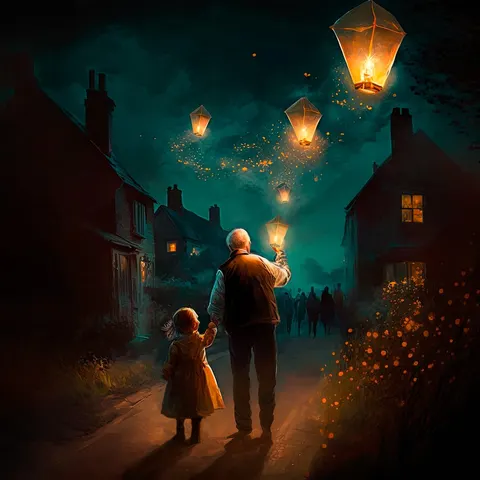
Stay, Moment
Stay, moment, for you are so fair.
But can the moment ever stay
when it bows to no one's will
and we have sentenced it to the road!
For it was we, with trials, with questions,
with victories inside our brows,
who set it upon axles
and gave it wings!
For it was we, with pain and wonder,
who taught it how to fly.
And now it trembles with a hidden joy,
it trembles with impatience.
It will break loose, it will fly off
like a bullet or a tear—
saturated with all our labor,
with all our wonders.
And re-created in such
particles of happiness on the way,
each of us will be departing
from himself, from his own death.
Will be departing, will be staying,
repeated in a thousand things,
and with a starry brilliance shine
on those who travel through the night.
Vladimir Bashev
(Click on the title to read the corresponding poem.)
Though a financier by profession, Tsvetomil's great passion is images. Perhaps it is written into his name, which in Bulgarian begins with the word for color… He started out as a photographer, and today he describes himself rather as a visual artist searching for different forms of expression.
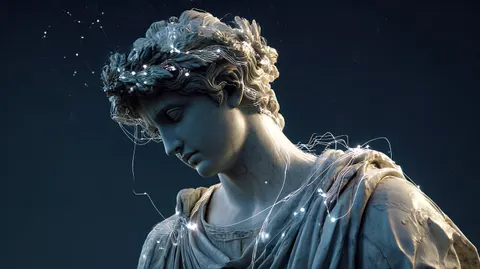
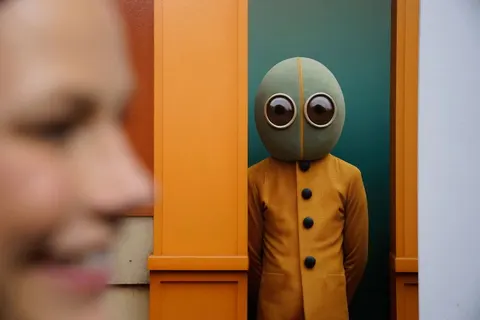
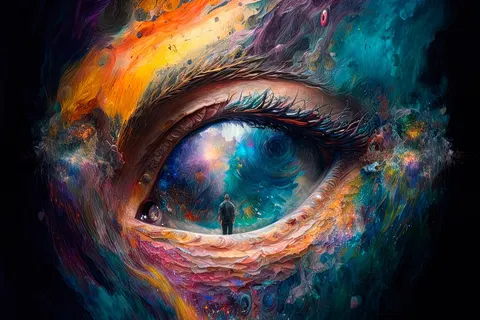
His exhibition “Svetogled” brings together 15 little-known poems by Bulgarian authors with 15 images that complement them. And although they were once again created with the help of algorithms, this time they were not invented by them. Tsvetomil describes to the MidJourney platform what he expects to see and how, then compiles the results and works on them further. His aim is to show that this kind of technology can be the next step, the next tool—one that complements the human being rather than replaces him.
“As paradoxical as it may sound, I think that as technology advances, the author will actually become more and more important,” he says. “The human element and the path walked will matter more and more, because otherwise there's no point—pretty pictures are everywhere, and there will be ever more of them.”
For many, photography is literal art—seeing the world through a real image—but even in his photographic work he tries to create worlds detached from reality. Worlds much closer to his inner one.
“That's where the artificial intelligence project came from—to me, every person who follows their passions and interests and manifests their own interpretation of them is a creator. In this project I combined my curiosity about poetry and about technology, and that gave me complete freedom to dive deep.”
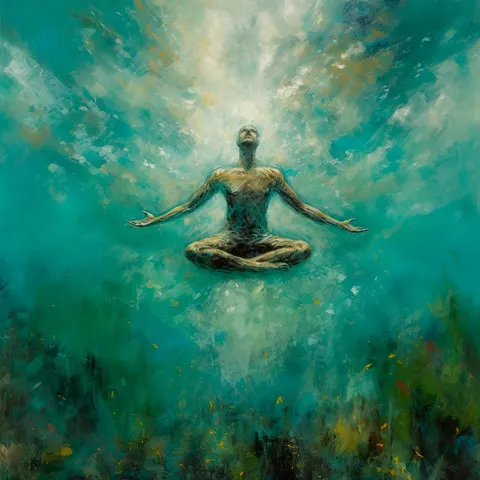
Taking a Breath
Out of inertia
we seek the clean breeze outside,
yet its source
lies within our souls.
Don't hold the air
inside you, it will choke you.
Even if they are blocked,
both the nostrils and the mouth.
Breathe it out through the wounds,
through the tears, through the blood,
through the sweat of the pores—
salty, condensed air in verse,
laughter,
a cry.
And with a full chest you will take in
a high mountain breeze,
purified by the pines
of your own breath.
Blaga Dimitrova
Although as a schoolboy he had no interest in poetry, and literature was not among his favorite subjects, years later he rediscovered verse as a source of inspiration. And all of this intertwined with his interest in science—for many years he has followed the events of Ratio, a Bulgarian science festival, and artificial intelligence capable of creating images became the catalyst for his next ideas.
“It's very hard to represent a poem with a photograph; there's no way a single image can be that rich. Every poem is a separate universe in itself, and if you want to transfer it visually, you have to make some kind of equivalent of it. It doesn't work with fragments alone—that way everything breaks,” says the visual artist. “You have to dig deep into both the text and the visual. Once a tool appeared that could help me make such a project, I chose it immediately and started learning it.”
But how to go beyond the literal? He decided simply to let himself drift with the current. He began spending long days at the chitalishte, Bulgaria's traditional community center and library, reading and rereading poetry collections by authors from different generations and setting aside those that resonated most strongly with his own feelings, his own “svetogled.” He set himself rules—no politics, no specific places, no historical figures or events. Only poems that would be just as relevant fifty years from now, because they carry a universal feeling.
“I'd come home, read them, and when something struck me, I'd mark it, digitize it and start working. Searching for the most fitting image to illustrate it!” he says. “The idea was to use lesser-known authors—I'd read and be amazed at the beautiful things written by people I'd never heard of. Over time an enormous critical mass piled up, and at some point I had to choose, asking myself about each one: ‘Tsveto, this poem and this image—is this really you? Does it really sting you inside, or do you just like the picture? Or do you simply think the poem will go down well…?’ The hardest part was stripping away those aspects and leaving only my own view of the world in the exhibition. Those excerpts—picture and poem—should be like neatly arranged little packets of meaning, something that touches me deeply.”
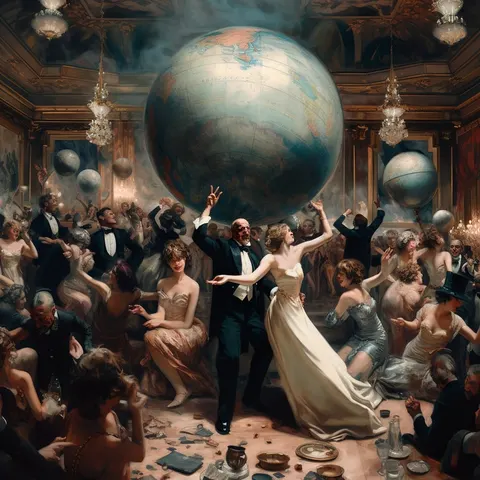
Floating Restaurant
We eat and drink, and our eyes wander
toward the gilded locks of the women—
drowned in honey, the greedy flies don't know
that they will never fly again.
The Earth drifts like a floating restaurant
through cold and maddening space.
And there's no saving shore out in the cosmos
where we might rest from our drunkenness.
The players who conduct the dance
have turned man into an accordion…
But from the merciless laws of the dance floor
our heads are full of lawlessness.
Our souls' belts loosened all the way,
we rage like pirates who have never sighted land,
and in the devil's dance of elbows and of hooves
bare feet run away from the boot…
And as we leap through the air to catch
the outstretched palm of the gods,
we vomit our bellies into the ocean
and spit iron at the sky…
The singer-moon, seduced long ago,
lies half-naked—her skirts around her waist.
And from the back alleys of the dark universe
come screams and shouts till late.
And the sun—the chief of light—
keeps silent, ready to boil over any moment.
And watching where the Earth is heading,
it tears its hair out and pours it over us.
Boris Hristov
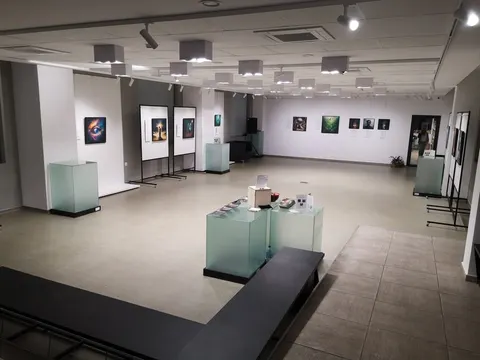
And so: 15 poems by 13 authors—Vladimir Bashev and Martin Spasov have two works each. There are names from the school textbooks, like Smirnenski and Yavorov; popular poets such as Damyan Damyanov, Boris Hristov, Blaga Dimitrova, Mladen Isaev and Stoyan Mihaylovski; but also names heard less often today, like Penka Tsaneva (Blenika), Nikolay Antonov and Marko Nedyalkov. The exhibition opened in Burgas and can be seen until November 14 in Burgas, at the Center for Contemporary Art and Library, exhibition hall, 4th floor. After New Year it will move on to other cities, including Sofia, Varna and Plovdiv. The exhibition is made possible with financial support from the National Culture Fund under its Debuts program. You can follow here to see when it comes to your city.
Tsvetomil says that today, in the exhibition hall, he truly sees himself. “For the viewer it's more fragmentary, but I think everyone can find themselves in some of the pieces, in a poem, in an image.”
Curiously, as he walks his path, the algorithms themselves evolve alongside him. In the beginning MidJourney “reads” the text more holistically, its images are easy to recognize, it has something like a style of its own. The newer versions, by contrast, turn it more into a tool for creating images from a description. “Now the idea is more that if you have something in your head, you learn to steer it there, rather than giving some instructions and taking whatever comes out ready-made.”
“The whole process was very vivid; every time I turned a page I felt as if I were opening gifts full of meaning, while the program gave me the freedom to tinker and develop directions that were sometimes unexpected.” In his first project, Tsvetomil was more of a curator—feeding in data, taking, choosing and presenting, although it turned out he had to make quite a few decisions; he didn't leave everything to the algorithm. Today, though, he presents a vision entirely his own, which the algorithm merely helped him create.
“The first thing I was after was bringing it back from the perfect to the imperfect—teaching it to have empty spaces, artifacts, mistakes—so that some questions remain and not everything is clean and clear. For there to be shadows, for details to get lost, so that a person can fill them in visually and take part in the process.”
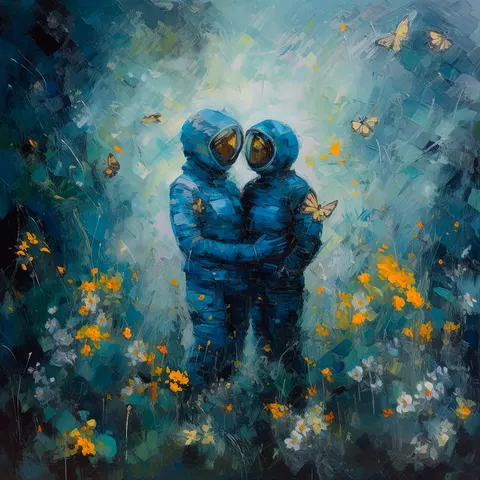
We Asked for Suns
We asked for suns, but what use are they
when a shadow hangs heavy between us?!
With weary gaze and starchy souls,
we fail to recognize the beautiful peacocks
that suddenly have lost their plumage
after a very long chemotherapy.
For such beauty we need sight,
but in so many cases our soul is blind.
We've grown used to living at speed,
we're quick to anger and quick to love.
And meanwhile—exquisitely simple—
a bee gathers happiness from a stamen.
That's how we are—we kindle the hearths,
yet embrace with cold hands.
Because among ourselves we're always predators.
Though otherwise we feed on plants.
Martin Spasov
It took him a long time to settle on the right style. Image generators keep getting better at things that resemble photorealism, while the author wanted to go back to something more painterly. He experimented with techniques, styles and colors until he found what he was looking for. In the end he settled on impasto—a much rougher technique, with paint applied thickly to the canvas.
So each image came about after the photographer described what he imagined, added the instructions for the particular style he had arrived at, along with a few more words from a list of emotional terms that had struck him. Finally he edited the result, combining and adding to it. Only two or three of the images are shown without any further processing. For some poems he worked for days on end, while for others he found the feeling he was after more quickly.
“In the end the goal became a kind of personal experience, a looking into oneself. You read things written by people, many of whom are no longer with us, and you converse with their thoughts. Through poetry they show you what moves them, how they try to make sense of life's journey. And as you encounter these things, you learn. You arrive at self-awareness through the example of others,” says Tsvetomil.
“Every poem is a picture, every picture is part of the way I see the world. The funny thing is that these aren't my poems, and technically the images aren't entirely made by me either,” Tsvetomil smiles. “Someone will say—fine, but what do you do, what's your role in this exhibition? It wouldn't exist in the world in this form if it weren't for me. By taking from the digital space and bringing it into the physical world, I lead it closer to people. It's experienced in a completely different way… Besides, people tend to overlook the effort and work that actually go into even this technique. You have to get your hands on such technology to understand that it is definitely not just a click of a button.”
It is no accident that the author decided to print and sell each image in a single copy only, turning the gaze back to the times of classical art.
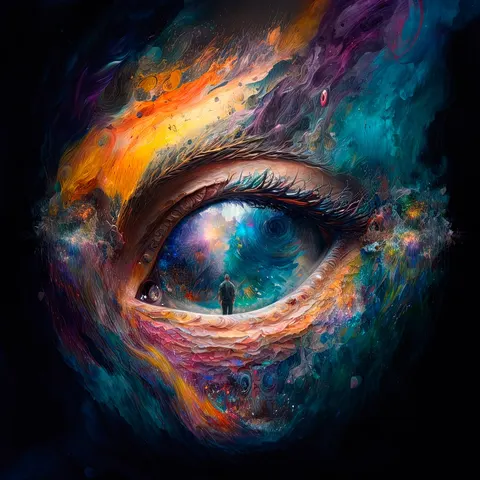
Man
Man is not the ash of a cigarette
and a handful of soil,
a leaf
and a dead stalk.
A spark
that smolders
and burns out
in the days'
enchanted circle.
Man is metal
and sound,
and song,
and atom,
and dream,
and freedom.
And sweet fruit,
and heavy autumn grapes,
and a never-setting star!
Man is sky
and a distant road,
and thunder
that has broken every chain,
and a mine,
and a bullet,
and a forged bayonet,
and a rose in bloom,
and a merry tear,
and wind,
and sea,
and lightning,
and wound,
and cry,
and thrust,
and cosmic chime.
Man is the thundering bell
that wakes eternity from sleep!
Marko Nedyalkov
“When technologies like these arrive, many questions arise, and it's especially complicated in the long run. People who have already worked in the visual arts, who have built up some visual culture, a feeling for the world, somehow pick them up and learn to use them. They can weave them together with their own visions, techniques, projects—that, to me, is the point. But for someone growing up now, it may be a shortcut. We evolve in everything we do; the process is a transformation—we learn, we progress, we make mistakes. The problem is when we rush to skip ahead to the result,” the photographer reflects.
“With algorithms you still rummage around in your head for things, you put in or take out as you see fit. It's still a kind of dance in which you create, even though you don't have much connection with the real world. And I believe you have to live the world too—that's the main problem: it comes from a program that doesn't live anything, and that alone can break the bond between a person and art.”
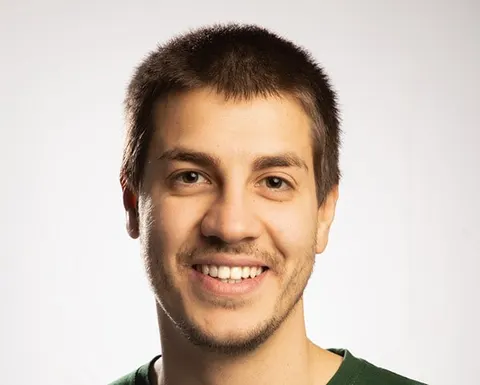
The photographer says the work was quite exhausting. “You're bombarded with images, and at some point you simply go numb. You want a little rest, a breath of air.” For now, his fascination with artificial intelligence has come to an end. That's why, for his next ventures, he has decided to look for older and alternative methods, to do something with his hands and restore the balance.
Will he really manage to break away from the algorithm? Either way, as I trust the poems and pictures here have convinced you, beauty is still alive. And when people use algorithms creatively, thoughtfully and responsibly, the results can be human and beautiful, full of meaning. They can create art that moves us…