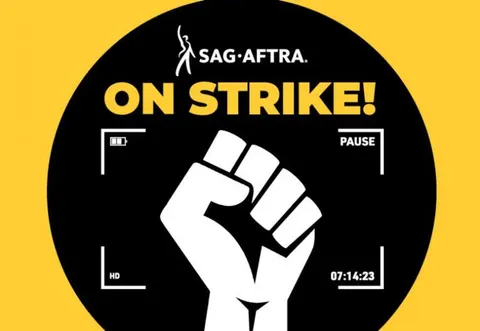
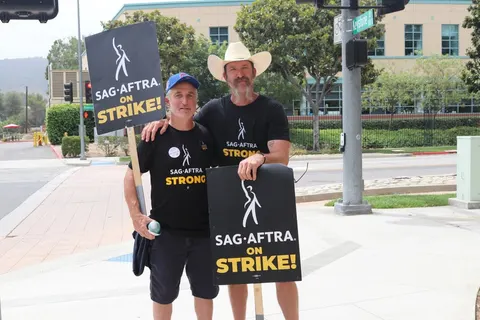
A few days ago, 160,000 people rose up in an unprecedented protest against artificial intelligence, which could take the bread out of every one of their mouths. No, they weren't factory workers or taxi drivers, but Hollywood actors, many of them heroes known all over the world, holders of prestigious awards. The screenwriters stood beside them.
Artificial intelligence against Hollywood stars and writers… Alien vs. Predator?
It turned out to be the largest strike in the United States this century, the first joint strike by actors and screenwriters in more than half a century. Projects worth billions were halted, and Hollywood literally froze, much like the world did during COVID. And if, in the churn of world news, this story never reached you at its full scale, that is one more reason why it's worth talking about.
But how is it that actors, of all people, took the threat of algorithms so seriously? Why is technology behind the biggest revolt in Hollywood's history, and what does it have to tell us?
Isn't it time we all learned something, one way or another, from the stars' rebellion?
Once Upon a Time in Hollywood
And so the long-awaited Oppenheimer arrived. After a drenching (and well-deserved) media warm-up, July brought the moment for two long-awaited Hollywood premieres destined to become a sensation.
A few days later came the premiere in the United Kingdom. Right in the middle of it, all the lead actors stood up and walked out of the theater in protest. That was exactly when the long-awaited start of the full-scale Hollywood strike was announced.
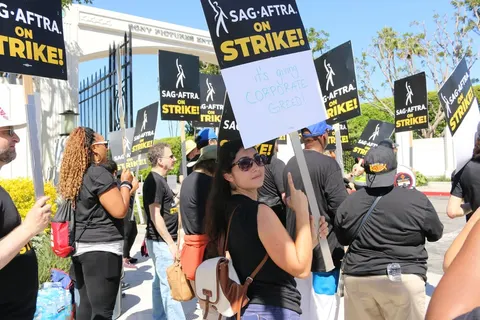
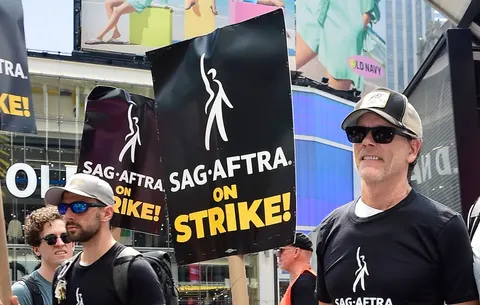
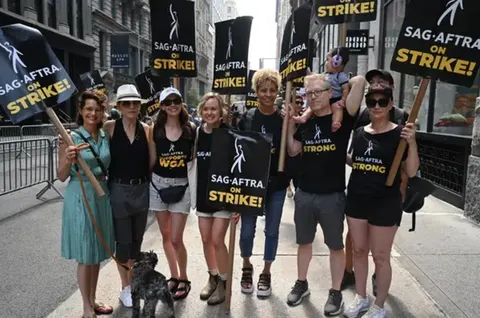
The SAG-AFTRA union represents no fewer than 160,000 television and film actors. In mid-July the organization joined the Writers Guild of America, which had begun its own full-scale protest 70 days earlier. A battle to defend their rights unlike anything seen before… and one that somehow stayed on the margins of media attention.
In the last joint protest of actors and screenwriters, back in the 1960s, the stars were led by their union leader… Ronald Reagan.
Are actors and screenwriters the new Luddites? Is this just haggling, arm-twisting between guilds? Or is it the first bright, insistently flashing red light warning of the great change coming with the advance of artificial intelligence?
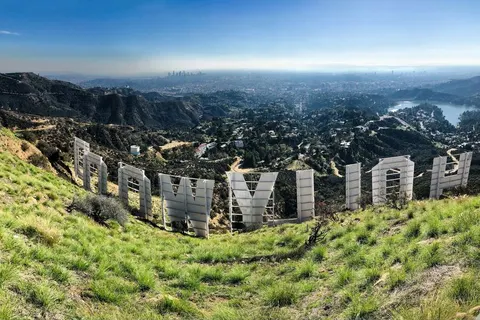
Hollywood Business
Artificial art, virtual people—all big topics of our time that somehow remain in the shadow of the daily news.
If you follow Digital Stories, you certainly know them. You also know about “Nothing, Forever”—the The Bold and the Beautiful of the new age, the series generated entirely by artificial intelligence, showing new plot after new plot with familiar characters 24 hours a day, in real time…
On the other side is technology in cinema. You've surely come across pictures of the green screen—actors are filmed against a clean background, and then the computer takes care of filling in everything else to create the perfect image of a swooping dragon, an ultrarealistic explosion or a terrifying battle.
More or less, all of this comes together in today's topic—the largest strike in Hollywood's history. It shows that the mecca of cinema, the most powerful and globally dominant American intellectual machine, is frightened of what is coming.
Of the time when algorithms, not people, will write screenplays. Of the moment when it will be enough to scan an actor to reproduce every scene they appear in. And then the next ones, and the next…
Or is that time already here?
Stars vs. Algorithms
In our part of the world we're used to calling it a “collective labor agreement”: the guild in a given field negotiates general terms with the employers. Also in our part of the world, we've grown out of the habit of believing that in this whole process the rights of the people in that field come first and are well enough protected—and there are probably reasons for that.
Well, the same thing is happening in Hollywood. However much the market may look like the one unavoidable force shaping the rules, it turns out that's not quite the case. The first signal came from the Writers Guild of America, which refused to sign its agreement with the AMPTP—the largest producers' organization, representing the makers of television and film productions.
Negotiating with the studios is the main task of the screenwriters' and actors' unions. The last such agreement for both guilds was signed in July 2020, and of course its main focus was regulating the rules during the raging pandemic. It expired on July 30 this year, and so the time came to negotiate the next one.
The apple of discord became the screenwriters' demands for limits on the use of generative artificial intelligence: that it be labeled, and that there be restrictions on how copyright is respected when algorithms are trained. All ethical questions that will come up on the agenda more and more often.
The Silence of the Lambs
You don't believe this is the future? Well, I find it a rather convincing argument that the producers' organization was also insisting on rules specifically concerning algorithms.
Two months later almost the same thing happened with the huge actors' association, which joined the strike. Again with demands to guarantee actors' rights as the new technologies arrive. To impose limits on how they can be simulated virtually, on what effects can be layered onto their images…
Duncan Crabtree-Ireland, the chief negotiator for the actors' union, says we are on our way to a world where the most frightening prophecies about the advance of technology, familiar from the series Black Mirror, have come true.
On the Red Carpet
According to him, during the negotiations the Hollywood studios proposed using “groundbreaking artificial intelligence” to “scan” background actors and pay them just one day's wage of $200, while the companies would own the scans and use them in any project they wanted. The producers' alliance responded that the innovative proposal actually protects actors' digital likenesses.
“If you think that's a groundbreaking proposal, I suggest you think again,” said the actors' negotiator.
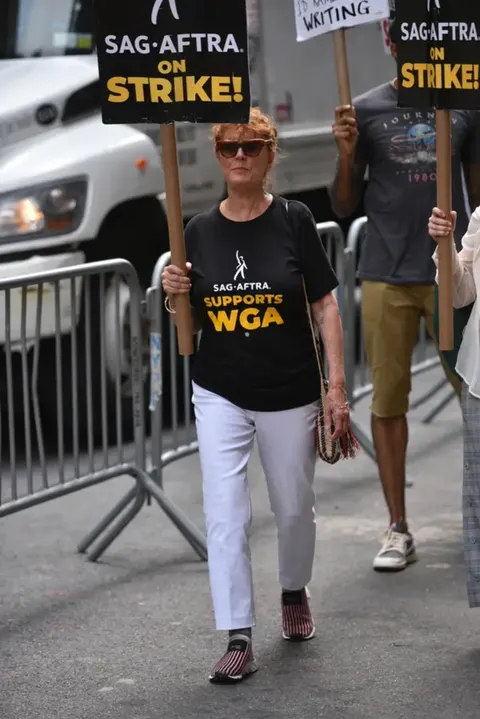
Of the guild's 160,000 members, most are certainly not among those expecting an Oscar tomorrow or whose names you've heard. And yet it is telling that the stars of Oppenheimer too showed solidarity with such arguments. Perhaps in our part of the world it's worth thinking a little more about how we support one another within a profession. Even if we go back to the days of the old craftsmen's guilds and compare them with today's dimensions…
Being Determines Consciousness
That impressive membership includes not only actors but also radio announcers, models, esports competitors, even influencers. In principle the union covers only the territory of the United States, but clearly its influence is tied to sectors whose output then reaches the whole world.
And the strike turned out to be entirely serious—union members may not appear in films or commercials, or take part in promotions, until the protest ends. Exceptions are made only for educational films, charity campaigns and public causes.
How united are the actors? In the vote in early June on whether to go on strike, 97.91 percent backed the decision. Yes, far from all your favorite stars have spoken out on the issue, but few allow themselves to play the role of strikebreaker.
As for the screenwriters, they fear that any good idea of theirs can easily be developed further by generative algorithms, leaving them with nothing. While in the world of artificial intelligence we still mostly talk about general frameworks and concepts, here we are dealing with very concrete applications.
Die Hard
Of course, much of any negotiation like this stays behind the media screen. It's perfectly normal, especially in a marketing kingdom like Hollywood, for the disputes to come down to… money, while only in the spotlight is it about rules.
The producers, however, do not deny that algorithms are among the contested issues. Since mid-July, an ever-longer list of major productions (from the sequels to Avatar, Gladiator, Mortal Kombat and Top Gun to impressive new projects) has kept piling up, postponed or blocked because of the strike.
“I don't think the AMPTP realizes how hard we are willing to fight,” says SAG-AFTRA member and actress Lacy Mosley. “They think they'll wait us out and starve people to motivate us to come back to the table. But they're crazy, because we're used to living without money.” Hollywood performers, really?
“They don't understand that nobody gets into this industry without having heart and without wanting to achieve a deeper purpose: to connect with people. A computer can't re-create what we do,” the actress believes. I suspect Lacy could learn a thing or two about negotiating from Prof. Yanka Takeva, the veteran head of Bulgaria's largest teachers' union.
Avatar
Certainly another thing that has changed drastically since the previous agreement is the rise of streaming platforms at the expense of traditional film and television. It changed the whole system in terms of financing, organization and who sets the rules. Movie tickets and TV commercials gave way to viewer subscriptions.
“The business model in Hollywood has changed because of streaming, digital content and artificial intelligence. This is a historic moment. If we don't stand tall right now, we are all going to be in trouble, we are all going to be in jeopardy of being replaced by machines and by big businesses who care more about Wall Street than about you and your family,” says Fran Drescher, president of SAG-AFTRA. She is an actress who appeared briefly in Saturday Night Fever, became famous from the series The Nanny, and has a fascinating story both personally and professionally.
Pay is always subjective. There are many rankings: according to one, Bruce Willis is the highest-paid actor of the past 20 years thanks to a single film; according to another, it's Keanu Reeves; and for several years Dwayne Johnson—The Rock—himself topped the annual lists. I'm sure people like Charlie Chaplin or Apostol Karamitev, one of the great Bulgarian actors of the twentieth century, would have plenty to teach them about the craft of acting, and yet… The Rock is The Rock. He may look as if algorithms generated him, but he wasn't: it's real cameras pointed at him that film him, and he is not a fully virtual character, of which there will obviously be more and more.
Nothing to Lose but Their Chains
The contracts under negotiation are quite extensive, and although all eyes are on the limits on artificial intelligence, there are many more points of contention on which the two sides cannot agree.
The union, for instance, is pushing for a form of compensation based on how often a production is viewed on streaming platforms. It wants equal pay for actors in different parts of the United States. As well as a number of smaller demands—for example, that actors who do their own hair and makeup be compensated with at least $35. One of the innovations both sides agree on is that background actors receive at least 48 hours' notice if they are to appear in nude or sex scenes.
Either way, the applications of artificial intelligence come to the fore. Brian Cox, the actor from the series Succession, told one of the protests how he had been shown a video of scenes he had never played, yet they looked so real. “The AI Brian Cox was even imitating animals. I have never played an animal in my life, damn it. Nobody can escape this today, and it's time we stopped it.”
George Clooney, who supports the protest from the front line, says that many actors and writers today have lost the ability to earn a living. “This is an inflection point for our industry. For it to survive, that has to change. For actors, this fight is only beginning.”
Opium of the People
At some point the strike will end. In negotiations like these, a mutually beneficial solution is always found sooner or later. We've had them here too—remember Tobacco, Dimitar Dimov's classic novel with its tobacco workers' strike, or even the teachers' strike at the start of the century that gave birth to the notorious call “Let's break up the sedyanka,” the traditional village evening gathering.
And yet, the questions this event highlights are bigger.
- What will the entertainment of the future look like?
- Are humans the only ones who can create today?
- Can artificial restrictions solve the problems?
- What are the professions of the future?
- What will we do with the time technology frees up for us? Isn't it time for more rest?
- Has the moment come for universal basic income?
- Where should we draw the line for algorithms?
Our future as a civilization depends on the answers…