Spomnqte li si 6liokavicata? That is “Do you remember shlyokavitsa?”—written in shlyokavitsa itself, the makeshift mix of Latin letters and digits that Bulgarians once typed online instead of Cyrillic. Some of the fundamental tools of online communication change so fast. Only a decade ago it was a real problem to write in Cyrillic and have the person on the other end read text rather than hieroglyphs.
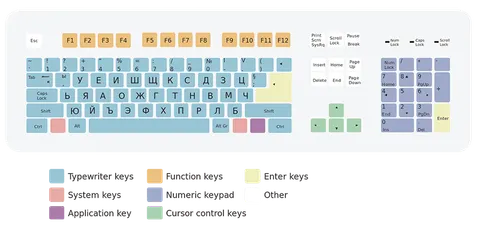
But when it comes to writing in Bulgarian, another great battle remains unchanged, a battle between generations and logics. How are the letters on your keyboard arranged—according to the good old layout inherited from typewriters, known as BDS? Or the phonetic one, where the Cyrillic letters follow their Latin equivalents?
Is there a better solution? Does this choice really make a serious difference to how fast we type on a computer? And might both standards be obsolete, since they come from a time when their main purpose was to suit the typewriter?
While we wait for voice commands to become good enough, especially in less widely spoken languages like Bulgarian, there are plenty of fascinating things to say about the keys we strike with our fingers every day as we try to express our thoughts where they increasingly thrive—online.
Letter Eaters
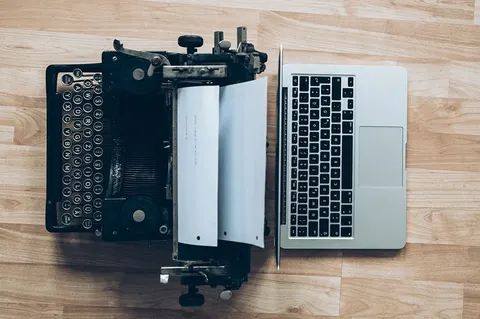
This story begins 115 years ago, when computers did not exist even in people's imagination. Typewriters were arriving in Bulgaria, the first prototypes coming at the very start of the last century. Manufacturers had no standard, and each one “distributed” the letters as it saw fit.
One of the places where the novelty was used most actively was the National Assembly, Bulgaria's parliament. In October 1907, Teodor Galabov, head of the parliament's stenography bureau, assigned his staff a quantitative study of the Bulgarian language: they were to analyze the typed texts and record how often each letter was used.
The results were published at the end of that same year, and on their basis the BDS standard—short for Bulgarian State Standard—was drawn up. It has remained almost unchanged to this day, the differences being the letters removed in the spelling reform and, above all, the symbols that “hide” together with the numbers.
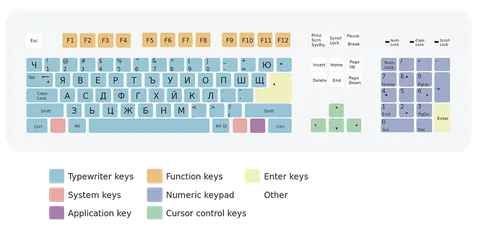
The layout was designed to make typing as fast as possible. On the one hand, it assumed that typists use the ten-finger system, and still—the most frequently used letters fall where the index fingers rest. О, Н, Т and А are placed so that the stronger fingers strike them.
All Bulgarian Men Shall Observe B-D-S
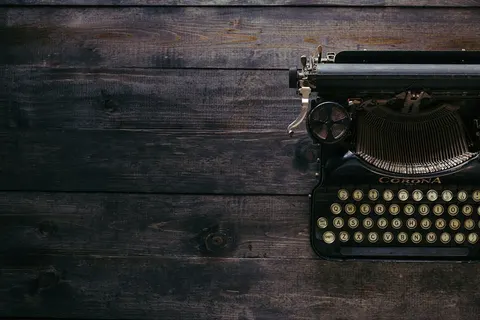
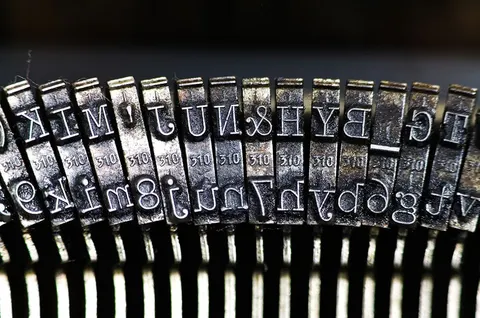
It was also important to separate the pairs of letters most often combined: a person types faster by alternating hands than by typing mostly with one. Naturally, a feature peculiar to typewriters was also taken into account—anyone who has touched this “antique” technology knows that pressing a key makes a little lever “slap” the ribbon, which in turn prints the letter. Accordingly, it mattered that letters be typed with as few collisions as possible: two levers staying pressed at the same time would jam the machine.
Here, though, this is more of a side effect that makes no difference—but does no harm either—today, when the levers are gone, replaced by computer keys.
In the middle of the last century, international typing competitions became popular. Back then our standard proved very good, and we won a number of speed contests—the indisputable criterion of how good the Bulgarian system was.
As applied linguistics specialist Assoc. Prof. Maria Stambolieva writes, “designed with brilliant precision, the BDS keyboard is unanimously recognized by its users as one of the most perfect in Europe. Using BDS with the ten-finger system makes it possible to enter information at speeds close to those of stenotype machines.” And that means a truly incredible speed—over 1,000 characters a minute, fast enough to type spoken text in real time, even when the speaker talks fairly quickly.
I Have a Finger in It
So the generations of Bulgarians who used typewriters effectively had no choice and learned to type on that very standard keyboard.
Then, of course, came computers. For a long time Cyrillization was a serious problem with them, which is why writing in Latin letters was not some disregard for our language but simply a necessity in the early years of the mass internet. At some point most of the problems were solved, and communication quite naturally moved to Cyrillic. And along with it came a new eternal dispute: phonetic or BDS?
For the generations used to typewriters, it was easier to carry on with the good old system created for the needs of the Bulgarian language. At the same time, generations appeared who had learned to type in English. And for them, quite naturally, the first choice was the phonetic keyboard.
Typing on phones turned out to be a serious factor too. In the days of the mobifoni—the bulky early handsets of Bulgaria's first mobile operator—and the first GSM phones with keypads, writing in Cyrillic was awkward (and often impossible): there were no printed letters, and one key served for 3 or 4 characters. Yes, today's smartphones give us more freedom, with a virtual keyboard that mirrors the real one and can also be phonetic or BDS. But that brings us right back to the main question.
Literally
Is there a winner in this dispute? There is no way to name one definitively—if you are used to one keyboard, switching to the other would certainly cost you considerable time and effort. Whether you use only four fingers or all of them, whether you look at your hands or not, experience shows that in everyday life the speed hardly differs that much.
And yet there is the other point of view. On one side stands a system made specifically for fast work in Bulgarian, so proven over the years that it has barely been changed. When, not long ago, 200 public figures (and, who knows why, clergymen) demanded a change, it boiled down to… removing the letters Э and Ы, which really are not used, in favor of… Ѣ, Ѫ and Ѭ, which, I am sure, every one of us writes daily. Should there be a capital “ь,” or an accented “и”—the “ѝ” that distinguishes “her” from “and”? Let us leave that argument to the specialists. In any case, if we use “й” instead of “ѝ,” it is not considered a spelling mistake, explains Assoc. Prof. Stambolieva.
According to most of them, BDS is still the better choice if you are just starting to learn to type on a computer. They believe this standard should also be taught in the education system.
By Our Keys You Shall Know Us
As Assoc. Prof. Stambolieva writes again, “today the mass arrival of computers into the everyday life and homes of Bulgarians has turned entering information via a keyboard into the dominant kind of ‘writing.’
Our children often sit down at computers before they have even picked up a pencil or a pen. Yet precisely in recent years, when using a keyboard became a necessity, the century-old Bulgarian tradition of teaching typing on BDS was broken off, and students were left to teach themselves however they could and saw fit. Bulgarian schools not only do not teach them to type; they do not even advise them which keyboard to use. And many of them hop with two little fingers across a letter layout that is inconvenient for entering Bulgarian text, designed to serve the speakers of another language.”
The specialist has more to add today, too, when I asked her for a comment. According to Assoc. Prof. Stambolieva, the subject of keyboards matters mainly from the standpoint of education and the health of those who type. “For typing to be efficient, there should be training, as happens in many countries. And that implies textbooks and unified keyboard layouts. Health is an important question as well. A well-planned, ergonomic keyboard requires less effort and strain on the hands and eyes.”
In her view, the phonetic system requires leaving the letter area and moving the hands to the zone meant for the function keys. That makes it harder to type without looking at the keyboard, and slows it down. “I have tried to explain to experts at the Ministry of Education and Science the need to introduce keyboard typing classes in schools, but so far without success. And they would raise children's literacy many times over,” the researcher says.
Word by Word, Key by Key
The phonetic keyboard has some curious quirks. The most “consensual” letter remains “е,” since it sits on the same key in English and in both Bulgarian keyboards.
On the other hand, for a long time we had “ж” matching “v” and “в” matching “w.” That is because the standard was based on the German transliteration that traditionally dominated typography. We are left to wonder why and how “я” ended up in the place of “q.”
Besides the fact that the phonetic solution mechanically transplants a system made for another language, it is worth noting that QWERTY, the English keyboard we all know… is not the universally accepted best option either. The well-known Matt Mullenweg can tell you so, for example—the creator of WordPress is among the champions of the most popular alternative, which goes by the name Dvorak.
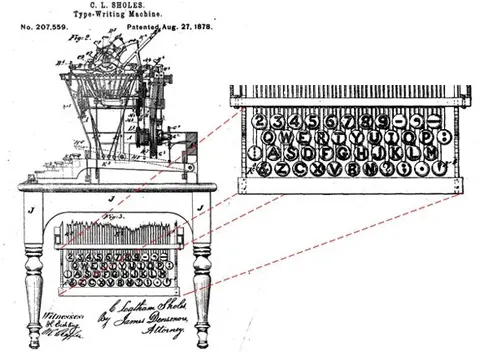
The history of QWERTY is considerably longer than that of our BDS. The typewriter was officially patented in 1868, and the standard appeared only five years later. Both steps were the work of the American inventor and publisher Christopher Latham Sholes, and they quickly took hold as the standard. Still, the final version of the layout was the work of Remington. The arms company wanted to change its image, bought the patent and became the world's first major typewriter manufacturer.
It seems that in creating the standard, the main aim was to avoid jamming the machines, as already mentioned, rather than to draw on statistical data, as in the case of the Bulgarian solution.
ASD, ASD
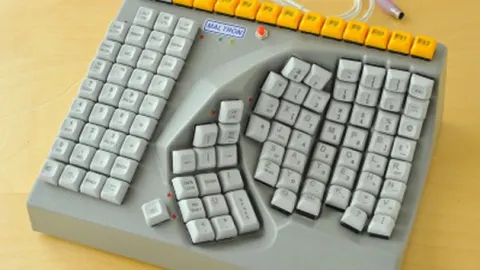
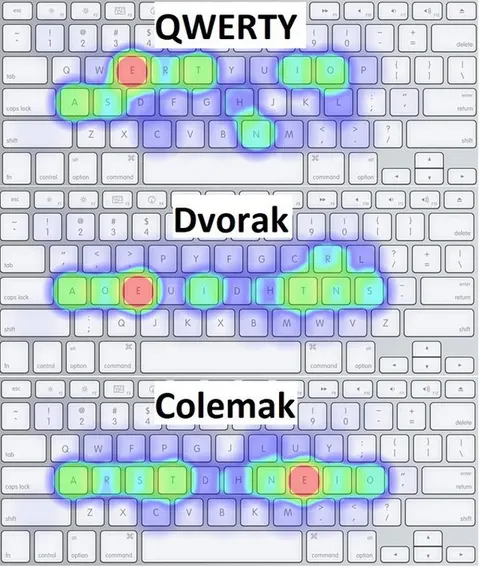
In the 1930s the most popular alternative in the English-speaking world appeared. It bears the name of its creator, the statistician Dr. August Dvorak, and proved considerably better suited to fast typing. Alas, it is still rarely used today, even though the subject resurfaces every few decades. According to its creator, Dvorak raises typing speed by as much as 74 percent and cuts errors by 68 percent. Its main advantage is that it shortens the distances between frequently used letters and “moves” all the most frequently pressed ones to the middle row.
Matt Mullenweg says it took him a little time, and he is very pleased with the results after switching from QWERTY to Dvorak. The differences in layout, as the diagrams show, are considerable—if Matt types the first four keys of the middle row, for example, instead of the usual programmer's combination of random letters ASDF he gets AOEU: clearly the most frequently used vowels are gathered there.
Look, a Key
The current world record for fast typing in English is held by Stella Pajunas, who reached 216 words a minute on QWERTY in 1946. With that she beat the previous best of 213 words, set by Barbara Blackburn in 1946, who for her part used Dvorak.
Nowadays there is also a third contender in the keyboard dispute, the only one of those mentioned that was created for the needs of the computer world. COLEMAK, from 2006, claims to take the best of the other two solutions.
There is a fourth participant in the dispute as well—KALQ, designed specifically for touchscreens, to be used when entering text on a tablet or smartphone.
And yet, at least for now, the winner here is clear and indisputable. More because of tradition than for objective reasons. Today we could create, in no time at all, an algorithm to work out what a keyboard that allows faster and more efficient typing would look like. You will agree that would be far more precise than whatever it was that someone did 150 years ago. Here, for example, is an interesting analysis of this kind, which clearly shows how badly QWERTY lags behind the other solutions. And still… try explaining to keyboard manufacturers that they will have to throw away all the ones with this letter layout printed on them…
Finger to Finger
The best thing today is that we can choose between keyboards, and they are now so good and standardized that they allow us luxuries unthinkable until recently. For example, writing “ѝ” instead of “й” when grammar requires it (Shift + ь, that is, the Latin “a” key, for BDS, and Shift + the Latin “x”). We can open and close quotation marks the way Bulgarian punctuation says we should—„“. And we can use almost any symbol we need—the other accented vowels, for instance—thanks to the ability to add extra characters.
Either way, whatever the layout, whatever the letters, what matters more is what they say when gathered into words, and how they say it. And as long as there are letters, there will be us. Just as there will always be the dispute over which keyboard layout is better… if you don't believe me, ask the programmers. They will certainly have a different opinion.