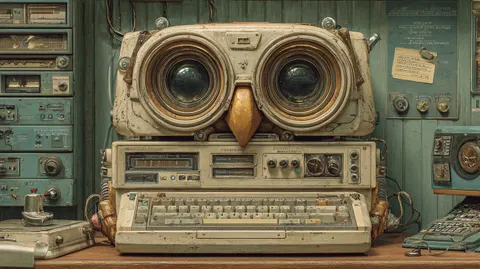
Have you heard of the literatron? It is… a machine that produces text on a user's instructions. It analyzes texts, writes bestsellers, composes campaign speeches, assembles comics and threatens to shrink the language of the media to 500 permitted words.
Because of it, celebrities give their opinion on something they don't understand. Conferences are organized on “Literatronics and Persuasion,” “Literatronics and Defense,” “Literatronics and Religion.” There is an author's manuscript, produced at a pace of one page every quarter of an hour, and the first worry about it is whether someone might sue the “author” for plagiarism. Meanwhile, the “author” himself has invented exactly one single word.
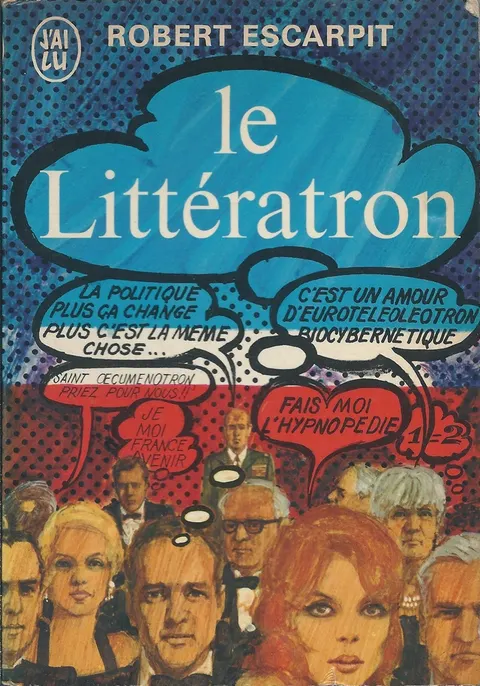
Nothing new, right? We all have AI now, and these plots are everyday life; only that word “literatron” sounds a little retro. Why it does becomes clear when you look at the date on the cover of a slim little book that it is no exaggeration to call prophetic.
The novel Le Littératron by the Frenchman Robert Escarpit came out in 1964 in the series Le Meilleur des mondes. The series was named after Aldous Huxley's Brave New World, a rather telling touch. It appeared in Bulgarian in 1985, translated by Georgi Kufov—the man who also translated Kazantzakis.
Escape Room
No, the author is not simply a science fiction writer who stumbled onto a lucky metaphor. Robert Escarpit (1918–2000) was born in Saint-Macaire near Bordeaux and hardly ever left his native region—if we don't count five years in Mexico after the war. A graduate of the École normale supérieure in Paris and a specialist in English literature with works on Byron and Kipling, he taught comparative literature in Bordeaux, and between 1975 and 1978 he was the university's rector.
At home he was popular as a journalist. For a full thirty years—from 1949 to 1979—Escarpit wrote a short satirical column in Le Monde, producing more than 9,000 pamphlets in that time. A whole generation of French people began their day with his irony about the news. He founded the first French university institute of journalism, and in 1972, together with Roland Barthes, he launched the French Society for Information and Communication Sciences. He is called the father of the sociology of literature.
In Le Littératron, his subtle irony spares neither the technocrats with their five-year plans, nor the press, nor the university, nor the church, nor the literary juries.
Seven Times Mérik
The hero, Mériadec Le Guern, called Mérik by his friends, is a sly fellow with a degree in “linguistic aesthetics and applied psychodemography”—in other words, a humanities graduate who knows how to adapt to his surroundings, juggles foreign terminology with ease and is completely incapable of inventing anything at all. He is not a scientist. Nor is he a writer. He is a man of words.
To advance his career, Mérik needs an idea, which he doesn't have. Just then he comes across an old brochure from a literary congress describing a machine that analyzes style with the help of punch cards. Mérik reads it in a single night, and at dawn he comes up with the name.
But does the invention really resemble large language models?
To put it mildly.
Assoc. Prof. Dr. Maya Gorcheva of UNIBIT, the University of Library Studies and Information Technologies, noticed it back in 2023, months after ChatGPT appeared (read it here). She examines, one by one, the texts created by the Literatron and extracts a simple and unpleasant formula from them: “Through the machine, it is not quality that is assessed, but quantity.” And further: “Each of the projects shows how the statistically most widespread (but not the only) option, passed through the machine filter, becomes the only valid, profitable one.” The new novel produced by the Literatron is a “reconfirmation of the status quo,” and invention is “mimicry of the already familiar.” So, if you're curious now, here are 12 quotations from the novel itself.
1. With Words You Can Do Anything
“Huguette was feeding me nonsense. I was not a man of science, and I could hardly even consider myself a man of letters. My gift for imitation and my linguistic abilities fooled the uninitiated, and as long as I had even a vague notion of the subject, my deft handling of technical terminology allowed me to unsettle certain specialists who were no more specialists than I was. But I was utterly incapable of inventing anything whatsoever.
I went so far as to curse the rhetorical nature of my education. With words, I told myself, you can do anything, except real things.”
A gift for imitation. Linguistic abilities. A vague notion of the subject, but a deft handling of terminology that fools people.
Doesn't it sound like the biography of a large language model yet?

2. A Little Shakespeare, a Pinch of Marlowe
“Strange as it seemed, this paper, delivered at a literary congress, spoke almost exclusively about electronics. It described in broad outline a machine capable, after chewing on a text for a few seconds, of declaring: ‘This is Shakespeare 1603 with a pinch of Marlowe at a dose of 0.08 percent and traces of Bacon. All the same, I found a misplaced comma on the twenty-third line of page one hundred and two.’
It was too good to be true. I instantly saw all the applications such a machine would be fit for, if it were ever built.”
The date given for the paper is no accident. In January 1954 in New York, IBM and Georgetown University demonstrated the first machine translation to journalists—some sixty sentences from Russian into English, computed by an IBM 701. The promise was that within three to five years the problem would be solved for good.
Well, it took a little longer, but machine translation today is extraordinarily good.
And yet here we are, still arguing over whether building such a machine really turned out to be a good idea. All while we keep searching for its sensible applications, all while we keep being impressed by the next model of AI, and the next.
3. So Much Time Lost
“I looked at the date of the article—1954. So much time lost! How was it possible that after so many years no one was talking about this wonderful machine yet? Which group of researchers was keeping it under lock and key? Had it emigrated to some other country? Whatever had happened, the doors of history had to be opened for it. Our century was waiting for the verbal machine. Thanks to it, literature, pedagogy, information and politics would at last become exact sciences. All night I built grandiose plans around the machine. At dawn I found a name for it—literatron.”
Actually, the name isn't bad at all; to my mind it's even far more meaningful than the catchy “ChatGPT.”
Or what about “artificial intelligence”? Is it still artificial if it was created by a natural one? Is there no artificial in the natural? Is it even intelligence?
Of course, we owe the term, as readers will remember, to a group of scientists, again from the era in which the novel takes place.
But couldn't we come up with a more fitting name?

4. Evasive Answers
“In a series of interviews, Brigitte Bardot, François Mauriac, Fernand Raynaud, the Reverend Father Riquet, Louis Aragon and André Malraux expressed their favorable or unfavorable opinion of the invention. And since they understood nothing about the matter—and rightly so—it was not hard to lend their evasive answers a subtly implied favorable meaning.”
And again… just like today's large language models, wouldn't you say? The speakers are different, but the public conversation about what we have is just as evasive and “subtly implied.”
Escarpit adds two opponents—the demographer Alfred Sauvy and the biologist Jean Rostand, who condemn the machine in the name of humanity. We have no shortage of those today either, including among the very scientists who develop artificial intelligence…

5. The Name of the Rose
“The Literatron did not need to be invented. It lacked only one thing—a personality, a civil status, a trade name… Provided you use such a machine properly, you can ask it to identify a given text, to analyze it, to evaluate it and even to correct it. We can also, by reversing the order of operations, ask it to combine words, ideas and grammatical structure on its own—that is, to write, to compose literary texts. All of this was tried, tested and acknowledged as possible many years before you did me the honor of becoming my student. There was even some sort of poetry machine that produced perfectly acceptable verse…
– It was called Calliope.
– Exactly. That name is prettier than Literatron, but, I admit, less profitable.”
A machine for… verse?! Apollo from the machine?!
Until a decade ago we could look at this idea with a smirk; some may still approach it with prejudice, indignation, even denial, but that machine is already here… Whatever we call it.
6. It Looks Sensible
“The advantage of your Literatron is that it looks like something sensible. We will know why the money is being spent, or at least we will pretend to know. The Literatron is a goal, a motivation, as the psychologists say. Naturally, it is an empty undertaking, but that doesn't matter. The best hypotheses for research, the ones that open the financial floodgates, are neither the truest nor the most honest. Look at the discovery of America!”
The machines are far too expensive for what they do—because texts have to be encoded, programs written, “the memory fed.” Today we say “collect data,” “train a model,” “build a data center,” and the sums we're talking about are measured in hundreds of billions.
The Literatron “looks like something sensible.” It is a goal, a justification. We'll know why the money is being spent. Or we'll pretend to know.

7. Literatronics and Religion
“– And what topics have you planned for your colloquium?
– So far I have ‘Literatronics and Persuasion,’ ‘Literatronics and Culture,’ ‘Literatronics and Defense,’ ‘Literatronics and Decolonization.’
– Fine, add ‘Literatronics and Religion.’ I'll find you a first-rate man in that sector. An American canon. He drew up the plans for an automatic confessional. You mark your sins on a dial, drop half a dollar into the slot and get a coupon of absolution, which you exchange in the sacristy for so many candles, so many prayers, for whatever you need, really! Very ingenious! And have you thought about education? You need a ‘Literatronics and Education’ sector.”
Try the experiment: replace “Literatronics and” with “AI and” and look through the program of any conference from recent years. Persuasion, culture, defense, development, religion, education.
The automatic confessional with half a dollar in the slot… today it is so close to the truth. And “Literatronics and Defense”…? Alas, here too Monsieur Escarpit is frighteningly on track.
8. More of the Same
“The three sheets contained the same text. It began like this: That's politics for you, the more it changes, the more it stays the same. It's all cronies, swindles and the like. If they hanged a few of them, things would go better! The smartest ones, no doubt about it, are the dumbest. The little guys get into trouble, and the big ones always get away. What we need is a man with a firm hand… And it went on like that for a full twenty-five lines, down to the last sentence: And it's always the same ones who go off to die.
I raised my eyes.”
The novel's “Project Narcissus” works like this: pollsters write down what voters say in bars and markets, the Literatron extracts the most frequently repeated claims and hands them back to the same voters as the candidate's speech.
Escarpit wrote this in 1964. Half a century later we would pretend not to remember Cambridge Analytica, microtargeting, messages calculated from the profiles of the very people they reach, and we would feel betrayed by technology. But it simply did what it was designed to do—it gave us back our own words.
Yes, if we spew out the same simple, banal prompts, if we use the same base models, the results of our interactions with AI won't be pretty.
“Slop.” We still don't have a good Bulgarian word for it.
We see it everywhere. But is the problem in AI or the literatron, or in the pre-computer device?
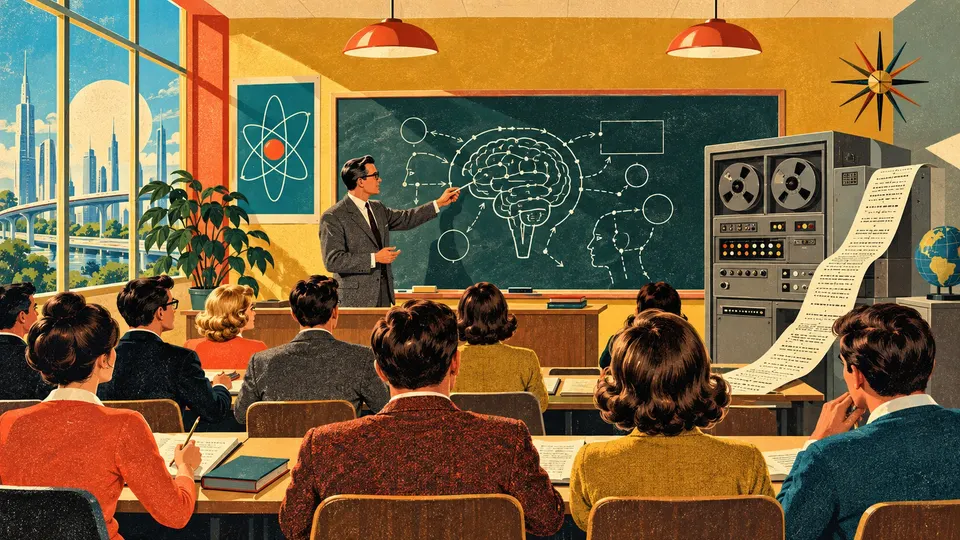
9. In the Shadow of Stethoscopes in Flower
“The report presented four projects for novels. In first place, with a print run of 700,000 copies, was a sentimental novel in a mass-market edition, titled Virgin and Typist. Next, with an estimated print run of 500,000 copies, came a fat medical-sentimental novel. It was titled In the Shadow of Stethoscopes in Flower. Finally, the fourth project was a novel described as ‘objective-phenomenological,’ which was to consist of a series of sentences in the second person plural of the present tense, without periods or commas.”
How much words deserve to be valued and loved in times when, at first glance, they seem so cheap.
10. Tempo, Tempo, Keep Painting!
“During the week, Boomerang finished editing Virgin and Typist. The Literatron had worked around the clock at a rhythm of one page every quarter of an hour. I was assured that no writer had ever achieved such a pace of production, except perhaps Georges Simenon, but only when he stayed awake, whereas the Literatron did not sleep at all.”
I could name you Bulgarian counterparts of Simenon without much difficulty, too. Yes, the speed Escarpit describes is laughable today. But the question of speed versus quality, of human limits versus machine ones, of the obvious advantages, is becoming ever more important.

11. People, Future!
“And strangely enough, from each of these texts it retained only five words, always the same: I, me, France, people, future. To broaden the vocabulary, we lowered the threshold of frequency and semantic intensity below the one at which these words had been isolated. And then there appeared: prosperity, peace, justice, and a little later—freedom.”
“Project 500” is the only one left unfinished in the book. Its goal: to extract, from a huge mass of texts, 500 words that would be the only ones permitted in the press, on radio and on television. Orwell had published 1984 fifteen years earlier, and his Newspeak is exactly this—a language whose vocabulary shrinks until thought becomes impossible.
The difference is that in Escarpit's book nobody bans words. The frequency threshold is simply raised. Whatever falls below it doesn't exist.
And you—do you already sense the loss of certain words? A poorer vocabulary, more clichés, partly because of the arrival of AI?
12. Claude, Freud, Einstein
“They had to know me, but not know too many things about me. In the same way, if we had given too many details about the Literatron, some of its applications would certainly have provoked objections. The ideal was to make society hold, about literatronics and about me, that kind of mythical notion, that semi-religious feeling it has, for example, about Freud and psychoanalysis or Einstein and the theory of relativity.”
Good publicity is not to be underestimated. Ask people like Sam Altman or Dario Amodei.
Ten years later, Escarpit wrote a sequel to the literatron—Le Ministricule (1974), The Little Minister, with the same characters, in which he mocks politicians and businesspeople; alas, it has never been translated into Bulgarian.

Is everything new just the well-forgotten old? Or is everything old a new thing not yet invented?
Is there nothing new under the sun? Or is there nothing old?
I confess, I came up with these sentences myself; neither the literatron nor Claude gave them to me.
This piece was prepared based on an idea by Assoc. Prof. Dr. Pavlina Todorova.
And if you have an idea for the next Digital Story, I'd be glad if you shared it with me here!