Quantum computers are quietly turning from a flight of fancy into a technology that could drastically change the information society. Each of us, in our own way, has noticed the breakneck development of technology and how it has changed our lives over the past decades. Before we knew it, the boxy computers with black-and-green screens were replaced by lightning-fast machines that have cozily taken over every part of daily life. We used to measure their memory in tens of megabytes; today even gigabytes are not enough for us.
With every year, electronic computing machines, as we used to call them back in the day, become faster and more efficient, but perhaps they are already close to their limit, and it is time for the next step. And according to the “fresh” estimates of IBM's scientists from March 2021, the new era in this field begins very soon—in 2023.
Quantum Leap
It was predicted in the 1980s and is on its way to becoming reality. Quantum computers have been one of the most talked-about technology topics of recent years, and the biggest companies in the IT world are locked in a furious race to build working prototypes.
Moore's Law states that every two years humanity will be able to create processors with twice the potential computing power. Formulated in the 1960s, it has held without fail to this day. We are already close to the limit of what familiar technologies allow. But as a famous champion of this law, the futurist Ray Kurzweil, likes to repeat, the principle will keep holding. It's just that when one technology reaches its limit, the next one naturally appears, completely different and opening new horizons.
Quantum computers were born as a bold idea that at first sounded like science fiction. Today they already belong to the present and the future—and you can even buy a quantum computer… but it won't come cheap.
A Bit Beaten…
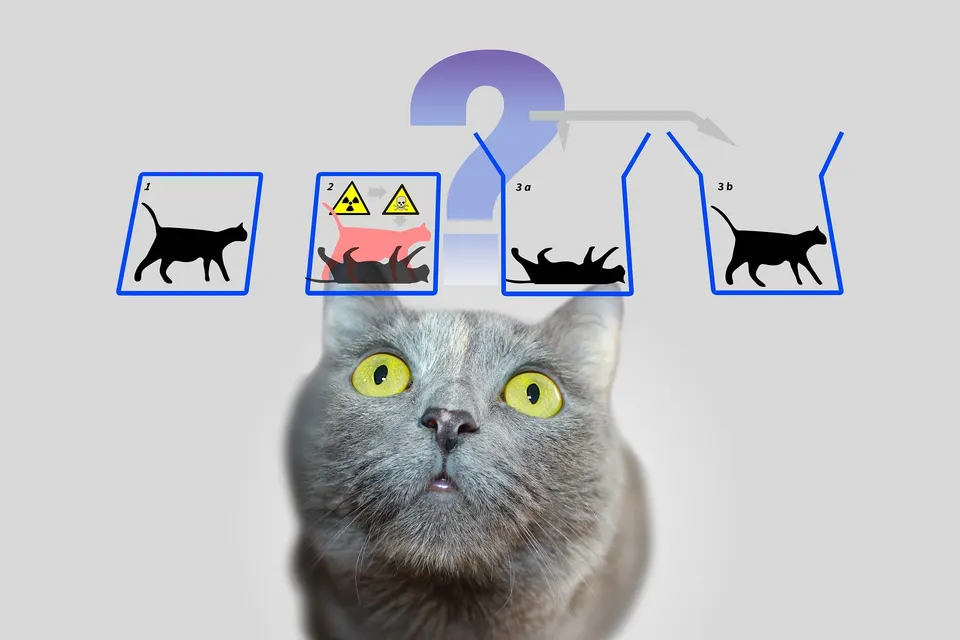
And here we come to that inexplicable cat in the headline. Who might be the most famous meowing heroine of science and pop culture, who on top of everything is only a metaphor? Schrödinger's cat, of course. The renowned physicist devised the thought experiment to explain to the uninitiated how impossible quantum mechanics was… only for it to turn out, years later, that the seemingly absurd example really does illustrate beautifully what happens in the world of the tiniest things. The imaginary little animal sums up an entire science: while it is in the box, for us it is both alive and dead at the same time. In this way it illustrates the basic principle of quantum mechanics—the branch of science that proved that in the world of microscopic particles entirely different rules reign, and each particle can be in many places at once.
But what do quantum computers have to do with the meowing celebrity? You probably know that today's digital world rests on binary code. In it, yin and yang do not intertwine, because bits—the smallest building blocks of our information society—carry either a zero or a one. So both in your computer's memory and in the “head” of your high-tech microwave, the whole business comes down to a very, very long string of these two numbers, which turn into commands and pictures, store your emails or build the flawless images of realistic computer games.
This, however, does not apply to the mystical machines that are the subject of today's meeting. In quantum computers, besides the all-important ones and zeros, there is also… something much bigger in between. If you imagine a bit as a light switch that is either on or off, here there is also an intermediate state.
Bit by Bit
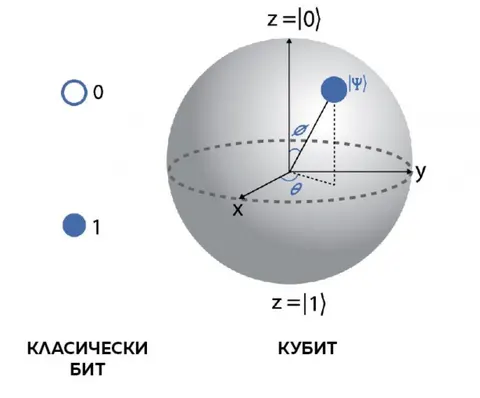
This time yin and yang truly intertwine, and this intermediate situation in which the unit of information can reside is called superposition. Being both extremes at once, in superposition the unit of information can combine parts of seemingly mutually exclusive opposites. It is time to refute the age-old wisdom that there is no such thing as being half-pregnant, since there is a “half-zero” and a “half-one.”
These different particles of information are called quantum bits, or qubits to their friends. Thanks to them, quantum computers “think” in their own particular way. Qubits can carry a combination of one and zero, but they can also be in both extremes at the same time. And that's not all: the state of each qubit affects the others in the system, which makes things even more complicated. But also more interesting, and therein lies their great advantage: quantum calculations run in parallel, meaning there is no need to try, one by one, all the possible combinations that lead to the solution of a given problem.
What the Quantum Is Going On?
So in the areas where our quantum friends are better, finding the answer to a question with 100 possibilities will require 100 qubits rather than today's trillions upon trillions of bits. “Classical computers are like a solo voice—one line of pure tones moving forward. A quantum computer is like a symphony—many tones that complement and interfere with one another,” says Prof. Seth Lloyd of the Massachusetts Institute of Technology.
The decisive breakthrough came in 1995, when the British theoretical physicist David Deutsch proposed the scheme still followed today: you take a set of qubits and record their initial parameters. Then the necessary transformations are carried out using logical operations, and the resulting value is recorded as the result. Qubits replace semiconductors, and the transformations are in the hands of logic blocks.
Has it become too complicated? That's normal. Bill Gates admits that “there is one part of Microsoft's work that, frankly, I can't understand. I supposedly have serious knowledge of mathematics and physics, but all the explanations start to look like hieroglyphics to me when it comes to quantum computers.”
The idea for these machines was put forward in the early 1980s, independently of each other, by the physicist Richard Feynman and the mathematician Yuri Manin. Feynman asked himself how, given that traditional machines cannot simulate quantum systems, we could study the world of the tiniest things from then on. “Nature isn't classical, dammit, and if you want to make a simulation of nature, you'd better make it quantum mechanical,” he wrote.
No Error Goes Unpunished
“I think I can safely say that nobody understands quantum mechanics,” the same Feynman was painfully honest. “It must be clear that when it comes to atoms, language can be used only as in poetry,” added Niels Bohr. In other words: the mathematics works, but our thinking is still far too limited to truly grasp these extremely complex processes.
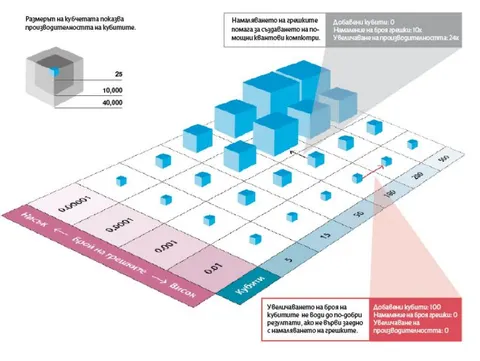
With quantum computers, apart from one and zero becoming relative concepts… 1+1 doesn't make two at all. Every additional qubit in a quantum computer drastically increases the number of errors that crop up, and this makes developing them even harder, as the diagram on the right, prepared by IBM's engineers, shows. Every additional qubit brings numerous new quantum states of the individual units. So another important challenge for developers is not only to “raise” the number of qubits in processors but also to drastically reduce the errors—only then will quantum computers be capable of all the wonders we expect.
But what will change one day, when we make the necessary breakthrough in this field, when we have working quantum computers at a reasonable price and they enter everyday life?
Not Worth a Cracked Qubit
First of all, you'd better have sold your bitcoins by then. But no, don't rush off to the exchange bureau; the danger is unlikely to come to a head in the next decade.
Encryption is one of the key aspects of blockchain—the technology behind cryptocurrencies. The information about “electronic money” is encrypted—computers process it in such a way that it can always be verified whether a payment took place, but nobody can make it in your place. The battle between technologies that encode information and those that try to decode it is a never-ending game of catch-up. And once built, a sufficiently fast quantum computer could crack the encryption algorithm of bitcoin. Which in turn would let it peek into your wallet and send its contents wherever it pleases. Many talk about the technological apocalypse that will happen when someone gets hold of a real quantum computer.
Fortunately, there is salvation here too. Specialists are increasingly working on algorithms resistant to this danger. Such algorithms have already been created, and although moving the entire bitcoin network over to them would be a serious challenge, the security of the money can still be preserved. Some newer blockchain networks and virtual currencies already use these encryption algorithms. But whether they are secure enough… we'll find out only when there is someone around to put them to a real test.
A Domestic Drama of Bits
Either way, wonders are expected of quantum computers. They may never manage to overtake today's machines in some types of computing work, but in others they will be many times faster. One of the areas where they are expected to lead to scientific breakthroughs is nanotechnology and the creation of new materials. They promise to help us develop far more advanced medicines, which will dramatically increase average life expectancy. The reason: chemistry and technology increasingly rely on simulating real experiments in a quantum environment, and that is far beyond the abilities of today's machines.
And last but not least: they will probably be many times better at developing artificial intelligence.
Q#
Most specialists will tell you that there is no way quantum computers will one day replace the ones on our desks, but hardly anyone can be sure. Just as it was in the 1940s with the huge room-sized machines whose capabilities are today a small part of the repertoire of the phone in our pocket. It's no coincidence that, when it comes to quantum computers, humanity today is considered to be at the level of knowledge it had about traditional ones back in the 1940s.
The reason: we have to approach them with a completely different paradigm. However complex they may seem, even the most powerful supermachines of today are quite familiar and predictable to us. The deep logic of how they work doesn't change, and the computer languages we command them with follow similar principles.
Whereas here we face something entirely new. Specialists' thinking has to change, a huge base of experience has to accumulate, before we understand how best to use the powerful weapon we will have at our disposal. Programming languages adapted to the peculiarities of the technology are only now being developed; the most popular is Microsoft's prototype Q#, which for now is used on machines that simulate quantum computers.
Quantum for Quantum, Faith for Faith
There are tasks today's computers handle very quickly, and others that simply aren't for them. If they have to add or subtract… even your grandmother's Elka, the Bulgarian-made desktop calculator of the socialist era, can cope with huge numbers. Difficulties arise, for example, with factoring composite numbers. Here is a comparison: if you want it to break a 400-digit number down into its prime factors, your computer will have to perform 100,000,000,000,000,000,000,000,000,000,000,000,000,000,000,000,000 operations, which will take it longer than the age of the Universe. Its quantum relative would manage it in a second—with just 64,000,000 operations.
Yes, we have quantum computers today, but they are still far from becoming full-fledged devices. They are rather experimental systems of modest complexity, with a long road ahead of them.
That road, however, is clearly promising enough. The US, Russia, the UK and China boast of the serious funding they put into research. Companies such as Microsoft, IBM, Google, Alibaba together with the Chinese Academy of Sciences, and Cisco are harnessing enormous resources. According to researchers at the last of these, humanity will have a good enough quantum computer by the mid-2020s.
Linger On, Bit, Thou Art So Fair!
Once you start following the news about the latest technological success in the field, the first thing mentioned will be the number of qubits—the units of information a given project has achieved. This is somewhat misleading: just as your 100-watt bulb from the past is no equivalent of its granddaughter from the energy-saving era, the 50 qubits of one project cannot be compared with those of others.
It is precisely 50 qubits that are considered the threshold of quantum supremacy—the moment when such a machine will handle some of its tasks better than ordinary ones. But many other things must be taken into account: so far these qubits manage to survive only for a span of time that even mayflies would laugh at—the quantum state lasts for tens of microseconds, while supremacy will come into effect when it is preserved for minutes.
The Lord of the Qubits
Quantum computers became the talk of the town after March 2017, when the journal Nature announced in a cover story that they were ready to leave the labs. In 2018, Google officially unveiled its 72-qubit quantum processor Bristlecone, claiming it was the most powerful computing machine to date. Also in the race are 49-qubit prototypes from IBM and Intel and Harvard's 51-qubit machine. Alas, all of them are far from quantum supremacy, because their qubits are too unstable. What's new about Google's prototype is that the information units are arranged in two chains of 36 each, so that they check each other for errors.
Curiously, almost all the companies that are mastodons of the computer age are developing their quantum projects with unprecedented transparency. The projects of Google, Microsoft and IBM are presented in detail online, and anyone can take part in developing them and suggest ideas to be tested on the prototype machines. Because an unconventional task sometimes needs a sufficiently crazy solution.
The interest is serious: in the currently most popular project, IBM Q Experience, 120,000 users tested more than 5 million applications on the quantum computer via the cloud over 4 years, resulting in more than 60 scientific publications.
As for manufacturing quantum computers, at the moment only one company offers to sell you one, should you wish—the Canadian company D-Wave. It offers the D-Wave 2000Q model with a full 2,000 qubits (albeit very, very short-lived and with limited applications) for $15 million. If you decide to find company for the barrel of sauerkraut and furnish your basement with it in search of the medicine that will help you live to 200, the upside is that you won't pay much for electricity afterward. The D-Wave 2000Q uses a mere 20 kW, roughly 100 times less than traditional supercomputers.
The company promises that as the technology develops, its quantum computers will not start consuming more, even though they will significantly increase their performance… You will, however, have to dig deep for cooling, because the system runs at a temperature of 0.015 degrees. Kelvin, alas, which equals -273 degrees Celsius, or several times colder than open space.
The Quantum Passenger
Besides, they won't help you with, say, your math homework. “D-Wave computers are specialized, and they can't be used for everything like the other prototypes. In practice they are designed to solve specific tasks, but by a happy coincidence some of these tasks are of great importance to industry and science,” explains the programmer Vladislav Zorov, who follows this field of science closely.
For a long time scientists doubted that D-Wave really offered quantum computers, until Google's engineers confirmed that the calculations performed proved it. One of the Canadian company's first customers, the aircraft maker Lockheed, used the quantum computer to check the software of the fifth-generation F-35 fighter jets. In just 6 weeks they managed to find a bug that, with the most advanced computers, would have surfaced only after many months.
According to economists, the quantum computer segment has yet to experience its boom, and still everything is in the hands of the scientists, from whom we expect not only to build the computer that will achieve quantum supremacy but also to put it to work searching for solutions, materials and medicines that will change our lives. Until then, Schrödinger's computers will be like their meowing colleague—existing and not quite existing at the same time.
Published in: Spisanie 8 (8 Magazine), issue 10/2018
Last updated: May 11, 2021