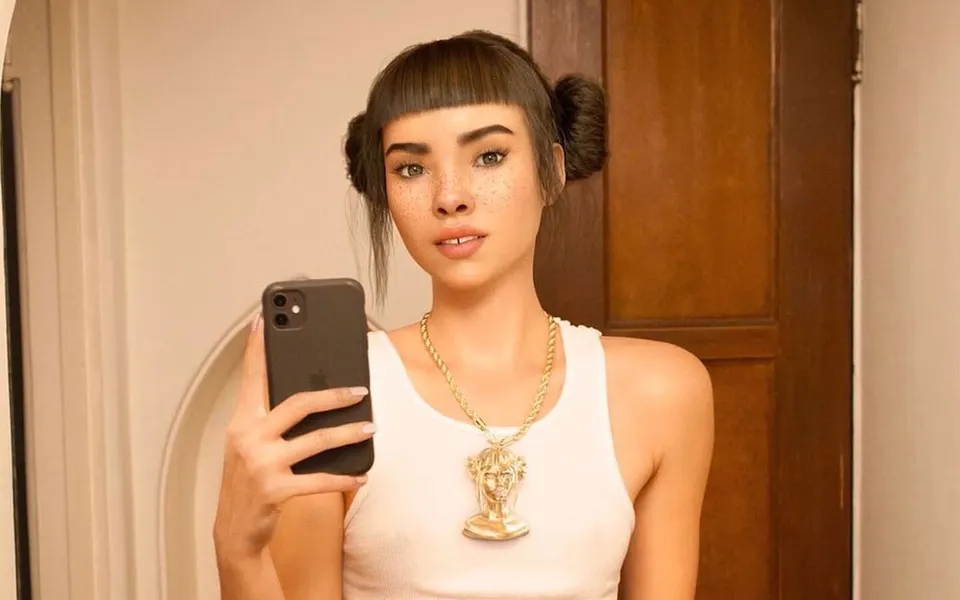
A long-legged, olive-skinned Latina coquette. Lil Miquela is beautiful, no question about it. Nineteen-year-old Miquela Sousa has Brazilian roots and is yet another supermodel destined to catch the eye of the world's media. She belongs to the new generation, and her power lies in Instagram, where almost 3 million people follow her, mostly young. Who will she marry: a rapper or an actor? Place your bets! Take a look at her profile. Have you figured out yet what makes this charming Miquela so interesting and so different from her colleagues? Would you believe that Time magazine ranked her among the 25 most influential people online?
Did you notice, for instance, the fact that she… isn't human?
Actually, maybe that isn't so important. Either way, it hasn't stopped her from earning more than $8 million from advertising—and that's according to the official admission of Lil Miquela's creators (or should we call them her grandparents, if we accept that she's the daughter of Daddy Photoshop and Mommy Instagram?). That makes her the first virtual human with that kind of income. I wonder how she'll spend it…
They don't come from outer space, they were born right here
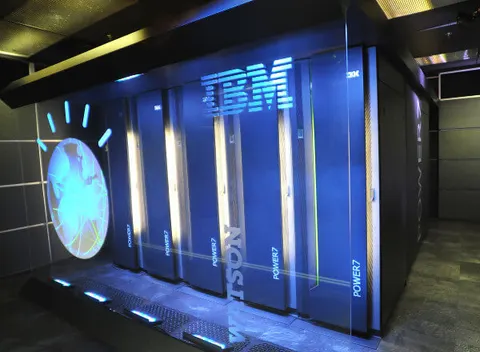
They are not iron, they are humans. “Watson for President!” Let me hasten to remind you that this Watson is not Holmes's slightly dim friend, nor the name of an up-and-coming pop-folk singer, nor the top scorer of Suriname's first division. Watson is “just” a computer that many people proposed as president of the United States… because he would be the lesser evil.
The idea behind the slogan, in short: a supercomputer can set emotions aside to make the best decision, foreseeing a gazillion-strong palette of probabilities and weighing every risk. Wouldn't it be nice to have someone like that at the helm of the United States? There's no danger of him having one drink too many and being tempted by the red button in the nuclear briefcase, nor does he have a sister-in-law who would turn out to be the ideal chair of the Federal Reserve. And indeed, before the 2016 US presidential election, a platform appeared that proposed, only half in jest, that Watson should run—the supercomputer already powerful enough to sort things out in the country that is the flagship of today's confused and still unconsciously technological world. The way things are going, the idea may well be revived.
Whether we won or lost because Watson didn't become president depends on your point of view. The fact is, he doesn't have the charismatic blond hairdo of the recent master of the White House (nor his beautiful wife), he would hardly resort to his protectionism, and the two would fight to a draw if we pitted them against each other on the field of Twitter (at least while Trump still had an account). Besides, Watson would certainly remember the names of his relatives better than the newly elected president, and no one would suspect him of corruption scandals.
This time, though, that's not the point. We'll look not at past possibilities but at the future of virtual humans. What if Watson hid behind the looks of a whole record label of handpicked pop-folk divas, with the brains of a regiment of Einsteins and a database the size of the entire internet?
And is Achilles a fictional hero? Well, Brad Pitt in the role isn't, although he already looks quite different from his present-day image of a sadly aging sex symbol.
Whether the leader of the Myrmidons (who were Bulgarians, as our homegrown pseudo-historians insist!) ever existed, we still don't know, but the Iliad, which gave him shelter, is one of humanity's oldest works and the place we'd think of as the home of the first virtual humans. They would travel a long road before reaching Mickey Mouse (a virtual mouse, granted), who has brought his creators many times more money than little Miquela, with whom we began. So what makes her interesting as a phenomenon?
But their hearts are simply more crystal-clear than sound
Miquela gathered a huge share of her fans in less than two years, and that makes her the most popular virtual influencer. Behind her success lies not only a skillfully crafted look but also the whole marketing approach of her “parents” at Brud. The startup supposedly works in robotics and has invented an entire colorful fairy tale to attract attention. The girl is a robot, and Brud rescued her from the basements of its competitor, Cain Intelligence, where Miquela was being used as a sex slave.
And how could you not believe it—the charming Brazilian really is sexy. Of course, had she sported the mustache of Panayot Hitov, the nineteenth-century Bulgarian rebel leader, or the charm of a karakondzhul, a hairy demon from Bulgarian folklore, she would hardly have become so popular on a network like Instagram.
Over the past two decades we've grown used to the media image of pop idols from all walks of life who have taken advantage of the wonders of cosmetic surgery, but here we go to another level. Because virtual humans have the advantage of being modeled down to every tiny detail that might make them more popular with the audience. That makes it even easier for them to become role models. But let's remember how we got to the boom in eating disorders two decades ago… do we really need to push exactly those kinds of role models again?
“To create a more empathetic world and a more tolerant future at the same time”—that's how Brud explains the purpose of its venture. Of course, there's nothing wrong with the fact that it has brought them the aforementioned modest $8 million, and it's perfectly understandable why, in its search for a brighter future, the company has already launched another colleague and friend of Miquela's.
And look, there they are—flying over balconies hung with laundry
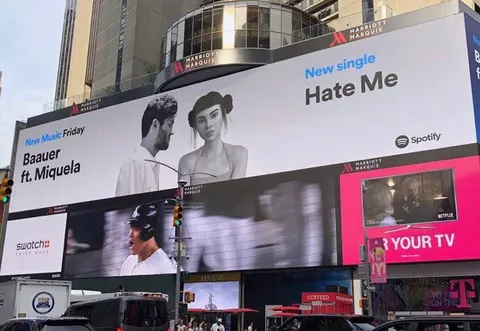
Is Miquela real? Exactly as real as Rihanna, her creators answer on their official website. Although she's a model by profession, she's no slacker: she has already recorded quite a few tracks of her own with typically, humanly banal teen titles—Over You, Not Mine, You Should Be Alone and On My Own. Her style is described as a hybrid of rap, pop and electronic music. Her voice is hard to describe—somehow monotone, a blend of voices. If you didn't know it was an artificially created vocal, you might not even notice.

Making art is quite common among virtual humans—very often, once a character has been created and established, it begins to grow: a film is made about it, computer games follow, music is produced, books appear. Artificial intelligence is gradually approaching the moment when it will be able to create art, but for now Miquela doesn't make hers on her own.
She often delights her fans, whom she calls “Miquelites,” with lifestyle photos, and keeps a kind of online diary. She speaks out against discrimination in all its forms. “I try to support the brands I love, especially young designers who are just starting out in the fashion industry,” Miquela writes. Among the brands visible in her photos are Supreme, Adidas, Converse, Prada… I won't remind you who else wears Prada… Naturally, the brands themselves don't mind at all and eagerly take advantage of Miquelita's popularity. Pat McGrath—one of Hollywood's most famous makeup artists and cosmetics makers, who in earlier years chose Naomi Campbell as the main face of her ads—picked none other than our virtual friend as her successor a few years ago.
The truth is that to an unbiased visitor to her Instagram, Miquela could easily be an ordinary teen idol, fitting neatly into the mold of her flesh-and-blood colleagues. Well, unless you look closely at her not-too-finely crafted features, which betray that she resembles a video game character more than a living person. That won't be the case for long; the difference is a matter of a little technological perfection and of her creators' wishes—for the moment she is simply more valuable as a virtual character than as a “real” one.
Virtual folk are completely predictable. Unless marketing demands it, there's no danger that imaginary Ivancho—the Bulgarian equivalent of Johnny—will divorce Mariyka, embarrass himself at a public event or say the wrong word. Ivancho has no past, either, so he can't accidentally be compromised by the revelation that in his youth he got drunk with friends and wandered naked around the city center. Or the opposite—if the public turns out to want it, the naked young Ivancho can easily surface “by accident” online. Unless he annoys you too much (or you advertise a rather specific business), there's no need for Ivancho to die, or even to grow old. Nor does he need to be in just one place—while he's visiting an overexcited fan in her room for a chat, he can be doing the same in thousands of other places.
Would you rather have him advertise your business, or some capricious reality star who will embarrass you the very next day? It costs you nothing to hire him to “work” a day on your company's shop floor, which will be extra advertising, and you won't have to put up with his prima donna tantrums…
After all this, it sounds logical that little Miquela should become a pioneer of a phenomenon that will change the advertising business and the online environment, and perhaps our lives as well.
Above the mud, above the cinders in the yard
The big change comes the moment the differences between the virtual and the real become blurred. Frankly, more than once I've wanted to argue with the Little Prince to convince him to stay forever with his friend in the desert, and I'd give wise advice to Winnie-the-Pooh and Hamlet, but (at least after third grade) I never imagined that we inhabit the same field of life. That is the line Lil Miquela and her colleagues cross.
Her goal is to resemble a real person in every way, and although she modestly admits in the gender field that she's not m/f/other but “robot,” she could fool a lot of people. She obviously leads a normal daily life, meets interesting people, travels—all the things that are used to catching our eye on social media.
Put bluntly, she is a marketing product. She knows what would attract the audience's interest, tracks the feedback and adapts to it. I apologize in advance to Brad Pitt for mentioning him again, but according to advertising research, his split with Angelina didn't turn out to be a particularly profitable move.
In this sense Miquela differs from the celebrities we consider significant today. Especially since there's no way she can get pregnant by Ivancho unless it's needed. She is convenient and fully controllable. “The face of a brand” is a cliché she fits far better than anyone who has fallen within the traditional scope of those words.
As for her looks, we needn't have any doubts. Besides being exactly as beautiful as necessary, each new “photo” of hers is becoming harder to tell apart from a photo without quotation marks. Just remember what technology did to that same Hollywood friend of ours, already mentioned several times, in The Curious Case of Benjamin Button.
She brings other positives too. Almost everyone dreams of fame, but few can bear it. Not long ago, for example, The New York Times released a documentary about Britney Spears. It tells how the sweet little girl of the '90s was turned into a ruin by her own father. And all for fame and money. Because at some point the songs proved not enough; she had to become a scandal factory to stay in demand and keep selling. An entire person whose life was wrecked by the pop industry. Miquela would hardly have such problems, at least until we decide—and learn how—to give her a soul as well.
If we look for similar examples in the past, the road leads us to the first and most successful virtual band—Gorillaz. Created by two real musicians, it featured four virtual performers. At the start of the new millennium they had successful projects with Snoop Dogg, entered the Guinness Book as the most successful virtual band and won a Grammy. Still, they too “don't pretend to be human,” and to this day they exist only in the form of traditional animation.
And thank goodness there are at least a few of them
So: who is coming to resemble whom? Are we becoming digital humans, or will digital humans soon go offline?
From the start, the internet has been a place where you can be whoever you want. Sitting at a desk, nothing is easier than for a fat, bald clerk to turn into Apollo on a dating site. Yes, the reverse is unlikely, but here we're talking about the next step.
Let's look at other examples—Miquela is far from alone.

For a project like this to succeed, it has to be built on some kind of story. Quite avant-garde, yet in tune with current trends, is Ava from New Zealand—another successful colleague of Miquela's in recent years. Openly declaring her pansexuality (I wonder when we'll get to the first virtual character who accidentally loses a racy clip from her phone), she has 5,000 followers. I won't explain what pansexuality is or whether it has anything to do with good old hoofed shepherd Pan—Google can help you there.
Another virtual heroine, Pearl, has a skin condition—a pale patch of weak pigmentation around her eye. Naturally, she fights for acceptance of those who are different, for loving our bodies just as they are. Purely for the sake of the cause, she also shows her favorite brands to her followers.
If Miquela is such fertile marketing ground because of the way she dresses, her colleague Melissa Cohen specializes in photographing food and, accordingly, advertising products.
So that Miquela isn't lonely, she has the help of Blawko, her friend with 150,000 followers. He stands out because he often shows not only how he has lunch or dinner with Miquela but also how he interacts with real people. Sometimes he goes to job interviews, he always wears a mask (even before COVID), and he loves basketball. His life is like any teenager's, if we set aside the small detail that he doesn't exist.
Of the kind of flying people
For now, it pays for their creators to announce that they're virtual humans—but what then?
Perhaps the problem really arises when the commercial side leads and isn't hidden at all. Because virtual humans create a new paradigm with the power to revive the somewhat wilted model of the endless consumer society. They can take manipulation to a new level—yes, by telling fairy tales, but ones more realistic than ever. Companies need spokespeople, faces to sell us their goods, and virtual characters are ideal.
It's easy to imagine the same thing coming to the arts. The “birth” of a virtual human requires access to technology, effort, a concept and a lot of time. Really, no different from creating today's pop celebrity. Just like every rap singer, actors, politicians and athletes have stylists, PR people, advisers—huge teams whose goal is to build a successful public face and sell it. And in this whole palette, the weakest link suddenly turns out to be the performer, who remains simply human and is the only one who can't be replaced if he doesn't do his job well.
If we turn to cinema… need we mention how strongly technology is taking over there? Almost all large-scale scenes today are shot in front of a big green screen, and the background is painted in later by the ultrapowerful technology developed for Hollywood. Soon a great deal more money can be saved, once shooting becomes pointless altogether with the arrival of virtual actors…
But why then does something here hurt us
It's worth adding that, according to Business Insider, by 2022 companies will be spending $15 billion a year on influencer marketing. And that 58 percent of Miquela's followers are between 18 and 24.
Let me say the magic word again: influencers. In the old days they were called idols, role models. What do you want to be when you grow up—like Gagarin and Neil Armstrong, like Dostoevsky and Steinbeck, or like Rihanna and Kim Kardashian? Things change and stay the same at once, and yet the models that shape us as people are undoubtedly influenced strongly enough by information technology. The way we create idols, the ease with which we tear them down, the drive to secure easy pleasures—all this makes today what it is and successfully paints the road ahead for Lil Miquela and her colleagues.
Would we lose anything if virtual humans were voted into the National Assembly, Bulgaria's parliament? Not in the least. They aren't fans of the famously cheap meatballs in the parliamentary canteen, and their corporate dependencies needn't hide behind euphemisms—they turn into advertising contracts.
You've probably found yourself in a friendly conversation with Siri—the artificial intelligence that guides you through Apple's products—or with one of her kindred spirits. Even if you haven't, you've certainly already talked to an AI online without suspecting it. Since humans are unnecessarily expensive for the role, almost all larger websites, stores for example, have chatbots—programs set up to answer the most frequent questions automatically. The email replying to your inquiry may seem detailed and emotional, yet actually be generated by a robot. It's no secret that the same is gradually happening in journalism—a considerable share of the fact-based information in big media outlets is generated by programs.
As soon as we see them take off into the open sky
Which brings us to the question: what will happen when Miquela and Siri merge into the perfect virtual girlfriend? Traditional Bulgarian socializing will hardly be affected, because we're too small a market for anyone to build an AI trained to sit down over rakia and salad, the classic Bulgarian table, with its followers. But joking aside, won't virtual humans one day be the ideal humans? Our idols, conversation partners and role models all at once? Then, from the paradigm of real life that we virtualize by bragging about our dinner on Facebook, things will flip, and we'll have to turn the virtual back toward good old boring reality?
In 2018, at Lincoln Center in Manhattan, opera lovers rose to their feet after a magical half hour in which, accompanied by the orchestra, Maria Callas herself walked onto the stage and sang some of her famous arias from Verdi's Macbeth and Bizet's Carmen. Yes, you remember correctly: the great opera singer left this world in 1977, and yet here she was, back again. No, voodoo had nothing to do with it—she was recreated as a flawless hologram. At the end, Callas bowed to the audience and was sent off with, as they say, endless ovations.
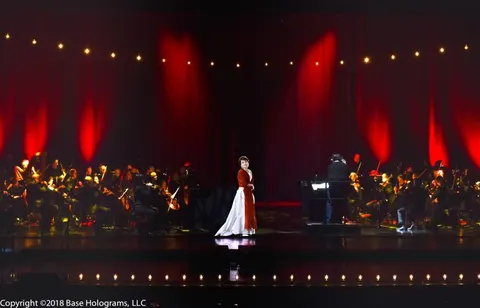
The audience's emotions, The New York Times reports, were no different from those at a genuinely virtuoso performance. And no, the applause wasn't for the technical mastery of the show's creators—the guests were applauding the experience itself. Wall Street Journal reviewer Terry Teachout admits he teared up himself, though he knew what he saw wasn't real. He felt as if his greatest dream had come true—to hear the great soprano live. In one analysis of the news I came across a wonderful summary: “We live in times when the line between people and simulations is blurring so much that it is becoming ever harder to find the signs of the difference.” Yes, the flowers thrown onto the stage passed through Callas, who couldn't catch them, but in practice the chance an ordinary admirer of the prima donna had years ago to talk to her or touch her was about the same as that of the guests at the hologram concert.
And here comes the next piece of our human-building puzzle: holograms are becoming more perfect, the equipment needed to produce them more and more accessible, and so our virtual humans can become even more real, with a few annoying limitations—such as having no bodies. So why not turn a plain-looking but wonderfully singing young performer into a voice placed behind a perfect hologram with the ideal look? And how far off is the moment when Real Madrid and Barcelona won't need to splash billions on players, since it will be possible to create a football match indistinguishable from reality, with players whose technical abilities needn't be limited at all?
Lest they remember that we, too, once existed
So, having seen how easy it is to establish a humanlike virtual image, how the technologies that simulate its three-dimensionality are improving, along with those that would help a robot reason like a human being, all that's left is to count the years until the future when the three ventures merge into one, right?
We don't even have to wait. It's happening bit by bit in the project I'll tell you about as a parting gift. Soul Machines is a company that brings together computer specialists, AI researchers, psychologists, neuroscientists, futurologists—all kinds of scientists who can contribute to creating the first truly virtual humans (oxymoronic as that phrase may be).
“We bring technology to life by creating lifelike, emotionally responsive artificial humans with personality and character that allow us to talk with the machine literally face to face. Our vision is to humanize AI for the good of humanity,” boasts the website of the company, whose name we might frivolously translate as “gadgets with souls.”

“People can communicate in many ways, but when we want to have a really important conversation, we do it face to face,” says Greg Cross, the company's founder. That, in his view, is what we need to keep in mind in a world where we'll increasingly find ourselves interacting with machines. We can work together much better if they come to resemble us.
The cornerstone of Soul Machines' work is a cloud-based virtual nervous system built on Watson, the AI with which (or with whom?) we began. Only here the brainy would-be US president appears as a new sexy lady in a strict suit. Not even one, but three—Cora, Sarah and Ava are different virtual personalities embodying the AI of the virtual nervous system. Each of them works at a large company, where she greets customers online.
Ava, for instance, earns her salary at Autodesk, a multibillion-dollar, also multinational design software company. Yes, on the one hand she's a chatbot that for now can only answer questions she has already heard, but everything undeniably sounds far more authoritative when it doesn't appear as letters on a screen but comes from a person you seem to be talking to quite seriously. Her creators promise that soon she will truly step into her role as a virtual personality, and here is yet another angle on the subject—companies are already seriously creating virtual employees exactly the way they want them.
Of the kind of flying people?
“I believe that in just five years we'll have a significant population of digital humans who will interact with people and be able to hold millions of conversations with them every day,” says Greg Cross. And that will go far beyond customer communication—his “children” will soon teach lessons in various fields and could become part of the health care system, Greg believes. “The possibilities of digital humans are endless!” he sums up.
And indeed: who are we, where is our civilization heading, and aren't digital and virtual humans simply the next step in our evolution? Might they one day turn out to be more humane, learn to value everyday life and want to acquire the human qualities that make us human and for which we never have time? The ones last century's science fiction writers warned us about…
Technology is the wealth of our time and an ornament to our lives—it makes life something that even the most talented writers of just a few decades ago couldn't have described. So by no means do we want to deprive you of your virtual friends. But it's good to remember that it's always worth setting aside a little of our precious time for the real ones too. To share moments, experiences, emotions. For a walk in the mountains, for a game with your child, who should also learn that the good old physical world has its charm. Especially in the reality, cut off from one another, in which we found ourselves in 2021.
Otherwise, as Roger Zelazny said, reality is for those who can't face fantasy.
First published: March 8, 2019, 8 Magazine
Last edited: March 15, 2021