Not long ago I told you about the impressive venture of Anton Orush, the young man who built, and himself became, the most complete living archive of Bulgarian technology there is today. Back then we promised to return to him and take a peek at some of the digital riches of “Sandacite” (“The Chests”).
The moment has come for the creator of this treasure-trove portal to tell us about six of his remarkable discoveries. What set the old Bulgarian ancestors of the computer mouse apart? What kind of gadgets are punched tapes? What did the first electronic chess set made in Bulgaria look like? And how did the world's largest floppy disks come to be… Bulgarian?

Their stories are told by the most fitting person of all, the lord of “Sandacite.” Anton is showing these five impressive finds for the first time, especially for Digital Stories.
1. Electronic Checkmate
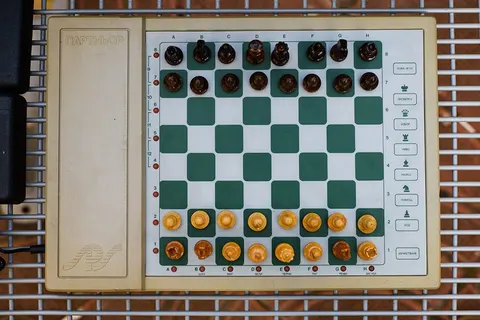
Here is the Bulgarian electronic chess set “Partner” from 1987, the country's second chess computer after the “IZOT 1042S” of 1985. Made by the Software Products and Systems corporation, it lets you play against it, or it can simply act as referee if you have a real opponent.
It runs on a 3-megahertz Western Design Center 65C02 processor and has 2 kilobytes of RAM and 16 of ROM. Its squares and function buttons are touch-sensitive.
Let's imagine we are already playing against the “Partner.” Because the squares are touch-sensitive, when we pick up a piece to make a move, or to carry out one the machine has announced, we have to press lightly with the piece on the starting square and then on the square where we place it.
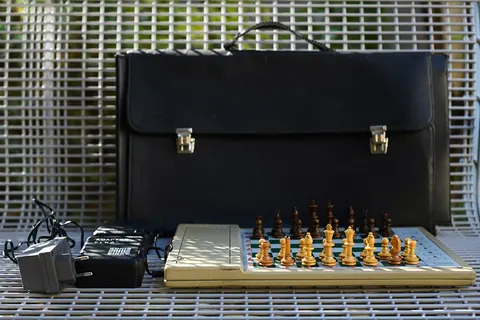
The “Partner” has nine difficulty levels and knows 3,000 openings from real chess games. The higher the difficulty, the less time we are given. Curiously, it also has a “Help” button that can offer hints if we are struggling.
The “Partner” signals errors and checks whether the pieces are set up correctly. By pressing “A1” we can forbid the computer from thinking about its next move while we prepare ours, and with “F1” we forbid it from reading from its library, so it has to work out its moves on its own.
2. Goliath the Floppy Disk
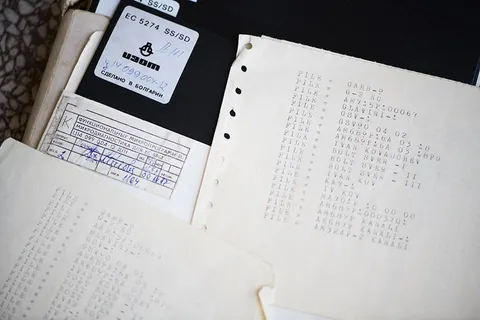
The 8-inch “IZOT ES 5274” disks are the largest floppy disks in the world! They were made at the Dinko Banenkin Plant for Information Media in the village of Dragor, near Pazardzhik. They look like baking trays, packed in a sleeve 20.3 cm across.
This is also the oldest floppy disk standard in the world that allowed data to be written and erased repeatedly. They were available from 1973 and were used in so-called desk computers. As the name suggests, these had the shape and size of a desk and served a specific purpose—like the prepress “IZOT 1004 S” or the banking “IZOT 1025S.”
The “ES 5274,” released in 1982, was the most popular model of 8-inch floppy. It is of the SS/SD type (single side, standard density): the disk has one writable side and a standard recording density. Its capacity after formatting is 242 kilobytes, absurdly small today but an impressive figure in the 1970s.
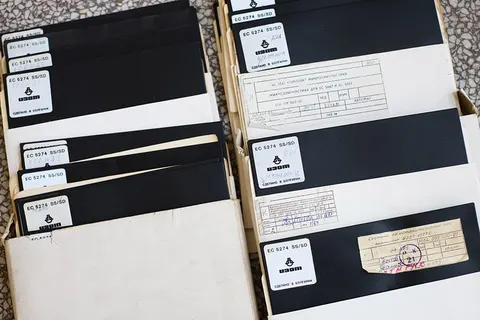
Larger programs were sometimes stored on a series of disks loaded one after another. These twenty-plus disks, for example, hold the software for the “IZOT 1027 S” desk computer, designed to automate writing the control programs for metal-cutting machines.
The “ES 5283” is another model, with two writable sides that hold a whole 1.5 megabytes of data.
3. Tape Instead of a Disk
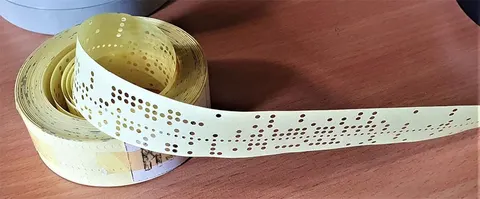
This ancient computer storage medium is punched tape, made at the Elektronika plant in Sofia in 1986, though the plant produced it earlier too. Anton's tapes are kept in their original boxes, and this one has been used and carries a recording.
Chronologically, punched tape was the second data medium after punched cards. It is incredibly rare to find Bulgarian punched tape, says Anton, who in twelve years has come across it only once.
Quite a few interesting Bulgarian computers—such as the very first one, the “Vitosha” (1962–1963), and the computerized time-tracking system “IZOT 1001S” (1979)—used tapes like these.
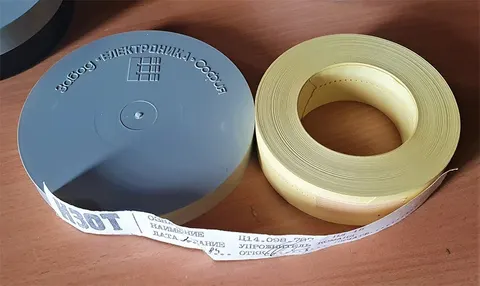
This punched tape has never been used—a living time capsule of sorts. Its only perforation, the dotted line running along its length, is the so-called feed track. The reader's sprocket wheel uses it to move the tape forward.
The principle of the technology differs little from punched cards. Here too, data is stored depending on whether there is a hole (a perforation) at precisely defined spots. Tape was the natural successor to cards once it became clear how easily punched cards got scattered and how often they had to be swapped in the device, which was a nuisance. So a medium was designed that worked on the same principle but took the form of a continuous strip.
The width of the tape varies with the number of tracks; Bulgaria used 5- and 8-track tapes. Punched tapes could reach 300 meters in length, holding as much information as 1,500 punched cards.
The paper is extra strong so it doesn't tear after punching; it is usually yellow but can also be white.
Punched tape is tied to one of the more interesting collector's tales in Anton Orush's bottomless supply. An acquaintance of his heard that a friend in a remote village had such tapes, but decided Anton wouldn't need them: “You've got everything anyway, and I don't feel like dealing with that guy, he asked way too much for them.”
“It came up by chance, and when I heard how he'd brushed them off, I was literally shaking. Good Lord, I've been looking for punched tape for years, and it's so rare, so important, so unknown!” the collector recalls emotionally. On top of that, the asking price turned out to be perfectly reasonable. His acquaintance resisted hard, because he didn't want to call his friend again—the two had fallen out. “Then it turned out his car had no insurance, so I said I'd cover all the travel costs,” Anton remembers. To make matters worse, the owner of the tapes stopped answering his phone.
“I went to bed on edge, and the next day I waited for news. Around noon my acquaintance wrote to me. He'd already driven to the village and was talking to the owner. He was sending me photos of the tapes and asking which one I needed. Later the go-between told me the reconciliation operation hadn't been easy at all; it even involved a bottle of top-shelf whisky, luckily on sale. In the end I got the punched tapes I'd dreamed of, and the story, besides ending happily, taught me something. Once again I saw how badly things can go if we're arrogant and haughty. I have friends from all walks of life, and every one of them can help me with something.”
4. An Old-Fashioned Mouse
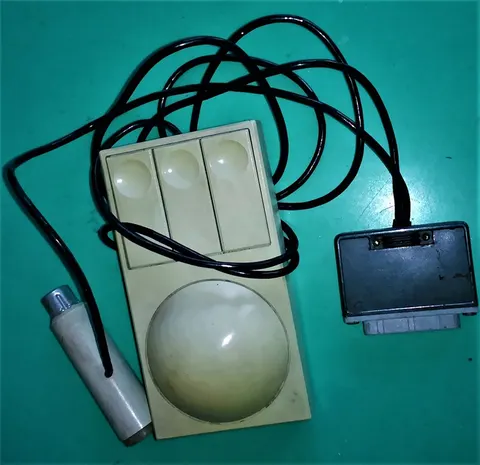
The first Bulgarian computer mouse, the “MAN'88,” came from the Plant for Consoles and Keyboards in Gabrovo. This one even still has its original little box.
As you can see, mice back then didn't look like today's: this one has three buttons instead of the current two, and no scroll wheel. In those days you moved up and down with the keyboard keys. The cursor was a blinking square, usually green.
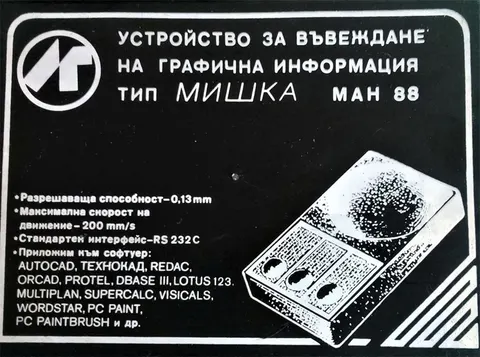
The buttons' functions differed from today's and depended on each program; there were no real standards in the field yet. That's why the box lists which programs it supports. Early on, mice were used most often in design programs (CAD).
Most programs of the 1980s rarely used the middle button, which is why it gradually disappeared. And when scrolling came along, the easiest thing was for the scroll button (and later the wheel) to take the place of precisely that middle button.
5. The Copying Machine
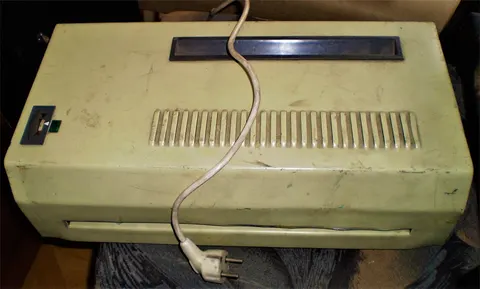
The Bulgarian copier “Infra'66” was made at the Orgtehnika plant in Silistra. There may not be a second surviving one. Its casing is metal, and for a desktop device it is rather heavy. Back then it was called a “thermal copying device,” because the paper it printed and duplicated documents on had a heat-sensitive coating, and that coating is what produced the print.
Into the top slot you put the original sheet, printed side up, and on top of it the sheet to be printed, with its heat-sensitive layer also facing up. The sheets pass through infrared rays, and the temperature of the heat-sensitive paper rises. Wherever a ray of light meets the dark parts of the original, a chemical reaction takes place in the heat-sensitive layer that darkens it too. The result is the printed copy, which a roller then pushes out of the machine.
The “Infra'66” made one copy in 10 to 15 seconds. In its day the device saved typists around 20 minutes of working time. The arrival of this model was a true blessing.
It could laminate sheets on both sides and make copies with heat-sensitive carbon paper, made at the Hemus plant in Burgas. “Once I found a whole pack next to a garbage dumpster,” says Anton.
6. A Board Small as a Palm, a Computer Big as a Mountain
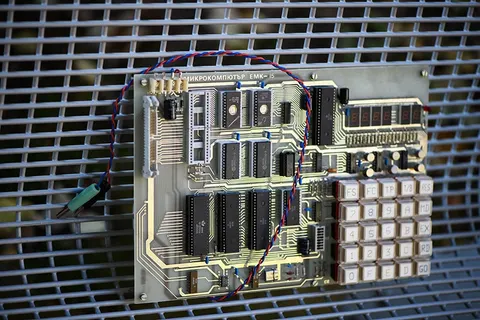
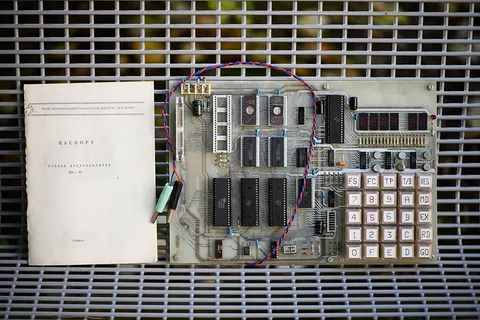
This unassuming-looking circuit board is actually… an entire computer. The term is a single-board computer. The “EMK 11A” was “born” in 1983 in the Computer Engineering department of VMEI Sofia, the Higher Institute of Mechanical and Electrical Engineering that is today the Technical University of Sofia.
All the components fit on a single board: the microprocessor, the RAM, the input-output controllers and so on. Devices like this are usually used in education and in fields where it matters to see clearly how something works.
A single-board computer usually has no slots for extra cards and boards. Such devices are also used as computers embedded in larger machines whose operation they have to control—a production line, for instance.
The processor here is the “SM 601,” made in Botevgrad. Unlike later EMKs, the “11A” could use a cassette recorder as external memory. It runs on 5 volts.
One of the teaching functions of these computers was to show how RAM works. The first four of the six LED displays show the hexadecimal address of the memory we want to work with, and the last two show its contents.