They are futuristic, self-healing, miniature biological units made from frog stem cells. They are called xenobots. They can move in different directions carrying a payload, they learn collective behavior and easily turn into a swarm.
Robots…, but not quite. Living creatures…, but not exactly. They are built from living cells, yet designed on the same principles normally used to make robots.
Sounds like something from the pages of a 1970s science fiction novel, back when imagination about the future somehow spilled far beyond today's technological limits, doesn't it? Well, this is the entirely real description of xenobots.
Biology and computer science join forces in a very meaningful way to create them. The technology through which xenobots are “born” really works, and they do everything listed above. Yes, perhaps far from perfectly, but they are advancing fast and have enormous potential—even to extend our lives. At the same time, they raise some rather important questions.
A Robot in Need Is a Robot Indeed
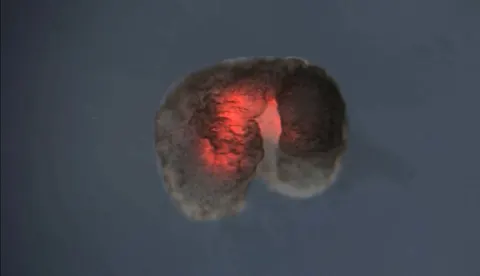
The second generation of xenobots has arrived with even more interesting results, just a year after its predecessors. The little critters no longer simply move in a controlled direction like a flock. They have gained the ability to reassemble themselves from separate groups. The miniature robo-organisms now have memory: they can record information.
The new xenobots move faster, find their way in different environments and live far longer than their ancestors, while keeping all the important skills their forebears had.
All right, but is all of this really possible? A natural question amid today's information chaos, where there's no way to sift meaningful ventures from loud headlines and marketing tricks.
The Robot Is Out of the Bag
Their name sounds rather like marketing. “Xeno” must be something foreign, different. And they are indeed biological, organic, small and strange clusters of living cells. Designed as if they were robots.
The project belongs to the renowned Tufts University and the University of Vermont. The world learned of their existence in May 2020.
Much more quietly, their second generation was unveiled at the end of March this year (you'll find the scientific paper here). The technology is extraordinarily futuristic and promising—it's almost strange that it isn't talked about more.
Perhaps because it appears in years that have turned out to be surprisingly primitive. Years in which we keep fighting diseases dangerous to our species with distance and bits of cloth over our faces, as we did centuries ago. Of course, science always deserves new chances; you never know where the next revolutionary solution will come from.
The Robot Doesn't Fall Far from the Frog
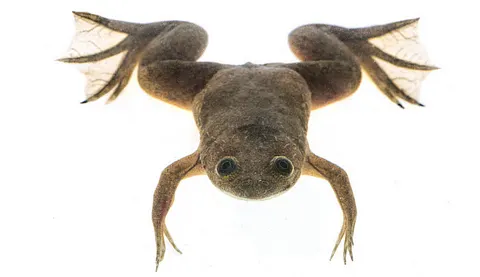
Xenopus laevis, the African clawed frog, is found in Africa and South America. It doesn't differ all that much from its cousins we know here in Bulgaria (if we've stepped away from our computers lately). What sets it apart is that it lives almost entirely in water. It is this very frog that gave xenobots their name and is… something like their parent.
The biologists at Tufts isolate skin and heart stem cells from clawed frog embryos and let them develop. Placed in favorable conditions, they begin to divide at a serious pace. Within just a few days they grow cilia, thin little hairs that can move back and forth or spin in different directions. In humans, tissue similar to what is synthesized this way can be found in the lungs, where its job is to “push” all kinds of foreign bodies out.

Curiosity Killed the Robot
In the xenobots, these cilia at first turn into a kind of little legs.
“In a frog embryo, these cells cooperate to build a tadpole,” says Prof. Michael Levin, the lead biologist on the project. “We are exploiting the amazing plasticity of stem cell groups whose job is to build. To try to create a new, rudimentary body.”
And so the scientists take the cells out and simply let them develop and multiply.
Then they switch on the computers to track the evolution of the whole process.
“Taken out of their ‘role,’ we see these cells trying to find new uses for the ‘hardware’ encoded in their genes, for the filaments they build to create movement. It's astonishing how quickly they step into new roles, learn different skills and behaviors, without going down the long usual path through which every next step in the evolution of species is created.”
Robot Haste Makes Waste
This is where artificial intelligence and computer technology come in. Their task is to monitor the development of a huge number of cell cultures, analyzing the behavior and capabilities of each. To model different combinations of skin and heart stem cells depending on the purpose of a given xenobot.
What is the main point of algorithms in this kind of research? They can save a vast number of trials and errors. Once they are fed the initial parameters from creating a few cell cultures, they can run an enormous number of other experiments through their “virtual brains,” judging which directions are worth further tests and where all seems lost.
When it comes to xenobots, they evidently prove good enough, since they make it possible to create the miniature robot organisms so quickly.
“The computers come in to judge which of all the possible swarms of xenobots can best perform a given task,” adds researcher Joshua Bongard. “We believe they will soon be able to do useful work. For now they handle only the simplest problems, but at the next stage we'll be able to create xenobots that clean the oceans of microplastics, turning them into soil.”
There's a Buyer for Every Robot
As Doug Blackiston, one of the leading specialists in this part of the project, explains, “xenobots are largely built the same way as traditional robots. The only difference is that we use cells and tissues rather than metal components and chips to build in some predictable behavior.
“On the biology side, this approach helps us understand how cells communicate and interact with the others, and how we might control that interaction in the future.”
“You can imagine the potential of this technology,” Blackiston goes on.
“By adding biological components, with the help of computer design and 3D printing, it will become possible to produce swarms of living little machines capable of delivering drugs to different parts of the body, ‘cleaning’ plaque out of even the smallest blood vessels, selectively removing tumor cells.”
Robots Need Elbow Grease, Not Prayers
The work begins with spheres averaging 3,026 stem cells, ± 180. Just four days later the cells differentiate, turning into epithelial cells. They reach 500–600 micrometers in size, which is about half a millimeter. Thanks to their cilia, the little xenobots can move quite fast in an aqueous solution—more than 100 micrometers per second, or about 4 meters an hour.
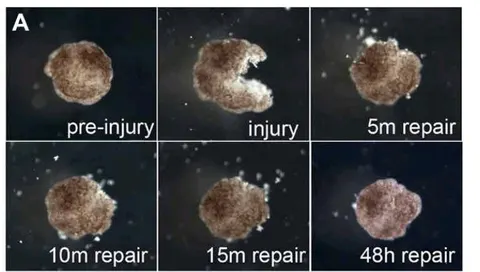
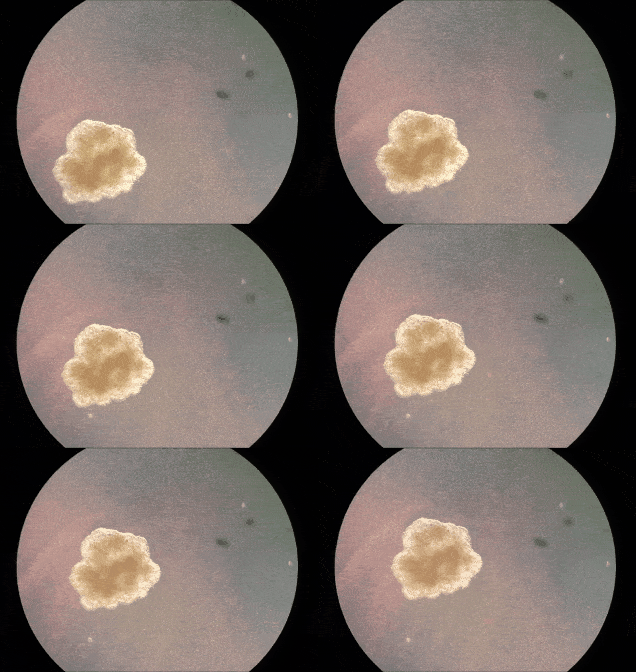
On the fifth day, some of the little robots are injured with surgical instruments. Even after being cut deep across their diameter, the tiny spheres regain their shape in just 5 minutes.

The Dogs Bark, the Robot Moves On
The xenobots prove able to squeeze into tight spaces and keep moving forward, changing their shape according to the obstacle in front of them.
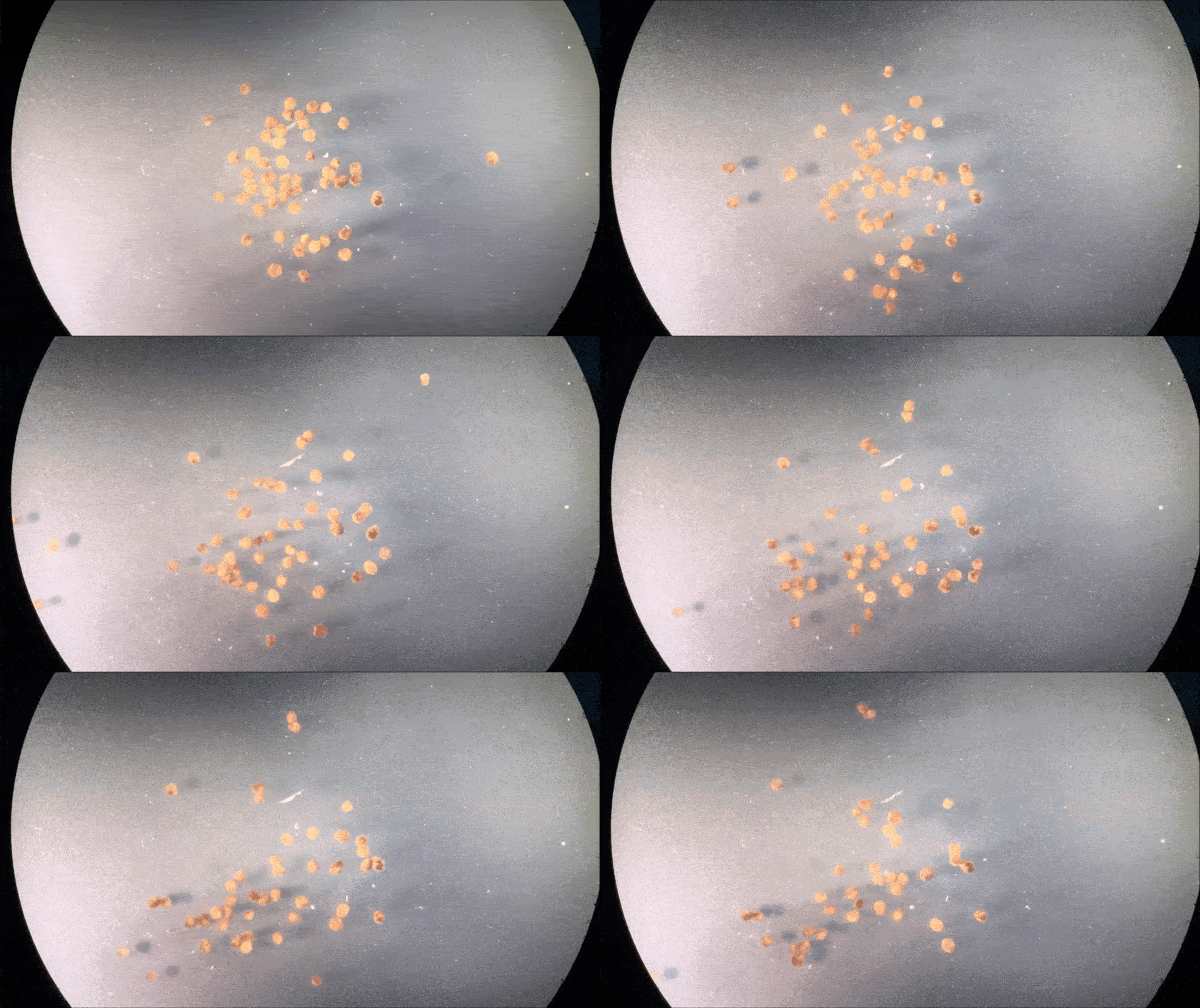
As for coordinated effort, the scientists stage a kind of Survivor-style contest for their little pets. They release them onto an arena full of tiny 5-micrometer particles of iron oxide.
For 12 hours the xenobots clean the space, gathering the “garbage” into a pile at one end. They manage it without getting much in each other's way, even though the process is not controlled from outside in any way. The only variable is the different shapes the xenobots are given—chosen with the help of an algorithm that predicts success for the various options.
An Angry Robot Goes Home with an Empty Bag
Having achieved the first stage—developing groups of xenobots that move in different directions and heal themselves—the scientists faced a rather serious challenge. They had to give the creatures something considered a cornerstone of robotics: memory.
For them to have any meaningful application at all, the individual units need to store data long enough for it to be processed somehow and used to modify the robot's behavior. To decide what its next actions should be.
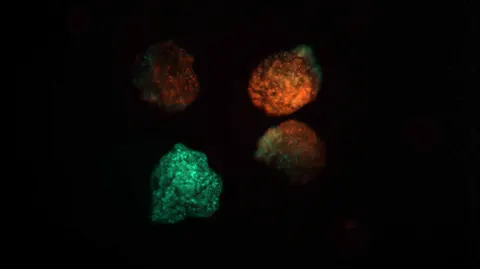
In pursuit of this goal, the xenobots' creators use a traditional solution—light. They manipulate the fluorescent protein EosFP, which normally glows green but, when exposed to light with a wavelength of 390 nanometers, begins to glow red.
To use this effect, the scientists inject messenger RNA encoding the protein into the stem cells before creating the second-generation xenobots. This gives them a built-in ability to store one unit of information. It's easy to check whether a given cell of the xenobot has been exposed to the chosen light. We have our first zero or one.
A Robot May Change Its Coat…
“By adding new capabilities when we create xenobots, we can use computer simulations to predict more complex behavior,” Bongard says. “That will let them perform much more complicated tasks. Not only reporting on certain conditions they have found themselves in, but also changing and repairing them.”
The first xenobots lived up to 10 days, since they relied solely on the energy stored in them as embryos. Once it ran out, their cycle ended. For the second generation, a way to “recharge” has been found, and the new machine-critters live up to 50–60 days.
A Hungry Robot Doesn't Dance
The biologist Prof. Levin became known for his TED talk on the subject. In it he describes how good it would be to have biological robots on our side to clean the environment and heal us. But also to help us understand how individual cells live together, interact and specialize so that together they build a whole organism, whether a frog or a human.
A separate Institute for Computer-Designed Organisms will soon open, bringing together the project's scientists from both universities. Its goal, according to the initial announcements, is not only to show the full palette of the biological robots' possibilities. But also, through that, to help us understand much more about the link between the “hardware”—a creature's genome—and the “software” of intercellular communication through which tissues and organs are built.
All of this could give a major push to the birth of regenerative medicine. Medicine that could restore injured, destroyed or missing parts of the human body. Even stop and reverse aging…
When the Robot Cart Tips Over, Everyone Knows the Way
All right, somewhere around here we may have gone too far. We now have an “organism” “designed” with the help of computers that can carry information, interact with others like itself and heal itself. But to soon allow us to… restore a ruined kidney, or even a whole arm?!
And then what? How will we be sure what exactly it is doing and what controls it? If we accept that traditional technology, with its metallic gleam, has always been more or less alien to our organic bodies… what happens when we release living robots inside ourselves?
And are they really alive, anyway? Are they organisms at all, given that they're created in this programmed way? Or are we already living in an all-too-Brave New World?
There's nothing frightening about it, according to the scientists. The team discusses its progress with ethicists at Harvard's Wyss Institute. Prof. Levin says that “in a world where it is already entirely possible to create artificial pathogens, worrying about the risks of technologies like xenobots is absurd.”
One Day a Robot Reigns, the Next It Serves, the Next It Herds Ducks
And yet many open questions remain front and center. For example: is it right to meddle in such delicate processes? Do we really know enough to be sure that with biological robots we'll secure victory over serious diseases rather than open Pandora's box? What happens if, at some point, things advance so far that refined swarms of xenobots develop some form of consciousness?
Yes, for now they are controlled and harmless. A fascinating idea that offers some very promising possibilities. I don't know about you, but I find these little frogs rather endearing, and they deserve their chance. As we well know, technology is not to blame for the problems or benefits it brings. Light or dark, harmful or useful—it is only and solely we, humans, who make it so.