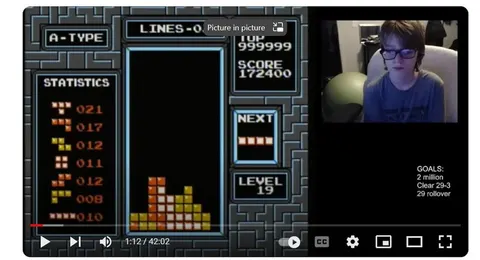
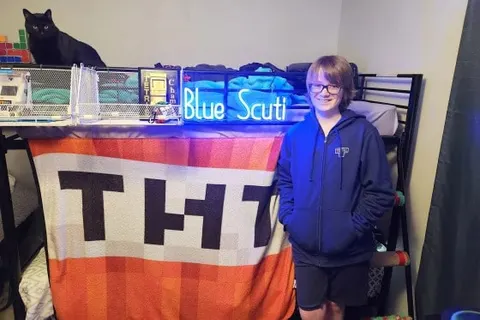
“I’m going to pass out, I can’t feel my hands…” Blue Scuti mutters, before he realizes he has fulfilled a dream that seemed impossible. Almost four decades on, he has beaten, one way or another, the game we have all played.
Sitting in front of a retro cathode-ray-tube TV, found after countless difficulties, clicking the buttons of a retro controller for 42 minutes straight at more than 20 taps per second… the teenager reminded us that there is no limit to what a human can do.
But how can you beat a game that has no end? And why are this success and the road to it such important news for humans as a species? News about our ability, through cooperation and talent, to keep moving forward… To create, to make things, to find meaning. To give birth to stories.
Tetris is a legend that passes through the generations to give birth to new legends. A week ago we took a stroll through the history of the game that came out of a Soviet laboratory during the Cold War. Today we will look at a brand-new record that has so much to tell us about ourselves.
Oh, the Games We Had Back Then…
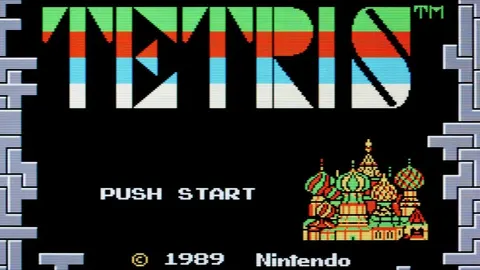
Among the thousands of versions of Tetris, perhaps the most popular is the one for the Nintendo console. And even though this is technology that looks ancient today—you can only run it in its classic form on an analog TV—the cult around it has not faded in recent years; it has grown. Ever more fiercely contested tournaments are held around the world.
The players have become astonishing virtuosos. In the classic versions of Tetris, a player cannot beat the game—there is always another level, and another… So how did an American teenager manage to beat it?
The story is full of technical details, but in short: the classic Nintendo Tetris was built to squeeze everything out of the hardware of those prehistoric computer days, when even megabytes were a mirage.
Rolling with a Flourish
In principle, the game speeds up and gets harder until level 19; after that it keeps generating new levels, but only by cycling the colors of the pieces. So over the past decade players have been racing to set records. The speed is truly astonishing—the movements on the screen can barely be followed by eye, and the same goes for the fingers on the controller. Players think many moves ahead, and they also need a certain dose of luck.
For quite a long time it was believed that the record had hit its ceiling. Players stalled around level 50, where the algorithm starts generating pieces in colors that are almost indistinguishable from the background—the developers simply never expected anyone to get that far. These levels are known as “the coal.”
Then the limit became physical: after the 20th minute, players’ fingers simply give out, and that slowed progress once again…
In 2021, however, the new record holder came up with a completely different technique—“rolling”—which everyone uses today. Instead of just pressing the controller’s buttons with his thumbs, he simultaneously pushes the controller up against them with his index fingers, gaining those vital fractions of a second. And so the record kept climbing.
Game Over
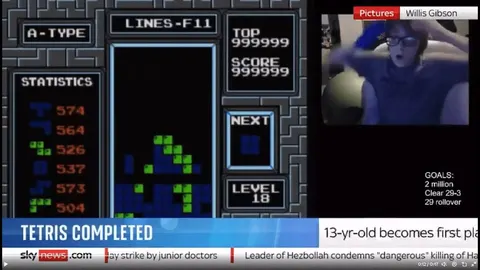
And so a new big goal appeared. Programmers trained an artificial intelligence to play this version of the game, and it began reaching unthinkably high levels, until at some point… the game stops. Because of the limited memory and the choices made by the original programmers, those unthinkably high levels contain points that, under very specific circumstances, bring the game to an end. Or, more precisely, freeze the screen.
It was in 2021 that our friend Blue Scuti also began playing competitively. Only 11 at the time, he won tournaments and quickly settled in among the elite players chasing the unthinkable goal: to beat the legendary Tetris.
That is exactly what happened in the first days of 2024. Scuti missed his first chance, then everything seemed irretrievably lost, until… two levels later, he couldn’t believe what he had achieved. After 39 years, Tetris had been beaten one way or another (or at least outsmarted), Scuti became a celebrity, and players began wondering what the next big goals might be.

An interesting video (in English) about the technology and the history of the record, and about the next feats in the game that players might chase.
The NeverEnding Story
Here’s an idea. Back in 1992, the mathematician John Brzustowski pondered whether a person could play Tetris forever. He concluded that the game is statistically doomed to end. If a player gets a long enough run of alternating S- and Z-shaped pieces, at some point it will make him lose. But how long would you have to play for statistics like that to catch up with you? And developers could rule it out anyway with a slightly improved algorithm.
“What is a final victory in the game?” Pajitnov asks rhetorically. “Grasp the horror of those words.”
The boy’s real name is Willis Gibson. “Scuti” comes from Scutum, the Latin name of the constellation of the Shield, and in slang it means something big, exceptional.
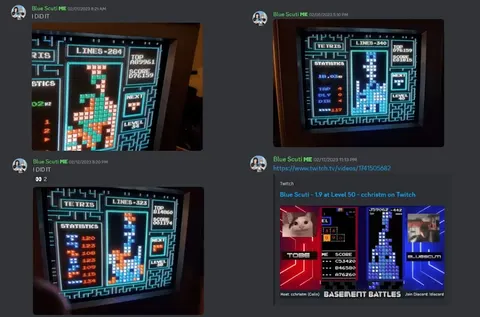
Scuti plays about 20 hours a week. His family approves of the hobby; they even went to considerable lengths to get him the old-fashioned TV he needed. He reached level 157, a practically inhuman performance in a game designed to go up to level 29!
He now holds the records for the longest game, the highest score, the highest level…
Four Weddings and a Funeral
The fate of this game seems somehow bound up with tragedy. Scuti dedicated the record to his father, who died a month before the kid became world-famous.
Pajitnov also said he was very impressed by the kid’s success, but he made a point of noting that it was not his game that had been beaten, but simply its implementation for the Nintendo console.
Formally, he is entirely right. But something else matters more.
For a quarter of a century now, algorithms have been stronger than us at chess… and so what? Tournaments are more appealing than ever, players keep finding unconventional moves, memorable competitors and fascinating personalities keep emerging. They even give us reasons for national pride, as Bulgaria’s women chess players have done in recent months.
The algorithm long ago beat us at Go too, a game that gave it trouble for a long time (it was a game of Go, by the way, that brought our hero Pajitnov and the Japanese together). Yet today Go is more popular than ever, and stronger players keep appearing…
In times when technology is ready to beat us at more and more games, it turns out that we humans are getting better too. That we manage to find new forms, new directions in which the machine still can’t catch us. Might the same happen in almost every field? Might the progress of artificial intelligence create new forms and help us rediscover art?

Homo Ludens
“The way this 13-year-old achieved his dizzying feat tells us a lot about how the limits of human achievement are changing in the digital age,” writes the cognitive science professor Tom Stafford. And further:
“The achievement is real, but its significance reaches far beyond the world of classic arcade games and those who love them. What Gibson did, and how he did it, offers general lessons about how people learn and how the frontiers of human achievement expand. Gibson didn’t just pick up an old console; he joined a living tradition. There are thousands of players devoted to Tetris on the NES—the platform on which the game was first released in North America.
Much of the discussion around artificial intelligence focuses on the areas where human skills may become obsolete, but it is a mistake to treat human performance as a fixed target. As Gibson’s record-breaking feat showed, we are constantly looking to the outer limits and, in reaching them, extending our grasp.
The lesson is that pushing past the limits of human skill is the result of continuous collective innovation, as well as of remarkable individuals. Humans are a species defined by our capacity to learn, and in the digital age there are more and more opportunities to venture into unexplored territories of performance in every aspect of art, science and culture—including Tetris.”

The Sport for a Peaceful World
“I invented Tetris for my own pleasure. That’s the only way anything can be invented,” Pajitnov smiles.
Recently, in an interview about the big questions of 2024, the futurologist Assoc. Prof. Mariana Todorova told me about her meeting with the cosmonauts who returned to Earth a few months ago. She was surprised that instead of technology, they talked about the human side of things, about our future together as a species.
“They wanted to show that when humanity faces a truly important global question that concerns everyone—in this case, the success of that space mission—geopolitical and strategic stories don’t matter at all. Both the Russians and the Americans said: we want to offer humanity the formula for understanding, a model for success, for cooperation. Up there we depend on each other and we really are like brothers.”
Isn’t Tetris a wonderful metaphor for what can unite us? It set out from a country that no longer exists, headed east, and through the East conquered the West… To remind us that we are capable of the next big steps. That we can grow, dream, and as a species use technology fully and consciously. But that is only possible when we are together.