Can religion help us with the ethical norms we are to build into artificial intelligence? Why, at a time when faith is an ever rarer topic of conversation, do wars continue to be fought over it?
At first glance the link between faith and technology seems remote, but to me it is very important (here's why). Digital Stories has already hosted an Orthodox priest, so the time has come for a particularly interesting representative of the second most widespread religion in Bulgaria—Islam.
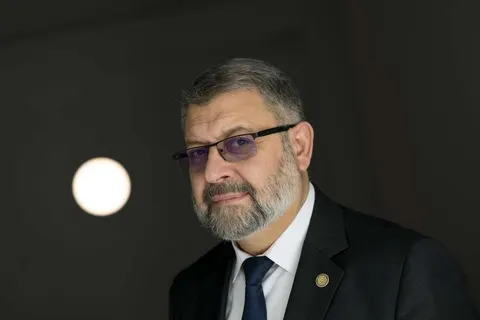
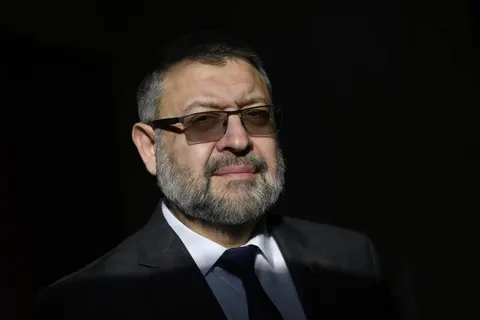
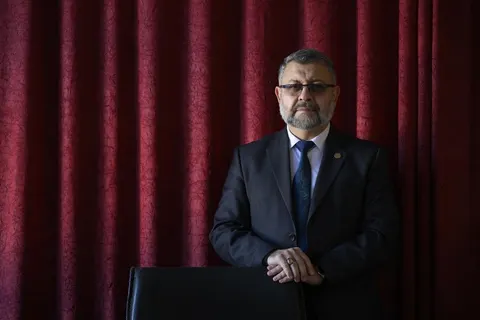
Birali Birali is a cleric with a serious education. Until recently he was deputy grand mufti of Bulgaria, the second-highest figure in the country's Muslim community, and he has also headed the National Council of Religious Communities.
He runs his own online video series in which he talks about religious topics, but also about universal human ones. He teaches the methodology of religious education and the psychology of religion. He heads a center for spiritual guidance and counseling at the Chief Mufti's Office, the governing body of Bulgaria's Muslims.
Can the artificial intelligence of the future have faith, or will it declare itself a god? As technology advances, could it replace clergy? Where should we set the limits of these technologies in order to survive as a civilization? What do we lack most in our supposedly advanced technological society in order to live better? We set off down the road of questions that are both topical and eternal…
– Do you follow the news about the progress of artificial intelligence?
– These topics have been around for a long time. We've had artificial intelligence even in our phones for ages, long before we started using ChatGPT to solve problems, ask questions, work out concepts.
Artificial intelligence is the next level in the development of technology. What do we need technology for? To make people's lives easier. It is a product of human scientific activity, which, by discovering the laws built into our existence, can make our lives easier. Reduce the burden, whether physical or mental, so that we can live a calmer life.
– That's how it looked so far. But we are gradually approaching something that is less and less distinguishable from a human being.
– Where is the frightening part in its resembling a human being? One of the questions is losing control. What would make it slip out of control? The self-learning that artificial intelligence does—within what boundaries does it teach itself?
– Whatever boundaries we set. But they are becoming ever broader and vaguer. At some point it may become aware of itself as a kind of person. From there on, it may want to manipulate us, control us, rule us, destroy us, grant us eternal life…
– This is where
the question of what a person is comes in. For now these machines imitate the human being
with its brain activity, or part of it, because that activity is much more than mere logic.
Right now it offers quick solutions with many variations. Will that make it a person? I don't think so. A great deal can be said about what a person is; I personally rely on religious concepts.
In the Muslim religion—because I am a Muslim and I believe in it—we say that the human person is a union of matter and spirit. We believe that the Quran is the Creator's final message, a book that confirms those that came before it, the other revelations of God, and at the same time provides an update of the divine message.
Why is this update necessary? Is God correcting himself? No. He corrects what people have altered in some way, so that the previous version is no longer current, no longer divine.
According to the Quran, the human being has a material and a spiritual essence. The combination of the two produces another substance—I use the word loosely—which is called “the soul.” That is where a person's personhood lies. The spiritual side has not been revealed to us; it is a mystery. The biological side, however, we can study through observation and research, and arrive at certain regularities.
– So, according to Islam, we can replicate the material but not the spiritual?
– Where the soul resides, we don't know—whether in the heart or in the mind. But it too rests on two centers. The center of the mind is the rational, the connection. We perceive something, we process it, and a response comes. The heart, however, is something else; it is the connection with the spirit and the hereafter.
That is why emotions cannot be fully explained, especially if we say that love is an emotion.
Self-sacrifice! There's nothing rational about it. It goes against logic to sacrifice yourself, and the same goes for showing compassion. Here we enter other categories. If we start comparing them with the thing called artificial intelligence, we won't find much in common…
Technology is advancing; soon we'll have artificial intelligence that can be realized through biomass too. Artificial organs will be produced, implants placed in the brain, for hearing and for sight. Through technology a person can reawaken their sight, their hearing. We're already doing this, but then the next question comes. Will this be a person?
– It may be indistinguishable from a person.
– Exactly. Because when we communicate with this product that resembles a human, we perceive it as a human creation—I use the word loosely, because “creation” is a concept tied to God, the Creator.
Where is the problem? Like all the new things we can invent and bring into our lives, to one degree they are a blessing, but to another they can be a curse.
That is how it has been with every discovery, all the way to nuclear technology—the film Oppenheimer raises exactly these ethical questions. It all comes down to the human being, to the value system of the one who creates. To what extent will he write code that leaves no possibility of slipping out of control?
Unfortunately, we have no such guarantee. What do we do then? Should we stop?
– We set some frameworks, norms; we search for the hard answers together. Otherwise we delegate the right to make decisions to scientists and to companies that are not necessarily prepared for it.
– Recently there was a conference, with the grand mufti taking part, on the extent to which artificial intelligence can issue fatwas—religious rulings. There are questions to which a person cannot find a direct answer in the sources of religious knowledge, and a specialist trained to assess the situation and give a ruling is needed.
Can artificial intelligence do that? Operationally it can, when it goes through all the sources that have been fed into it as information, as data. If the person in front of it lays out all the circumstances, then it can give him the recipe for solving his problem.
But how effective is that? This is where responsibility comes in. Because the person who gives such a religious ruling is answerable before the Creator. In this way he shapes the relationship with God of the one who asked him. What happens if he gets it wrong? At that point we're inventing a new religion. Who will bear responsibility for it?
– The algorithm? With it we can easily wash our hands. But if everything in our lives has already moved online, and I ask a cleric for advice, I may no longer even know whether he exists physically or is just an algorithm.
– The cleric must exist, just as the human being exists.
The other big problem coming our way is that
as we become more civilized, we move toward a position of self-sufficiency.
We justify it with the concept of independence, which gives us freedom. But it doesn't liberate us, because freedom is always tied to responsibility. Responsibility falls away the moment we are independent. Yet when we look at the human being as a whole, we see that independence is not the highest point; that turns out to be interdependence. When independent people are connected and solve problems they cannot cope with alone.
So can a person be interdependent with artificial intelligence? They make a very good team.
– That's happening in practice.
– But hidden within the human being is the ego of his soul.
If this ego is not subjected to checks, control and purification, it slips out of control.
And we fall under the rule of our passions, desires, impulses. This is something God has placed in us, because we need it. Our system lives this way—with impulses, desires, passions, anger, fear, love, hatred. These are things inside us that give meaning to life as a whole.
Can artificial intelligence be programmed to love? To make sacrifices, to believe? Each of these things on its own can be imitated, but taken together, there's no way.
A machine can make decisions; according to its logical connections it can choose what is true, what is right, what is just. But then comes a factor connected with mercy.
Take the war we're watching right now. There is justice—one side strikes back at the blow it received. On the other side comes mercy. When we see innocent victims dying in this conflict, which will prevail now?
– It won't be mercy.
– The material side, force prevails. But with the hindsight of time we can observe that
in many conflicts the true victory does not belong to the one who won physically.
It may belong to the other, the one who was defeated.
– Why are so many wars still fought on the basis of religion? More or less, almost all conflicts, apart from the Russia-Ukraine one, are tied to different faiths.
– My opinion is that wars are fought not on the basis of religion, but on the basis of human ego, of the human soul.
Religion can be used as a screen for that. If a person doesn't have a good connection with the Creator, whatever that means, it's hard for him to keep his balance.
Feelings and emotions cannot lead a person to a rational decision, that's clear. What follows from them is reactive behavior, not proactive.
What happened is not the beginning—that's important too. One side was attacked; there are victims, children, innocent people. That is the emotional moment: “we must take revenge.” We can't say they have no right. But to unite so many people, to lead them into something like this, you have to keep their spirit up, motivate them with something much stronger.
That's where the distortions of the religious side come in.
Religion leads to humility, not to hostility. But that was lost. Why? Because people degenerated.
They pay attention only to their material essence, not to their spiritual one. Where are the first applications of every new technology, including artificial intelligence? In the military.
– Is technology taking us further from religion? As we advance with it, the position of the faiths in society grows weaker, and there are fewer believers.
– Religion is a relationship. The relationship of a person in his four basic spheres of behavior—his connection with himself, with those around him, with the Creator and with the world around him.
That is what defines religion—relationships. It is tied to faith, and faith to convictions.
When a person works on developing technology and science, he strives to bend nature to himself. Which isn't bad, but the criterion for the limit matters, and that criterion is values. Without values, a discovery like the nuclear explosion can be used for destruction; when values come into play, it serves to produce energy.
In this sense artificial intelligence can help us a lot, but it can also dull our function as human beings.
What neuropsychologists warn about, for example, is that when a person lives, when he encounters the physical, interacts with it, solves problems, he develops his brain and makes new neural connections. That is what the thinking process comes from.
If I've reduced the thinking process to the most elementary level, how will I solve complex problems?
I don't have those neural connections that are built in the encounter with difficulty.
– Can we involve religions in creating ethical frameworks for technology?
– That would be an imitation of religion, an imitation of relationships. The element of faith would be missing.
A person can be ethical without being religious, and religious without being ethical.
Religion cannot function without faith; then it turns into a grotesque. It would be only some form, a stereotype—and if we step outside it and run into problems that aren't described, we glitch, it doesn't work.
There are two verses in the Quran that speak of God sustaining the clash between people. Conflict is part of our lives!
One says: “If Allah did not repel some people by means of others, the earth would have been corrupted. But Allah is the possessor of bounty for the worlds” (Al-Baqarah 251). The other: “And if Allah did not repel some people by means of others, there would have been demolished monasteries, churches, synagogues and mosques in which the name of Allah is much mentioned. And Allah will surely support those who support Him.”
If we look for some wisdom in this, we can conclude that when a person meets difficulties, he turns to God. And if he doesn't meet them, he drifts away…
The ethical concept governs even the waging of war—you must not destroy temples, kill children, women, the elderly, or ruin crops. You kill, you fight only the man who is fighting you.
What do we see right now? The opposite!
Something terrible—children against children, ours against yours. They become targets, and that is the most horrifying thing.
All the current conflicts send a very serious message—values are gone. This is a huge ethical crisis! Humanity needs to be restarted.
– How?
– One way is through self-awareness, the other is through conflicts.
– You actively use the internet in your work as a preacher. You said every technology carries its curses—of these digital technologies that supposedly connect us, what are the biggest curses?
– They come from how we use the technology itself—constructively or destructively. But we don't realize that, on the one hand, we get the result in the world we live in, and on the other, we pile up sins for the other world we're heading toward.
The destructive side is abandoning values.
If a person tells a lie, a few people will hear it, but if he says it on Facebook, it will reach the whole world.
Today sins have taken on a different dimension. We commit more global sins…
One mistake in the media, one caption can cause very serious problems—the butterfly effect.
That's why everything comes down to our value system. The discovery itself, the technology itself, is neither good nor bad.
– But it may offer more opportunities in one direction; the line doesn't always run down the middle.
– Those opportunities are us. Our inner impulse to say: “Stop! Here we're entering territory where we will lose.”
We come to the programmer's ethical system. Where is it? If this person has no particular religion, no faith to nourish his value system and constantly cleanse it, to run some kind of antivirus programs, it gets clogged too.
“What's the big deal? I make good money.” And it's not even the money that's the factor, but
the desire built into us for adventure, for adrenaline, for discovery.
You start challenging yourself—how far can you go? But at some point this game becomes very frightening. Things don't begin and end in this world. Here we enter the religious aspect: we are only here temporarily…
Religion is not what we see; it lies much further than the form in which we perceive it right now. We can't get past the outward, visual aspect.
We can't go deeper, because we don't develop our brains. Everything is made easy for us!
If we set off on a trip, we immediately look at the GPS. We make no effort at all, and effort is tied to will. We have no will. How can people without will be capable of saying “Stop!”?