
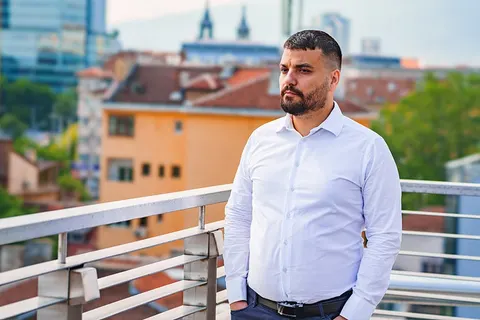
Ivaylo Hristov is the creator and co-owner of Dev.bg, the venture that lets software specialists from all kinds of fields sync their watches every month with the latest in their area. And, even more importantly, it lets people in IT easily find work where they feel at home.
Ivaylo knows very well how much that matters. He walked away from a dream job at Microsoft to start a venture of his own, which became a serious success.
Which Bulgarian software companies are poised for a real breakthrough? Where are we strong, and where do we lag behind in an industry that has done so well in Bulgaria? How, over the last 20 years, did whole new professions emerge on a massive scale, and how did programming turn from an exotic pastime into the most sought-after career?
Ivaylo tells the colorful digital stories of a man who has seen so much in this field.
– You started programming in what were frankly ancient times. How did you get into it?
– When I was in fourth grade, they took us for the first time
into the computer lab, and my eyes popped out… it was as if I were looking at a rocket!
I can’t explain why it drew me in so much. Today I have a son, and sometimes I try to push some toys on him, but he likes little cars, diggers and trucks and doesn’t want anything else. I was the same way: when I saw a computer for the first time, I knew this was my thing.
My mother enrolled me in a programming school, then I got into the mathematics high school in Burgas and joined its informatics program. We went to competitions and won olympiads.
I call it love at first sight. Back then there was no money in the profession; the motivation that programmers earn more came later. We even put up with the downsides—we were the nerds who did boring stuff. My classmates went out to smoke during the breaks, and I ran to the computer lab.

– Then you went on to university, where you quickly started teaching, right?
– When I was finishing high school, I placed very well in the fourth round of the olympiad. They directly credited me with a 6—the top mark on the Bulgarian six-point scale—for admission to Sofia University, and I went in to study informatics. In my third year I started helping with the lab sessions; for me those were elementary things. After that we started teaching elective courses, and there was huge interest in them—200 or 300 people signed up.
That was the beginning of SoftUni; its ancestors were those courses. The head was Svetlin Nakov, and I was on his team when the whole thing grew. Nakov created a National Academy for Software Development modeled on what we were doing at the university; it was bought out and became the Telerik Academy. And a few years later, when they parted ways, he founded SoftUni.
– And then you ended up at Microsoft, almost by accident…
– No, it wasn’t an accident at all. I was a .NET programmer, and the pinnacle of that technology is Microsoft, because they created it. I applied, and it took two years. The process is very tough; there were very complex interviews. Then it turned out I couldn’t go to the U.S. because the visas had run out and I had to wait until the next year. Just as I decided to use the time to do a master’s degree here, Microsoft called and asked whether I’d like to go to some other location. It turned out only Copenhagen fit. I had to go through the whole process again—five or six rounds of all-day interviews, extremely intense.
The Danish team liked me too, and in September 2007 I went to work there.
I quit my job, went to Microsoft and… didn’t like it at all. Literally on the third day I knew it wasn’t for me.
– Why? Wasn’t it something like a dream come true?
– I didn’t like the project I was working on. I was writing business planning software for factories with huge warehouses. For six months I had no idea what was supposed to happen. It was a total failure. I had spent two years applying, I had left my job, my friends, my apartment… everything, and it turned out I didn’t like it there.
Otherwise Microsoft is a cool company; they take care of their people. But for me it was a turning point. I thought I’d like working in a big corporation, and it turned out to be the opposite. Since then I’ve known that I want to work in small companies. I tried quite hard at Microsoft for a year and a half, but it didn’t work out. I can’t say there was anything that wouldn’t have happened if I hadn’t been there, and I love seeing the result of my work. In a corporation that had 80,000 people back then, that simply can’t happen.
We had calculated that at Microsoft people wrote an average of 77 lines of code a year. You’re a programmer… That’s not per day, not per hour—per whole year! In big corporations, speed inevitably drops. People often say, “If you want to go fast, go alone; if you want to go far, go together.” But the bigger an organization gets, the slower that “go together” becomes.
– Have you never regretted not staying there? That’s a career opportunity plenty of people dream of.
– No, not for a second. Even before I had kids, Monday was a happy day for me, because I was going to work. I love my work and I want to do it with energy and enthusiasm.

– What did you take up after you came back to Bulgaria?
– Entrepreneurship pulled me in. After I left, together with colleagues—two Danes and a Bulgarian—we founded our own IT company called Komfo. Within a few years we grew it to 70 employees with offices in three countries and clients like Sony Ericsson, IKEA, Microsoft and all the Danish telecoms. I left the company in 2014, gave myself a bit of a break and started working on a few projects.
My idea was to become an active board member at several companies, to sit up top at the strategic level, with a manager running things while I helped without being actively involved. But it turned out that if you have no focus, things don’t happen. So I dropped all the other initiatives I had and decided to concentrate on Dev.bg.
– Why did this venture turn out to matter so much to you?
– At that moment one of my big goals was to do something to make Bulgaria a better place. And I thought a lot about how that could happen.
For things to get moving, we all have to do something.
I decided it made sense to do it where I’m strongest. The IT industry is export-oriented; it brings money into Bulgaria and, to a greater or lesser degree, makes our country richer. My mission is to work toward a better-functioning software industry, because that’s good for the country as a whole.
A few things weighed on my heart. Until recently, job listing sites were simply awful to use—they broke the search on purpose,
you can’t find your way around, you dig through page after page. Your eyes bleed, and there isn’t even any information about the companies.
That was exactly what interested me—what product I’d be working on, whether it’s a small or a big company, what the technology is. I wanted to see only what mattered.

– So today you’re building a project that you yourself needed back then?
– Exactly. I wanted something to exist that I had needed myself. A job board just for the internet sector, where you can search by technology and all kinds of other filters. If a person can find what they’re looking for,
if they land in the right place, they’re much happier and more productive. Not like me at Microsoft.
It was hard for me to move twice—you leave friends, girlfriends, you organize luggage. I stayed a year and a half only because of the hassle of moving, which I wanted to avoid. And people in Bulgaria, when they don’t find the right job, change it after seven or eight months. It’s truly valuable for employers and employees alike when people land in the right place. When they feel happy.
We do plenty of other things too; we organize lots of events that help the community grow.
When I sold my shares in Komfo, I could easily have retired and never worked again. I do it because it gives me pleasure and I want to create.
– Do you miss coding now?
– Yes, sometimes I sit down in the evening, once the kid is asleep.
I haven’t done it professionally for 10 years now and I’m pretty “rusty,” but I build some automations for myself.
For example, I was curious how much money one of our competitors makes from paid IT job ads, so I wrote a script to collect the data.
– Clearly that’s for life, too… I can’t stop writing either—that’s why this site exists.
You’ve worked in this sector for almost two decades. What has changed most dramatically over all those years?
– An awful lot. I’ve been working since the years when people were paid under the table and one of the big interview questions was “Will my social security be paid on the full amount?” Since the times
when the QA profession didn’t exist, there were no perks, and demand for programmers wasn’t that high.
There was room for good programmers, but it was completely different.
I entered university in 2001 and started working two years later. Right then, after the dot-com crash, lots of programmers had been laid off—500,000 in the U.S. alone. There were years when nobody was hiring and it wasn’t easy to find a job. But that changed quickly and for good.
Many new professions were born. I watched QA emerge; it all started with the line
“Clients are complaining there are lots of bugs, let’s get some student
to click around and say if they find something.” From “someone to come and click around,” and only in a few companies, it became a very serious profession with methodologies, automation and huge demand.
Unfortunately,
with the huge demand for programmers, many people became overly demanding.
Another big change is that companies today try to offer all sorts of bonuses to attract people, and some have simply become the norm. Today, having a Multisport card and supplementary health insurance isn’t seen as a perk anymore; it’s rather strange if you don’t have them.
– In your view, in which areas and technologies are we stronger here in Bulgaria?
– Definitely in backend technologies, in algorithms, in everything that requires more mathematical thinking, because we’ve long had a strong school in that direction. We’re good at QA and system administration. I don’t think we’re that far ahead in design and the visual arts, comparing with Denmark. The best designers we could find in Bulgaria were average there.
In the things that require serious math as a foundation, we’re very strong. In the visual ones, there are countries that are way ahead of us.
There are also many specific quirks. If we talk about programming languages, for example, since one of the creators of Ruby is a Dane, the language is very widespread there, while here it isn’t so much. There are other technologies too, like Vue.js—in other countries you can find quite a few specialists, but in Bulgaria they’re rare.
– Because there aren’t many projects using it. I really like Vue, but I went for Angular instead, precisely because Vue isn’t in demand.
– It’s a bit of a vicious circle: there are no projects because there are no specialists. It’s the same with other technologies, like Elixir—popular in some countries, not here. Here .NET has more specialists than Java, while globally it’s the other way around. But these are minor market quirks.
– And why do you think there are still far fewer listings and less demand here for specialists in machine learning and professions related to artificial intelligence?
– I think they’re quite in demand in Bulgaria too. But right now we
are making the transition from being an outsourcing destination to higher added value.
Twenty years ago very little was done here through the full cycle; most work arrived as a specification that needed to be “coded up.” Only now are more product management roles appearing in Bulgaria; that used to be done almost entirely abroad.
Machine learning is exactly the kind of thing with high added value. But I think we have quite a few companies working on data processing and artificial intelligence, and we have specialists too—we’re not far behind. In machine learning we also have potential talent, because once again there’s very serious math behind it.
– More and more people from other professions are entering the industry, because it’s the only sector where pay is decent and conditions are good, thanks to the demand. But the gap in talent remains and may even be widening. How long will this last?
– I think the gap in specialists is widening constantly, and it will stay that way for a very long time. A huge number of companies are being born, and new ones are coming to Bulgaria, global ones at that—Hitachi, Dell, Daimler, Commerzbank. Demand for talent is rising dizzyingly. Only two companies closed their offices because of COVID, but
I haven’t heard of any others, nor of any that are shrinking and cutting staff.
COVID brought something else. In the West they became convinced that they can hire and manage people remotely, and right now there’s very strong interest. Suddenly Bulgarian talent has access to the global market. Which is
a very big challenge for Bulgarian companies and a huge opportunity for our IT specialists.
– But for the same reasons, the West now has access to a vast sea of programmers from all over the world, from Asia, for example. Won’t they push us out?
– I’ve worked with an Indian team, and my experience was very unsuccessful. When I was a team lead, my boss decided that programmers in Bulgaria were too expensive, so he interviewed and hired an entire team in India. It was a disaster. No matter how hard we tried to work with them, it didn’t work out—for cultural reasons, nothing else. If I opened a company now, I wouldn’t turn to Asian countries. But in Ukraine, Belarus, Serbia and Macedonia we can hire people.
COVID really stirred the pot, but right now I see very strong interest in Bulgarian programmers
from foreign companies.
– Yet the generations of young people coming up keep getting smaller. Do we have any direction with hidden reserves, where more talent could come from? For example, finding a way to bring minorities into the process—I still don’t know a single Roma programmer, and I’ve been looking for one to interview for a long time.
– For me, the foundation of being a good programmer comes from math, so first we’d need to see how people from these minorities can be taught math. And it’s not even so much math as logical thinking. If that turns out to be possible, it would be a promising venture. But it’s something that would bring results in five to 10 years, and until then the gap will keep widening.
– Yes, but I find it strange that nobody is trying, because it could be a very successful investment, on top of the social effect. And is there a chance that older people will come in en masse?
– I don’t think so. A 50-year-old junior is more of an exception. When we were students, we joked that programmers are like prostitutes—you become one before 35, and after that, you don’t. Now I don’t agree; I know many successful programmers who are 50 and older. But starting at 50 is an exception; it can’t become a mass thing.
– Which Bulgarian companies do you personally expect big news from?
– In 2007, when I went to Denmark, people there knew Telerik. I love projects that become famous all over the world while people also know they’re Bulgarian. SiteGround is a really cool company that puts Bulgaria on the map, and so is Hyperscience. Now we’ll see what the new companies like OfficeRnD, Payhawk and Gtmhub achieve—they have huge potential. EnduroSat—it’s really cool that things like this happen in Bulgaria, that we’re part of the space industry. Dronamics are still at an early stage, but they could revolutionize the transport sector. They have huge potential, and there are more projects.
Many companies with a Bulgarian trace do unique things. Take Gameloft—even if they’re not exactly Bulgarian, I’m really happy when super-successful games come out of here and are played by millions of people. What Chaos Group did—create a product used in the film industry all over the world. And it was made in Bulgaria! In the gambling industry, in fintech and blockchain… There are quite a few companies we’ll see achieve huge success over the next five to 10 years. Interesting news awaits us!