“Calling the inexplicable a ‘miracle’ is a beautiful way of admitting how little we know,” says today’s guest. “Miracles are also a chance to stop fooling ourselves that everything depends on us alone, to catch our breath and learn to trust life.”
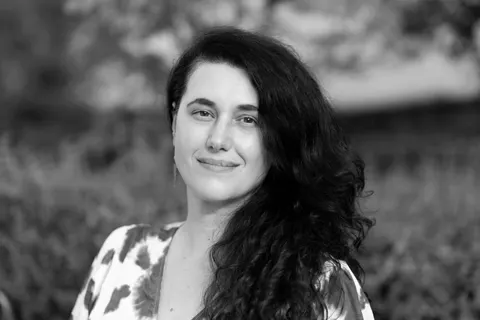
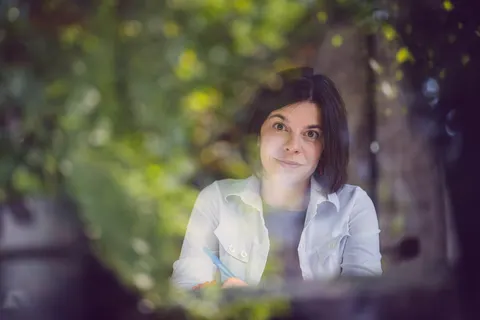
Ivanka Mogilska is a copywriter with 20 years of experience, the last 15 of them freelance. She is a blogger, editor and teacher. She is the author of seven books, the latest of which is the collection Obiknoveni chudesa (Ordinary Miracles). But… do such things really exist? We will ask her in a moment. Her airy, wise stories hold the everyday miracle, which, in my view, is the very reason to keep going.
We will talk about digital and analog miracles. About the miracles worth teaching artificial intelligence and the ones it may someday create. About brevity and the long texts that carry meaning. About the need, every now and then, to “get off the merry-go-round”…
– You are, in my opinion, exceptionally good at saying things briefly. A priceless skill that even ChatGPT doesn’t have. How do you learn it?
– Joan Miró has a canvas—three black lines of different lengths on a white background. It’s called “Path.” He tells how he first painted the picture with all its details—the path, the grass along it, the cart, the donkey, the man, the starry sky. Then he began removing everything unnecessary, until in the end only the three black lines were left.
That’s how I work too—I cut mercilessly. I write every day—work texts and fiction—and
I edit to the bone everything that doesn’t serve the overall idea and doesn’t create the impression or mood I want.
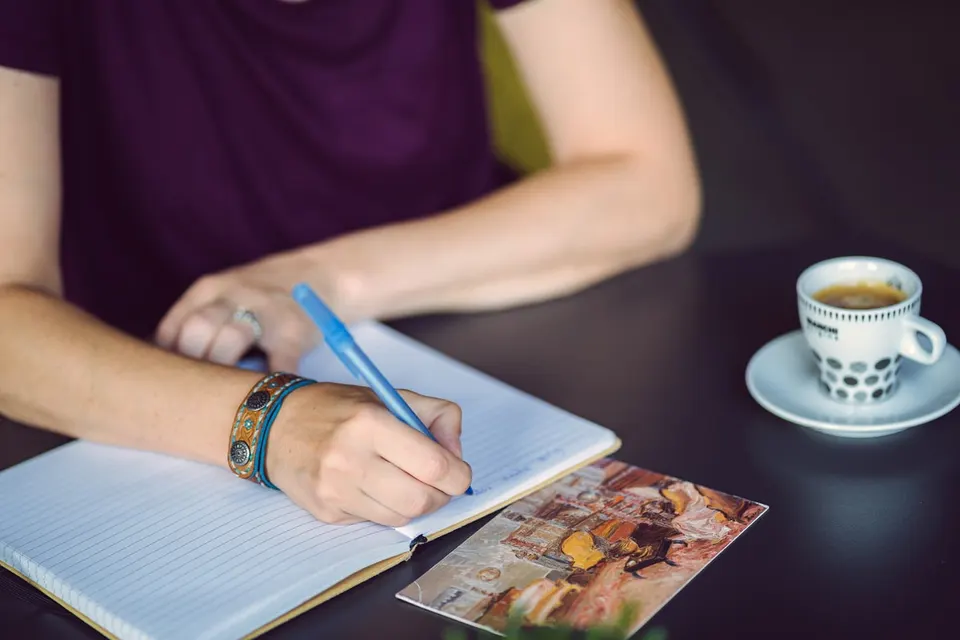
Since I’m lazy, over time I’ve probably learned not to sprawl too much into explanations and descriptions that will get thrown out later anyway.
To say things briefly means finding that one word that will paint the most accurate picture, convey the most meaning and have the strongest effect.
Which word that is depends on the context, on the specific subject and on the way the author relates to it, on the impression they want to leave with readers. ChatGPT is a language model. It guesses how to arrange words so they resemble human speech as closely as possible, but it doesn’t think and has no imagination, reflection or self-reflection. Nor does it have the context an author has while writing.
– “I edit to the bone” is a painfully familiar and precise phrase for me… What is the difference between saying things briefly and the short formats that all of us are drawn to online?
– One concerns form. The other concerns style, meaning, the clarity of a text, regardless of whether it’s short or long.
– And what are the advantages of the long text, which today we have relegated to a supporting role?
– I don’t know, I don’t know. I’m still a fan of novels so thick that when I prop them on my chest to read, they leave bruises.
– Me too! That’s exactly why this site exists, where I write only long texts—long by the standards of online communication. I think we all need to immerse ourselves more often in deep, detailed reading… Except that finding the time is often a real miracle.
Miracles, and the wonderful way you write about them, are the reason we’re meeting. Do you think there are ordinary and extraordinary miracles?
– Perhaps there are miracles we hope will happen and others we don’t even dare hope for. In that sense, yes, there are ordinary and extraordinary miracles.
But on the whole, there are no miracles. There are processes (some explicable, others not) of which we see only the result. That result of a process invisible to us is what we call a miracle.

– Or maybe we’re simply a species that needs miracles to find meaning? If everything is rational and explicable, it somehow becomes meaningless too…
– I don’t know whether we need them; they simply exist. They are part of our lives because there are so many things we can’t explain.
Calling the inexplicable a “miracle” is a beautiful way of admitting how little we know.
Miracles are also a chance to stop fooling ourselves that everything depends on us alone, to catch our breath and learn to trust life.
– How do we teach our children about miracles in today’s hurried times, bombarded as they are by attractions?
– Time isn’t hurried; we are the ones hurrying, and it’s up to us not to.
In my view, while they’re small, children accept everything as a miracle, because even the most everyday and banal things are inexplicable to them. Maybe the question should be how not to train our children out of seeing miracles. And the answer is—by never ceasing to look for them, find them and create them ourselves. Leading by example is a fearsome weapon.
– And if we stay with leading by example… how do we explain to the algorithm, to artificial intelligence, what a miracle is?
– Someone has already explained it. The AI-based language model gives the standard definition of what a “miracle” is and points out why it can’t believe in miracles or experience them the way people do. Because
its answers are based on algorithms, not on personal beliefs and feelings.
– Judging by Ordinary Miracles, it seems… Greece has plenty of time and soil for miracles?
– There’s soil for miracles everywhere. Where a person finds them is a matter of attitude.
Travel is an excellent tool for smashing prejudices, for the urge to get to know the other and the wish to put ourselves in their place,
for stepping out of our comfort zone, landing in sometimes critical situations, understanding and respecting other people’s rules and traditions—all of this is food and water for miracles.
It so happened that for the past few years I’ve traveled around Greece for months at a time. That’s why many of the stories I tell were born there and live there. My previous collection, Taya zemya, onaya zemya (This Land, That Land), had stories set all over Europe, because we toured it by car. It also has a story from Vietnam, where I haven’t been yet, but I very much want to go.
– We’re a country rich in nature and history, but also in neighbors. How do we learn to like them?
– In 2019 I spent a month in Novi Sad, where I spent time with Serbs, young people—boys and girls of twenty, twenty-something. We worked together, and before we left, one of the girls told me:
“But you’re really cool, and we know that Bulgarians aren’t… Well, that they stab you in the back.”
That knowledge had stayed with them from their history classes, where they learned about the Inter-Allied War, the 1913 conflict in which Bulgaria fought its former Balkan allies. And there they were, kind and friendly, yet expecting some nasty surprise from me, and then… nothing unpleasant came their way.
In folk museums on the Greek islands I’ve happened to read things about the Bulgarians who fought in the Inter-Allied War that were the same as what I’ve read in Bulgaria about the Greeks. And yet nowhere have strangers treated my child better than in Greece. I don’t think it’s because they see me as a walking piggy bank, that is, as a tourist; they simply have a special attitude toward children, one I encounter far more rarely here.
In the Balkans we have an explosive history, and it’s good to know it, but it isn’t healthy to live only with it. We are here now; it’s unproductive (if we must speak in modern terms) to work with notions from the past. The question now is how we treat one another and how we can be most useful to each other. It’s impossible to find an answer if we don’t get to know each other.
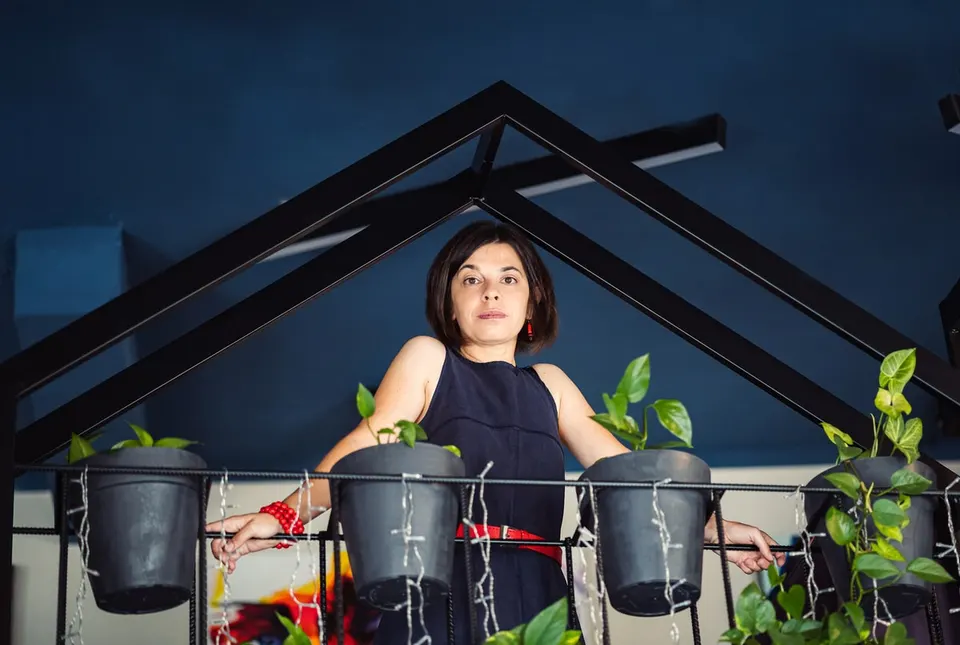
– You say you often experiment with ChatGPT. Tell us about some interesting, unexpected uses. Are there areas where it impresses you?
– My experiments have no particular practical value for anyone but me. I want to know what ChatGPT can and can’t do in my field and in my language.
Most recently I asked it to write me a text in the style of Kazantzakis, then in the style of Ivan Vazov, Bulgaria’s national poet and novelist, and then in the style of Ivanka Mogilska. What was interesting to me was that the language model did an excellent job of choosing themes—these authors really are moved by the themes it suggested. The result in terms of style and language, however, was lamentable.
For now, the only thing that impresses me is how quickly you get the feeling of an unpretentious conversation with a living, if not very close, person when you “talk” with ChatGPT.
– I think that’s how it won popularity so quickly, while we still can’t discover all its true abilities and find exact uses for them. Will the algorithms take copywriting or writing away from us first?
– At least for now, if we can’t tell AI what kind of copywriting text we need, it will give us some text or other that won’t do the job. In that case the algorithm can’t take anything from us, because we can’t give it anything. In copywriting, writing is the last stage of a long process.
Perhaps at some point artificial intelligence will manage to go through that process on its own and write excellent advertising messages and content. That in itself isn’t a vital activity.
Advertising departments don’t make bread, don’t save lives, don’t create beauty; they only advertise.

Besides, sometimes the most visible products and services aren’t the best ones but the ones with the bigger advertising budget. So if the algorithms take copywriting from us, fine, then we’ll do something else.
As for fiction, a person writes out of an inner need that nothing and no one can take away. Only they themselves can give it up.
Of course, at some point AI may start writing truly gripping stories and novels. For me it will still be interesting to read what a human has written—what mastery they’ve achieved in expression, how they’ve served me the story, from what angle they’ve seen it, what they did in situations I’ve been in too, how they coped with feelings that also raged in me, how they live or have lived, what they’ve understood about life, and so on. After all, I’m human too. I’m moved by the experience of my fellow humans; I admire their mastery, wisdom and inventiveness.
That the machine can produce text is wonderful, but I don’t see what it will give me.
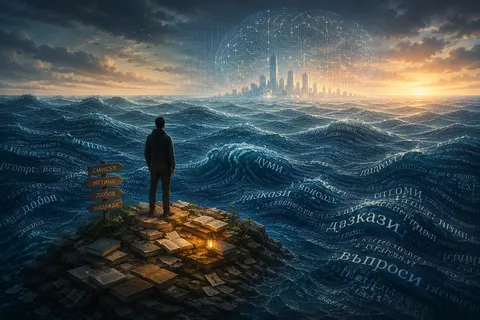
– Alas, one of the directions is precisely that it talks us out of writing ourselves. And the big questions arise when a text can no longer be told apart—was it created or generated… Do we live in a world of words, of letters or of bytes? What does this battle look like to you, and who is emerging as the winner?
– The problem is that we talk about a battle at all. I don’t understand why we should voluntarily give up any of our worlds.
I don’t believe the human need to tell stories will disappear that easily.
We’ve carried it within us since we began painting on cave walls, and maybe even before that. Perhaps only the means by which we tell them will change.

– I think so too—it’s no accident that the segment I host as a guest on “The Library” on BNT1, the main channel of Bulgarian National Television, is called precisely “Letters and Bytes,” in an attempt not to pit them against each other but to bring them together for the good of us all. But what does our success depend on?
– On not giving up either one or the other; let’s use both.
– What miracle do you dream of, personally and globally?
– I dream of getting off the merry-go-round—of work, speed and stress—that we all live on. It’s getting harder and harder for me to spin on it for long, and I step off more and more often. Unfortunately, I still haven’t figured out how to do it for good.
Globally, I’d be glad if history stopped repeating itself. If… we broke the curse and, for a change, didn’t repeat the same mistakes but tried making new ones.
– The merry-go-round is a big subject, and how hard it is to get off it every now and then… Do you have a recipe for that? I find myself thinking this is something we could borrow somehow from the Greeks and other more southern peoples…
– I don’t have a recipe. I just try to ask myself periodically what kind of life I want to live and to stick to the answer I’ve given myself, as far as I can.
I don’t think we can borrow anything from anyone in this respect. If a person realizes how deadly the desire for constant growth is, and also that they don’t need to have a lot, they need to have enough to live and feel good, they’ll find a way. Of course,
they’ll also need the strength to resist the outside pressure for constant expansion, acquisition, consumption.
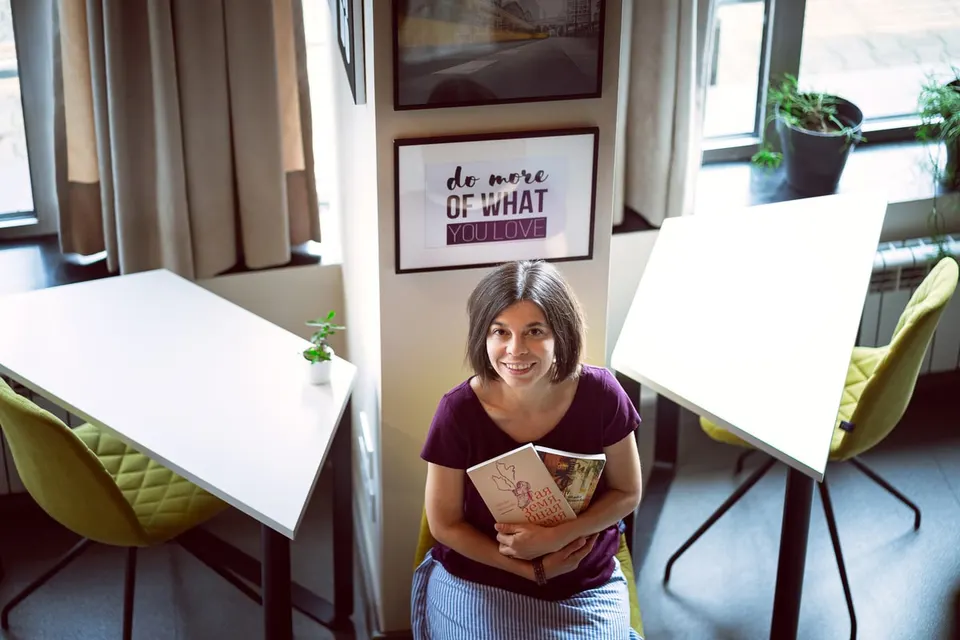
– Does the future of hyper-personalized content worry you?
– What worries me is a future without critically thinking people, people who can’t tell facts from fiction, and a future in which people react entirely emotionally to every trifle without giving themselves time to think and put themselves in the other person’s place. A future in which we all know everything and our truth is the only possible one.
– Alas… we see more and more of it in the present too, and I’m not sure we’re doing enough to fight it. What will the last text written by a human be?
– I asked ChatGPT-4 the same question. Its answer was far too long; I’ll quote only the ending:
“Ultimately, regardless of the form and content of such a final text, it would represent a significant symbol of human culture, history and aspirations, leaving a lasting imprint on what it means to be human.”
I’m not so categorical or so grandiloquent. In my opinion it will be a shopping list or a to-do list, or a work email that is “very important” to its sender, a notice that a credit card has been blocked with a demand for immediate payment, or “zdr, kpr,” Bulgarian texting shorthand for “hey, what’s up.” It will certainly be something absurd that will nevertheless, in some way, hint at what it was like to be human. Unfortunately, the beings that come after us are unlikely to find that text. The phone, the computer, the server it passed through will long since have become a heap of rusty junk…