“Our hectic daily lives” is a cliché we repeat every day.
Perhaps because it is unconditionally true. There is never enough time; they've started making the days far too short. The minutes slip away, leaving no time for quiet moments with family and friends, for a book, simply for reflection or complete relaxation…
How could it be otherwise? Today, in a single day, we can take in more information than people only a few generations ago absorbed in months, even in a lifetime.
Where does this constant feeling come from? Are the generations different, is there more work? Or is there simply something that keeps us under pressure? Something that keeps scaring us that we're missing the moment, even when there is no reason at all…
Was I Late, or Was Time in a Hurry?
Technology is drastically changing our relationship with the past. How it is drawing the future is something we talk about constantly on this site. Now it's time to turn our gaze to the present.
One of the things the development of the digital world has pleased me with is that you no longer need to wear a watch on your wrist. Why carry the weight of something ugly and uncomfortable whose only job is to tell you some arbitrary hour you can see everywhere anyway?
Well, today plenty of people wear watches again, as yet another accessory with a screen, one that is close at hand (or on the hand) to filter out only the most important messages (and, if need be, even show the time).
Of course, the reason time is never enough is obvious, and if you read Digital Stories, you have surely guessed it already: we have all turned into serotonin-addicted devotees of the feed.
It doesn't have to be the social media feed, even if we keep our distance from those networks. It's about the bombardment of constant messages, news, emails; of every conceivable unit of information.
The Happy Don't Watch the Clock
Is this bad? Not necessarily; it's simply one more thing we need to be aware of. So that when we feel the speed of our day has become too much, we know why, and how to rein it in.
Not long ago I put a question on the subject to two writers, both observant and sensitive to what is happening to us, though from different generations.
“Our daily lives really are hectic,” replied Byurhan Kerim. “Anyone who uses a smartphone is already part of this acceleration. But I'm a fan of the hectic life, I love running between a hundred things. The problem comes when this pace starts to create tension and becomes more destructive than not; that's when it's good to find a way to slow down.”
Absolutely! His colleague Elena Pavlova (also known as Virgil Dreamond) aptly observed that, judging by all the forecasts for the future, technology is developing ever faster, bringing us ever more rapid change. “The digital future demands more and more adaptation from every human being. More and more people are dropping out of the race, reaching their limit. Even I resisted installing Viber for a long time, because I didn't want to have one more thing, one more app. I really am addicted to all kinds of gadgets, but I too am reaching the limit of adaptation.”
In a Hurry
It gets even more interesting if… we peek into the future of the present, however paradoxical that sounds. Technology really is developing at its exponential pace, undeterred by wars and recessions, by epidemics and cataclysms. Meanwhile we humans remain the same linear creatures, finding it ever harder to keep up.
If you're not among the youngest, you may have noticed the curious phenomenon that time seems to flow faster as we age. Psychologists explain it by the fact that we encounter fewer and fewer new things. And our brain is an optimized system that tries to save resources; it's no accident that our childhood memories are often far more vivid, colorful and surprising.
Could the same thing be happening to us as a species, caught up in the whirlpool of technology in our mature years?
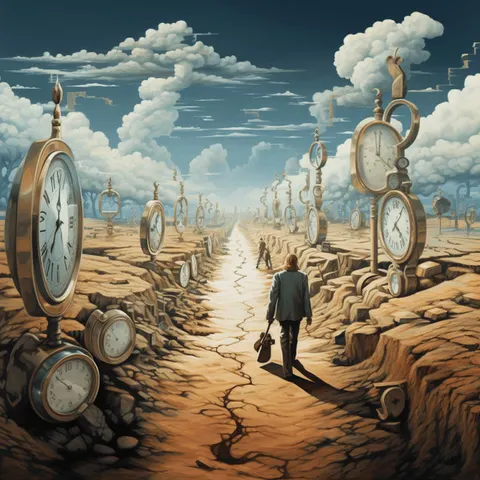
Where Are You Off To?
We can see it more than clearly in children. In the old days you couldn't say “I'm bored” twenty times an hour instead of going out and inventing a game with friends. And have you noticed how impatiently little ones treat TV commercials? Which, for us in the 1990s, doomed to watch cartoons in a narrow window of hours, were almost an extra treat…
It shows in the content we consume online, in the “evolution” from long blog posts through status updates all the way to stories and TikTok. We try to split the second, to cram things in, to take in more and more… but more of what?
The reference points are different today. Once, the day “ended with Channel One,” when Bulgarian National Television's main channel signed off for the night; now it ends whenever it pleases. Even the proverbial “nine-to-five job” has somehow, imperceptibly, perhaps around the time of covid, turned into… “nine to six.” With all the vagueness of the home office, at least until it, too, is ended by the wise ideas of lawmakers and the goodwill of elders like Elon Musk, who consider it “the laptop class living in its own world.”
Haste Shames the Hipster
Just a few centuries ago, before the Industrial Revolution, the attitude toward time was completely different. Mass-produced spring-driven clocks appeared only in the seventeenth century! Only a few generations back, people didn't know what a second was, and if it weren't for our biological limits, we would probably have learned by now to split in two even the smallest measured unit—the attosecond, equal to just 0.000000000000000001 seconds. Not even computers can do that, but one day they will, rest assured.
Yes, it was quite late that technology allowed everyone to know what time it was, and for a long time at that—at best from the strikes of the clock tower. There was no way to arrange a meeting for “ten to.” Not to mention the “wonderful” idea of introducing daylight saving time, which was supposedly meant to be a mere memory long ago.
But that's not the only reason the exact hour wasn't all that important. When the rhythm of your life is set by your natural biological clock, things are simpler. The same goes for when work is measured by what you've created and how you did it, not by how long it took you.
Just consider how colossal the difference is. From childhood we take it for granted that our days are divided into blocks of time we must use—to study, to work. Something that, until so recently, made no sense at all.
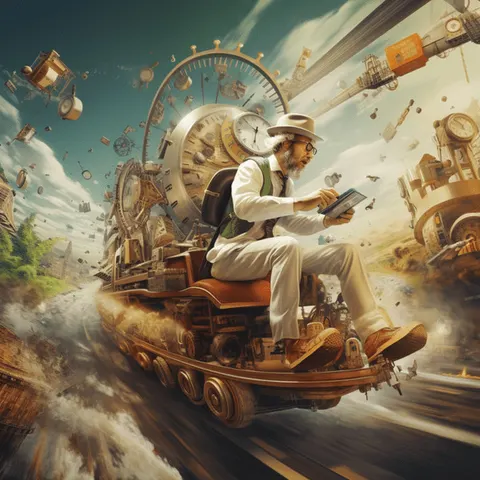
No Time!
Something so important, because time is precisely our most, most precious resource while we're on this planet!
The only thing we can't add to ourselves, even if we live on nothing but avocado.
The only thing in which we are all equal.
The only thing that truly matters to use to the full.
But does the pressure of missed notifications help with that? Not in the slightest. Technology can actually be useful to us in precisely this important task—instead of “eating” into our time, it can make it fuller. For example, by sparing us the long hours of our lives spent commuting to work when there's no need. By relieving us of more and more boring, routine tasks…
Except that here comes the battle for our attention among all the websites, apps and messengers. Every ad relies on convincing you that you have limited time to take advantage. Every network relies on making you check in constantly to see how many new likes your latest photo has collected and what comments, how many people have visited your site. The wheel spins at a frantic speed… Simply because the apps themselves are built that way. Because they have to fight for your attention in fierce competition with all the others, and the feeling that you're missing out is their most powerful weapon in that battle.
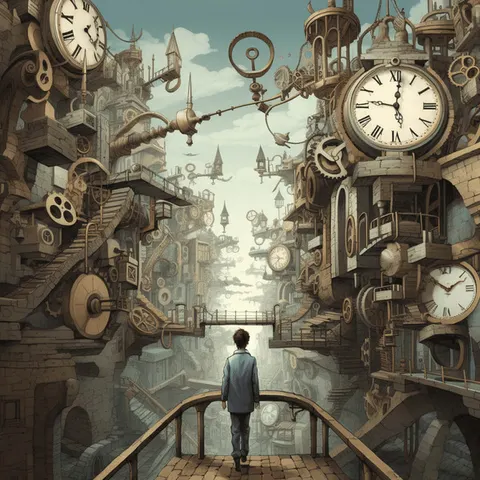
O Tempora! O Mores!
A bit contradictory: technology is often designed to make us feel we're wasting time, while… it is often precisely technology that wastes our time?
Well, I'm sure you know just as many people who said on their deathbed, “Ah, why didn't I scroll online more,” as who said, “Ah, why didn't I stay longer at work.”
And what about the social networks that urge you to share where you are this very second? And the smartphones that made us rush our selfies while we actually miss the moment itself? And instead of memories, we're left with stories that vanish into oblivion within seconds—and into the giants' endless collection of data about us.
Yes, all these products are useful for making fuller use of time, but only up to a point. Once that point is crossed, it's time for solutions such as digital minimalism.
A Time to Live and a Time to Die
Let's be honest: not everything happens fast. I know many of you are proud of being able to speed-read; I, for one, will tell you that in my view it's nothing to be proud of. And far more often, the minutes spent savoring your favorite art, whatever it may be, are more valuable than days of scrolling. Not to mention the time spent with the people dear to us.
Fast reads and fast knowledge are often like fast food—their calories burn off quickly, leaving behind senses that are bloated, atrophied and have forgotten the true taste. Until we have merged with the robots, slow work is very often more precise, more controlled and more refined. Fast work, meanwhile, comes with stress and high levels of cortisol, which later keeps us from falling asleep.
“We do not get to choose the times we live in. We can only choose how to live in the time that has chosen us,” says Tolkien. Other, more familiar words to Bulgarians, written by Vasil Levski, the nineteenth-century revolutionary revered as the country's national hero, are also a more than accurate insight here: “Time is in us and we are in time; it turns us and we turn it.”
We were better off before Einstein; good old time just went along in a straight line before it turned into relativity, an inseparable part of space.
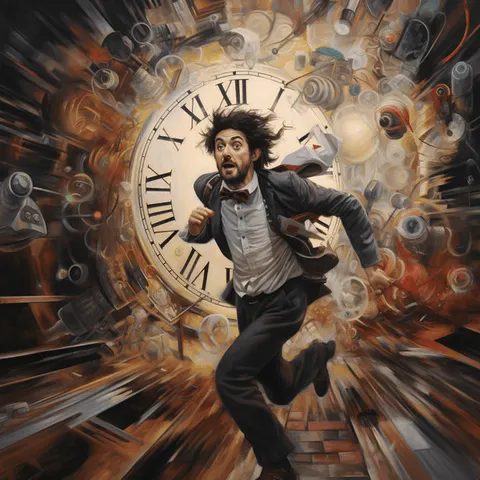
Make Haste Slowly
And although the stress of time arrives with clocks, the ancient Greeks already had two words for it—“chronos,” which gave us many other familiar terms today, and “kairos.” The first is objective and measurable, while the second is inner and human. Even if you know you scraped the car at 5:20, you'll tell your friends it happened after work, before you got home.
Kairos is a feeling and an attitude; chronos measures, fixes, defines. And if today we have let the latter reign, it can only do us good to pause and listen to the former. So that it reminds us how time stops when we truly enjoy ourselves, when new things happen to us, when we have a meaningful conversation, even an online one. When kairos arrives, chronos slows down…
Other peoples (southern ones, for some reason) have noticed it too. Dolce far niente. The sweetness of doing nothing. The pleasure of switching off from the hectic rhythm and savoring the moment.
And is there even such a thing as the present? Not according to our own brain. David Eagleman is one of the best-known researchers of the biological clock in recent years. He suggests the following exercise: stand in front of a mirror. Look in turn at your left eye, then your right, then your left again. When your eyes move, it takes them time… but you'll never actually see them do it.
More Haste, Less Distance
Our brain “edits” information and runs, more or less, behind the present. In this case, it receives information about the complex path the eyes follow and simplifies it. The same thing happens with every part of our daily lives. As one of Eagleman's teachers, Benjamin Libet, put it: “We are not aware of the actual moment of the present. We are always a little late.”
What's more, Eagleman explains, we still don't know how many internal clocks there are in our bodies and how they work.
“If all our senses are slightly delayed, we have no context by which to measure a given delay. The more detailed the memory, the longer the moment seems. This explains why we think time speeds up as we grow older—childhood summers last forever, while old age slips by while we take a nap.”
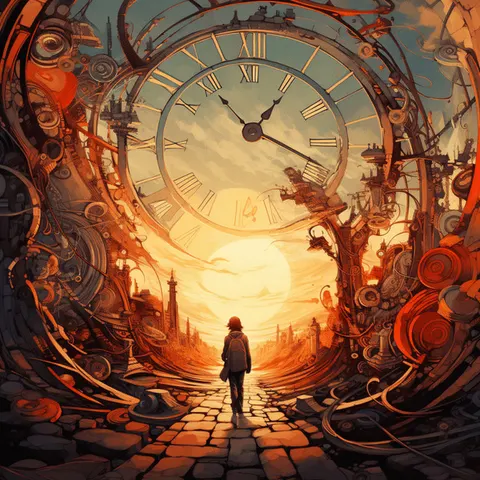
In Search of Lost Time
We all remember what we were doing on September 11, 2001, don't we? Or on November 10, 1989, the day Bulgaria's communist leader Todor Zhivkov was toppled—provided we'd been born by then (or that it isn't more convenient today to make up a cooler version). Routine is the enemy of memory, and therefore of the moment, of kairos. And however much the feed, in its advanced versions, may seem to be the opposite of routine, it is simply routine's dopamine-enriched version.
“Time is a rubber band,” Eagleman says again. “It stretches out when you really use your brain resources, and when you say, ‘Oh, I've got this, I expected this,’ it shrinks up.”
The other option is considerably more tedious. You may remember the character from Catch-22 who wanted to lengthen his life. “He was doing this by cultivating boredom. Dunbar was working so hard at increasing his life span that Yossarian thought he was dead.”
Stress, too, slows time down, as does the thought that we are mortal.
On Slowness
Yes, boredom slows time down too, but it also makes us forget. Unlike the moments when something new happens, when you find yourself in a different place, meet a new, meaningful person and sink into conversation.
There's also a curious study from 2015, technologically so very distant. “I found indications that our interaction with technology has sped up our internal pacemaker,” says Aoife McLoughlin of James Cook University. “This may help us work faster, but it also makes us feel more pressed for time.”
According to her, the reason is smartphones. Her study compared people who are connected to technology every hour with those who rarely use it. Asked how much time had passed, the first group estimated an hour that had elapsed as just 50 minutes, while the second estimated it as even more than an hour. There were differences depending on the content, too. For those who had mainly watched ads, time passed faster than for the others, who had read a long text online.
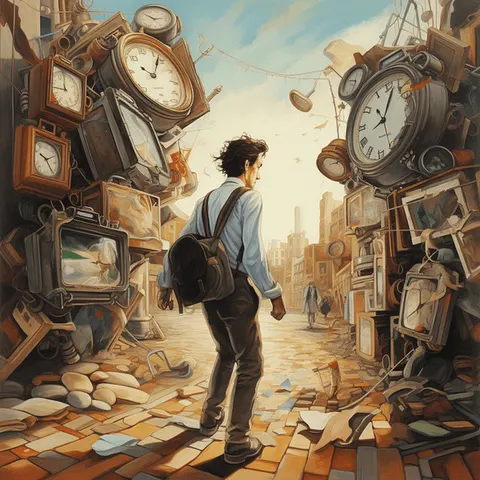
O Moment, Stay!
“It's as if we are trying to imitate technology by being faster and more efficient,” says McLoughlin. “There seems to be something about technology itself that prompts us to speed up this pacemaker inside us that measures the passing of time. A faster speed of information processing may be an advantage in many circumstances. But it increases time pressure, which will increasingly lead to stress or depression.”
Is she right? Statistically, doctors aren't warning us about something so widespread eight years after those words, but doesn't each of us feel it today?
“In my view, this shows that there is an objective, quantifiable cognitive basis for slowing down from time to time, for easing the pace,” McLoughlin adds. “It's a scientific reason to sometimes stop and smell the roses.”
Quite wise advice. Indeed, “people board the express trains, but they no longer know what they are looking for. So they bustle about and go round in circles…” And sometimes all it takes is to stop and think every now and then. And if they are sad, to calmly watch the sunsets…