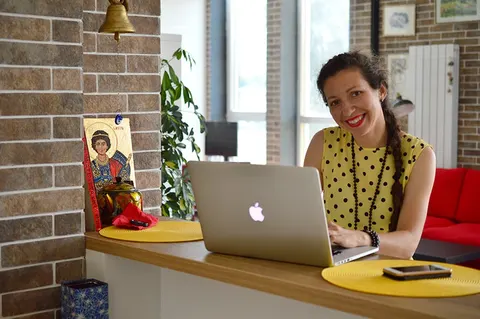
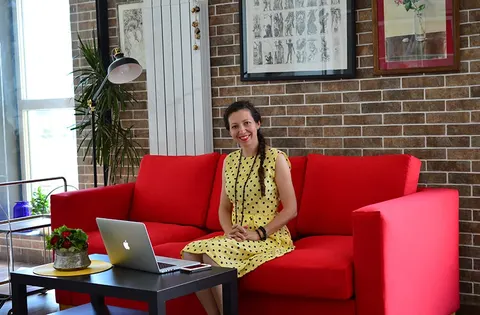
Marina Shiderova is a person of both art and technology. Her heart has room for a great love of painting and for her professional calling alike. She and her team create next-generation digital design that turns opening a web page into convenience, aesthetic pleasure and adventure.
Marina graduated in engineering design from the Technical University of Sofia, specialized and worked in Germany and China, but chose to look for success back in Bulgaria. And she found it.
For five years she has headed Fram Creative, the studio she founded. Her team of specialists in different fields of design has built numerous impressive online projects for companies across many sectors. Clients who trust her include Deloitte, Duracell, Coca-Cola, Econt, one of Bulgaria's biggest courier companies, and even… “Gospodarite na efira” (Masters of the Airwaves), Bulgaria's long-running satirical TV show. (More of the projects by Fram and by Marina)
I met her in her role as a teacher of “the art of creating landing pages.” In that course she offered many meaningful and useful touches to our everyday life online, to success on the web, to the relationship between websites and their users.
She is our guest at Digital Stories so that we can add one more valuable perspective on the technological present—the one from the standpoint of design.
– How are the most interesting ideas in web design born? Do they come out of nowhere, or do you dig into the particulars of the specific company?
– The most interesting ideas come the same way as with any true product of design. They are often inspired by nature, by historical styles, by events.
The most beautiful, original, remarkable ideas online are born from something that is very strong in the real world.
And when the author is impressed and refracts it through their own prism, through their creative work; when they manage to give it a new form, a new life, that is when the result becomes truly impressive.
– Is that perhaps how your company got its name? Why did you choose to name it after Fridtjof Nansen's ship?
– He and I were born on very close dates, and I grew up with his stories from a young age. To me he is an example of a truly meaningful life. At first he was a man of great success in sports, then he became a remarkable scientist and explorer. During that period he built the ship Fram, which was inspired by a walnut shell. He took the shell to the shipbuilder, the best of his time, and told him: “I want you to build me a ship with this kind of structure. That way it will withstand the ice and every other hardship.” He turned out to be right.
Toward the end of his life Fridtjof Nansen went into politics and created the famous Nansen passport, which helped many people find safety abroad after the wars. He received the Nobel Peace Prize. And “Fram” means “forward”…
– Many people believe there is no room for creative people in building websites. Is that really so?
– On the contrary, all websites and all digital products are creations too. They also have a certain style and rules of construction; they are 100 percent creative work.
My worldview says that the most perfect digital products are created by true designers, by true artists.
Not by people who have somehow picked up a trade and come from other professions to make a living, but by those who have the necessary creative education and sensibility. Digital products are works of art, but of a new era; they are simply the creative work of our time.
– What do you think, can success online come if something doesn't look good, if it isn't beautiful and polished?
– Every online project has to strike a perfect synergy between the functional and the beautiful. You shouldn't fall into either extreme. If it's too functional, we go back to the era of so-called developer design, when programmers made functional things, displayed some forms and things happened, but in a not particularly pleasant—let's just call it ugly—way. And if the project is made only by designers and artists, the result is a set of pretty pictures that carry neither function nor meaning.
That is why the UX/UI profession exists: it is exactly the combination of the functional and the beautiful. The right balance between something working, being easy to use, and looking good, being visually pleasing.
Right now, a website having a very strong UI—that is, being visually attractive—is a serious priority, because it has become a major factor in how people choose. In many fields there is a pile of apps that overlap. In fintech, for example, every app has payments, transactions, a personal profile, everything that's needed. And what sets them apart and makes people choose is how they look, how they are presented visually. The user's choice is often entirely subjective, literally of the kind “I like the yellow better, so I use this app.”
– How would you describe the UX profession to someone who doesn't know what such a specialist does?
– They work on creating the user experience. They analyze the right users for a given digital product, try to step into their shoes, to feel what they feel, so as to make the product easy, convenient and usable.
– You mentioned what the internet used to look like—websites were glossy, colorful, glittering, with Flash animations. Now it seems to be the time of flat, simpler, cleaner design.
– The changes aren't so much about flat design versus colorful pages. Rather, the needs for different kinds of websites have changed. It used to be that making a website was a grand project—who would see it, what people would think. There was a huge emphasis on animations, on videos. Now people would rather have a website as a business card, even if it's more modest, simple, light. But one through which they convey, sell and visualize their product or service.
Today most websites are simpler, functional, and go for a lighter, cleaner aesthetic. That also comes from ready-made templates—there is a huge choice of them and they are very widely used. Few people draw and work on complex visuals, collages and site structures. More often you just take a template that can be quickly and easily customized for functionality and efficiency.
– And what comes next as a trend?
– The next fashion is definitely 3D. The era of an ever more three-dimensional, more realistic feel is coming. It goes hand in hand with virtual and augmented reality, but the trend is getting stronger even in graphic design.
– With websites you can immediately see what works and what doesn't; that is undoubtedly a huge convenience. But aren't there downsides too—you rush, you miss the bigger trends, you deprive yourself of creativity…?
– We come back to the question of UX again. In the end, the goal of any website is first of all to get some job done for the user. That is, the most important thing is for everything to be easy and convenient for them.
When a site is being built, designers often place a button, the so-called call-to-action, that seems perfect to them and in just the right spot. Then user research and testing show they were wrong, and that forces a change of position, of text, of shape, of color. It's important to keep checking this all the time. Creating the user experience really isn't exactly creative work.
– So the creativity lies more in the visual and marketing side of things?
– Yes, that's right.
– What are the most common user experience mistakes that testing reveals?
– Usually it's about wrong user paths that lead to lower usage. You've lengthened the user experience with unnecessary steps, the buttons are in the wrong place, the whole thing has become complicated for some reason, and as a result users can't cope with the product.
– So any simplification online is welcome for the user?
– Exactly.
– Do you think media on the internet have a future?
– It's a very sore subject for me that we are moving more and more toward less paper, less analog. I don't know, I can't imagine life without real books, without the print editions of some media. From the standpoint of the customer experience, media certainly have their own touchpoints and channels through which to reach people. The digital doesn't get in their way; it complements them.
– It should. Unfortunately, though, it destroys them by depriving them of the chance to be professional. It makes the traditional ways of funding—selling content and advertising—impossible. But that really is another topic.
How far do graphic design and web design overlap? Do people with knowledge and experience in graphic design manage to readjust easily to online projects?
– Yes and no. It depends on how technically minded they are and how quickly they absorb the basic rules of building UI/UX design. On my team I have several people who studied graphic design and have transformed themselves extremely successfully. Their previous visual skills help them enormously to express themselves and create more beautiful content in the digital space.
– Do you have to like a product to be able to present it well enough?
– Absolutely. I'm convinced that
if you don't put a piece of your heart into everything you do, into every product, first of all it has no meaning
and second, you won't be able to defend it. There's no way to put your name to something you don't believe in and that isn't yours.
Of course, in many cases clients dominate and change the product to the point where you no longer recognize it, it's no longer your thing. There are decisions on which you simply can't bend. Where you can't give up certain judgments you've made about the product. In the end, the client may choose purple, which you don't like, may choose an illustration that you don't think is ideal. But if the rest is right—the right UX, the right path, the right core idea—things work out.
– Have you ever turned down a client because you didn't like their product or it contradicted your worldview?
– Yes, we don't work for certain industries that go against my values.
– What personally keeps me away from marketing is the underlying idea that at a certain point you somehow have to mislead, to manipulate. Where is the line?
– My theory is this:
If the product doesn't disappoint afterward, then any marketing means are allowed.
Disaster strikes when the product is disappointing. When something worthless is put into the most wonderful packaging.
But if a product that is more modest, not so impressive, is given good marketing packaging thanks to which it finds its users, its place in the sun, and it doesn't disappoint anyone, that is perfectly okay.
– You think it's easy to get someone to buy once; the hard part is getting them to buy again…
– Precisely, that's the secret! Many brands keep making this mistake. What's the point of tricking someone into buying once, just like that? Given that they'll be disappointed and complain to another six or seven people. And they themselves won't buy again…
– People have lost the habit of reading long texts. Is there still a place for them anywhere on websites?
– Sadly, no. The trend, at least in UX and UI, is that the shorter the content, the more readable it is. People stopped reading long ago; they scan, which is also sad for someone like me who grew up with books and libraries. Who reads. Texts are becoming ever more technical, short, trimmed. The pleasure of reading is missing. This trend certainly applies in full force both to websites and to mobile apps.
Everything has to be said in one sentence, in a few words, quickly, briefly, precisely and clearly.
– Do you think there's any way this might change one day? That design might start working more to hold that attention? Because at some point we really are all going to explode from sensory overload…
– It depends on the type of product. If, for example, it's educational and its purpose is to enrich people, to give the feeling of a real book, then the mechanisms needed to improve the experience will be used. To get people to read, to hold their attention. But most often we create apps for general use—and then you have to say what you sell, what your products and services are, in the shortest, clearest and simplest way possible.
– Have social networks diminished the importance of product and company websites?
– I don't think so. Right now product websites are a very important factor for reputation. It's unlikely that anyone will choose a brand just because of its Facebook or Instagram profile. Today every company has to develop a whole ecosystem, to have all the necessary weapons. To have its product site and its brand site, to develop good profiles on social networks. And to have some channel through which people can get in touch and talk—a call center, say.
– Do blogs have a future as a type of website?
– Yes, they are a product too, just a product of personal brands. That is, these are people who sell themselves as products, as brands. And thanks to that they create the necessary content, their image. They build an aura around themselves, around what they create, whether it's recipes, paintings or articles. They may change their form, may no longer be called blogs, but they'll keep working in that direction.
– From that point of view, an influencer's work is also a form of blog, just on a different kind of platform. Even if it's only to snap ten photos a day on Instagram.
– Yes, but an influencer is a blogger who can't write—a wordless one, let's call them…
– In the end, after everything we've talked about, I arrive at an unpleasant thought that had never occurred to me in this form. All online communication can be reduced to buying and selling something.
– Yes, I think so too.
– It's a little sad, isn't it? It's very hard for anything significant enough to exist online that is simply the result of goodwill, a noble idea, the level playing field the internet was supposedly meant to give us.
– Yes, it really is sad. But it has also been driven by everything happening to us on a global scale. We have become truly devoid of spirit. The pandemic made us even more selfish, more self-absorbed.
What the media were saying last year—that as a result of it we had become one big family, more united and compassionate—is complete nonsense. Everyone isolated themselves, closed up. Began to fear terribly for themselves, for their own health.
At the same time we were left without absolutely all the things that make us human—starting with celebrating family holidays, through concerts, theater, cinema. Everything that was our spiritual life was cut off.
It was as if the users suddenly changed. Suddenly people had a different profile. That's the sad part…
– Still, let's not end on the sad note. Actually, why did you come back to Bulgaria?
– I love my country. I love its people and I believe they have enormous potential. They have simply lacked the historical chance to find themselves in the right conditions for development. Each of us carries enormous potential; we just don't realize it.
– What fills you with optimism?
– There are many things that make me smile every day. I have endless reasons to feel deeply grateful and happy. Starting with my wonderful team—of all the millions of designers in the world, these are exactly the people I love creating with and sharing the creative process with—and on to the happiness that fills you when you create.
There is nothing more wonderful than falling asleep at night happy and satisfied that you have created something beautiful
and meaningful during the day. There isn't a day I start without a smile and endless eagerness for what my team and I will create together!
– What do you dream of?
– I dream with all my heart of building our own Fram standard, which would become the foundation on which millions of people around the world build their digital products.
Something like an alphabet, or like an anatomy, but for designers, programmers and business people.
All the digital products made with it will look beautiful, stylistically consistent and functionally sound. That would usher in a new era of real standards in building digital products.
– Quite an ambitious idea… Of course, I'm keeping my fingers crossed for you to succeed! And I'd be glad to have you as our guest again someday, to tell us more about it…