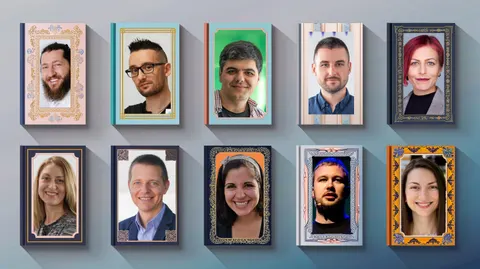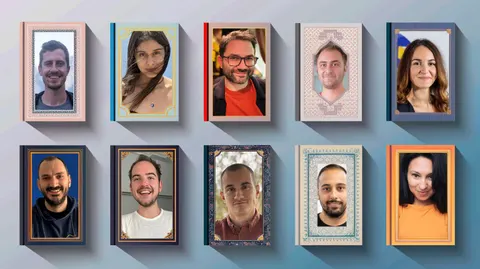
Do the people who drive the world of information technology forward actually read? They read like there's no tomorrow, and you're in for a surprise. Time for a very important and very bookish experiment. I'm going to invite 15 leading Bulgarian figures from different corners of the computer world to tell me their three favorite books and why they would recommend them.
Will they respond? Will it turn out that they mostly read titles about software, business and self-improvement?
Their answers, to me at least, turned out to be surprising.
Is it hard to be a god? A question for connoisseurs. And why is it hard?
What Are You Reading? 3.0
Why, here in Bulgaria, does nobody care much about the favorite books of the people who end up in the spotlight? My conversation with Daniel Penev got me thinking about this. Last Tuesday I told you about the favorite reads of the leaders of the digital world. Bill Gates, Musk and Altman certainly impressed with their recommendations. Then I talked with Hristo Blazhev about one of the most important choices in every one of our lives: “What are you reading?”
Which brings us to the experiment in the pixels that follow. “Recommend me a favorite book!” You rarely hear an invitation like that in the media. (A wonderful exception is “The Superhuman with Georgi Nenov”.)
I put the question to 15 people who have been guests of Digital Stories and who come from our software industry. I tried to pick different profiles—programmers, managers and other kinds of specialists. People from business, from education and from science. I received nine answers, but with such interesting and unexpected books… I dare say I'm a fairly well-read person, yet they definitely impressed me. Both with their variety and with the messages they carry. You'll find the recommendations in the order I received them.
I'd be glad to hear what you think. I fully understand the other invitees, swamped by the madness of everyday life, who didn't send their picks. They're always welcome to do so—the topic matters, and there will certainly be a sequel soon with the next round of book recommendations. But let's not waste time; let's see which books my guests recommended.
What Is Happiness?
Petar Sabev is a software testing specialist with vast experience, an event organizer, a traveler and a man with a broad, unusual outlook.
(More about him and from him—here.)
His book recommendations:
- Among my favorites, read as a traveling man, are Eric Weiner's “geographies.”
“The series begins with, and is best known for, The Geography of Bliss. As the cover says, it is ‘a fascinating tale woven from psychology, geopolitics, science, travel and humor, a provocative and entertaining analysis of what happiness is, what it isn't and where we can find it.’
They're very interesting because they combine travel, reflection and fascinating side stories from different countries and cultures, and they answer precisely questions like what happiness is, what bliss is, what wisdom is, or even what God is according to different cultures.”
- Man's Search for Meaning by Viktor Frankl
“It's not an easy book, because it tells of life in the concentration camps, but it reminds me that life is short and fleeting, and that the problems I have are laughable against the backdrop of world history and world peace.”
- The Hitchhiker's Guide to the Galaxy by Douglas Adams
“The Guide is a favorite of mine. Not only for the humor, the 42 and the IT jokes, but for personal reasons too. After a conversation about the number 42 and the Meaning of it all, back when we were a young couple, I gave my now-wife this book wrapped in a towel, and I think she was quite impressed. She asked me, ‘Why?’ And I answered, ‘Read it and you'll understand!!!’”
“If you ask me again some time from now, I'll probably tell you something completely different, but here are three completely different books. 🙂” Petar Sabev added, opening the experiment in exceptional style with terrific suggestions. I've never read the travel series he started with… maybe it's time?

Time Shelter in 1984
Atanas Raykov is Viber's global vice president of marketing and business development. Thanks to him, a large part of the team building the popular platform works in Sofia.
(More about him and from him—here.)
His book recommendations:
- 1984 and Animal Farm by George Orwell
Key books that often come as a set, including as an audiobook. They remind us how far a society can go to the extreme if institutions and the safeguards against autocracy fall apart.
With the advance of technology, this dystopia is entirely possible. On the other hand, we need stories to remind us that indifference, or blindly following the next savior (be it political or technological), can in itself be a key complicity in bringing such dark scenarios to life.
- Time Shelter by Georgi Gospodinov
I'm a huge admirer of Georgi Gospodinov as a writer and as a person. I have the honor of knowing him personally, and I firmly believe the awards this book has won are fully deserved, because it draws a brilliant parallel between the effects and defects of personal and collective memory, which can create fertile ground for nostalgia for bygone times—nostalgia that can grow into a mass illusion that “the good old days” can return in a world changing at breakneck speed.
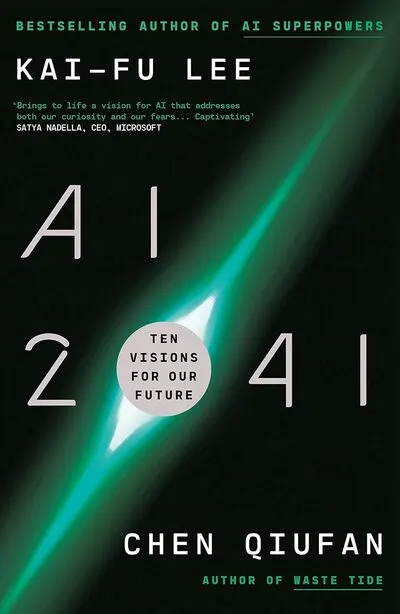
- AI 2041 by Kai-Fu Lee
The most interesting book on artificial intelligence, describing in a very accessible way possible scenarios for the future and how it will be changed in the coming years by the development of AI in its various forms. A great combination of fiction and strategic analysis from one of the most prominent professionals in the field.
“It was very hard for me to put together a list of (only) three recommendations, and maybe that's why this one is heavily influenced by the current situation in the world (and in technology),” Atanas adds. We also get a pick that hasn't yet been translated into Bulgarian—the last one, with its glimpses into the future. But… these really are vital reads in the context of today.
Digital Stories with Frankenstein?
Yordan Darakchiev has spent nearly a decade developing Bulgaria's first one-year module that gives people enough knowledge to start working in data science and artificial intelligence (and I can vouch for it personally as one of its students).
(More about him and from him—here.)
His book recommendations:
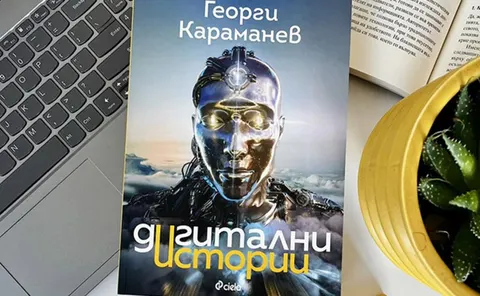
- Digital Stories by Georgi Karamanev
I'd recommend it in any other ranking. Here, specifically, I'm afraid of being accused of having ties to the author. Setting the stories themselves aside, for me they're a source of a lot of positivity and inspiration. Interesting people and ideas are all around us; it only takes a little listening to the stories that surround us, a little filtering of the useful signals out of the noise, to look into someone's soul or into the future.
- Frankenstein by Mary Shelley
The original text, not the later versions. I love horror, especially the classic stories and novellas. I wondered which classic exactly to recommend, but Frankenstein is worth reading for many reasons. To me the book is a love letter to science. I really like the theme of devotion that drives a genius to madness. And the questions it raises (about ethics in science, for example) still apply today (when the monster might be called a chatbot).
Oh, and yes, the cry “It's alive!” is nonsense—it's not in the original. Popular culture has watered down and changed the meaning of the original a great deal.
- The Hitchhiker's Guide to the Galaxy by Douglas Adams
I've never found a good Bulgarian translation of Frankenstein, one that captures the nuances of what's written. The Guide and its sequels, however, are translated quite well by the team at Bard, the publishing house.
In almost every respect the book is the opposite of the first one. Adams looks at very deep and complex subjects with lightness and humor. But it (fine, they—there are several books) is much more than light reading. What I like most is the approach of explaining the most absurd things as if they were perfectly normal, and the normal ones as if they were strange. I do it very often myself—not only for comic effect, but as a way of getting to know the world… it's part of who I am, and I owe it mainly to the Guide.
- House of Leaves by Mark Z. Danielewski
Unlike the others, I found it very hard to choose a book to somehow “round off” the list. I wavered between many titles—classics and contemporary works, technical books with logic puzzles… In the end I chose a book that I definitely think deserves more popularity. The main reason it's here is that it has a long history of making people who have never opened a book in their lives fall in love with reading.
The story is almost a cliché—a man finds notes about a house where strange things happen. But the Victorian theme isn't the main reason I recommend it. The way it's written is fascinating. You don't read it from beginning to end like a standard book.
The reader is an active participant in, and interpreter of, what's happening. For me it's a whole experience, not just a book that tells a story. You have to live through it to understand it. And yes, it's read on paper… It used to be very hard to find; in the last six months I've spotted it a few times in Sofia.
Digital Stories?! And alongside books like these… All I can do is say thank you for such high praise; it's because of opinions like this that the book exists and that this site keeps on existing too.
I'd also point out that the Guide shows up for the second time… we IT people definitely have a feel for things and a sense of humor! And I'd never heard of this House of Leaves—yet another addition to my personal list.
Tobacco Shrugged
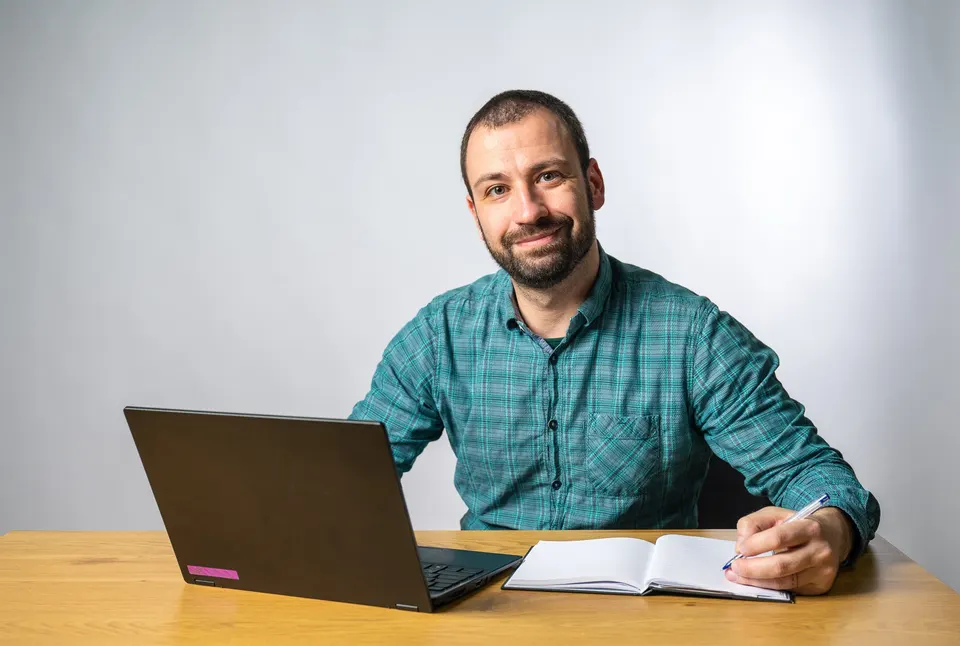
Angel Georgiev decided 18 years ago that he would work in education. He is the creator of the Znam.be platform and of the Sindeo applied academy for education.
(More about him and from him—here.)
His book recommendations:
-
Atlas Shrugged by Ayn Rand
-
Tyutyun (Tobacco) by Dimitar Dimov
“These are the last works of fiction I read. There are interesting similarities between them. I also really liked Shantaram and its second part, The Mountain Shadow, by Gregory David Roberts. The funny books by Stoyan Nikolov (Torlaka) are very good as audiobooks because they're written in dialect—Severozapaden Roman (Northwestern Novel) and Avtonomiyata???? (The Autonomy????). Stefan Tsanev's Balgarski hroniki (Bulgarian Chronicles) opened my eyes to quite a few things. In my opinion, this book is a must for every Bulgarian. Are these books enough? I have many more!”
Thank you, Angel—they're definitely more than I expected! What could Boris Morev, the ruthless tobacco magnate at the heart of Dimov's novel, and John Galt have in common? I'll ask him the next time we meet. I'm especially pleased that Bulgarian authors have started to appear. Even one who was once my guest—alas, Stoyan Nikolov (Torlaka) is no longer with us, but his books go on stirring, amusing and provoking thought…

Success with Principles
Mario Peshev is a programmer, marketer, entrepreneur and much more. The websites he and his team look after get 1,000,000,000 visits every month, and he has written part of the code that powers the WordPress platform.
(More about him and from him—here.)
His book recommendations: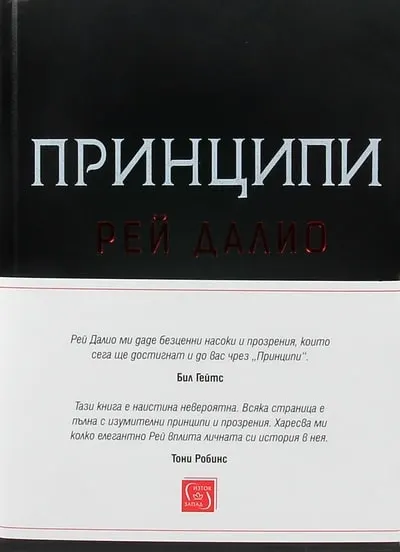
- Principles by Ray Dalio
“One of the most significant reads for me professionally—very important lessons for life, as well as an expansion of one's mindset with rules like radical open-mindedness, and why broadening your horizons is so essential to success in any undertaking.”
- The Success Principles by Jack Canfield
“If you've ever read the Chicken Soup for the Soul series, with stories that leave their mark even 20 years later, Jack develops in considerable detail important principles of success: how to define it, goal setting and fulfillment in personal and professional life.”
- The Subtle Art of Not Giving a F*ck by Mark Manson
“Much of my philosophy of life is tied to Stoicism, and Mark offers a modern reading of life and reality, along with principles for dealing with disappointment through a more realistic assessment of the world around us. He raises many questions about value systems and what we see around us, since the same circumstances can lead to a radically different reading with the right preparation.”
And so the list has grown considerably, and we've stepped well outside the world of fiction, which is wonderful. I warned my guests that fiction is my weakness, but they had complete freedom to recommend whatever books they saw fit. Special thanks to Mario, who also welcomes readers to his Goodreads profile.
Liftoff!
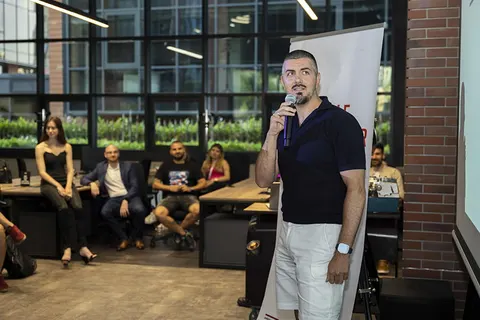
Mihail Stoychev is one of the most successful Bulgarian IT entrepreneurs. In just a few years he built two extraordinarily successful startups—SMSBump and NitroPack—both acquired by global companies.
(More about him and from him—here.)
 His book recommendations:
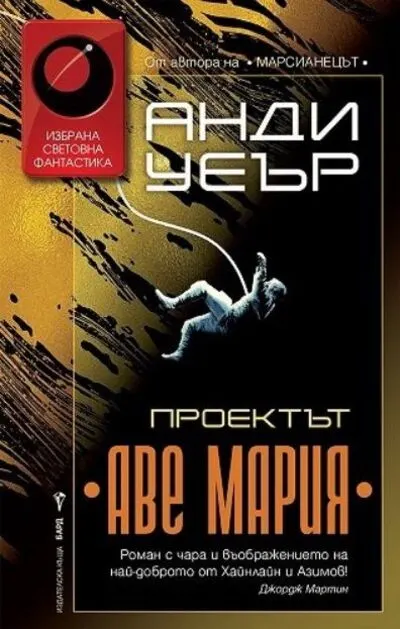
- Project Hail Mary by Andy Weir
“I don't really read business books—I mainly read science fiction, so I'm not sure this will be useful,” Mihail writes to me. Oh, how could it not be useful? On the contrary, it's delightful! I adore science fiction, and I think a world where tech leaders read more of it is a wonderful one. And look—his list opens with a book that is among the favorites of many of the world's IT leaders too. It doesn't seem to be discussed as much here in Bulgaria; to my shame, I admit I still haven't read it, but I'll correct that mistake very soon.
-
Onassis: An Extravagant Life by Frank Brady
-
We Are Legion (We Are Bob) and the whole series by Dennis E. Taylor
Very interesting recommendations! And it's impressive that Mihail made them before the news broke that the first book in Taylor's series would come out in Bulgarian too—and today it's already in the bookstores!
The book about Aristotle Onassis, meanwhile, is the first biography any of my guests has recommended to me.
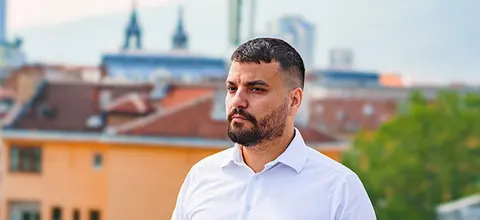
Boundaries
Ivaylo Hristov is the creator and co-owner of DEV.BG—the venture that lets software specialists keep their finger on the pulse, and find jobs too.
(More about him and from him—here.)
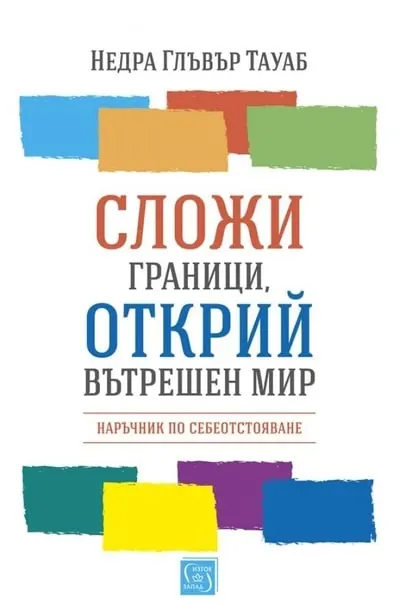 His book recommendation:
- Set Boundaries, Find Peace by Nedra Glover Tawwab
“Healthy boundaries. We all know we need them in order to achieve balance between personal and professional life, to deal with difficult people and to enjoy wonderful relationships with our romantic partners, family and friends,” the cover says. And about his recommendation Ivaylo says: “Lately I see an awful lot of people, especially men, who have problems with boundaries, and it affects them very, very badly. I'd definitely recommend this book to more people.”
And truly… it's so hard to set that boundary, as Ivaylo says, and even more so, I see it myself, for men. Meanwhile, the average life expectancy of men in Bulgaria is definitely a subject we need to talk about far more.
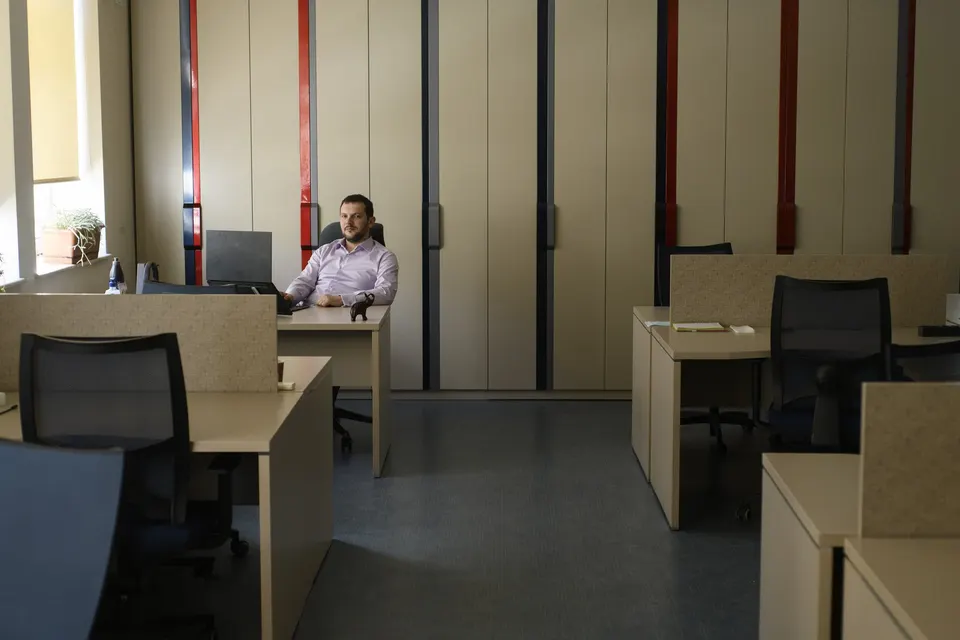
An Unexpected Combination
Viktor Botev is the chief technology officer of Iris.ai. The Norwegian-Bulgarian startup develops systems that apply artificial intelligence to processing large bodies of scientific data.
(More about him and from him—here.)
 His book recommendations:
- Hard to Be a God by the Strugatsky brothers
“My favorite book, which I read every now and then and keep rereading. I think it's quite relevant to our times, and to what awaits us with artificial intelligence :).”
- The Grand Design by Stephen Hawking
“It describes, in relatively human language, the idea of modeling the universe, multiverses and what physics is actually after.”
- Nexus by Yuval Noah Harari
“It presents the development of humanity and our understanding of the world around us through innovation and progress. It focuses on some of the risks of becoming the destroyers of ourselves.”
- Steve Jobs by Walter Isaacson
“It's not fiction but a biography, yet it's written beautifully. Full of lessons and vivid examples from the life of an extraordinary man who was, after all, a man with his own mistakes and flaws.”
Now that's a colorful palette—special thanks to Viktor too! And with the Strugatsky brothers, I've definitely found a kindred bookish spirit in him.
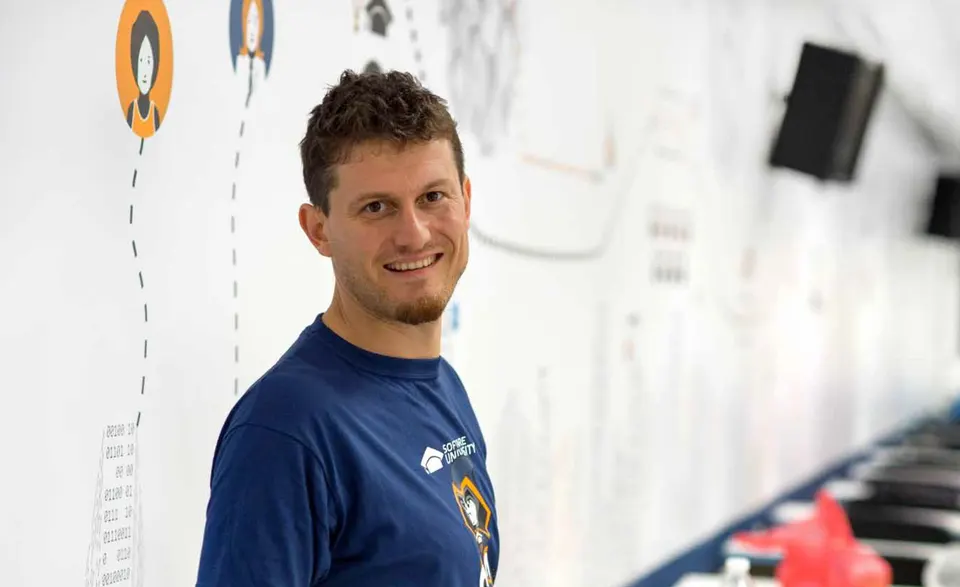
Don't Read, ChatGPT
Svetlin Nakov is the founder of SoftUni and one of the people who have changed the most not only my life, but the lives of thousands of Bulgarians who have turned to the software industry.

(More about him and from him—here.)
His book recommendations:
-
ChatGPT
-
Claude
-
Copilot
“I don't read any other books. My time goes to the kids and the family. I dream of reading my emails one day, but it's not going to happen.”
I've always loved Nakov's sense of humor; it certainly helped me a lot when I was watching his lessons, thanks to which I became a programmer. Here, though, besides making me smile, he also gave me an interesting idea for how to end today's experiment.
Stefan Stefanov FTW!
There haven't been many Bulgarian authors on the list so far, so why not ask my “friend” ChatGPT for three ideas in that direction?
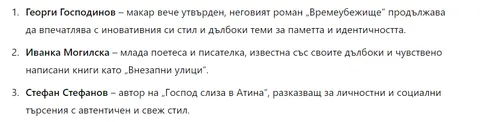
Oh, amusing and instructive. The first recommendation is clear and indisputable—it's no accident it's already on our reading list. The second… is by Ivanka Mogilska, whom I like very much and who has been a guest of Digital Stories! I haven't read this novel of hers; I'm adding it to my personal list.
The third idea, however… There's no such thing. A novel with that title was written by Alexander Sekulov, also a wonderful writer and my guest. As for who Stefan Stefanov is… I'll leave it to ChatGPT to explain that to the people who hold the rights to the book.
Bookish and Personal
You know, it isn't nice to do to others what you wouldn't want done to you. So before we part, here are three recommendations of my own. It's very hard for me to limit myself to that number, but you can find many more in my Goodreads profile. Still, the rules apply to everyone.
My book recommendations:
- The Little Prince by Antoine de Saint-Exupéry
I believe the world would definitely be a better place if everyone read and reread this slim little book every few years. And you'll find my more detailed explanation here.
- One Hundred Years of Solitude by Gabriel García Márquez
I don't think anything about this one can be explained. Either you sink into it and come out completely different, or you can't make it past the second page. But it's vital to try…
- Clean Code by Robert Martin
How on earth has Uncle Bob's software bible never been translated into Bulgarian?
Programmers are people too, right? Not only do they read, but reading can be useful in their work. So I'll give in to temptation and hand one of my spots to the book that has shaped me most as a software engineer.
Of course, there's no escaping fiction… I've written a novel myself, too, and a collection of digital stories.
What's more, thanks to Digital Stories I'm lucky enough to meet in person the authors who win me over. Whenever a Bulgarian book impresses me, I immediately invite the writer for an interview (and it has failed to work out with only one of them).
So, have you picked your next read? How can we change the fact that 40 percent of Bulgarians haven't read a single book in the past year, if we don't talk about books…
Did you find the experiment interesting? Would you like it to continue with other guests? You can reply to me or share an idea for the next Digital Story here.