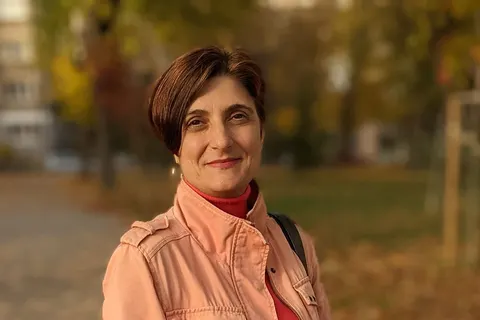
Kak se pishe? (How Do You Spell It?) is a website that has won itself enormous importance for life online. Its creator, Pavlina Varbanova, gives practical advice, on a volunteer basis, about spelling, grammar and punctuation in all their nuances.
We met a year ago to talk about the story of the venture and about the important questions of how we treat our language. Expected or not, that conversation, “How Do You Spell It?” “Idunno”, is still the most-read story on Digital Stories.
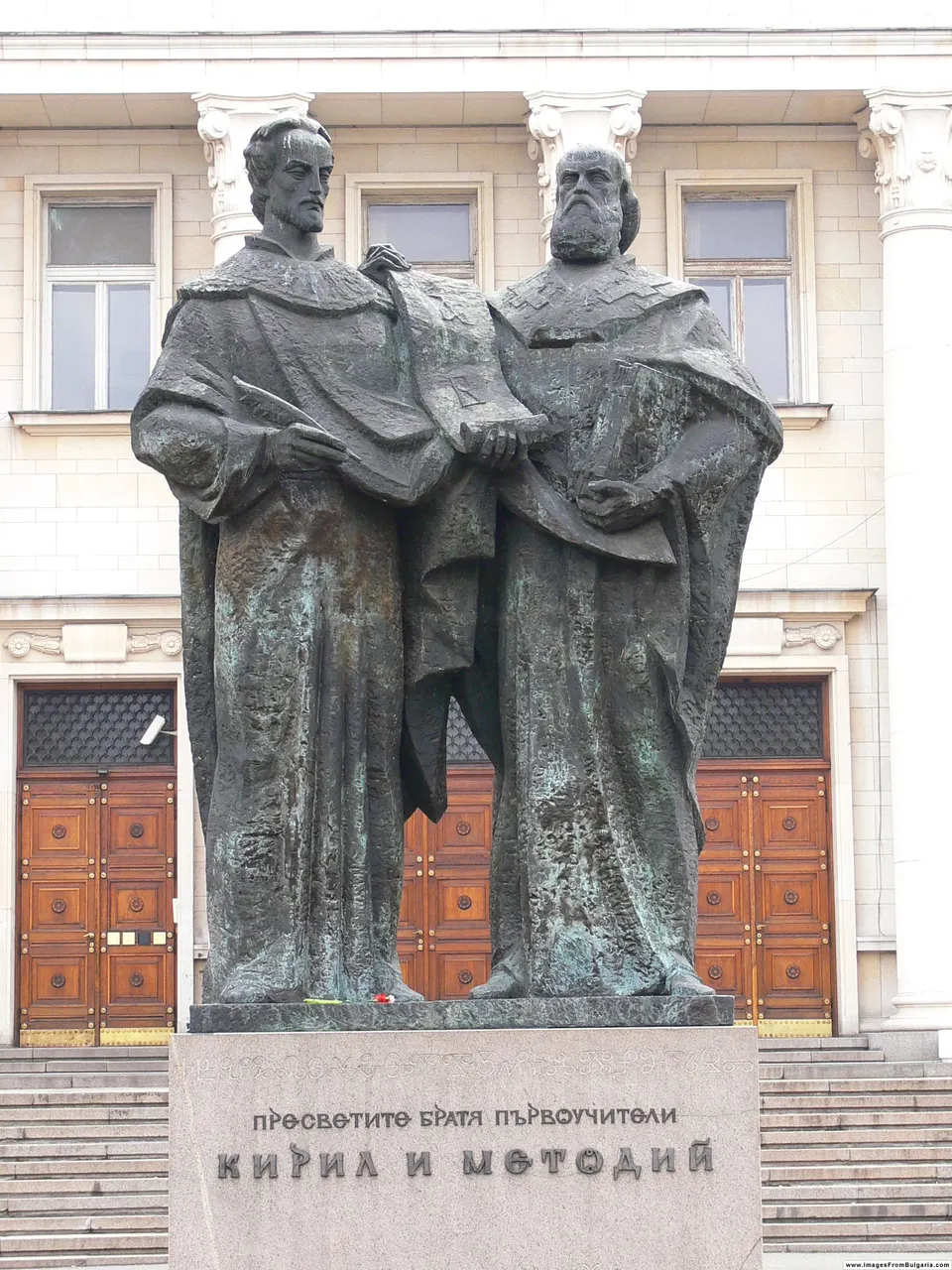
On the eve of May 24—the Day of Bulgarian Education and Culture and Slavonic Literature, when Bulgaria celebrates the Cyrillic alphabet and Saints Cyril and Methodius—we meet to continue. We will talk about the words that build us and about how we treat them. About the holiday, about the sometimes false pomp that accompanies it, and about an honest attitude toward language. About how words are a mirror of ourselves and of life. About the words we turn into weapons, and about the technologies that give them enormous power to destroy.
– What does May 24 mean to you? Do you celebrate it in any special way?
– It has always been hard for me to pin down what I feel on that day, because that is when people usually say pompous things about the Bulgarian language and utter grand words. It receives the kind of attention it lacks for the other 364 days of the year. The moment May 24 arrives, everyone suddenly remembers their beautiful native tongue.
That’s why I see a certain hypocrisy in those majestic speeches.
I rarely post anything on the Kak se pishe? Facebook page on May 24 itself, because I think it would sound clichéd. For me, love of a language is expressed in an honest attitude toward it. And in seeing it and accepting it as it is right now.
Let’s not forget that, after all, the main function of any language is communication; through language we talk to each other. Its secondary role and function is to be a mark of national belonging. My words will probably sound scandalous precisely in the context of May 24, but as I said, this is what love of one’s native language means to me—to look at it honestly and say frankly what you think of it.
– And what do you frankly think of it?
– It is the language in which I can best express my thoughts and feelings. I suppose every person has a language in which they feel at home, and if I had to make some kind of appeal on May 24, it would be:
Let’s use the Bulgarian language in a way that keeps us feeling cozy at home!
– Still, historically it is telling that such a day exists at all; I, at least, haven’t heard of an equivalent in other cultures. It’s no accident that there is a constant debate about whether it should become a national holiday…
– I see sense in that. But on the other hand, I’m afraid that a holiday that truly unites us all, such a bright date, would once again be exploited, soiled and trampled in the mud. Maybe that’s why I wouldn’t want it to become a national holiday.
We are specialists in desecrating what is sacred.
– Last time we talked about spelling and about the story of Kak se pishe? This time I’d like to talk about words. Do you have favorite words that are disappearing, that aren’t used so often anymore?
– Yes, recently I used the word „боравя“ (boravya, “to handle, to wield”), and I asked myself: how many young people today even know what it means? They probably don’t use it; it may already be slightly archaic, and most would say “make use of something.” But how many young people would know what it means if they heard it out of context?
– It definitely carries nuances, too. I wouldn’t say it’s a full synonym of “make use of.”
– I don’t think absolute synonyms exist—words always have their own nuances. But in many cases one word can be successfully replaced by another in a given context.
Sometimes I think about certain words we have started using in a distinctly English manner. “Literally,” for example. That word is used so often in Bulgarian, and not in its actual meaning. You can’t say “literally” and then use a word figuratively. In informal English, “literally” is used for emphasis, but in Bulgarian, at least in the standard language, we still shouldn’t use it that way.
Yesterday my husband was watching a football match on television. I was listening with half an ear, but I noticed that the commentator used the word “literally” in every third sentence. At one point I felt sick and said that if I heard “literally” one more time, I’d go to the other room. And my husband asked, “Will you literally go?”
Clearly it was a filler word in the commentator’s speech. Those are the words we have to watch out for, especially in speech. In writing, when we reread the text, we will probably notice that a certain word appears too often, but in speech our self-control has to be greater.
There is something else, too: English is much more tolerant of repetition, especially of pronouns—that is a grammatical necessity and there is no way around it. Whereas
Bulgarian is not so tolerant, and you have to be careful, especially with filler words.
– Why do we seem less inclined to coin new words today? My attention was recently drawn to this topic by an interview with the translator Rada Gankova, which provoked quite a few comments.
– I have thought about why, when some new concept enters the language and we need to name it, we use the English word instead of trying to forge a Bulgarian one. I can think of two reasons, though there are surely more. One is that
in our time new concepts flood in at a terrifying speed, and we don’t have time to invent so many words.
I would say new concepts appear every day. It takes time to think, to come up with Bulgarian words and to establish them gradually. It can’t happen in a day—launching them into the public sphere and having them accepted immediately.
Besides, we Bulgarians have always had a certain affinity for what is foreign and—I hope this doesn’t sound exaggerated—even a reverence for it. Perhaps it’s a matter of national psychology; perhaps it is also connected to the fact that for so many centuries we had no state of our own. But
we look at what is foreign as something better, something that will show us in a better light if we adopt it.
Let’s remember how, as far back as Krivorazbranata tsivilizatsia (Misunderstood Civilization), the 1871 comedy by Dobri Voynikov, Monsieur Margaridi spoke in “Frenchified” words while Anka and Madame Zlata imitated him. This is nothing new. Perhaps we believe that foreign words will practically elevate our speech, will make us look smarter, better informed, up to date.
There are languages—among the Slavic ones, Polish is one—that are more flexible, more open, and for them this capacity for self-renewal through creating new words is inherent. To Bulgarian, word-making seems somehow alien, especially today.
– In technology, at least, there is a third factor: communication is constantly conducted in English, and it is very hard to switch contexts between languages. For instance, the term стринг (string), meaning a text-type variable, has an exact Bulgarian translation—низ (niz). I have yet to meet a programmer who uses that word, even though it is logical and pleasant-sounding.
– Yes, that is also a very important factor. If, for example, a Bulgarian uses English most of the time at work, he will be inclined to use more English words when speaking his native language, especially on professional topics. It will simply be easier, and he won’t have to wonder, “Now how was that in Bulgarian?”
Our sense of language is built to make things easy for itself. As a rule, if you have a hard way and an easy way to do a job, you’ll choose the easy one. It’s the same with language.
– Proof of your second explanation, I think, is the fact that many Bulgarians living abroad speak with fewer loanwords and have a richer vocabulary, because they miss the language. They have a kind of reverence for Bulgarian.
– I think their self-control is much greater, too. I suppose that, living abroad, they realize how strong the influence of the foreign language is, and they make a deliberate effort to preserve their native one. Some time ago an acquaintance of mine who works in the European institutions told me that there is also the fear of falling behind the trends in contemporary Bulgarian. Because, being abroad, they don’t have such direct contact with the language.
– I really like your initiative to choose a word of the year. The whole world does it, and no one here had thought of it. What made you start?
– Precisely the lack of such a ranking in Bulgaria. For many years I wondered why we don’t have a “word of the year,” why such rankings exist for English, German and Spanish, while here there is no institution to take it on. Abroad it is usually done by specialists, by linguists at prestigious institutions. It was exactly that gap that made us—Doroteya Nikolova and me—get it started.
The same thing happened, by the way, with Kak se pishe?; that’s how the site began, too. Only there the absence was felt far more acutely. Because we can live without Words of the Year, but without a reliable site where you can check how a word is spelled or where a comma should go, it is harder to cope with your own writing.
I am very glad the media took an interest in Words of the Year. When an initiative like this appears, it stirs public curiosity. In my view, it is not only natural but necessary:
for society to see itself reflected in the words it has spoken most often during the year, because they say a great deal about what has happened,
and about how people make sense of it, what they have given more importance to.
– They are also a kind of signpost for the media—showing what really matters to people.
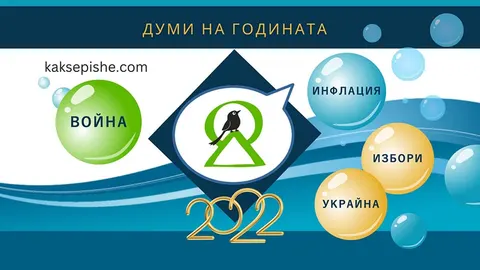
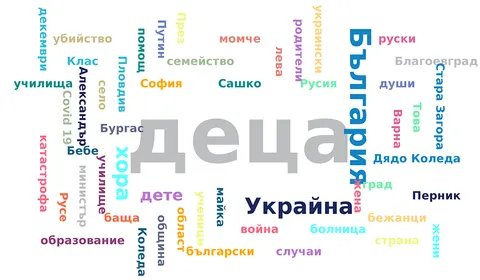
– This year we already had a partner in the media monitoring and analytics system Sensika. The company’s specialists processed an enormous body of texts published in 2022—more than 11 million—and presented us with a ranking of the words in the media. There was a large overlap with the people’s ranking, but differences too, of course.
– Which words surprised you by making it into that ranking?
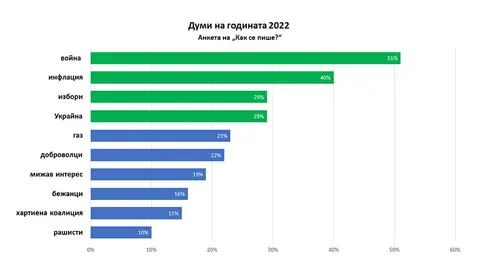
– I wouldn’t say I was surprised; the words that rose to the surface were the ones Doroteya and I expected from people—“war,” “inflation,” “elections,” “Ukraine”. Among the words most used in the media, for example, was “price” instead of “inflation,” meaning the topic of inflation was apparently presented through rising prices. Of course, the word’s high frequency in the media was also due to the fact that last year the price of natural gas and fuel was crucial for society and was accordingly widely discussed.
In fact, one word in the media ranking did surprise us—“child.” It made us wonder to what extent children truly represent a value, how important they are in our society, and how much the topic is abused. Because that, too, can happen in the media, as a way to attract attention. Articles are pushed out about problems involving children, and in this way they play on people’s sensitivities.
– And which words did you miss? Ones you hoped would appear in the ranking, but didn’t…
– I very much missed the positive words, although there were some after all—“help” and “support” turned out to be among the top fifteen in the media ranking, and that, of course, gave us hope. We have to keep in mind the broad meaning of words, though, because last year’s publications were often about military aid and support with weapons.
“Volunteers” was the positive word in the people’s ranking. That made us happy.
– But that, too, is proof that good things in our country don’t happen naturally—from Kak se pishe? to treatment for sick children, to planting trees and providing care for the elderly. Instead of institutions doing their job, volunteering leads the way…
– On the one hand, it’s good that people get involved, that they do something personally, giving their time, contributing even modest sums. But on the other, volunteers stand out, and we see how important they are precisely when someone else is absent, when someone else hasn’t done their job properly.
– Since you study language in the context of the media, I find the vocabulary they use extremely poor. They fall into templates, chase knee-jerk reactions, and consider that an advantage.
– Like any contemporary person, I also get my news about current events from the media. To be honest, what strikes me is not so much the writers’ comparatively modest vocabulary. What worries me more is the growing number of articles that are machine-translated, after which minimal effort is put into bringing those texts in line with standard Bulgarian.
And this isn’t only about foreign words. The lexical system is by nature very dynamic, and changes in it are the most visible. We worry a lot that more and more foreign words are entering our vocabulary and that we are using them more and more actively, but that is a natural process and not so threatening. That isn’t what erodes the foundations of a language.
The foundations of a language are eroded when morphology and syntax are affected.
Lately I see quite a few English syntactic patterns entering Bulgarian precisely by way of machine translation.
On the other hand, I think it is possible for a language to undergo enormous changes in its grammar—that is, in its morphology and syntax—and still keep its essence. Bulgarian is an eloquent example of exactly that. In the distant past it was synthetic, and now it is analytic. Put most simply, this has to do with the presence or absence of cases. Synthetic languages have cases, analytic ones don’t. In them, the relations between words in a sentence are expressed in other ways—through word order, through prepositions.
Bulgarian went through exactly that kind of cataclysm. It lost its case system, yet it went on being Bulgarian.
So it is possible for radical changes to occur in the grammatical system without the language losing its identity. I don’t see anything alarming for the moment, but I will simply note that while I used to say the grammar of the language was intact, now I am rather less certain.
– What’s interesting is that the great progress not only in machine translation but in artificial intelligence as a whole became possible precisely through language. Searching for patterns in it brought machine learning its breakthrough. Did you expect something like this?
– It was to be expected that machine translation would become this good and that artificial intelligence would achieve such results. What worries me most is the speed at which all this is happening. Because if it were slower and more gradual, we could adapt, we could limit the damage, which I think is inevitable. But it is happening faster than we can adapt so as to use both artificial intelligence and machine translation wisely.
– Yet when it comes to the written word, we are rather more conservative. For a long time now it has been possible to check our texts for basic errors automatically, but that doesn’t happen even in the media. Isn’t that a sign that new technologies aren’t adopted so quickly when words are concerned?
– I see that these technologies can be used skillfully. In the European institutions, for example, machine translation is used, but there it is in the hands of conscientious specialists who check both the original and the resulting text very carefully. It is inherently easy for something to slip into such a translation that even the translator may later miss. Say, some contextual meaning isn’t caught by the machine translator, and the person doesn’t notice the mistake. Or an idiom might be translated literally.
There are many dangers, many hidden reefs.
However qualified the translator, there are always risks in using machine translation, whereas with unmediated translation it is harder to make such a mistake.
– As always with technologies like these, it comes down to common sense.
– Yes, common sense is exactly what both machine translation and artificial intelligence lack. But
what worries me far more than the lack of common sense is the lack of sensitivity.
Artificial intelligence lacks humanity. It lacks the ability to put itself in someone else’s place—empathy. And when it falls into the hands of malicious people, they can wreak havoc, alas.
– And we ourselves increasingly lack that empathy in online communication, the ability to put ourselves in another’s place.
– Yes, because we meet face to face less and less often, which is when we truly
can exchange not only words but also gestures, smiles,
see the expression of the person opposite and tell from it whether they approve of what we have said, whether they agree with our position. We can adjust our behavior when we see how the other person reacts, adjust what we had intended to say.
I miss such face-to-face meetings very much, and lately, whenever I can, I meet in person with people I could otherwise just talk to on the phone or write to online.
As much as technologies make things easier for us, as much as they help us and save us time, they rob us just as much. They deprive us of that purely human contact, of the chance to feel directly the other person’s gaze, reaction, smile.
Yes, we can add a little smiley emoticon, but it’s standard.
Whereas a human smile has nuances. Yes, you might object that there are entire collections of emoticons, but even so they cannot convey the nuances of human feeling.
– I wouldn’t object at all. Besides, online, words are more and more often turning into weapons we throw at each other and fight with.
– Yes, that’s true. The algorithms of social networks, which amplify certain voices, are troubling as well. We have seen their consequences—Brexit and the election of Donald Trump as president of the United States. There is no doubt that these became possible to a large extent through targeted campaigns in which certain voters were bombarded and their decisions were influenced in an unnatural way.
Words are the weapon, and aided by social media algorithms, they can do great damage.
– Logically, these problems will become more frequent and more serious, since manipulation techniques keep improving.
– What troubles me is the absence of any countermeasures. I wish we could find some way to resist this. We can’t just stand by with our arms folded. But
I don’t know how artificial intelligence, in which I see a potentially great evil, can be reined in right now.
No reasonable person can be against the development of technology—but for the benefit of people, for their well-being.
– That is exactly why I created this site, and for two and a half years now I have kept looking for different perspectives on these big topics. Honestly, I didn’t imagine either that things I was writing as science fiction would be happening just two years later.
– It’s the speed that is alarming, and with it a person’s inability to adapt so quickly. Yes, we are adaptable, but not that quickly adaptable.
– I think the media are to blame as well, because they don’t cover these topics competently; they chase events and rely only on superficial or translated texts.
– We have long been in a vicious circle. Most media chase the topic of the day precisely because people expect to hear and read about the topic of the day. Clearly, negative news draws human attention like a magnet, while positive news—not so much.
– Why is it getting harder and harder for us to talk to each other? To find common ground, for words to bring us together? Different generations, different tastes, different worldviews…
– As for generations in particular, interests are very different. Topics are very different. Many older people aren’t up to speed with new technologies, and I think that keeps them from getting information from a variety of sources.
But we live in very complex relationships, and an enormous number of factors affect everything. It’s hard even to explain things with two or three reasons.
– While in online communication we try to be brief and extreme. That way both arguments and nuances get lost.
– They get lost, and we can’t take in the complexity of the picture. Yes, time always presses on us, and when the picture in a given field is very complex, you have to spend a tremendous amount of effort and explain endlessly to someone who isn’t a specialist. You have to burden them with details, and they have neither the time nor the chance to hear you out. They themselves need a simpler explanation so that they can at least get a general idea of the problem and perhaps of its solution.
This is where the role of experts becomes important. When I need to understand what the problem is in a given field, I turn to the opinion of a specialist I trust, because I have no other choice.
When we can’t inform ourselves and form an objective opinion on our own, we trust a person whose impartiality and objectivity we have come to be sure of.
– And if we come back to the media and the words in them, it’s a pity that the journalist’s expertise—as someone competent to assess and present information—is gone. It no longer matters at all, now that anyone can be a journalist, now that we journalists ourselves don’t see ourselves as anything different.
– It seems that many people now avoid the journalistic profession. Quite a few people of quality avoid working in this field, which demands truly great resources, intellectual capacity and, not least, conscientiousness. I understand them.
– So do I… unfortunately. Thank you for this conversation!