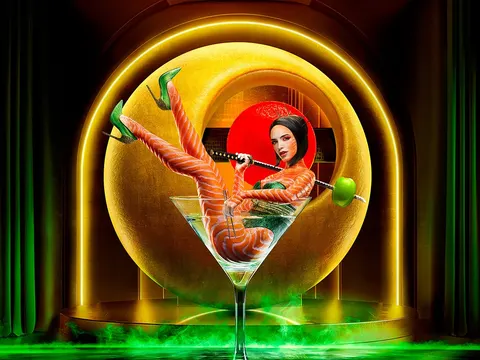
Have you ever seen chips that taste like shkembe chorba, the Bulgarian tripe soup, or like rakia, the fruit brandy every Bulgarian grandfather distills? Or a Lego set that builds the Alexander Nevsky Cathedral, Sofia's grandest church, or an old Zhiguli, the Soviet-made car that once filled Bulgarian roads? Can you picture Bulgarian celebrities in the game Mortal Kombat—Sancho, the sleepy hero of the bedtime cartoon every Bulgarian child grew up with, versus Danov, the early twentieth-century mystic and spiritual teacher, and Khan Kubrat, the seventh-century founder of Old Great Bulgaria, versus Gala, the TV host?
Well, no need to stretch your imagination: all of these ideas come to life thanks to the impressive collaboration between today's guest and the algorithms.
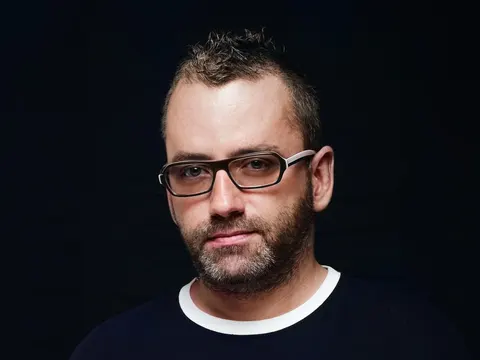
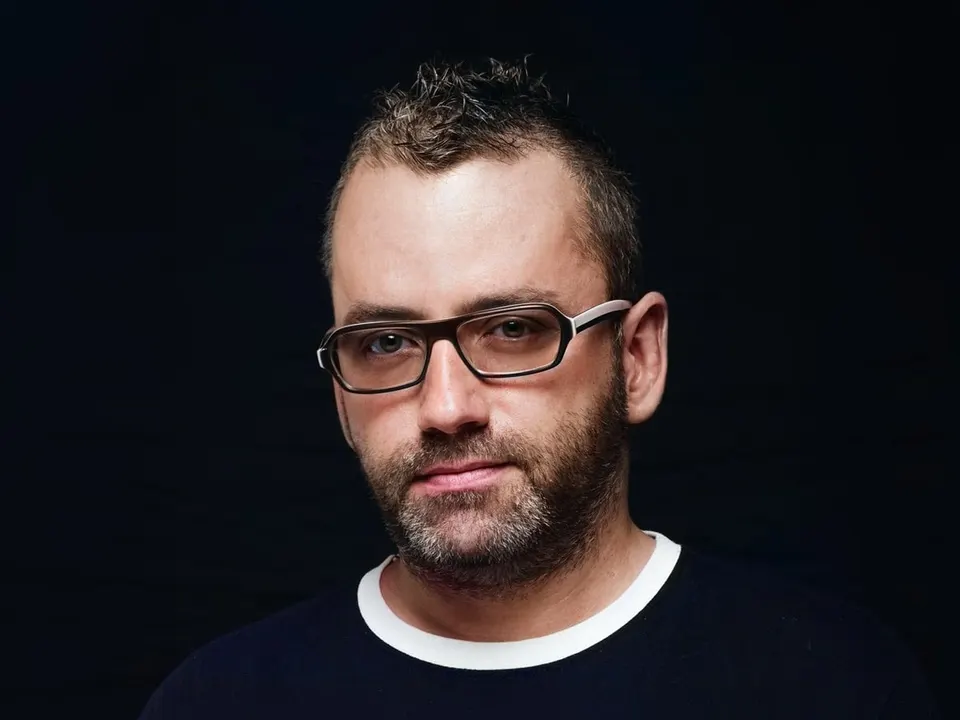
Rosen Dukov is a graphic designer with a remarkable track record. He has created the posters for some of the most popular Bulgarian films of recent years and designed covers for books that sit in every self-respecting library. He has won international Photoshop competitions several times, and it is no exaggeration to call him a world champion. In recent years he has been teaching these skills at SoftUni, the Software University in Sofia—design, photo editing and artificial intelligence alike.
Why isn't a visual artist afraid of competing with artificial intelligence? Why does he think it is important to get to know the new possibilities algorithms give us as soon as possible? What are the next original ideas he will use to show us how far generative models have come?
– How did you start using artificial intelligence to create images, and in design in general? Most of your colleagues, at least from what I've seen, avoid it…
– A few people I graduated from the High School of Fine Arts with even unfriended me
on social media. First I started building my own channel, PSHOW, where I try to gather useful information, in Bulgarian and in English, about how to work with Photoshop. It has always been my dream to have a channel where I pass on what I know, because Photoshop is a complicated program, and with the experience I've built up over 20 years I can make life easier for quite a lot of people.
Meanwhile, the boom happened. Apps like ChatGPT, DALL-E and Midjourney started coming out one after another, and at first they gave laughable results. But after just two or three months I began to see that, in big, very fast strides, the results were becoming satisfactory. I sensed that this was the next “big thing.”
I'm sure it is. I even think that
it is badly underestimated right now, with some people thinking it will come and go.
I also sensed where the potential was, where I could integrate it into my work specifically as a designer or in Photoshop, to automate a lot of processes and speed up my work.
– And then you went on with the channel AIHOW, where you provoke people with unexpected images and videos made with the help of the models… like the “Bulgarian Mortal Kombat.”
– If you know how to use it, AI is like any other tool, and at least for me, it helps.
It's useful for making working drafts, for giving me a basis for the text of a blog post.
How did “Mortal Kombat” come about? I had to make myself a base layer with the costumes, say from Midjourney, and then start layering the Bulgarian part on top—the face and the “joke.” That's what drives these experiments for me: there has to be something funny, something adapted for a Bulgarian audience.
Then I cloned my voice, made myself an avatar, and with the help of three or four tools I started making videos showing everything new that comes out in terms of apps and capabilities, and that happens extremely fast. In my view,
the people who are learning AI now, who are trying to integrate it, will reap big benefits in a year.
Because that's when the others will be starting, and those of us who already know how to use it and are interested in it will have a year's head start.
– But it looked that way a year ago too, and I don't get the sense that generative models are used all that widely…
– Things happen more slowly in Bulgaria. I taught an AI course for designers, and 150 people signed up—ten times fewer than for the Photoshop course. But among them were people who are genuinely excited about it and use it. I was also invited to an advertising agency to spend an hour and a half showing them what they can and can't do with AI. By the end, people were a little depressed.
“What are we going to do now?” Well, we'll adapt.
I think most people don't know what algorithms for video, sound and images are capable of. The new Photoshop has a fully integrated generative window where you don't need photos. We used to spend two or three hours searching stock images to find the exact angle for a composition, the right colors, and then it took more hours to collage those photos, to alter them so they looked good together, like a single picture… Now it's simple. As a colleague put it,
right now we're doing what clients ten years ago thought we were doing. We sit down, press a button, and design happens. That's what's going on.
It makes my work a lot easier, maybe because I've found some kind of golden mean. I'm an artist, a designer, and when I see something generated I know whether it's too close to the style of some famous artist, for example. I can judge in my head what's okay to use.
Soon we'll see this content generation—whether text, images, audio or video—become part of big applications.
Take GPT-4 Omni, for example. A few months ago I said this would be the next thing: a personalized assistant. There will still be Siri and Alexa, only now they'll be individualized, and depending on what you search for and what pages you visit, they'll adapt to you. It's a little scary, but…
– …but, to my mind at least, even more exciting. When I started this site three years ago, ideas like these sounded like science fiction, and then very quickly they stopped sounding that way. For instance, since most of my posts are on specialized topics, I used to use images from stock banks; now I go straight to Midjourney. Meanwhile, most people in the arts are afraid of this thing, or they dismiss it.
– I also think the image banks have had their day.
But let's not fool ourselves: on the other hand,
all of this is the biggest intellectual theft of the century.
These algorithms were trained without the authors' knowledge. Since there's no way to say exactly what percentage of what was used, I think we may end up with something like royalty payments.
Sora, for example, became possible because everything on YouTube was used. The creators at OpenAI were asked whether that's the case, and they didn't answer directly. That's why, in my view, most people in the arts are pulling back. Yes, it probably
can replace us to some extent as designers, but it can't replace us as creators.
However perfect the pictures are, they lack what every creator has. Whether we call it a “divine spark,” “talent,” “intuition” or “imagination.”
Generative models all work on the same principle: first they create noise, and from that they start filling in the picture. If you want to create something that wasn't in the database the model was fed, there's no way you'll get it.
– Almost all my guests from all sorts of fields think so. I disagree, though: I think algorithms can create works we might not be able to tell apart and might call creativity. It can create its own style by combining different styles. It can create an idea by combining ideas. And sometimes that's exactly what creativity is—compiling in our heads, consciously or not.
– I have colleagues who work with the big video game studios. One of them used Stable Diffusion to train his own AI to draw in his style. He fed it his own drawings, which I think is a wonderful idea—
you get an apprentice who does the dirty work for you.
Maybe the subject is still very unknown, inexplicable, and that's why some people are so reserved. We've given 30 years of our lives to build our own style, and suddenly it can be imitated.
I think we need to find common ground—to use human creativity in combination with technological progress. If we introduce clear norms and frameworks, there won't be a problem: it will save time and we'll do things much faster.
– But can there be frameworks? It's already very easy to run a model like that on your own computer and fine-tune it…
– I mean frameworks in the mind of the person operating it, more than anything. Not to create “in the style of so-and-so.” To guard against racial, gender and other discrimination, to be careful with sensitive topics. We're also witnessing
deepfakes, which I think could cause real trouble; they're becoming completely indistinguishable.
This year the boom was expected to be in video because of Sora, but it seems it will be in audio instead. It wasn't hard to clone your voice before, but now you can also sing beautifully. Ten dollars and you're a singer!
To some extent I'm on both sides. I assume some of my work, through platforms where I've uploaded a portfolio, has been fed into models. On the other hand, I've walked the path to building my own style and my own way of looking at things.
I have projects that have been waiting for 10 years. Back then I would have needed €500,000 to make a series; now it can be done with the work of just one other person for a week and almost no money!
– Won't that devalue all creative work? If everything suddenly becomes easy to make…
– I don't think so—it will make it more valuable. Generated texts, pictures and sounds will be used more and more widely. Maybe one day they'll become perfect, but right now they aren't. You can tell they're the work of a machine.
– You can't tell with everything. I ran a telling experiment showing that it's already almost impossible to distinguish what's generated…
– The bigger problem, in my view, is something else—that
people on the whole are lazy, they want information served up ready-made, they can't be bothered to learn new things.
They count on searching and finding, not on reading the whole story. We went through high school and university, and maybe that's what sets us apart: we have more information in our heads and our own perspective through which we refract every piece of information. So no matter how good you are, with algorithms you'll just make pictures that look good, but they won't be what a designer or a photographer would make.
The bigger problem, in my view, is where the world as a whole is heading.
– We keep handing more and more tasks to computers, they free up our time… and the question is what we do with that freed-up time.
– We'll have more and more time to do nothing. Or to sit around, watch movies, scroll social media. I see what's happening with those graduating now and with the generation before them. No standards, no values—it's sad, but that's how it is.
– Is there anything that would frighten you if you saw algorithms doing it?
– I don't see what could surprise or frighten me. First, I don't feel threatened as a professional, because I know AI will never do what I can do, not least because it has no imagination.
On the other hand, I see things happening super fast, and that can only mean one thing—that at some point the generated will become indistinguishable from reality.
That's my other theory: everything is happening so fast so that virtual reality can be integrated, so that people can be bombarded with ads through the headsets too.
– That's entirely possible… it's almost suspicious how the much-hyped metaverse has gone quiet lately. But if you read the comments under my articles, you'd conclude that we're just manipulating people, that artificial intelligence is a fabrication and nothing is actually happening.
– Let them think so. Except that online it's becoming ever clearer why, if something is free, you are the product. Most AI tools are very cheap; some, say, for Hollywood, are pricier.
But it's true that around me, too, most people just see something, are impressed and forget about it.
– When you create the “Bulgarian chips” and the Lego projects, how much of the images do you make and how much do the algorithms?
– It depends, it varies; broadly I try to keep it even. What matters most to me is experimenting. Obviously AI can make chips with different designs, but how would it handle tripe soup or tarator, the cold cucumber-and-yogurt soup? Since there's no way to describe them in English, it's 50:50 there. It depends on whether I can steer it toward something similar for some images—then I touch them up less. But in terms of design and framing, I get involved too. With the Lego I don't play around quite as much.
At first I swapped the faces, played around a bit… except on the Lego set for Sunny Beach, the Black Sea party resort—there they look like zombies anyway.
I decided to leave the images rawer so people could see what comes out—that there are some defects. It also depends on which tool you're working with. For realism, we know Midjourney is best; for more artistic and illustrative images I use Leonardo; for product shots, Copilot. I tell my colleagues too: it matters which tool you choose for what. We're gradually moving toward big platforms with rich interfaces.
– I picture it like Photoshop too, except instead of making masks you use ready-made functions. But either way you have to learn to explain what you want.
– Exactly—prompt engineering. You have to find a common language. If you write “a bear in the forest,” that's what you'll get, but if you add five more sentences it will bring in atmosphere, a point of view. Whether it's rainy or sunny, morning or evening. I think they still haven't told us everything you can do with Midjourney—they dole it out a spoonful at a time. You can play around a lot: say what camera and what lens, what focal length the photo should be taken with. In the end, what you get is as if you'd gone out and photographed the bear yourself.
– And here again the paradox is that to do it, you have to be a very good photographer or designer. It's the same in programming: to work effectively with the algorithms, you have to understand what you're doing and spot their mistakes. But because of these algorithms, it's harder today for young people to break in and learn the basics. Won't something similar happen in many fields?
– That, to me, is exactly the reason not to be afraid. Because if a person hasn't walked the path, they still won't know how to do something properly, even with the most perfect tools.
Everything is so easy now, if you have the will. You go on YouTube and in a few hours you learn the basics of perspective or anatomy, warm and cool, light and shadow. Or you can ask ChatGPT with a reverse search—you send it a photo and ask it for a description, to figure out exactly how it was made.
That thinking, human thinking…
Even if the tools for writing text, code, photos and video become perfect, everything will still depend on the people working with the machine.
– Is there anything you can't create visually right now and are waiting for the algorithms to help you with?
– I think we'll start “understanding each other” with fewer words. Right now, the more detailed the prompt, the better the results. Sometimes it doesn't understand exact keywords, and it works better indirectly—say you want an atmosphere of romance, a free style, a castle.
– Can algorithms create new forms of art?
– That's what it is, something new. This way of creating video or text is something completely different; there's no analogue among what we've known so far. But what's the difference? It has been given millions of images and will always be guided by the material it has. Whereas today this rain might inspire me to come up with something completely new. If I do it, it will be unique. Even if someone else photographed Sofia at this time, at the same hour, it won't be the same as if I did it.
The very fact that it can combine things, create a kind of eclecticism that is beautiful—that's an important task. I can't say it's art, but it's a new kind of logic for visualization. It will never be art…
– Won't it? With algorithms, too, all the photos of rain can be different, even unexpected. And they can generate lots of proposals from an idea…
– Yes, we stylize too, but with our brains. If you've studied art history, the styles of painters, their lives, and you paint and develop your own style, it's individual and unique for everyone. Generative models still resemble each other; you can see they're synthetic, unnatural.
Maybe that too will become indistinguishable, but that's my point of view. This technology interests me, and we're lucky to live in such interesting times. I follow what's happening, and when the tools get really good, I'll be able to finish all the projects I'm waiting on…
– All that's left is to wait for the moment when algorithms not only draw but make us rakia-flavored chips… or maybe the idea isn't all that great?! Let the readers decide. Thank you for the conversation!