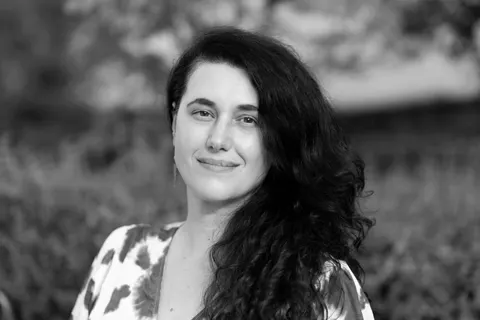
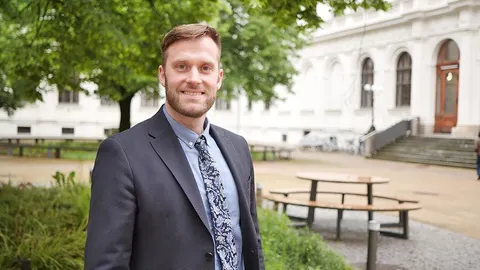
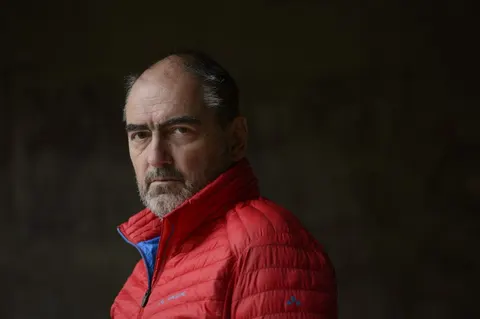
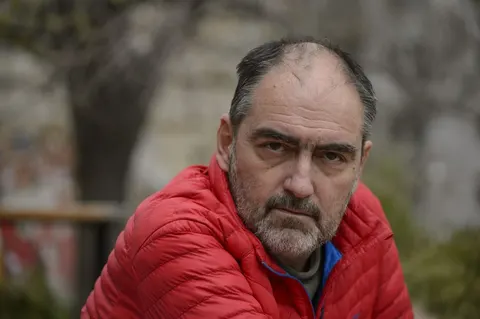
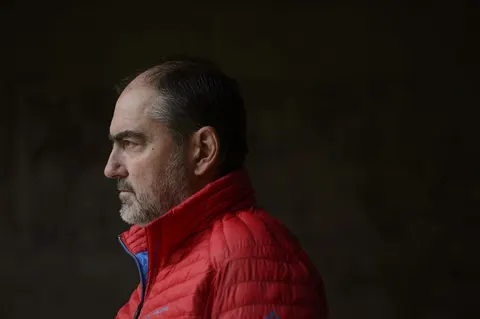
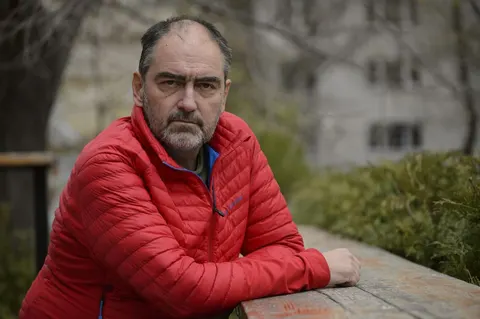
Dr. Slavyan Stoilov is a remarkable doctor and a highly unconventional man. As the physician on countless Alpine and other far-flung expeditions, he is responsible for the lives and health of his companions, sometimes in extreme conditions. As he puts it himself, he has occasionally had to treat a tooth with pliers and a hammer.
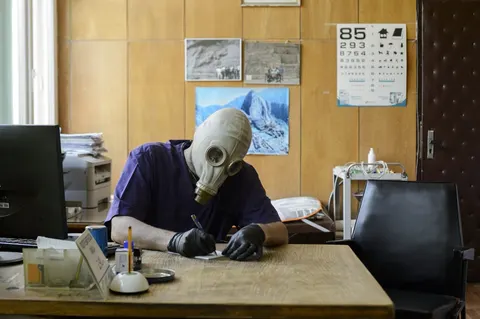
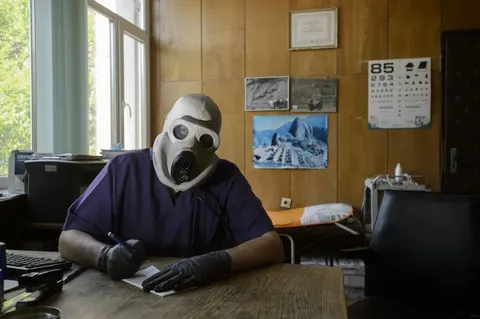
The rest of the time he is a general practitioner, and lines snake outside his office in a shabby diagnostic and consultation center, one of the state outpatient clinics in the capital, Sofia.
Dr. Stoilov studies ancient medical systems and is a fourth-generation doctor. Even so, he has a distinctive view of technology, about which he is far from always enthusiastic.
Is technology creating a new human species? Why do we Bulgarians keep dying at record rates, and can that change? How do we learn to look after our own health before it is too late? Why can Dr. Google sometimes turn out to be even deadlier than Dr. Mengele?
– Technology keeps advancing, yet in recent years our country has had record mortality. We are shrinking, and average life expectancy has started going down too. Why is that? Is it people who don't look after their health, or the system that doesn't?
– The state of our nation's health is heartbreaking. Yes, there were two years of pandemic, but other problems were neglected as well. Many people died because we didn't take care of them—we simply had no way to. The indirect victims of COVID far outnumber the reported ones.
But these trends were there before the pandemic too. It isn't like this in the rest of the Balkan Peninsula, but
we are extraordinarily ignorant and careless about our own health.
You can't have a kidney hurting for three months and then call on a Sunday at midnight. You can't have high blood sugar for ten years and only think to ask what to do once you start going blind.
Extraordinary ignorance and negligence—that's what we see every day. People who care mostly about eating their fill. But that only lasts so long, and then I move on to my “favorite” hobby—restoration. I tell them straight out: “Thank you for coming to my office, now I will begin my work as a restorer.” By then, though, it's too late.
– Where does this ignorance come from? After all, we have more access to information than ever, and there are constant awareness campaigns. On top of that, unlike in Western Europe, here you can get to see a doctor the very same day…
– The ignorance is heartbreaking. For the past 20 or 30 years there have been no courses, no methods, nowhere you can be taught by someone who knows what they're talking about. Even though we cost 1 lev—about 50 euro cents—and for some people we're free, most Bulgarians prefer Dr. Google. When I was a kid, one of my favorite films was about Dr. Giggles, a nastier version of Dr. Mengele. Well, sometimes Dr. Google is even deadlier.
There's no culture of caring for your own body and soul, and that has to start being built in the family and at school. Knowledge of how to behave in a critical situation is woefully, heartbreakingly poor.
So it depends on us, the people—not on us, the doctors.
– Then again, among doctors there are some who aren't even at Dr. Google's level.
– That's beyond question. If I had serious health problems, I'd turn to my fellow students and classmates who left Bulgaria long ago.
That's the system. At 50 euro cents a person, what motive do you have to give them a lecture?
And in plain language they'll understand, at that… A checkup covered by the health fund lasts 15 minutes—where do you even start? You have no motive to do it, the pay is the same whether you just write them a prescription for one pill without talking to them, as most young colleagues do, or sit down and explain what's going on… I'm probably some kind of romantic, but not only is my romanticism of no use to anyone, my income is 40 percent lower because of it.
– Yes, but I've witnessed you save people's lives with words like these.
– That only works if the person in front of you is intelligent and understands what you're talking about. Most people aren't that educated, aren't that intelligent—they need far more time. They have to come to believe you.
Young people, for instance, are very scattered. They can't follow an algorithm. One comes in and says, “Give me a pill!” But the problem isn't the pill—the pill treats the effect, and we have to treat the cause. They have no idea what we're talking about. For decades in Bulgaria
the word “prevention” was forgotten, then forbidden, and now it is utterly misunderstood.
– True, sometimes we're all looking for a pill…
– That's what Western man does. If it's any consolation, in the Far East they now want to be like Western man too, and they long ago stopped following the principles they had been taught for thousands of years. The ancient East started from the cause. The Chinese physicians of old who healed with acupuncture and acupressure, the ones we click our tongues at in admiration, were seen by their colleagues as mere craftsmen, as
weak doctors, because they had allowed their patient to fall ill and need treatment.
– Isn't the way we undervalue our health a contradiction of the survival instinct?
– People are afraid to accept the truth. When a person comes to me, I have to tell him what the problem is, and he's afraid to face that problem. We have a saying: “fight your fears.” But
we can no longer be bothered to face the problems that concern us.
We want someone else to solve them, it's easier that way. We don't want to take responsibility. Years ago I used to try to explain this.
If you don't respect yourself, you will always be ill.
If you don't respect yourself, you don't take care of yourself either. It's a kind of selfishness, but it's a matter of survival—every animal does it. You need to respect yourself, and instead you show up like a lump of offal because you never paid yourself any attention. That means you see yourself as a sack for food, nothing more. You don't see yourself as something that deserves respect and attention. You have no individuality, no strength. That's a huge problem.
– To some extent, we owe it to technology that we've turned out unprepared for the world we live in. It still has pandemics and wars, and we're already spoiled by comfort and not ready for such dramatic events.
– It depends, everything is yin and yang. Just as there are plenty of softies, there are other people trying to compensate—the pendulum can't stay on one side. That's why today there are also more extremists, in every sense. On one side are the people who can't be bothered to get up from their chair, on the other are those who keep inventing new, ever more extreme sports. Often they don't know why they do it, but really it's for themselves. Whether you gamble, drink, or practice an extreme sport, the biophysical and biochemical link is the same.
That's our nature. As the number of the lazy and the weak-willed grows, it gets compensated. The others are fewer, and so it comes to ever more radical extremes.
Social networks turn us into zombies. Then again, that saves the intelligence services a lot of money.
There are ideas that technology will create a new kind of human, and most likely we're already seeing them.
– Many scientists talk about this. For example, because of the new way we take in information, the way we concentrate. And maybe it's already changing us physiologically too—from sitting so much, from spending so much time in front of screens…
– Yes, humans aren't built to do that all day. And since our bodies aren't prepared for it, changes begin. Technology outpaces biological change—that's normal, technically we've always been ahead of our physical development. At the same time, this change works mostly on intellectual strain. The intellect races ahead, and physiology can't catch up, because it has laws of its own.
The body will lag further and further behind, and that will bring more and more diseases.
That has to be compensated somehow, and young people do it, mostly with chemical solutions, so they can feel energetic, strong, productive, potent.
Technology has changed a great deal. I was one of the first people in my neighborhood to have a cell phone. Not so long ago we walked around with mobiles with little antennas, and there wasn't coverage everywhere. Now we have 5G, it's changing us, and you communicate with people like that in a completely different way.
– How will physiology catch up?
– I don't know whether it will manage, a pace of development like this is beyond its capabilities. Following certain fashionable trends, there's the idea of giving it an artificial helping hand, some circles already want to, but
this is a very dangerous experiment.
People already talk boldly about these things—we'll put in two or three chips here, a few more over there. And the body, skipping all the variants of normal development, will become brand new, more stable.
– Maybe that's the natural course of development?
– Maybe it is, but we'll only be able to say so after many years, after one or two generations. Today we don't know what will happen in 10, 20 or 30 years. Cologne Cathedral took seven centuries to build. Gaudí, who began the Sagrada Família, had an idea of how it would turn out, but he didn't live to see the result.
It's the same with us. We'll start intervening with substances or microchips, but we don't know what it will lead to. We'll change some people, and in 20 years or a century the effect may turn out to be the opposite of what we expected.
I had a professor who was already very old when he lectured to me. The subject of his life's work was the secret of programmed cell death. Cells have an automatic program that at some point switches on and kills them. His dream was to find the code of that program, stop cells from dying, and live forever. He didn't succeed.
Someone may succeed, but what happens if we end up with an immortal ruler who is evil? That's what the Bible says too—the Antichrist will come with good intentions…
– What are the biological consequences of spending more time in front of a screen than you need to?
– Everyone will tell you it damages your eyes. That's not so—it damages part of the brain, whether or not you have glasses, filters, a modern screen. The reflex of blinking and moving your eyes is subconscious. When you stare fixedly, you don't blink and don't move your head, and that leads to problems with the brain's visual center. That's how you get a condition Germany recognized long ago—computer headache.
Let's keep going down. The ancients were very insistent that you sit correctly; we sit completely wrong, and that changes everything. The spine is the only thing holding us up against gravity. The moment that axis starts to go out of line, it automatically throws the body off balance, physiologically and biologically. Joints and muscles lose their elasticity, the skin of the legs changes, when the legs don't move you get venous stasis… I could go on for hours.
– So when does it become a problem? Where is the line?
– When you don't compensate for all of this with something else. I've traveled a lot, and some of the most passionate hikers and extreme climbers are programmers. Subconsciously they want to make up for what they lack, and they do it brilliantly. In fact, when I see someone very good in the mountains, I immediately ask whether they're a programmer.
– Still, that doesn't apply to most people.
– That's why we're different people—some understand what it's all about, and others don't. In the western parts of the country we have a wonderful word for such people—тулуп (tulup, roughly a dull, inert lump of a man). It can't be translated into another language, or even into standard Bulgarian. The others become tulups. They'll take medication their whole lives, but those lives won't be very long, because everything falls into total stagnation. Physiology, anatomy, sex life.
When all is said and done, a human being is not just a head.
– Is there really no way our health system can start working?
– Since this morning I've had huge problems with the idiocy of what you call a system. I can't work, I can't examine people the way I was taught, the way my father, my grandfather and my great-grandfather were. We have terrible problems caused by ill-conceived things, by rules made by people who have never seen a living patient. There is no system, and I don't see who could fix this. Enormous interests and a lot of money are at play here.
– Has technology ever saved you in a tense situation?
– If crampons, an ice ax and a rope count as technology… Or my own head.
Otherwise, I once witnessed a very interesting situation—a man over 1.90 meters tall and 115 kilos burst into tears like a little kid in the forest because his GPS battery died. He didn't know how to find his way with a map, he'd never seen it done. He sat down on a tuft of grass and started bawling: “That's it, we're lost, this is the end.” Nothing of the sort, I led him out to the road.
After all, I told him, we get lost so that we can find ourselves again.
The poor guy started hugging and kissing me.
There's technology and then there's technology. Long ago the Arabs sailed every sea with astrolabes. I've tried to understand how that thing works, and I can't.
Modern technology in hiking and mountaineering is extremely useful—I have wonderful gear I've collected over the years, new fabrics, new kinds of boots. But Everest was climbed without any of that.
– If we keep children away from technology today, aren't we turning them into outsiders? What's the right approach?
– I've seen cases like that. Let's call them “bio-parents.” For years they kept their children without internet at home and didn't get them phones, so they wouldn't get used to them, and when the kids went to school, they were complete outsiders for years, and the others mocked them. That extreme can't survive in this society either.
– Again, it's about finding the balance.
– That's exactly what being a parent means. Taking responsibility. Not like that woman who didn't want to treat her child's worms because she would be killing them.
Who teaches children to wash their hands? Those Westerners didn't know what washing your hands was, so with the pandemic they had to be taught that it's good to do it now and then. And to bathe.
We need to step into our role as parents. School and society can't replace parents—better that you teach your child to swear than that the street does. And that you explain certain things to them before someone explains them another way.
– What motivates you personally to keep learning—both about modern technology and about ancient medical systems?
– If I don't read at least one medical research paper, or something related to medicine, in some language, I don't consider the day normal.
Remarkable things keep appearing in medicine, a new generation of equipment and technology, things are moving extremely fast. One of my professors used to say that the information in the world of medicine is 50 percent renewed every four years! What you learned as a student hasn't been true for a long time.
As one of my teachers used to say, my goal is not to give you knowledge, but to teach you to look for it. Most of my colleagues are already old. To read, first you need to have technology. And much more than that:
you must seek out information, not let it seek you out.
Otherwise you've lost the war.
We have to live in the present every day, knowing the past and anticipating the future. And let's hope it does come after all…