“Despite the undeniable conveniences the internet offers, the virtual connection it establishes between people is fictitious, while the way it cuts us off from our actual neighbor or acquaintance is real and harmful.”
A mercilessly accurate description of our days now, shut away in Facebook, Slack and Zoom for a year already, isn't it? This is an old Digital Story that reads as if it were written today.
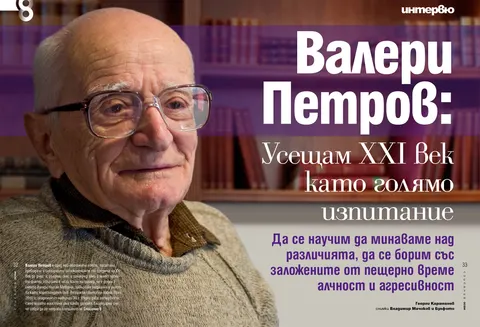
Exactly 10 years ago, on March 8, 2011, issue 3/2011 of Spisanie 8, the Bulgarian monthly 8 Magazine, published one of Valeri Petrov's last in-depth interviews, and I had the good fortune to be the one asking the questions. Three years before the greatest friend of the word in our time passed away. And thanks to the digital, we can revisit together this interview with the master of language, because his words sound remarkably timely.
Valeri Petrov (1920–2014) is the unforgettable poet, the translator of Shakespeare, the author of Pet prikazki (Five Fairy Tales). And for me personally, one of the greatest authorities when it comes to elegant language, to morality, to stories. To the strength not to surrender to circumstance or fashion.
I thought it would be like any other interview, even if with a man who did not like giving them at all. You go, you chat, you get the words down on the screen, clean them up and publish. But what a disappointment. It turned out he didn't give interviews like that, only in writing. Today that's common—you send the questions by email, the answers come back. “What do you think about…” “I think that…” A dialogue broken up by the network, often losing the connection along the way.
This dialogue, though, came precisely by email. Valeri Petrov was 92 at the time, and I don't think I've ever received an email from anyone that age, before or since.
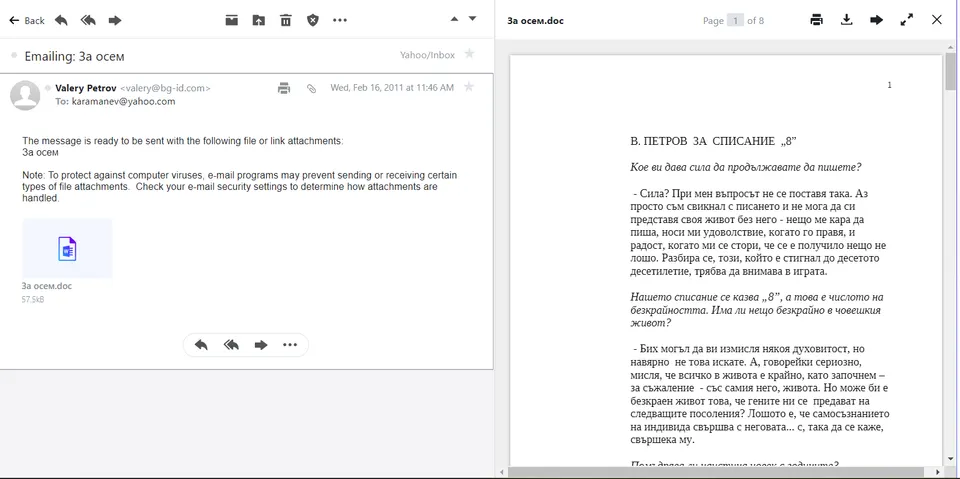
Just in time, right before the issue went out. I read the interview I had supposedly “taken.” Yes, the questions were mine, and it was as if we had met. There was nothing to touch except to add a headline—everything was polished to such a degree. Probably more literature than journalism. And still, there were my questions and Valeri Petrov's answers!
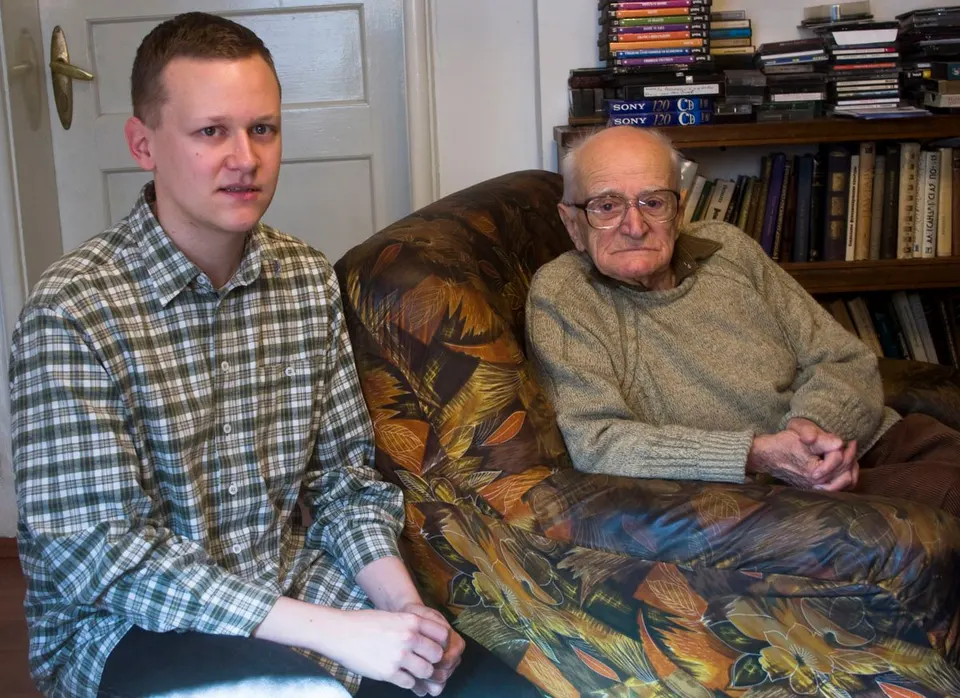
A week after the issue came out, I went to bring him a few copies of the magazine at his cozy attic apartment at 8 Elin Pelin Street, in the quiet depths of old Lozenets, one of Sofia's leafy older neighborhoods. And that's when I was lucky enough to truly talk with him. I was both sorry and lucky that I hadn't brought my voice recorder, because conversations have one kind of value when they are recorded and another when they are fleeting. Again delicate, calm, trying to give his opinion without imposing it, just like in the words below. Valeri Petrov observed rather than criticized that we are too easily led by the visual and the flashy, at the expense of the word.
Manuscripts don't burn; what is written remains, even on the internet. That is why I want to remind you of the interview I didn't take but whose answers I received over the network, from one of the few people who became undisputed authorities, passing through the turbulent times of the 20th and 21st centuries. One who remained among the last masters of elegant language. Whose words move you the way his poems do.
March 8, 2011, Spisanie 8:
– Mr. Petrov, what gives you the strength to keep writing?
– Strength? For me the question isn't put that way. I'm simply used to writing and can't imagine my life without it. Something makes me write, it gives me pleasure when I do it, and joy when it seems to me that something not bad has come out. Of course, someone who has reached his tenth decade has to watch his step in the game.
– Our magazine is called “8,” and that is the number of infinity. Is there anything infinite in human life?
– I could come up with some witticism for you, but that's probably not what you want. Speaking seriously, I think that
everything in life is finite, starting—unfortunately—with life itself.
But perhaps the fact that our genes are passed on to the next generations is a kind of infinite life? The bad thing is that the individual's self-awareness ends with his… with, so to speak, his ending.
– Does a person really grow wiser with the years?
– I'm not sure. Over the years he accumulates experience, but toward the end the reverse process often begins… let's not even say its name. Besides, in terms of intellect, people aren't equal at the start. The French have a saying: “Beauty lasts only so long; stupidity is forever.” I'm not talking about myself, of course, but I remember once, in connection with something that had happened in the past, I asked myself: “What on earth were you thinking when you did that?” And I answered: “With your own head, the very same one with which you could commit a no lesser new folly today.”
But jokes aside, as is well known,
an old man always has the feeling that he can advise the young, teach them something, but perhaps this feeling is deceptive, because they live in a different, new world in which he is a foreigner.
In any case, none of this matters much in practice—the young people in question don't listen to us at all. It's like proverbs—what are they, if not the attempt of generations to pass the lessons they received from life on to those who come after them? A failed attempt, because we learn the saying, we even quote it left and right, but we have to land in the very situation it describes before we grasp what it was telling us.
– Many people claim that rhyme and traditional versification are outdated, yet you remain faithful to them. Why?
– First, I think that—at least here in Bulgaria—this is probably only the feeling of some young poets and young poetry lovers, and that there are many more who dislike the disintegration of form in poetry, especially when it goes hand in hand with incomprehensibility, mannerism and plain laziness, as it often does. What's more, I think that readers' growing retreat from poetry has been caused to no small degree precisely by the destruction of classical verse, practiced for a long time in the West and recently here too. Need I say that all this is connected with the global spiritual crisis humanity is going through today?
But understand me correctly: naturally, poetry has been made, and can successfully be made, both one way and the other. I personally have been bound to traditional form since my debut; I simply don't know how to write otherwise, and besides,
I think modernity lies not in renouncing rhyme, but somewhere else entirely…
– You are one of the few people of your generation who work with a computer and the internet. What keeps older people from getting used to new technologies?
– I think what holds us back above all is age. I'm also only in kindergarten when it comes to the new literacy, and I keep calling my grandson for help, because a week's work has hidden itself in the magic box and I can't get it out. But the other thing that holds us back is probably the feeling of “what's the point at my age!”—and also the conviction, gained from secondhand testimony, that the internet does people no good.
I confess that I, too, am convinced that despite the undeniable conveniences it offers, the virtual connection it establishes between people is fictitious, while
the way it cuts us off from our actual neighbor or acquaintance is real and harmful.
This net doesn't connect us; it catches us and cuts us off from the real world with its real problems. But that is another, very big subject we don't have time for, because it would cover TV series, entertainment shows, “best-selling” literature, thrillers and killers, and generally the air we breathe.
– But people still have to be optimists, don't they? Where can we find the strength to move forward?
– I think the word “optimism” is a synonym for “vitality.” That strength isn't something you go looking for and find—like any other trait of character, you either have it or you don't. But one must make an effort to overcome whatever gloom one may have fallen into. If one succeeds, that will mean one is endowed with vitality. You see, what a great scholastic I am, eh?
Scholasticism aside, though,
I think a writer, even in hard times for society, must seek, for himself and for those who read him, a spark of faith in the victory of good.
– Along those lines, why is it important to preserve the child within us? How can we do it?
– That isn't something you can force. I think everyone, to one degree or another, keeps memories of childhood and something of a child's view of the world. I personally have a bad memory and few such memories, but something of the child's way of seeing seems to have survived in me, because when I look back at what I've written over the years, I see that images of kids flicker through it very often. I won't say “little ones,” because I'm sick of that word from its constant use in the press.
– Almost everyone who has had the chance has caught the thirst for fame and pursued it. You, on the contrary, have always shied away from it. How do you manage to guard yourself against that temptation?
– I'll answer with a story told about our great actor Konstantin Kisimov. After a tour of our National Theatre in Romania, someone asked him: “Hey, old Kosta, is it true that the beauties of Bucharest crowded in front of your hotel room?” And he replied: “Well, it ain't true, but you go on and tell it!” Such is my case too. What you say about me “ain't” quite true, though it flatters me. A person in the arts cannot escape the desire, if not for fame, then at least for recognition. What's more, it's actually not a temptation but one of our incentives to write, paint and so on. Not the main one. The main one is that you want to work, that your hands itch—in our case—for the pen or the keyboard.
But before the artist there are two paths, two ways of fulfilling oneself—
one is that of noisy self-promotion, the other that of diligent work and respect for art.
I personally have followed the principle “It will become clear in time.”
Lately, however, the criteria in our cultural life have become so muddled, the role of opportunism, advertising and politics in it has grown so much, and the good audience has thinned out so much, that I don't envy the gifted people who are only now entering the world of our culture.
– For almost a century you have watched our country, and the whole globe, change. Where are we heading? How do you imagine the society of the future—could it be more socially just?
– Your question puts me in a difficult spot—I just said that we shouldn't spread our bad moods, and we also postponed the subject of cultural globalization. But what can I do—I have the feeling that humanity is going through such a total crisis—ecological, economic, political, social, spiritual—as it has perhaps never had to overcome even once in the course of its entire history. I think I've noted elsewhere too
the frequent use lately of the word “survival”—clearly we aren't very sure the human race will survive. We must grow wiser, and the sooner the better.
We must learn to rise above differences of every kind, to fight the greed and aggression planted in us since cave times, which I believe lie at the root of everything. I feel our century to be the great test for Man, who has rather presumptuously called himself “knowing, wise.”
And you ask whether the future society should be more socially just. In my opinion your phrasing is too weak.
It must be not only more socially just, but entirely different, new, more humane and worthy of Man. Now then, at that point we could stop history!
I'm joking, of course; history can't stop, except—heaven forbid!—for ecological or astronomical reasons. But thinking within the limits of our foreseeable times, they try in vain to convince us that what we have may indeed be imperfect, but nothing better could be devised. Is that so? You call the horrors amid which the world lives imperfections? And so, because the Berlin Wall fell and so forth, we should stop thinking about a better arrangement of life on this planet, should silence within ourselves the anger against evil and the dream of justice that humanity has cherished for as long as it can remember?… Forgive me, I got carried away, and that “cherished” proves it.
– Will the book endure? What feeds the unrequited love for the television set that has been so widespread in recent decades?
– The main reason children get hooked on television is, I think, that it's easier to watch and listen to a ready-made fairy tale than to spell it out syllable by syllable in a book. It's probably the same with adults, but in both cases, it seems, the magnetic power of the small screen also plays a role.
As for whether the book will endure—I can't prophesy with certainty. I see it making efforts not to perish. And I hope it succeeds, but of course it is extremely important what thoughts and feelings both “media”—the book and the screens, small and big—will bring to people. And especially the small one, which turned out to be bigger than its big brother. Because
if the book must pay for its life at the price of good content, that too will be death.
But the bitter things I could say on this subject are well known to you and to your readers. I'll only express my general feeling: it is sad that in the society we live in, the power of money quickly turns the great conquests of human thought into instruments for piling up profits… I've put it badly, incompletely. In fact, the thirst for profit not only is the first to use the new achievements of science, but before that it actually gives birth to them, because it has come to need them… It takes over the realization of these human dreams altogether, diverts it—a paradox!—from its lofty aims and turns it against humanity.
Can you imagine—the wonderful products of the human brain being used for its own intellectual dumbing-down and moral degradation! What new Jules Verne could have foreseen in the last century that the magic ball for “far-seeing”—that fabulous flight of Eastern fantasy!—would become a megaphone for idiotic commercials! And that the role of the news, or of entertaining and cultural programs on TV, would be reduced almost to that of bait on the hook of commerce! Or that, with all its potential to be a “home school,” television would become a powerful breeding ground for violence and pornography! And this is only one facet of the whole “state of the situation.” Where did Zweig's peaceful world of yesterday go, Chekhov's gentle world!
We are all like the children we spoke about, and we don't notice what is happening around us and inside ourselves…
You aptly call our love for television “unrequited”—it doesn't love us, it is no friend of ours, and it brings to mind the Latin saying “I fear the Danaans even when they bring gifts”…
Forgive me for this second release of emotion… On the whole, I have the feeling I answered your questions at too great a length—I hope we haven't bored the readers! What do you say?