We often mention George Orwell and Aldous Huxley. And rightly so! The possible dystopian worlds we thought had stayed behind in the 20th century have returned as a theme, as a threat.
This writer inspired them both. His only novel is a dystopia, no less thought-provoking and illuminating than those of the two classics. Because it looks not so much at a possible totalitarianism come true as in a direction that is even more relevant today.
Yevgeny Zamyatin’s We is a brilliant novel because it offers a glimpse of a future in which technology has defeated humanity. It has locked people in its mathematical grip, turned them into numbers, into tools. It is one of the most powerful metaphors for what may be coming, and something worth talking about more and more. Technology sets the rules, and we have become the meaningless parts of a harsh mechanism…
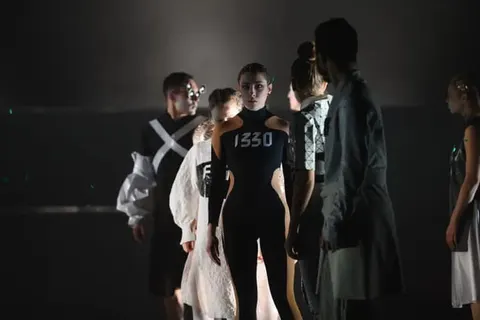
The Ship with Scarlet Sails
Real literature can exist only where it is created not by diligent and well-meaning clerks, but by madmen, heretics, hermits, dreamers, rebels, skeptics. And if a writer must be sensible, must be orthodox, must be, as today, useful… then literature has no meaning, it is just paper you read today and tomorrow use to wrap soap in at the shop.
(The quote is from the essay “I Am Afraid.” All other quotes in italics are from We, in the Bulgarian translation by Rositsa Bardarska.)
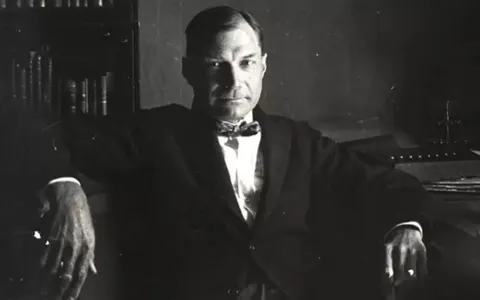
No less remarkable is the story of the author himself. A shipbuilder by profession and an accidental witness to what happened aboard the Battleship Potemkin, he wrote a letter to Stalin in which, once again, he peered into the dark future. And although he managed to leave his homeland in those bloodthirsty times, he never stopped missing it until his last day.
Yevgeny Zamyatin is a fascinating figure whose words are worth recalling today. When war, dictatorship and the clash of civilizations are returning with what seems their eternal historical weight. Now joined, however, by the incredible rise of technology and the dangers it brings.
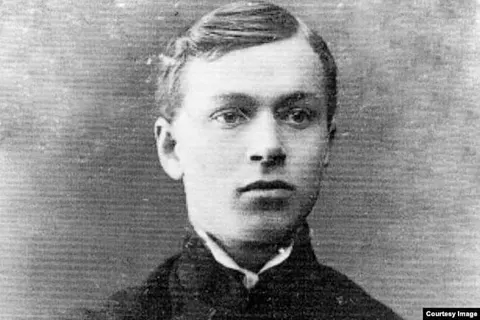
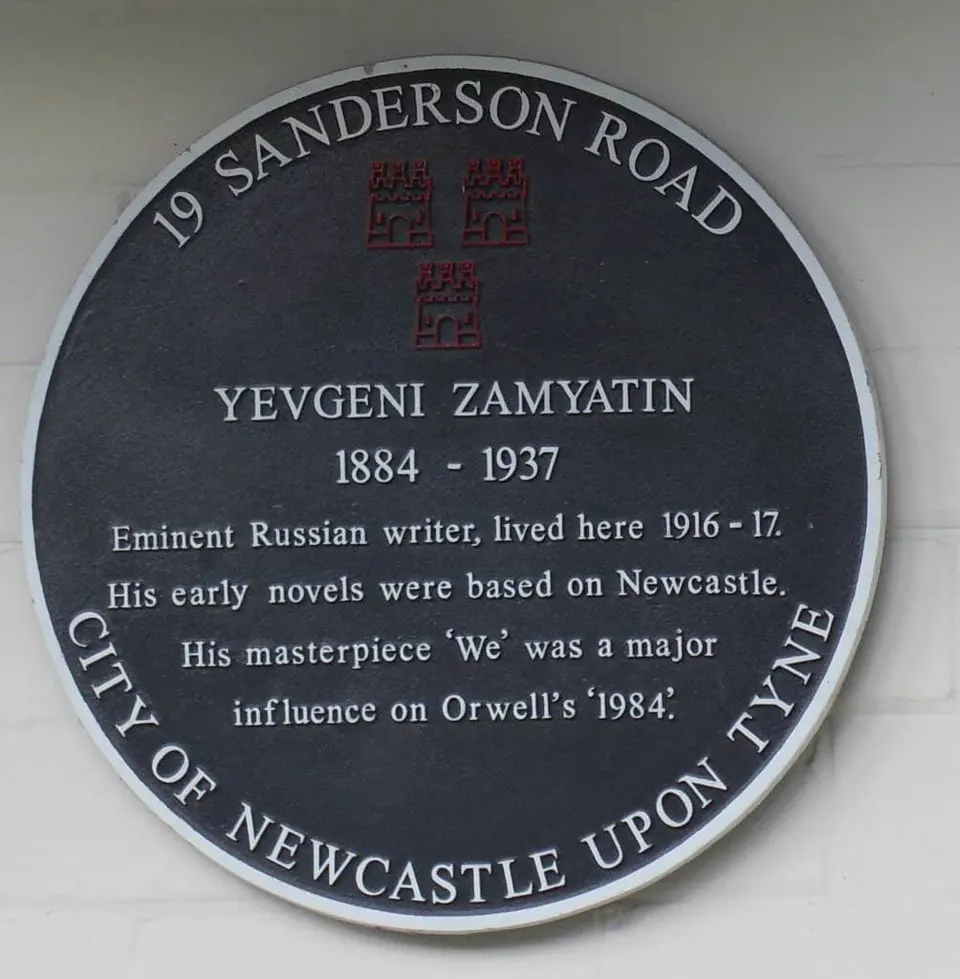
He was born in 1884 (Orwell?!). His father and grandfather were priests, and although he grew up, as he himself put it, in the deep Russian provinces, he was surrounded by an intellectual circle—his mother was a pianist, and Chopin could often be heard in the house. At four, the boy was already reading Gogol on his own. At school he did well in literature and tragically in mathematics. But, as he writes in his autobiography, out of sheer stubbornness he decided to enroll in the discipline with the most mathematics at the Saint Petersburg Polytechnic—shipbuilding.
There, by the River
And further—a question to myself: why is it beautiful? Why is this dance beautiful? Answer: because it is unfree movement, because its whole deep meaning lies precisely in absolute aesthetic subordination, in ideal unfreedom. And if it is true that our ancestors gave themselves up to dance in the most inspired moments of their lives (religious mysteries, military parades), that means only one thing: the instinct for unfreedom has been organically inherent in man since ancient times.
Zamyatin entered university at the beginning of the 20th century, just as the Russian Empire was giving birth to the phenomena that would steer the history of the entire Eastern Bloc. He was quickly drawn into politics, became part of revolutionary circles and grew close to the Bolsheviks.
Perhaps that is why chance played its part, when as a student he ended up aboard the ship Knyaz Potemkin-Tavrichesky, where he witnessed dramatic events. It is the story that Sergei Eisenstein would immortalize in one of the first undisputed masterpieces of cinema—Battleship Potemkin. Driven to desperate conditions, the sailors mutinied and seized the ship. Troops were sent against them and crushed the mutiny with bloodthirsty brutality.
Back at the university, Zamyatin became quite active on the political front. So much so that in 1906 he was arrested and forcibly sent back to his hometown of Lebedyan. Although forbidden to do so, he returned illegally to Saint Petersburg that same year and even… completed his education. Miracles possible only in the rebellious first years of the 20th century.
It was around then that he wrote his first short story. And the miracles continued. Since he stood out as an exceptionally talented shipbuilder, and such specialists were important and in demand at the time, he was soon pardoned. In the following years he worked quietly, until the First World War broke out. He publicly declared himself for peace and called for revolts, for which he was arrested again and deported far from civilization.
The Battleship Potemkin
The state forbade the murder of an individual, but did not forbid the half-destruction of millions. That means that to kill one person, that is, to reduce the sum of human lives by 50 years, is criminal, but to reduce the sum of human lives by 50 million years is not criminal. Funny, isn’t it?
After serving his sentence, however… it suddenly turned out once again that he was too valuable a specialist. He was sent to Great Britain to take part in building, on a Russian order, the icebreaker Saint Alexander Nevsky, which… by the time it was finished, the October Revolution had come, and it sailed back under the name Lenin. A huge ship, innovative for its time, capable of handling the harshest challenges of the Arctic Ocean.
Not only the ship but also the shipbuilder changed dramatically during his time on the island. Zamyatin traveled between shipyards scattered across the kingdom. What amazed him most and shaped his worldview from then on was technology. Progress, advancement. Inventions that promised to change our lives… not necessarily for the better.
Does that sound familiar from today’s point of view?
A Burden Without Shores
And isn’t it absurd that the state (and it dared to call itself a state!) could leave sexual life entirely without control? Whoever, whenever and as much as they wanted… Utterly unscientific, like animals. And like animals, blindly, they bore children. Isn’t it funny: to know horticulture, poultry farming, fish farming (we have exact data that they knew them) and not manage to reach the last rung of this logical ladder: child farming. Not to arrive at our Ideal Mother and Ideal Father.
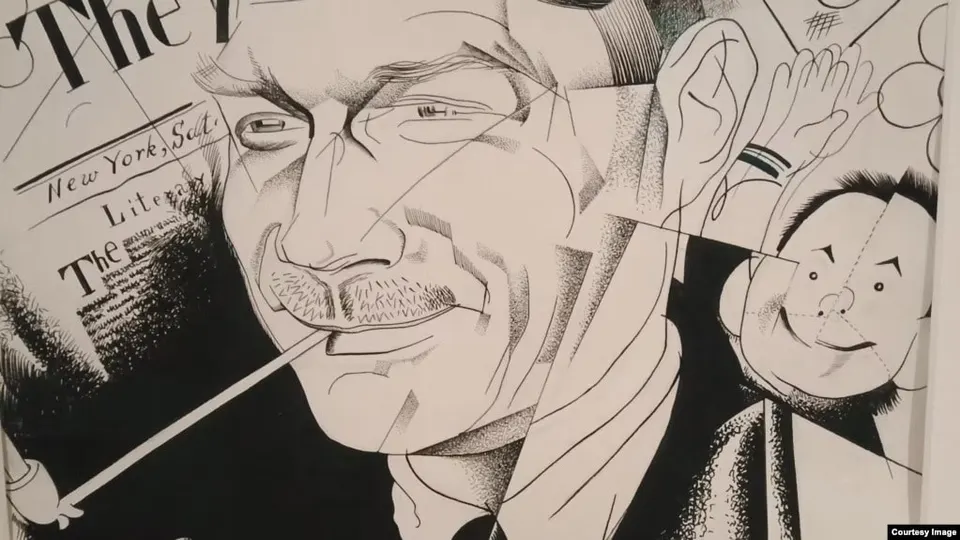
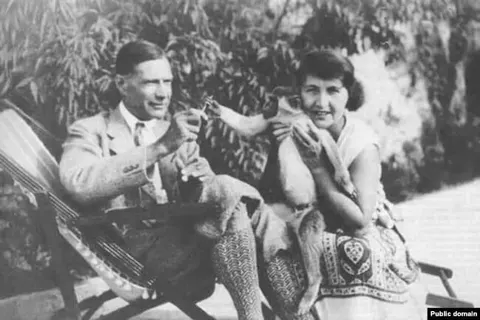
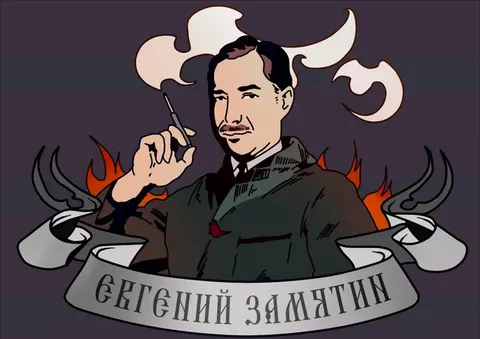
The shipbuilder changed outwardly, too. He adopted British manners, the local fashion and customs so thoroughly that later, after his return home, people would often call him, ironically, “the Englishman.” Korney Chukovsky wrote of him: “Yevgeny Ivanovich had one forgivable weakness: he behaved like an English captain. He smoked a pipe, spat like a true Yorkshireman, often said ‘alright,’ and, having put on his British face, listened and spoke without changing his expression. But his eyes were naive, peasant eyes, slyly narrowed, and his thick dark-blond hair refused to fit within the English barrier.”
Zamyatin clearly had a knack for not missing the dramatic moments: he returned home in September 1917. The writer made no secret of his enormous enthusiasm for the changes the October Revolution was bringing.
He took an active part in the Civil War, which once again landed him in prison, together with other famous artists, among them Alexander Blok.
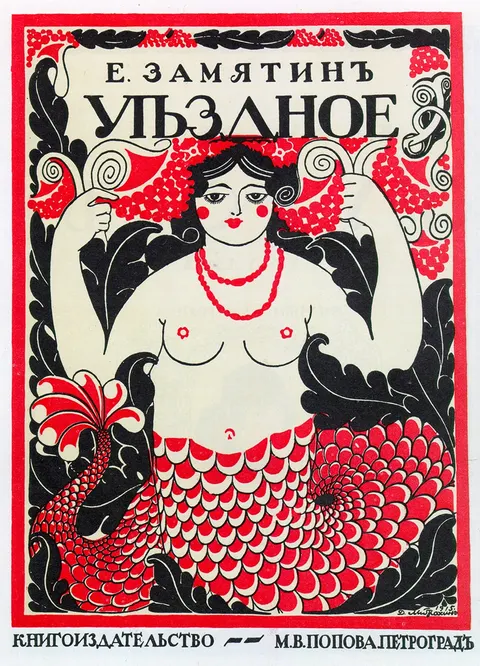
At that time, besides taking part in the events of the day and working actively in his profession, he was writing more and more. And so we come to 1920, when he finished his first and only novel, the one we are talking about today—We.
Although many, including Georgi Markov, the Bulgarian dissident writer, in a well-known essay on Zamyatin, find in the novel allusions to what would happen in the USSR in the following decades, it is much more than that. Zamyatin wrote it in a time of enthusiasm, when few had even heard Stalin’s name. This is not at all a book about the victorious revolution so much as about victorious technology. About a hyper-technologized society in which we have delegated everything to it, and we ourselves have become bolts in the system, little cogs that exist only to keep it moving forward…
Islands in the Stream
Hence the distribution: the ton has rights, the gram has duties, and the natural path from nothingness to greatness is to forget that you are a gram and to feel yourself a millionth part of the ton…
The fact is that the novel was never published in the years after it was written. Journalistic digging in the archives a few years ago showed that this happened more or less by accident. The editors were slow with their decisions; in fact, they had approved the novel… But Zamyatin was impatient, and that brought him serious trouble. We came out first in New York, and that is precisely what made the authorities turn their attention to the writer.
Unlike many of his contemporaries, great writers and poets whose names we all know, he was not repressed. In 1929 he was expelled from the writers’ union; it was clear that he could not cope with the demands of the new times. In 1931 he wrote his famous letter to Stalin, in which he explained his disagreement with the treatment of art and asked to be allowed to go abroad. He promised to return “as soon as it becomes possible to serve great ideas in literature without serving small men.” Pretty bold, wouldn’t you say?
He did, however, receive the support of Maxim Gorky, and, quite unexpectedly… he was allowed to leave the country. He even kept his Soviet passport.
Titanic
By turning this handle, any one of you can produce up to three sonatas an hour. And how much effort this cost your ancestors! They were able to create only after working themselves up into the fit known as “inspiration”—an unknown form of epilepsy.
Zamyatin spent the rest of his years abroad; in the 1930s, unprecedentedly, his membership in the Soviet writers’ union was even restored. He said he dreamed of returning home, but it never happened—heart disease ended his days in 1937. Abroad he never published anything new; his only creative work was as the screenwriter of a successful French film.
“The most unknown of the great Russian writers of the 20th century,” Alexei Korolyov called him.
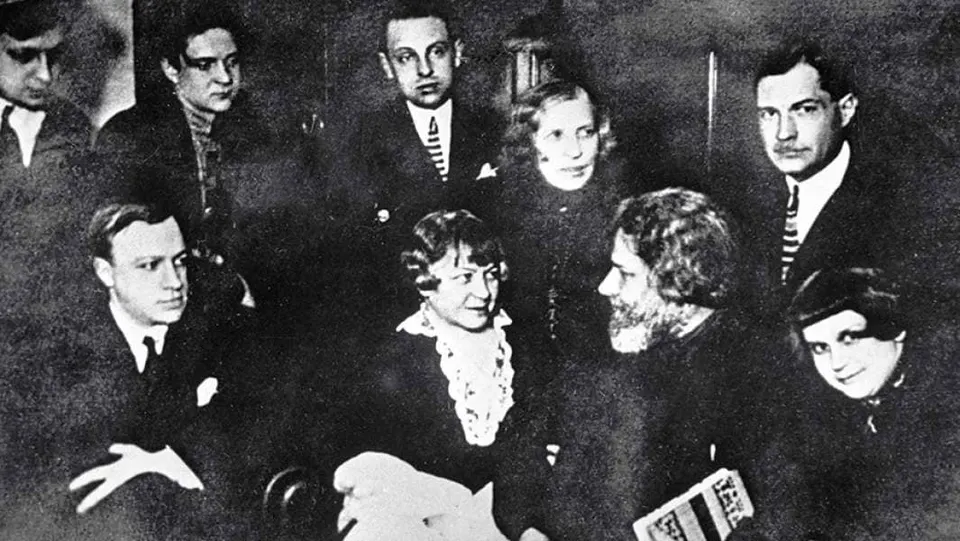
His whole life was bound up with the greatest literary figures of the time. His wife was a close friend of Anna Akhmatova and helped her when she fell ill with tuberculosis. The writer’s personal physician was Mikhail Bulgakov’s brother. At his memorial service, his words were read by the Nobel laureate Ivan Bunin.
The Icebreaker
I rushed to him as to a brother, straight onto the blades, and started telling him—about the insomnia, the dreams, the shadows, the yellow world… The scissor lips smiled.
– You’re in a bad way! I think you’ve developed a soul.
A soul? That strange, ancient, long-forgotten word. We sometimes said “soulful,” “soulless,” “soul-destroying,” but soul…
– That is… very dangerous, – I whispered.
– Incurable.
We was first published in his homeland only at the end of the 1980s. Long before that, the book had built a reputation in the West as visionary, prophetic, as the first literary dystopia. It is especially popular in England; the Pet Shop Boys have a song called “Integral” that retells its plot.
“My most jocular and at the same time most serious work,” the shipbuilder-writer called his novel.
Zamyatin said he had been inspired by H. G. Wells. Orwell himself wrote that he was impressed by We, and in his view Aldous Huxley, too, had learned directly from his Russian predecessor. Traces of our hero’s ideas can undoubtedly also be found in Ray Bradbury’s Fahrenheit 451.
Who borrowed from whom and how, who came first and who last (and Zamyatin came first, decades ahead of his colleagues), I don’t think matters much. The fact is that in each of these classics we have a totalitarian regime and a protagonist who stands up to it, launching his own small and naive revolution before the system, one way or another, destroys him. What’s more, I hope we won’t need to argue over which of these undisputed classics turned out to be most right with its terrifying prophecies.
Man Overboard
I know from my own experience: the most agonizing thing is to sow in a person the doubt that he is real.
And yet, there are just too many tentacles of a possible technological horror described in We, and we can see signs of them sprouting all around us.
Yes, technology is an enormous treasure, but it can also be a horror.
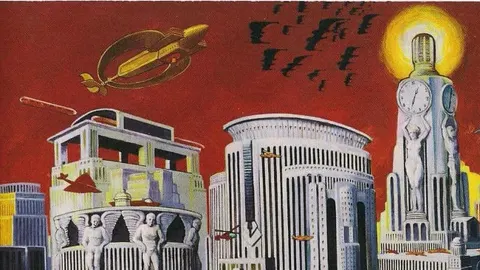
The action takes place in the 32nd century. All people are subjects of the One State; they have no names, only numbers. The protagonist, D-503, is a mathematician, one of the engineers of a flying machine called the Integral. It is easy to see the shipbuilder himself in him… only in space. (Or… Elon Musk?!)
The citizens of the One State live in identical apartments without curtains, wear identical clothes (“unifs”) and travel in small flying vehicles. (The sharing economy?!) In their free time they enjoy music created by special musical machines. (Artificial intelligence?!)
In the novel, people live in transparent homes and are not allowed to lower the blinds unless they receive the coveted pink ticket, which gives them a chance to be alone for a short while with a specifically chosen and approved member of the opposite sex. (Tinder?!)
Lifebelt
Haven’t social networks led us to something similar? With the way they collect and process our data, the way they manipulate? The way they make us share selfies and worldviews far beyond what is properly intimate?
And what about the estrangement from nature that came with technical progress? And creativity and art, presented as technologized activities delegated to algorithms?
The hate, the drowning out of the different voice under the weight of the algorithm, of the likes?
Our confinement in bubbles with a narrow worldview, in the panopticon of an illusory reality?
The blurring of truth? Of the criteria for credibility, of being properly informed?
A Sea of Words
– This is unthinkable! This is absurd! Don’t you understand: you are plotting a revolution!
– Yes, a revolution! Why is that absurd?
– It’s absurd because there can be no revolution. Because our—I’m saying this, not you—our revolution was the last one. And there can be no more revolutions. Everyone knows that…
The mocking sharp triangle of her eyebrows:
– My dear, you are a mathematician. Even more: you are a philosopher of mathematics. Very well: name me the last number.
– Meaning? I… don’t understand: what last one?
– Well, the last, the highest, the biggest.
– But that’s absurd. Since the number of numbers is infinite, what last number can you be talking about?
– And what last revolution are you talking about? There is no last one.
Here lies the remarkable difference between 1984 and We. Orwell’s characters clearly cannot stand the tyranny they live under and only pretend to approve of it out of fear. Zamyatin’s “numbers,” by contrast, obey the laws of the One State because “that is what makes sense.” Quietly submerged and tamed, like us in today’s social networks. Which take care to bestow content on us, to give meaning to our everyday lives.
As Zamyatin’s friend Yury Annenkov wrote, in his novel he proves that “human life cannot be artificially organized according to programs and blueprints, like a transatlantic steamer. Because in man, besides his material, physical properties and needs, there is also an irrational principle that lends itself neither to precise dosing nor to precise accounting, and as a result, sooner or later, the schemes and blueprints will be blown apart.” Will it turn out that way in reality?
We is a brilliant metaphor and a prompt to reflect on a possible hyper-technological future. Yes, it may not be a beautiful love story, nor the ideal beach read, but it is a book we should not miss today.
I would very much like it to turn out, just a few years from now, that these parallels don’t exist, that I am wrong. But…