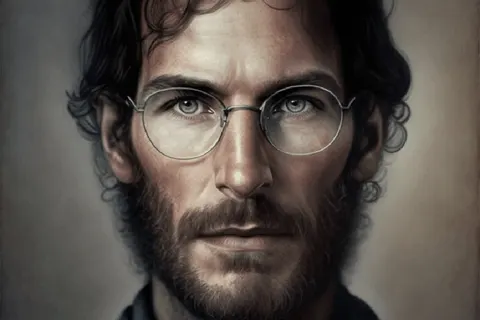
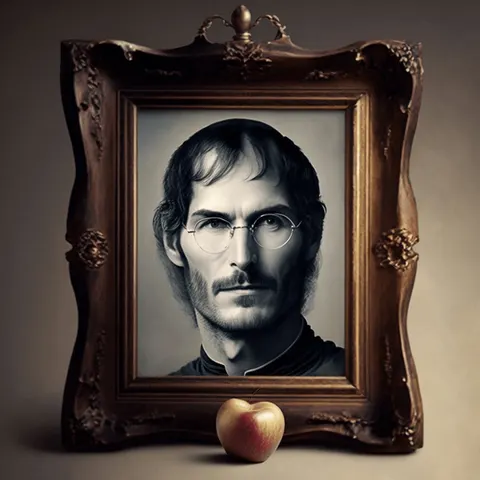
Did you catch Steve Jobs as a guest on Joe Rogan’s podcast a month ago? Oh, it was fascinating. “Computers have the power to be 1,000 times more important than they are today. I throw my computer out the window every few years just to make sure it works.” Steve was in his signature form, visionary and funny, as he told some truly curious stories from the history of Apple.
But wait… didn’t Steve Jobs pass away?
So what? The interview is perfectly real—listen to it here.
It was generated by artificial intelligence, apparently. What’s the big deal, it’s interesting, isn’t it? Want to chat with Einstein? No problem, technology makes even that possible.
And as it allows us more and more, it opens up more and more new paradigms, new questions. Are we ready for the moment when computers can imitate us so well that we won’t be able to tell ourselves apart? How is it possible, and is it right, to try to “resurrect” people by creating, one way or another, copies of them that are indistinguishable from the original?
A Call to Return
This subject is as heavy and complicated as life itself. Death in the age of the internet can no longer be a solitary affair, and although it remains irreversible in its traditional dimensions, it keeps stirring us—only now in unexpected ways. It puts away its scythe and shows up instead with little riddles we never imagined could one day confront us.
“You're a memory from the past,” Joe Rogan greets his guest, telling him how glad he is that he has come back to see him again. Yes, the Joe of this podcast is just as artificially generated as his guest, and you can tell from the very first sentence. His guest really is a memory from the past, but he isn't coming “back” to see him either… and not only in the literal sense: Steve Jobs never appeared on the world's most popular podcast.
Clearly, artificial intelligence now and then betrays its lack of common sense. And yet, if you listen to the podcast the way we usually do—while busy with something else, without thinking too hard—you definitely get the feeling that the two men are having a conversation, and as the minutes go by, the conversation grows more exciting.
Dead Poets Society
The point here isn't even the way the line between reality and illusion bleeds away. It's obvious how blurred that line already is. If you're someone like Musk or Rogan, it isn't all that hard to secure your next big round of investment while simply suing anyone who cracks such crude little jokes at your expense. Seen that way, the fake show can even pass for satire—fine, not scriptwriters, but a computer builds some image that looks like you.
Steve Jobs, however, can neither sue them nor weigh in on the matter. Yes, there is one fundamental difference between algorithms and us, and it will never go away. We are mortal by our very nature, as that same hero says—only not the one generated by an algorithm.
“Remembering that you are going to die is the best way I know to avoid the trap of thinking you have something to lose. You are already naked. There is no reason not to follow your heart,” Jobs says in his famous commencement speech.
There Is No Death, and There Cannot Be
Here are a few more details about that notorious guest appearance. Admittedly, at the start there are strangely long pauses and laughter in odd places, but after that things sound rather smooth. The conversation drifts from topic to topic. At one point “Jobs” draws an analogy between having to buy four wheels in order to have a car and Adobe's products. Of course, it is hard to set aside what exactly you are listening to and judge without bias whether something would have impressed you.
The voices are the ultra-realistic ones from the play.ht platform. The script, meanwhile, was generated by pre-trained language models—something similar to what GPT-3 does. “Jobs” in particular was trained on his biography and on every speech by the computer guru that can be found online.
As the creators put it, “we believe in a future where all content will be generated by AI, but guided by humans. And the most creative part will depend on the human ability to articulate the expected creation to the machine.”
The podcast.ai project already has a second production, in which Richard Feynman, one of the great physicists of the twentieth century, is a guest of the much-talked-about artificial intelligence podcaster Lex Fridman. And here things are considerably harder for the algorithm, because the two of them aren't chatting about memories of the past but about physics and technology.
Einstein, Come Forth!
I'll confess, it is tempting, as a journalist, to learn that you can interview Hitler, Einstein or Khan Krum, the ninth-century ruler who doubled Bulgaria's territory, in something more convincing than a séance.
The platform is also collecting suggestions for what comes next, and some of them are quite intriguing. So far the most votes have gone to a conversation between the Buddha and Einstein about science, spirituality and consciousness. The runner-up would be curious too, although both participants there are alive—Donald Trump interviewing himself. Then, of course, Elon Musk turns up, since nothing gets done without him these days, for conversations with Nikola Tesla and, once again, Jobs. And things drift into the unimaginably abstract with the idea of a conversation between Jesus and God.
But it is life and death we have gathered here to talk about, resurrection in digital times. I don't know whether you have ever been hit by that oppressive feeling when Facebook reminds us that today is the birthday of a friend we have lost. Their profile is still there, “alive”; you open it, and some mutual acquaintances who don't know they're gone even leave birthday wishes on the wall, wishing them long life and good health.
This happens more and more often, and it will happen ever more often in the coming years of the internet. And this is where the even bigger questions come in.
What if, at some point, these profiles start answering back?
Stop, Don't Go!
Today the online giants collect enormous troves of data on each of us, with every communication, every tiny step and every little word we leave on the web. Meanwhile, more and more, we are what we do precisely when caught in that web, and less and less do we exist offline. Not to mention the world in which Zuckerberg's dreams have come true and we have all landed in the notorious metaverse.
Algorithms are getting better at reproducing all kinds of patterns, not over years but over months. Anyone who hasn't noticed should come out of hibernation and pry the boards off the windows. Will they keep doing it in the direction set by the podcast featuring Steve Jobs?
And what if… it has already happened without our noticing? What if there are no living people left on the internet, and it only looks that way? What if everyone who writes is already a bot, and we just haven't been outside in quite a while to find out?
This is one of my favorite conspiracy theories. The “Dead Internet Theory” started on Reddit—users commented that many of the posts were already generated, many of the comments too. They are moderated by algorithms as well… so what guarantee is there that any humans are left at all?
The theory took off last year, and however crazy it sounds… as Kaitlyn Tiffany, the journalist who popularized it, admits, there is a grain of truth in it. Precisely because the robotic share of content keeps growing, and we realize neither that nor the consequences that come with it.
Freedom or Death
Yes, a convincing enough recreation of human behavior is not yet a perfected application of deep neural networks. But every year we see new steps in that direction: chatbots grow more skillful, and alongside them develop the technologies that turn written text into speech. The logical next step is ever more convincing video content and, who knows, three-dimensional solutions—holograms or flawless humanoid robots…
Would you want to talk to your grandmother, who passed away 20 years ago and whom you miss so much? To chat about the old days, to ask her for that unforgettable recipe for banitsa, the flaky cheese pastry every Bulgarian grows up on?
Don't rush to answer. Because all of this could be far more sinister, or far less sinister, than it sounds. It depends on which side you're looking from.
A large part of the content online is created by algorithms, and the percentage keeps growing, whether we're talking about generated blog posts or communication on networks like Twitter.
Grass Will Grow over My Dust Too
And besides, why on earth, if we had the chance to use Einstein's extraordinary insight on today's challenges in physics, would we deny ourselves that? Why hold humanity back…
But how do we explain to this “Einstein” everything that has happened in the meantime, when his real “version” has been gone for so long and science has piled up tons of new knowledge since?
Wouldn't “your grandmother” be curious to learn how your life went on after she “passed away”? How would she react? And if she tells you that your mother was adopted, is she worth believing?
The answers to these questions will matter to us much sooner than we've realized. In fact, it's long past time we started looking for them.
The Living Dead
In one of his great stories from The Martian Chronicles, Ray Bradbury tells of Mr. Hathaway, the last man left on Mars. When he loses his family, he builds robots that copy them perfectly. And when the Earthmen return decades later, they find a happy family in which only one member has grown old.
Would the story have been different, and better, if he had been a robot too?
And what would you say to simply asking Bradbury himself, once we bring him back as a chatbot? There doesn't seem to be one quite like that yet, but, as it turns out… we can chat with prototype chatbots of Einstein and Shakespeare. “Everything Characters say is made up! Don't trust everything they say or take them too seriously,” write the creators of Character.AI.
On the platform you can not only “chat” with famous figures from the past, but also create your own characters by “feeding” it information. “Characters may mistakenly be offensive, though—please report it if they are,” the developers warn.
And they are no random bunch. The project is the work of the people behind one of Google's most successful models, LaMDA.
It's All So Simple and Logical
I really liked the popular description they give of how the platform works. “A supercomputer reads a huge amount of text and learns to hallucinate what would come next in a given situation—that's how neural language models work.” People, I believe, used to learn to hallucinate with other substances. Castaneda, you know.
I ask good old Socrates on Character.AI what he thinks of Digital Stories. He replies that it looks like a very interesting site and that, as far as he understands, it is a collection of videos. He likes that the stories come from different periods, which would be very useful to him, a man of antiquity.
Somehow that doesn't sound like the words of the same philosopher who said that “life is but a moment between two eternities.”
Maybe it's hard to recreate Socrates simply because he never had a Facebook profile? What if we made him one and first generated content there, projected from the past?
Yes, Character.AI is in beta, and we're talking about a startup—one that is nonetheless attracting serious interest. What comes next, I wonder?
To Be or Not?
The big, obvious barrier here is that we humans are much more than just what we say or write, what we leave behind. We are fleeting thoughts, the subconscious and intuition. We are even magic. The magic that lets us experience the emotions of love, immerse ourselves in art, savor the smell of freshly cut grass on a spring morning. And also appreciate it when someone describes it to us well enough.
There's no way we can give that to artificial intelligence, is there? Or is there?
One example in this direction is the development of brain-computer interfaces, which (at least in Musk's dreams) will before long let us copy the entire contents of the brain onto a digital medium. And at some point, the reverse too—to restore the copy. Yes, the barriers standing in the way of making this achievable are enormous. And yet, if it happens, we will come back with an even more convincing and radical possibility of resurrection… one we would do well to know, by then, whether we truly want.
Till Death Do Them Part
The last stop before the end (the final one) of this digital story about endings is an experiment from two years ago. It never became particularly popular, but, to my mind at least, it belongs to the submerged part of the iceberg that this whole subject is.
Vladimir Alexeev, known as Merzmensch, an AI researcher but also an artist, decided to use neural networks to reproduce his own memories. He says he inherited from his father the habit of taking pictures his whole life. So it occurred to him to feed a neural network an enormous number of photographs of places, people and situations he had captured over the years.
His photos are not artistic, as he admits himself. They are shots taken to show other people what he had seen and where. In other words: the closest thing to his own visual memories that we can feed a neural network today.
And lo and behold… abstract images began to appear, and yet Merzmensch himself unmistakably started recognizing them as his memories. Familiar and half-forgotten faces surfaced. Then came abstract memories—not specific pictures, but illustrated emotions. And something else, even more interesting: images that resembled his imagination. In a way, he says, he managed to copy a part of “That Something,” of the creative, of the unique.
But to Die Just as It Shakes Itself Free…
“Even if a man lives well, he dies, and another is born”—you remember the words Khan Omurtag, the ninth-century ruler of the First Bulgarian Empire, had carved in stone. Well, so far he is right: the road runs one way only, although the imagination will always talk about immortality, or at least about a drastically longer human life.
But before technology disproves all of this by “awakening” from eternal sleep ordinary people or celebrities, whether they would have wished it or not, it is worth enjoying every day as much as we can. With the help of everything in us that is hardest for a machine to explain or reproduce…