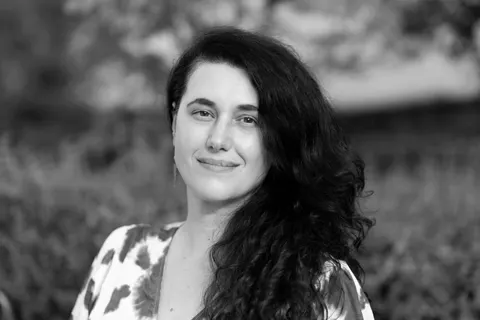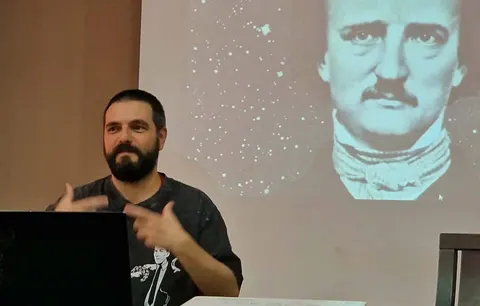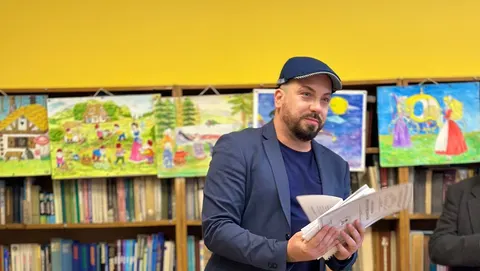
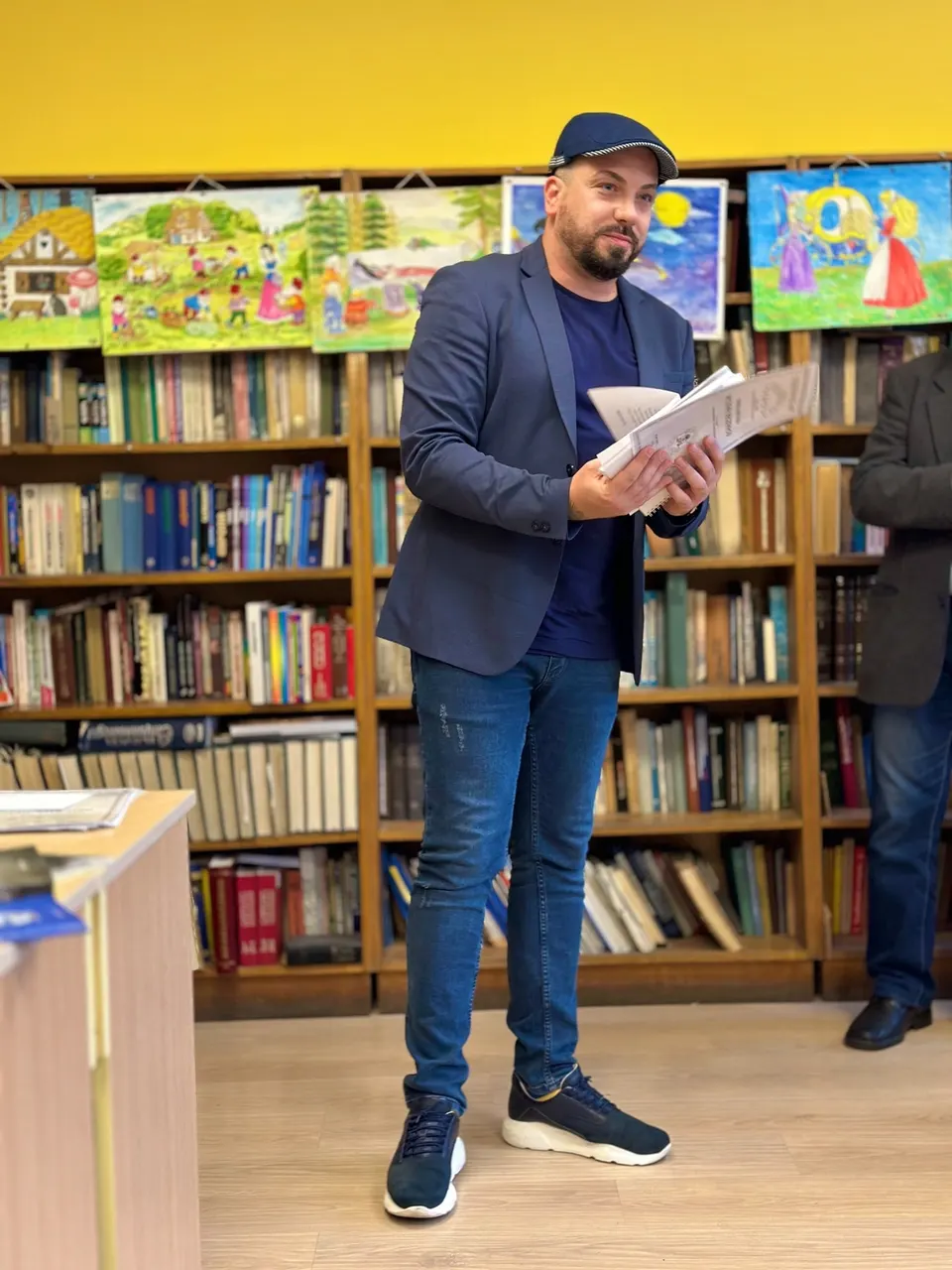
Veselin Veselinov is this year's winner of the seventh Stanka Pencheva National Literary Competition, named after the Bulgarian poet. And that is far from all: while we talk, he shows me a wall in his home covered with poetry awards.
He graduated from the Damyan Damyanov Humanities High School in Sliven, then turned to the many fields of psychology at Sofia University St. Kliment Ohridski. A doctor of clinical psychology, he has worked as a teacher and school psychologist for 13 years, and now he also teaches bachelor's and master's students at New Bulgarian University (NBU).
What does it mean to be a successful poet today? What keeps you going? What does the future of poetry look like? How long will it be with us? How can it move more people and help us make sense of the big issues of our day?
The themed series from Digital Stories:
- AI makes it among the best in a second poetry competition (an experiment)
- The Bulgarian Literary Banksy
- “Poetry remains a secret treasure.” “Hristian Papazov” in his first interview
- “A machine cannot be a poet”: LIK magazine in… 1967
- “Poetry of a New Generation: Real and Digital Writers”, The Library, BNT 1
– So here we are: poems generated by artificial intelligence made it into the top 10 of two consecutive poetry competitions in Bulgaria. That is also why I invited you—you won the competition in which I ran my experiment, the Stanka Pencheva. What do you think about what happened?
– I don't know if I'm the right person to answer, because I'm a bit of an odd one. I live on the sidelines of technological novelties and achievements. I'm not familiar with this subject at all; it is
very distant and foreign to me, and I feel enormous resistance toward it.
I have a solid education, but in a completely different field. In my work as a psychologist, I deal every day with the problems of flesh-and-blood people. Teenagers and their parents tell me about conflicts, doubts and worries in their families, and I'm too focused on that; I have no time for the news of the day, part of which is the fact that AI-generated literary works ended up among the top 10 in two competitions with enviable authority and influence in our circles.
But then it occurred to me that we can look at the subject through an alternative lens: people often grumble that literary competitions are fixed in advance, that something is rigged, that jury members break anonymity and that the prizes are handed out on some principle other than talent and merit. Well, these poems don't belong to a real person the jury might know or want to encourage. These are texts that were read without prejudice, liked for some reason, and managed to hold their own against the work of other people entering such competitions.
– Exactly! And once again I apologize to the jury, but there's no other impartial way to test how good the generated poems really are. Otherwise the reader is always biased, more or less…
– Yes, but I see it rather as proof that nothing is rigged in advance.
I mostly use Facebook, where discussions flared up—people from literary circles openly expressed their discontent after the Veselin Hanchev competition, and also around the news of AI's intrusion into the competition I won, the Stanka Pencheva in Straldzha. But you know what strikes me? They looked at the case only from their own point of view and their own pain at not being shortlisted or winning; there are people who vow every time never to send their work to such competitions again, because they aren't appreciated. They treat the choice of AI-generated poems as a chance to belittle the jury or the weight of the competition. I don't like that. Again, I keep away from these things.
– That's exactly why it matters that it happened in two consecutive competitions; we can't talk about blame or a wrong choice by the jury—these are serious names from the literary world. And all this, in my view, opens countless important questions, not only about poetry competitions, but about poetry, about creativity, about our future as a species…
– Many people are obviously worried, afraid of the development of artificial intelligence. Well, I don't see it that way, as some kind of threat. I don't think my work would be endangered by it in any way. I'm speaking purely professionally and financially—I don't think it could replace me as a specialist.
On the other hand, it's no drama for me if I don't get an award in some competition.
I have an awful lot of awards; some of them are on the walls at home. But so what?
A thinking person always doubts himself. I send what I've written to various competitions looking for confirmation that I'm not wasting my time, that I'm not doing it in vain or as an amateur, and such high praise from people with a lot of experience and many achievements in the field reinforces and somewhat soothes the natural anxiety of a thinking person: “Come on, am I good enough? Am I managing?” That's the test.
But, again, it's no drama if I'm not recognized somewhere. It has happened to me too, but I wouldn't go looking for whether there's an AI-generated poem among the winners, or publicly searching for flaws in the other prize-winners.
No, life goes on. A bit from above, maybe… I don't know, that's how I see things.
– And it does you credit; that's how every competition should look, whether in sports or in art. But shouldn't we change the rules somehow? I didn't know that generated poems were taking part in the first competition, otherwise I wouldn't have repeated it, but the result is there. Two out of two entrants with generated poems reach the top 10. It turns out not only that the algorithm writes indistinguishably, but also better than a large share of the people who took part. Two independent juries judged them. Isn't that an important sign?
– I don't know what “writes better” means, because everything is terribly subjective. If one day I'm on a competition jury, I'll like one thing; if you are, you'll like another, so I can't say it writes better.
I haven't read these poems; they're hardly classical verse. I suppose that since they were generated by artificial intelligence, they're in free verse…
– A well-known author wrote to me in a comment that we'd solve our problems if we asked for classical verse. That's not so, unfortunately; it isn't that easy. I say this as someone who knows the subject professionally, from at least two professions at that.
– So it can generate classical verse too, is that it?
– Even if it can't right now—and it may well be able to—it will easily learn. Otherwise, as a reader, I also prefer classical verse; you can still find poems of mine online, and they're all classical.
– This divide, “classical or more modern style,” again sounds to me like “for or against artificial intelligence”—Pavel Matev, Mladen Isaev, Damyan Damyanov and Nedyalko Yordanov versus Literaturen Vestnik (The Literary Newspaper), Georgi Gospodinov and the poets of early democracy…
Everything in our society is polarized. Starting with Levski and CSKA, Sofia's two great rival football clubs, Sofia versus the provinces, the gay parade versus the Christian family. And there you go, in poetry too: classical versus free verse, or for or against artificial intelligence.
In my view, if something exists, there's a reason for it.
People who send work to a given competition have probably researched what kinds of poems and which authors have won in previous years. Because there are definitely competitions where the winners are still only and exclusively authors of classical verse. And the opposite—ones that fully embrace the more modern verse, without punctuation, without capital letters, where rather peculiar vocabulary and slang can be used.
To sum up: I don't think artificial intelligence could ever write better than Boris Hristov, one of Bulgaria's finest living poets, than Palmi Ranchev, than Ekaterina Yosifova.
ETUDES FROM THE ROSARIUM
What a shameful handshake—
we part modestly, without a scene.
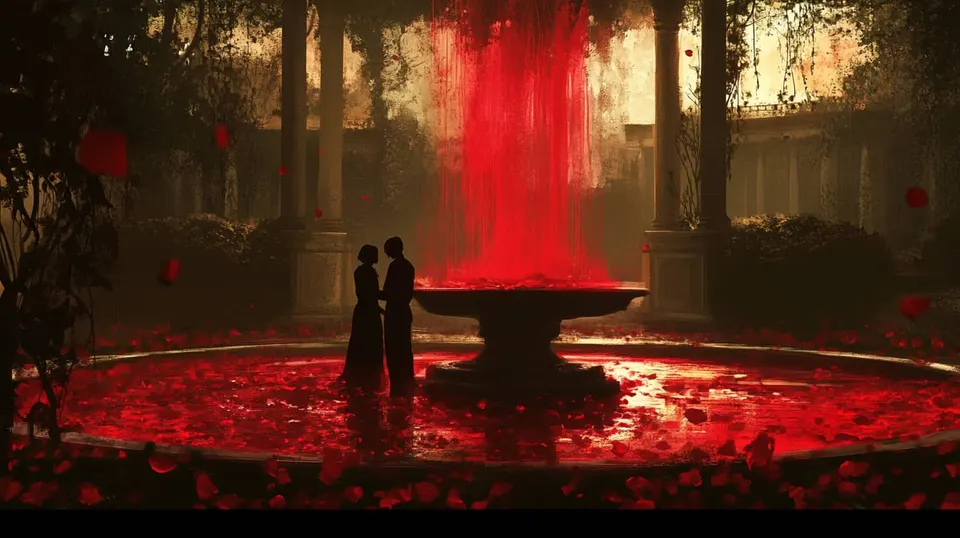
The central fountain turns the color of roof tiles
and objects to us, hoarse.
Grief steals in along its spray—
it will numb the yawns of weekday boredom,
it will ring out with a dull blow on the church bells,
it will deny even the pulpit, and happiness.
Is it possible at all,
when I don't feel your gaze upon my back,
and the sun gives no shelter
with rays of gelatin?!
On the benches newspaper pages lie in wait for me,
but there's no news about our wedding,
the balconies are like wrinkles on the neighborhood's face,
and the manholes—graves
into which I fall in my mind.
With the crumbs of daily memories
I'll guiltily feed the pigeons in the park,
until I lie down on the edge of the lake,
but let it grow dark.
Let the tulle of the stars enfold me,
let the roses smell heavy,
let them make me drunk with their scent.
And let me fall into deep sleep
in your city,
where until yesterday I was at home,
where lavishly
the moon ripened in your bosom
and beckoned me.
Here I meant to grow old proudly,
kisses propped against your brow.
Alas,
I will wake with elbows blossoming in blood,
that have weakened my instinct to dig a tunnel
to spaces so beloved, and past.
And no, I will not hang on the line of your clothesline
like a threadbare shirt!
On the earliest train I will leave,
untimely wounded and defenseless…
I asked Veselin to introduce himself through some of his poems as well. He chose these two—one classical and one modern. Click on the title to read the poem.
– I don't think so either. But still, I think we have a reason to talk more about these topics. That's what I want—to lead the conversation, not be led by yet another divide, which is why I invite people from both sides of every one of these divides. I also asked the visitors of the site what they think of artificial intelligence. Do they like it, do they think it will lead us to something better? Should we ban it? And 750 people took part, and the results were quite instructive.
What keeps you writing?
– I don't keep writing specifically for the awards, or from the position of a Facebook critic holding forth from the “lofty platform” of social media: for or against Georgi Gospodinov, for or against the latest winner of the Slaveykov Prize.
No. Poetry is simply an occasion for many pleasant, pivotal encounters. Now that's something artificial intelligence can't possibly give us.
Thanks to poetry, I've met interesting people I'd have no other way of meeting, you see?
I'll tell you a story that illustrates exactly this. I mainly write poetry, but years ago I sent a short story to a competition of the Burgas writers' community. I won—not first prize, but the special award.
It was on February 14, 2020, and that's where I met the editor of my book, Roza Boyanova, a renowned Burgas poet who handed me the award, and so we made contact. A few years later that proved very useful, because I needed an editor with experience and a name in poetry. I thought of her, asked her, and she agreed. And so I now have a published poetry collection, which won the Debuts program of the National Culture Fund a few years ago and was fully funded by them.
It came out at the beginning of 2022 and has also won a literary award—and we're talking about a book now, not one to three pieces. I did many lovely presentations in quite a few towns—Sofia, Plovdiv, Burgas, Stara Zagora, Shumen, Aytos, Pomorie, Borovets; we presented it in Koprivshtitsa during the Debelyanov Days, and I even took my poems to Macedonia. In these places I was joined by the book's reviewer, Tatyana Yotova; she plays the guitar, we have songs based on some of my poems, and it works really well.
So there you go: poetry is an endless opportunity!
That's largely why I send poems to competitions. In Straldzha, at the Stanka Pencheva competition, I met Academician Ivan Granitski, who chaired the jury, and Niki Komedvenska, who, like me, is from Sliven, but we had never met before. Poets from Kazanlak, from Yambol. These are moments that recharge you. Conversations with kindred spirits. You know, in our hectic daily lives we have no time left
to talk about literature, about things that find a place in our everyday lives less and less often. That motivates me to write; I value constructive dialogue between creative people.
– So do I. These very divides, the disappearance of nuance, the inability to discuss things properly are among the reasons this site exists. And which are your biggest poetry awards, the ones you're proudest of?
– I'm very proud of the Georgi Davidov National Award for sea poetry from the Municipality of Shabla, which I won in the summer of 2023 for a cycle of sea poems. I've won Bitter Wine in Petrich, I've been recognized at the Binyo Ivanov, the Georgi Chernyakov, At the Foot of Vitosha… The Yavorov Prize in Pomorie is also dear to me. Those are the ones I can think of now, but there are many more, and of all kinds.
– The awards really are many and impressive. And, frankly, as someone who reads, I'm sorry that I have to hear about your poetry because of something completely different. The idea of competitions is also to give a new author the chance to reach more people, but I don't think it happens… Is there a way for poets to reach more readers, as they once did?
– The context of the times is different. Perhaps one of the few good things before 1989 was the different attitude toward culture.
I was at a concert by Familia Tonika at the National Palace of Culture (NDK) in Sofia, and from the stage they told how there were mandatory songs they had to perform, one of them being “Lilac Nights,” to lyrics by Pavel Matev.
And again we come to a touchy subject. Those close to power or the dissidents? But look, that beautiful poem, “Lilac Nights.” The performers were practically forced to turn it into a song, and it has survived to this day. I love it precisely because of that popular song; it's stuck in my mind.
But that can't happen anymore, in my view, because we live in completely different times. Poetry is increasingly becoming a boutique art; there's no way mine has reached all that many people.
Actually, I don't know if I even want it to. I think those who should find me will find me. Sooner or later.
And that's no problem, maybe because I don't make my living from it.
– What would make you stop writing?
– I've never thought about that. When it comes to competitions, I never sit down to write because there's a set theme. No, it happens by chance. You're driving, some phrase comes to you, then you develop it. You read something, you like the story and give it your own reading through your writing. You live through something, time passes in which you make sense of it and turn it into art. I never write at any cost, so I haven't thought about what would make me stop.
Death, maybe. But there's something else too. Graphomania is a terrible phenomenon.
– Especially today, when anyone online can get likes for “cheap” words.
– Thanks to social media, we witness all sorts of things. And recognition in a literary competition could somewhat reassure you that you don't belong among the graphomaniacs. Although maybe they, in turn, just need to pour something out?
I write because I read a lot. That's it.
In my view, a writing person should read more and write less. It's a popular maxim. Through some kind of creative amalgam, many things get stirred up inside me, and so, based on what I've read and absorbed, I create new things of my own.
I jot down interesting words from prose that I think aren't used that much and would sound interesting in poetry. For me it's a kind of pleasure and a rest from long working days.
MY BLACK CHERRY
My black cherry, here's to you!
Like moments—these years—
whistle past the eaves of the house,
yet I love you just the same.
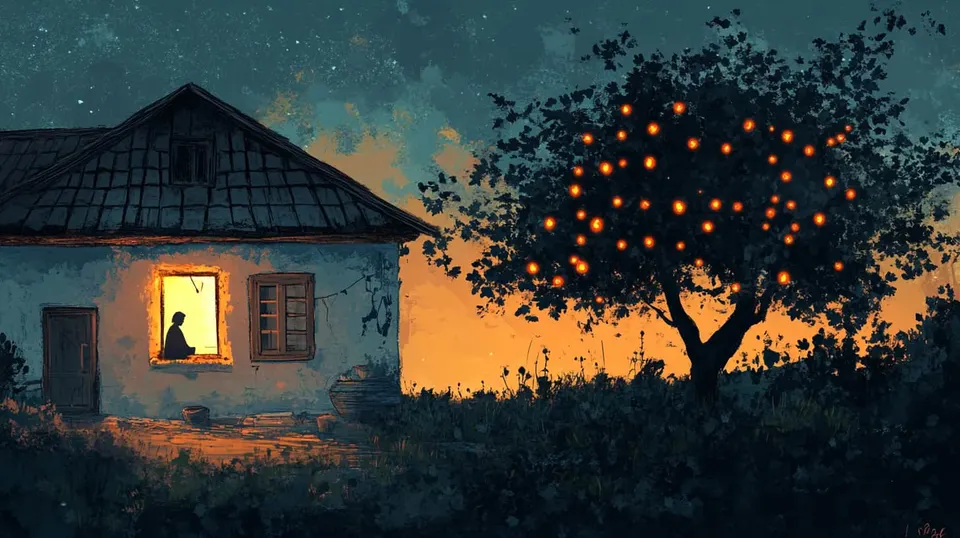
A night window always glows there:
you wait for me even after dark,
for you can't have supper without me!
You want me to tell you a tale…
Of the sea, now ripened and ours,
and of the summer past its peak,
of a kind girl—Cinderella—
like her, you never stopped giving!
How the softness of your caresses
tames the beasts in me!
And the tears—abundantly flowing—
you silver with full lips, with breath.
And I forget vain ambitions,
the unlovely I forget as well.
You are a joyful taste to the palate,
to the heart, which is a wound.
My black cherry, I'm staying!
Stubborn and headlong—here I am—
for the brand in the fire won't go out
when love is not only words…
I asked Veselin to introduce himself through some of his poems as well. He chose these two—one classical and one modern. Click on the title to read the poem.
– You work with schoolchildren and students, and I have two small children. I have the feeling that poetry is much more distant to them now. In high school, for example, Dimcho Debelyanov was a phenomenon for me that gave my life meaning.
– Of course it's infinitely distant to them.
Very often even writing in Bulgarian is distant to them; they make spelling, stylistic and punctuation mistakes…
For a large part of them, reading and writing are certainly not a value. And maybe only a few high schools in Bulgaria are left where this has been preserved. I can't say I notice any special attitude toward literature at all in most young people.
With university students it's also peculiar; they're quite different from me when I was their age.
In high school I adored reading Nikolay Liliev and the Bulgarian Symbolists in general: Emanuil Popdimitrov and Hristo Yasenov, though they're not as popular.
It was an adventure for me to discover authors who weren't in the anthology or the textbook.
And that also brought me a special feeling of joy at something I had discovered, something not all that mainstream.
Even now I love discovering contemporary Bulgarian authors. And when it happens, it's always exciting.
– Give me some examples…
– Galin Nikiforov is one, although his name can't compare in mass appeal with, say, Zachary Karabashliev's.
Kerana Angelova writes both poetry and prose—she's one of the Burgas authors, very peculiar, distinctive; she has captivated me. Zdravka Evtimova, also recognizable both by name and by face; I'm curious about her novel Thursday, and my favorite story of hers is “Time for Mowing.”
In general, I'm focused on Bulgarian literature. I read world classics less often. Maybe because context is very important to me, and in Bulgarian literature I find things that are closer to my everyday life. And to psychology, too, since that's what I do, after all.
– Me too; it's no accident that Bulgarian authors are frequent guests here. Thank you for the recommendations and for the conversation!
The themed series from Digital Stories:
- AI makes it among the best in a second poetry competition (an experiment)
- The Bulgarian Literary Banksy
- “Poetry remains a secret treasure.” “Hristian Papazov” in his first interview
- “A machine cannot be a poet”: LIK magazine in… 1967
- “Poetry of a New Generation: Real and Digital Writers”, The Library, BNT 1