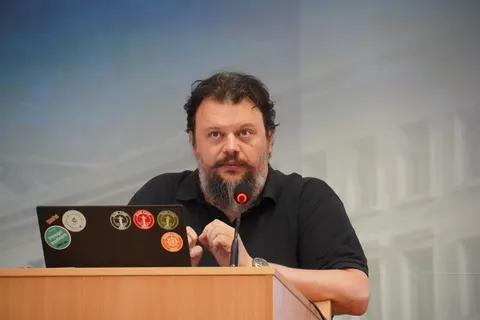
Vladimir “Kaladan” Petkov has worked in IT for two and a half decades, watching the past and present of information technology up close while waiting for the future.
His long experience lies in data and innovation. For six years he worked in digital media and business development as part of the team at Economedia, one of Bulgaria's leading media publishers. His career then took him to a leadership position at the international company A Data Pro, which specializes in processing and analyzing information. Today Kaladan, who took his nickname from the cult Dune saga, heads Identrics, a technology company that develops AI-based models for processing information.
For six years now, he and his friend Elenko Elenkov have been making the cult podcast Govori Internet (The Internet Speaks), which has grown into a whole platform of podcasts as varied in subject as they are consistent in quality. In 2022, at the big annual event of the portal dev.bg, Kaladan drew everyone's attention with the fascinating subject of ethical artificial intelligence, a guiding thread through quite a few Digital Stories.
How did underestimating the ethical side lead to enormous problems that have shaken the foundations of our civilization? What AI regulations is the EU preparing, and could they slow the boom in the field? How did the web move through its successive stages, and what should we expect from Web 3.0?
– Why do you think our programming guild finds it so hard to explain to society what is happening with technological progress, and with the world of artificial intelligence in particular?
– There are exceptions, but in my view software engineers are people who love to create, not so much to explain how they did it. For the past 20 years I've been working with engineers, and I see how excited they get when a new technology appears, when they see its potential. But
they rarely ask themselves how it would actually affect someone else's life.
What makes a task interesting is rather getting something to happen. The more complex and innovative, the better.
In recent years we've seen more and more how this approach leads to fast innovation, but very often also to some form of suffering. Especially in artificial intelligence, where
big companies, without much thought and without any regulation, apply advanced forms of automation.
They make a decision and roll out technologies that work, but nobody has fully thought through how they will affect a large share of people.
For example, we often talk about Facebook's algorithm tearing apart the fabric of society, or about Google, which every now and then fires people from its ethics team because they come out and say there are serious problems in a substantial part of these technologies. Here I'm referring specifically to the case of Timnit Gebru.
Engineers don't like to explain, and the people who make the decisions are driven by business goals. There's no culture of doing an ethical assessment of whether and how a technology will be used; that is seen as something that slows innovation down or makes it more expensive.

– And yet the moment for that to change has obviously come. Whether we're talking about social media algorithms or all the other directions in which the much-discussed artificial intelligence is advancing…
– In fact, the absence of such oversight is often even seen as a kind of advantage. Right now, for instance, we in the EU are quite heavily regulated, starting with GDPR and the AI regulation that is being prepared. Companies not based here point out that they have the freedom to do more things. The question is whether that's the right way. Because innovation increasingly comes not from small players but from enormous companies that affect the quality of life across the whole globe.
– It was from you that I learned how far the idea of ethical regulation of AI has advanced in the EU. Does it have the potential to work and bring order to such a complex and dynamic sector?
– That regulation leaked almost a year ago. It was available online, and lawyers, media and companies analyzed it. And it's a good thing it leaked, because that way businesses have time to prepare. How practical it will be is another question. The EU says the principle is that certain systems using this kind of technology will be banned, others will be classified as risky, and depending on the risk there will be some kind of certification. The idea is to look at the risk people would face if such a system came into use.
It doesn't address, for example, what people most often imagine—that someone will lose their job. Rather, it looks at the discrimination and segregation that machines, if they don't function as they should, could inflict on users.
The EU doesn't want to destroy innovation, so it isn't envisioning a centralized body, which would slow software development down. There will be organizations at the national level responsible for certification and oversight.
– But how well will that work? You give GDPR as an example, yet when it comes to protecting personal data, most people aren't at all impressed with the results…
– Under this regulation, anyone who isn't compliant will be fined, much like with GDPR, and with serious money at that. As for GDPR, there are countries where it's applied in an extremely by-the-book way, but also countries like Bulgaria, where the supervisory authority doesn't hand out fines easily.
The question is how far each directive can be adapted to local legislation. It's very likely that the Bulgarian state will make it all happen on paper. That agency is expected to understand every kind of AI, which is extremely difficult. People like that are very rare in Bulgaria, and they certainly don't work in government jobs.
– Recently I ran some experiments with apps for generating, automatically editing and summarizing text. In English they turned out to be astonishingly good, and I'm convinced that a large share of the texts we read online are already artificially generated. Because it's cheaper—and better, too, if I compare the results with the level of most Bulgarian news sites.
– Strange as it may sound, I don't think journalists are that enthusiastic for now; they're more conservative about who creates a text and what it says. But there are whole other industries that aren't so conservative—PR and marketing. There are very powerful tools where you give the machine the main talking points and it generates text, whether it's a product description or a blog post… Marketing people use these tools to boost productivity, but then they “keep an eye” on the final result; they don't let the machine write something and have it go straight up on the blog.
Image generation has seen a huge boom in recent months because of apps like DALL·E and MidJourney. They work on a very similar principle: you feed in an enormous dataset that has been processed and labeled. The machine recognizes what's in each picture, and so later, when you tell it, “Draw me Vlado eating an apple,” if it has seen lots of Vlados, apples and people eating, it can generate something along those lines.
– But, as you say, the difficulty is for it to understand which Vlado you're looking for. My father and my elder son are also called that, and to us it's obvious that you're three different people, but to the algorithm it isn't.
– Here, to a large extent, it doesn't even depend on what the algorithm is. The most important thing is who prepares the data the machine is trained on, and what they feed it.
Given that
machines are naturally unintelligent, they don't understand.
A classical computer doesn't come with the tools to understand our speech, our concepts.
The machine calculates very well, and we have to teach it the rest. That's why training an artificial intelligence goes through a phase in which the data it will be trained on is prepared.
If we go back to the upcoming regulation, many of the requirements will be aimed precisely at the teams that prepare the data, so that it's as diverse as possible. Men and women should be almost equally represented, there should be older people, people from minorities. And since this has to work in every jurisdiction, AIs will somehow have to be adapted to the specific culture.
This will be very, very expensive and complicated, and it's important that the people drafting the regulations take that into account. If the changes make the technology incredibly expensive and make it impossible to solve a specific problem, that would kill the whole field. We need to find a balance between having a more ethical AI and still being able to create new solutions quickly and bring them into the economy. Especially now, with the recession that's looming.

– The results of these generative models, though, are simply astonishing. We even see something like style, creativity; the different systems take quite different directions, which obviously comes from the data they were trained on as well.
– That's right. Here we can look at the case of a gentleman who entered an art competition and won it, and then revealed to the jury that he had used a generative network. There was a big scandal, and it opened up a conversation about whether it's ethical to use machines that way.
I followed the arguments he made with interest, and to be honest, I recognize myself in them. He said: “Yes, I use neural networks that somebody else made. But why do the people who care so much about human involvement completely deny my contribution in training the machine, choosing the data, experimenting, fine-tuning it?”
His point of view is that
the neural network he used is very much like a painter's brush.
Or a photographer's camera. Whether you take a photo, paint, or use a neural network, it's the same thing.
What's more, the neural network in a way democratizes art, opens it up to people who haven't spent years learning to draw, who don't have those mechanical skills. Some lack that kind of gift but have taste and ideas instead. In this way generative networks free people to be more creative by removing the need for certain harder skills.
For me it's wonderful to watch from the sidelines how
something that was extremely mystified just a few years ago—artificial intelligence—is now being democratized
to the point where you can run it on your own computer and generate images. These things advance constantly; literally every month there's some breakthrough. Recently I was invited to give a presentation predicting how AI would develop over the next 10 years, and I declined…
– That really does sound impossible…
– I said: let's try some more realistic topic, otherwise we veer into wild futurism. Saying what will happen with technology over the next five years is a crazy lottery.
– You say that on the basis of 25 years of experience. You've seen how many predictions went down the drain.
– Yes, including my own.
– What did you expect to be happening today that you got wrong?
– I've been working with the internet since 1998; I'm a fossil in many respects. Back then, in Web 1.0, there were classic static sites, documents connected by links, uploaded to the internet, very small and fast. Then Web 2.0 came along, and
it became clear that every version of the web is a critique of the previous one.
In the beginning it was decentralized, and that's what allowed it to happen: there was no single place that had to give you permission to put up a website. But that created a rather chaotic environment.
So Web 2.0 appeared. Web-based applications meant that instead of having a program, everything could live in the browser—you had email that behaved like a program, you had Facebook. That's how we ended up with a hypercentralized system. And now it's time for web3, as they call it now—it isn't even Web 3.0. It's a reaction, which is why we talk about blockchain, about crypto, about decentralized resources.
Fifteen years ago we couldn't see that web3 would be a reaction to Web 2.0. We rather imagined it would be something that built on it in a way that would make possible the so-called semantic web.
Right now humanity is creating an enormous amount of content that reaches us in HTML. That's convenient for us humans, but completely unreadable for machines. We pour a huge amount of content into the internet, and at the same time we have no tool with which to ask the web a question and get an answer. We once thought the internet would start working as a single, enormous resource, that it would come alive and all of its knowledge could be put to use.
The closest thing we have so far is Google, and it's still a search engine that works with indexes, keywords and logical operators.
– Web3, though, still looks like a vague and abstract notion… Speaking of hard-to-make predictions, isn't the podcast something we could never have guessed would take off as a popular genre? Reading seemed to be the main activity on the internet, and it fell first victim.
– The podcast is a reaction to Web 2.0. As a format it dates from 2000. Blogs had appeared a little before that, and some people decided to distribute their blogs as audio on the same principle. Then podcasts were dead for a very long time.
When social networks came along, people moved over to fully centralized channels for distributing information, and blogs and podcasts faded away until 2015, when they started to reappear as a kind of reaction. With centralized tools like Google and Facebook, a few big companies earn a great deal. They earn by collecting data about their users and selling advertising. There are many examples of how this kind of monopoly on the advertising business is very harmful.
– For instance, to the way we get our information. While we, as users, still aren't sufficiently aware of this issue…
– But it turned out that many people want to consume media, and have the time for it, as long as they aren't tracked, profiled and flooded with ads. As long as they get a format that lets them learn something new in a short time. And more than that: it turned out that people have time for media that don't require you to observe some ritual while you consume them. If you watch TV, you're focused, and it's the same with YouTube. Podcasts turned out to be great as something you can do while you run, drive, travel, when you have half an hour in which you want to consume something passively.
The podcast fit the spirit of the times and brought in a huge, engaged audience.
Many podcasts are actually long media forms, producing half an hour to an hour of content, and people got used to that. It became a problem only during the pandemic—people weren't traveling, and even though they had a lot of time at home, they no longer chose to listen to as many podcasts; they did other things.

– At least 10 people have already asked me why I don't do a podcast and write Digital Stories instead. I simply think there are enough strong Bulgarian podcasts, and writing is exactly what I'm better at. Might interest in well-written long texts come back one day?
– Yes, that's the other trend, the one we haven't gotten mixed up in—newsletters.
People developed the habit, created for them by social networks, of consuming content in only a few places.
It's very hard right now to start a blog and get users into the habit of regularly checking what you write. As soon as they sit down at the computer, their habit is to open Facebook, YouTube, Twitter, and the younger ones TikTok. That's their portal to content.
The only chance is to be featured inside it somehow. Unfortunately, the culture in which people browsed is gone. In the days of Web 1.0, sites competed over who would come up with more interesting ideas and design. That's when the foundations of things like usability and accessibility were laid, which, sadly, are somewhat forgotten today.
At the same time, some Web 1.0 formats, like podcasts, are being revived. So are newsletters, which are even older. They win because they fit a very particular kind of consumption. Take Benedict Evans's newsletter—extremely popular, influential, it reaches an enormous number of people.
I think there's a place for writing, but to a large extent it has to be won back
because of users' habits today.
– What keeps you going with podcasts? I know you have a business model, but the profits certainly aren't staggering…
– Having your own media outlet reminds me
how exciting it was to work with the internet in the beginning,
when Google was just one of the search engines and not even the leading one. Podcasts give me that excitement; they give me the chance to have something of my own. Not a YouTube channel—even with a big audience, you become dependent on the platform.
I can invite whoever I want, and that's very energizing.
You can make money from podcasts, but the audience isn't that big. Which is also a good thing, because we're not a mass medium, and so audience engagement is very high. We constantly get feedback and support, not just on Patreon but letters, ideas, impressions. That would change if they became more mainstream.
Podcasts give me freedom. I feel them as something truly, intrinsically mine.
– That's exactly how I feel about my need to write Digital Stories. Like a little kid, I'm delighted by the chance to write only what I want and find meaningful, in the way I like. Here's hoping you're right that reading has its place, one still waiting to be won back… Thank you!